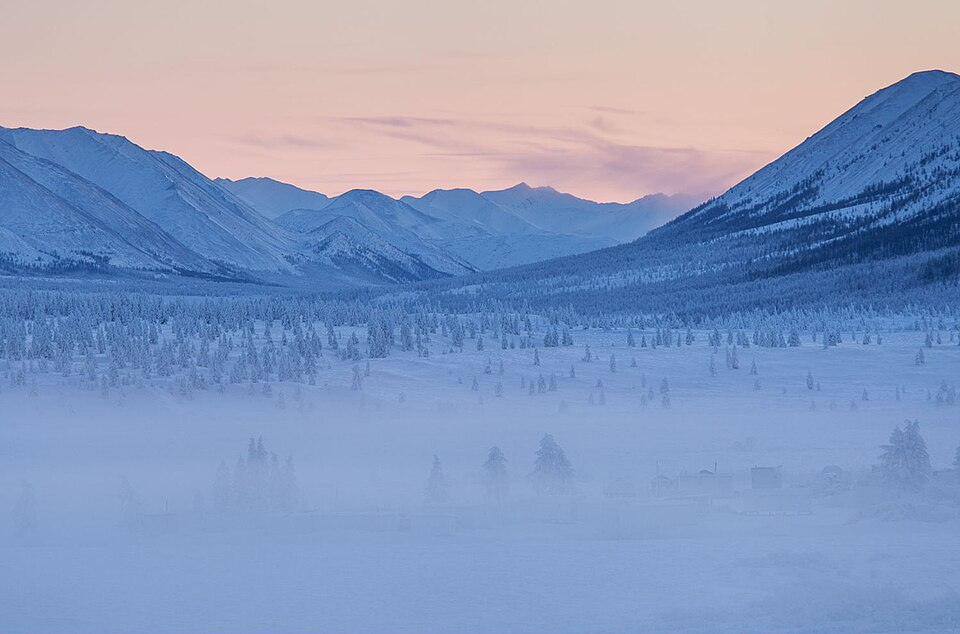
There is a stretch of eastern Siberia, inland and high, where the cold does something that cold does not do anywhere else that people live. It is not the coldest place on earth; that is the Antarctic plateau, where nobody lives permanently and the figures are far lower. What makes this region remarkable is the combination: temperatures that belong on an ice sheet, occurring in a valley with houses, a school, a shop and a road, where families have lived for generations and intend to go on doing so.
The area is in the Sakha Republic, which Russians have long called Yakutia, and the two settlements that compete for the record are both there. The competition between them is genuine and unresolved, which is itself part of the story of how a measurement like this gets made.
The number, and the argument about it
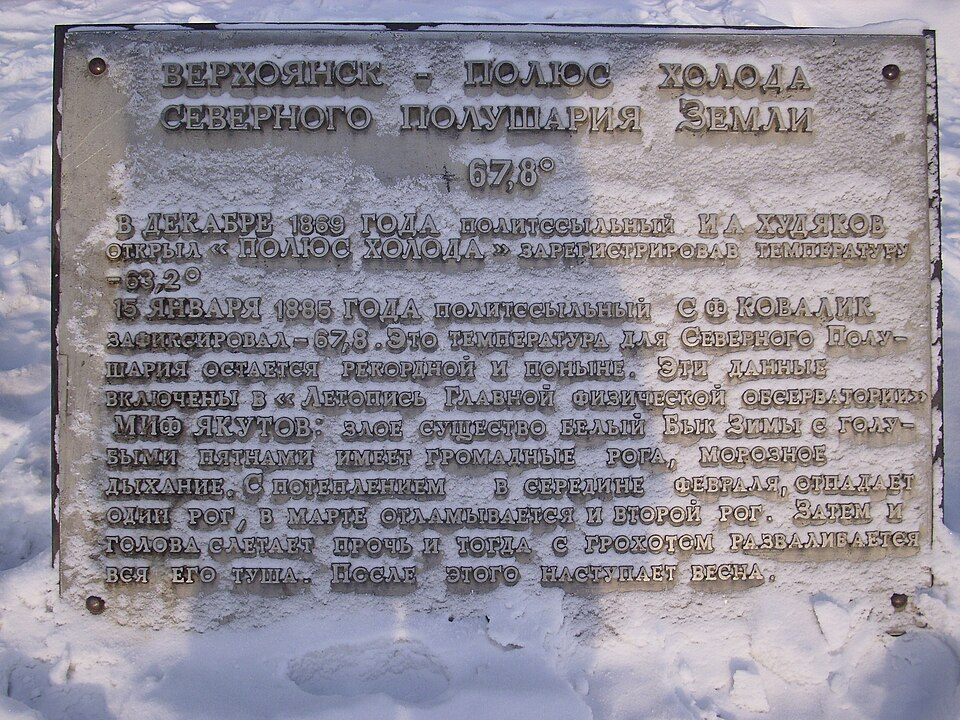
The figure usually quoted is about minus 90 degrees Fahrenheit, which is a little under minus 68 Celsius, recorded in February 1933. The other contender in the same region has a reading from the 1890s that is within a fraction of a degree of it, and a competing claim from the same 1933 cold spell.
Both claims rest on instruments and practices from a period before modern standardisation, and the difference between them is smaller than the uncertainty in either. That is why the honest description is that this region holds the record for a permanently inhabited place, rather than that any one village does. Both settlements have monuments to the figure, which is the correct response to an unresolvable tie. What is not in dispute is the general magnitude. This is a place where winter routinely delivers temperatures in the minus 50s Celsius, and where the record is only an unusually bad week rather than a freak event.
It is also worth being clear about what kind of record this is. There is no claim here to the lowest temperature ever measured anywhere, and the gap between this figure and the Antarctic readings is very large. The category is narrower and more interesting than the superlative suggests: the lowest temperature measured at a place where people live permanently, keep a school open, run a shop and bury their dead. That qualifier is doing all the work, and it is the reason the number has the hold on people that it does.
Like our content? Follow us for more.
Why it gets that cold there
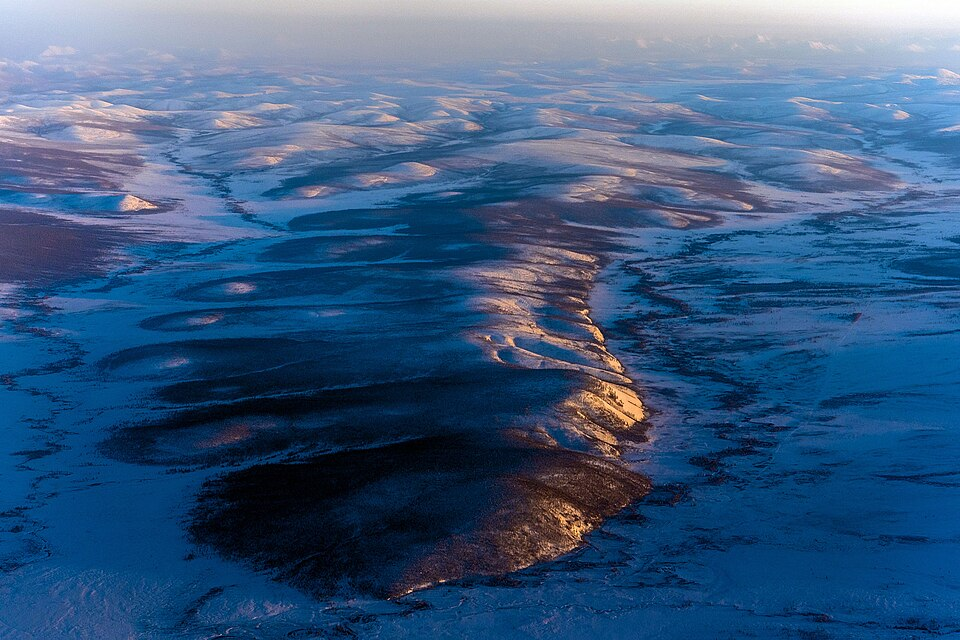
Three things combine, and none of them involves being especially far north. The region sits well south of the northernmost parts of Siberia.
The first factor is distance from any ocean. Water moderates temperature, and this is one of the most continental places on the planet. The second is a persistent winter high-pressure system that sits over the interior, producing clear calm skies that let heat radiate away to space night after night with nothing to stop it. The third is topography: the settlements lie in valleys and hollows, and cold air is dense, so it drains downhill and pools where the people are. A hilltop a few hundred feet above these villages can be substantially warmer in winter than the valley floor, which is the opposite of the usual arrangement and is the single reason the records are set in inhabited basins rather than on uninhabited uplands.
What that does to a house
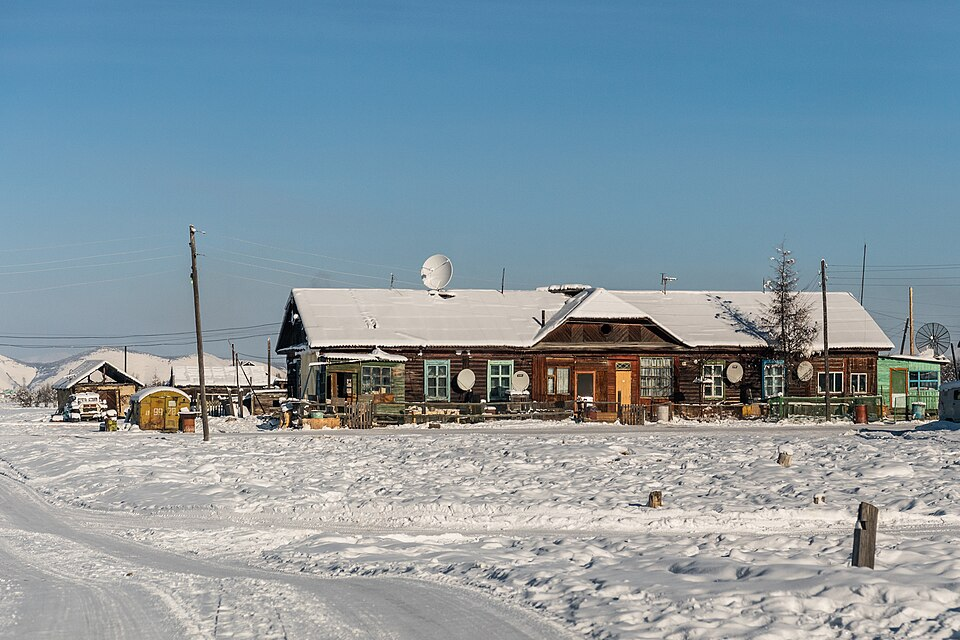
Everything about building is governed by permafrost. The ground is frozen to great depth and does not thaw, so a heated house set directly on it melts the ground beneath itself and sinks unevenly. The standard answer across the Russian north is to raise buildings on piles driven into the permafrost, leaving a ventilated gap so the cold air keeps the ground frozen.
Water is the other problem. Buried pipes in permafrost are not practical in the way they are elsewhere, so water supply has historically meant delivery, or cutting blocks of ice from a river and stacking them outside to be melted as needed. Indoor plumbing is not universal and outbuildings are, which in that climate is a daily act of fortitude that visitors tend to remember more vividly than the temperature readings. Burial is affected too: digging a grave in ground frozen solid is a days-long job involving fires lit on the surface to thaw a layer at a time.
Vehicles, and the habit of not switching off
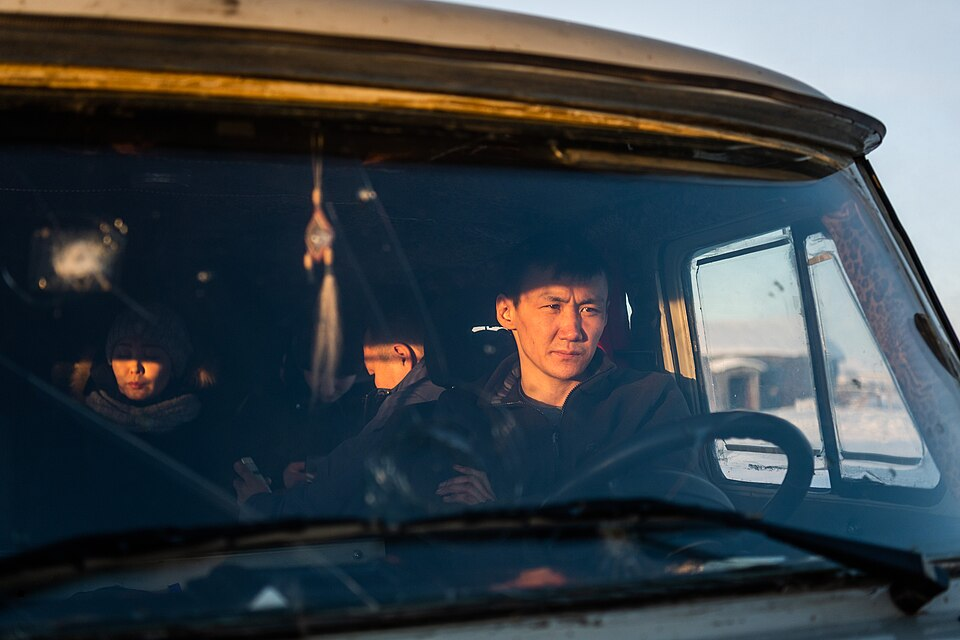
The practical detail that outsiders find most startling is that drivers do not turn their engines off. Below a certain temperature a cold engine will not start, diesel fuel thickens toward a gel, batteries lose most of their capacity, and rubber and plastic become brittle enough to break when handled.
So vehicles run continuously through the winter, for weeks, and if one must be stopped it is kept in a heated garage. Tyres go flat-spotted and thump for the first mile. Windscreens are commonly double-glazed with a second pane fitted inside. Fuel lines are lagged. None of this is improvisation by hobbyists; it is standard regional practice, and the cost of it is simply part of what living there involves. Children walk to school in it, and the local rule has long been that the school stays open until the temperature passes a threshold in the minus 50s Celsius, which is a long way below the point at which schools close anywhere else on earth.
The hundred-degree summer
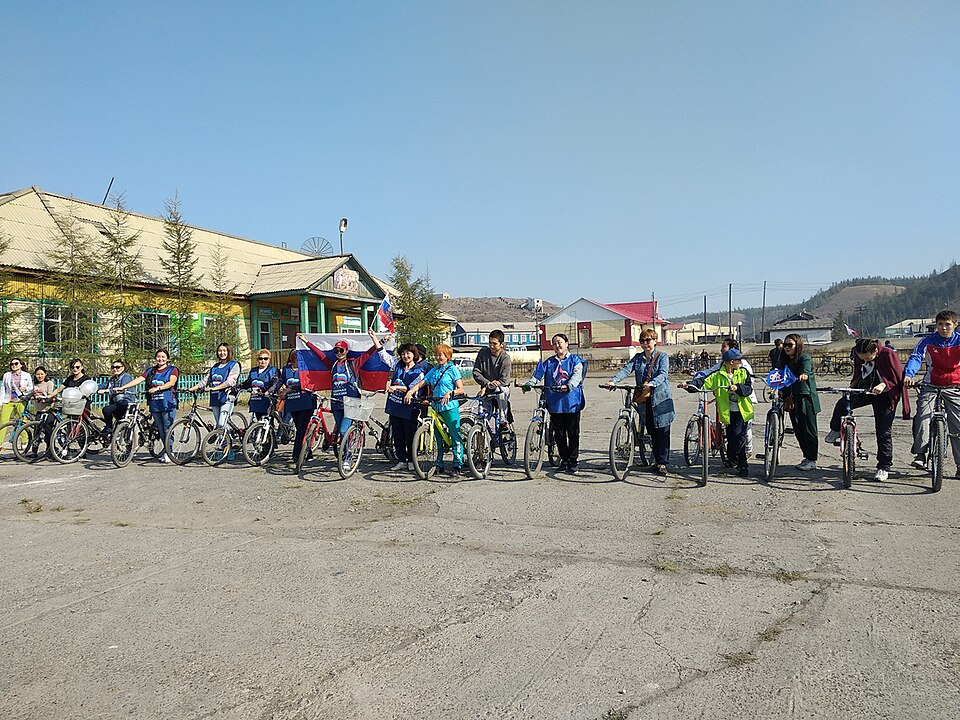
The fact that makes this region genuinely extraordinary rather than merely cold is the other end of the year. The same area, in June 2020, recorded a temperature of 38 degrees Celsius, which is a little over 100 degrees Fahrenheit, at one of the two record-holding settlements. That reading was examined and verified as the highest temperature ever recorded inside the Arctic Circle.
So the annual range at that spot is on the order of 105 Celsius degrees, or about 190 Fahrenheit degrees, between its extremes. There is nowhere else with a swing like it. Summer brings mosquitoes in clouds, soft ground above the permafrost, hay-making, and a brief intense growing season. Photographs of the place in July look like an ordinary rural valley in a warm climate, and the only hint is the way some of the buildings sit slightly out of true where the ground beneath them has moved.
The swing has consequences beyond the novelty of it. Infrastructure has to survive both ends, which means expansion and contraction through a range that no standard specification anywhere else has to accommodate. Roads heave. Pipes that survive the winter have to survive the thaw above them. And the permafrost itself, which is the foundation everything is built on, is now thawing at the top in a way that is causing real and documented structural problems across the Russian north, which makes the engineering answer that worked for a century a question again.
How people actually live there
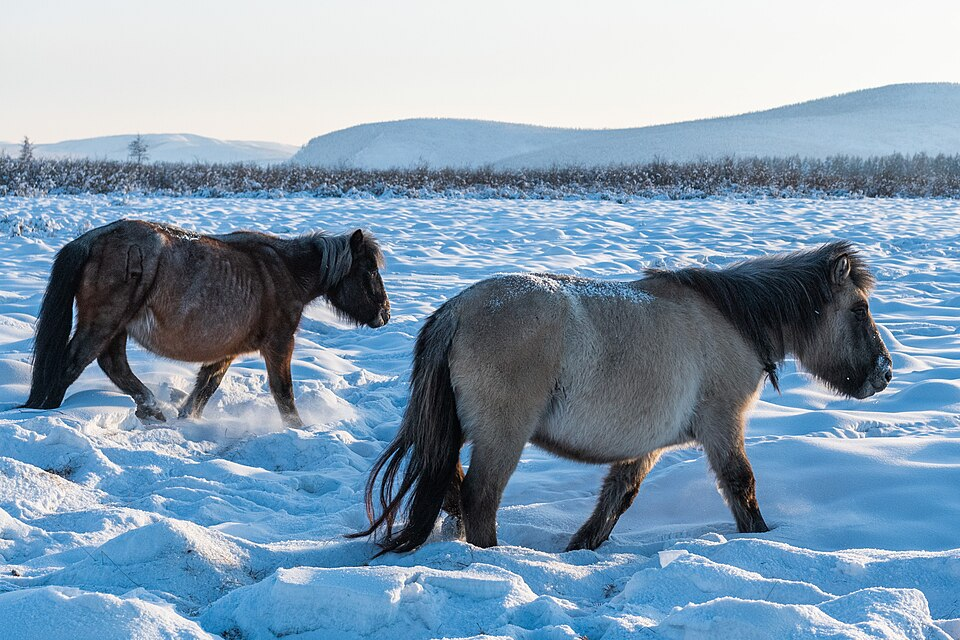
The traditional economy is herding — horses and reindeer, both bred for the cold — along with fishing and hunting, and the Sakha horse in particular is a genuinely remarkable animal that winters outdoors and digs through snow to graze. Food preservation is trivially easy and refrigeration is the problem rather than the solution: for much of the year the outdoors is colder than a freezer, and a porch is a larder.
The population of the record-holding village is a few hundred and has been declining, as rural populations across the Russian north have. There is a tourism trade now, small and growing, built on the number itself: people come to be photographed beside the monument and to find out what the air does to them. Residents are reported to regard this with the tolerance that people in extreme places generally extend to visitors who have come to be impressed.
The thing the thermometer does not convey
A reading of minus 68 is hard to hold in the mind, so it is worth translating. At those temperatures exhaled breath freezes and falls. Metal tears skin on contact. A deep breath taken carelessly through the mouth is painful. Eyelashes frost together within a minute. Spectacles are useless outdoors. Ink freezes, batteries die in minutes, and a phone taken out of a pocket shuts down before it can take a photograph, which is why so few good pictures of the coldest days exist.
And the permanent fact underneath all of it is that this is not an expedition. No one is being resupplied. There is a shop, a school, a clinic, a road that is better in winter than in summer because the frozen rivers become the road. People are born there and grow old there, and the cold is not an adventure but the weather. That is the part that separates this place from the genuinely colder places on the Antarctic plateau, where the numbers are lower and nobody has a kitchen.
Like our content? Follow us for more.