A paper mill is a chemical plant, a power station and a very large precision machine operating in the same building, usually beside a river, usually in a town that exists because of it. In 1960 the United States had hundreds of them, and the ones in the South and the Pacific Northwest were among the biggest industrial operations in their states. They were also, by every measure that has since been applied, running in a way that could not continue.
The interesting thing about the mill is that nearly every change was forced from outside and can be dated. The river, the air, the bleach plant and the machine floor were each addressed by a specific federal instrument, and in each case the mill’s own operators had known about the problem for years without having any mechanism to act on it. The paper mill is a good case study in what regulation actually does, because here it mostly made legal what engineers already wanted to build.
The smell was the process
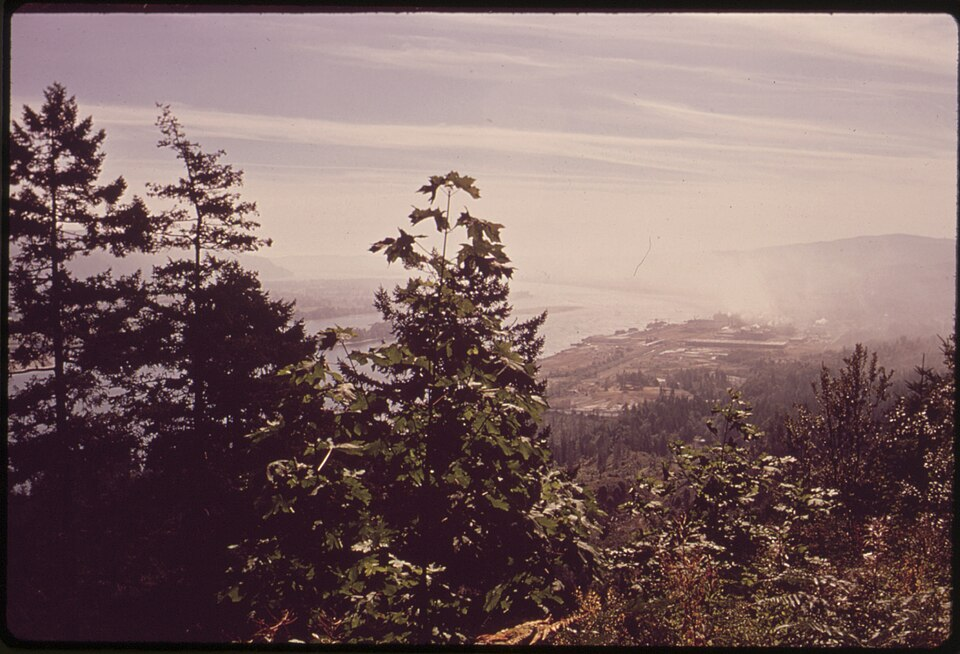
Kraft pulping cooks wood chips in a hot alkaline sulfide liquor, and the reaction produces reduced sulfur compounds — hydrogen sulfide and the mercaptans among them — which the human nose detects at vanishingly small concentrations. A kraft town smelled, continuously, for miles, and the smell was understood locally as the smell of employment. People said you got used to it, and mostly they did.
In 1960 that emission was uncontrolled in most mills. The gases came off the digesters, the evaporators and the recovery system and went up a stack. What changed it was the federal air programme of the following decades, which brought kraft mills under source-specific standards and forced the collection and incineration of the concentrated non-condensible gas streams. A modern kraft mill still smells, because the control is good rather than perfect, but the difference between a 1960 mill town and a current one is immediately obvious to anybody who experienced both.
Like our content? Follow us for more.
Elemental chlorine in the bleach plant
Bleaching is where the mill’s chemistry was most comprehensively rebuilt. Bleaching kraft pulp white in 1960 meant chlorine gas, in sequence with caustic extraction and hypochlorite, and a bleach plant was a place of chlorine leaks, acidic mist and corroded everything.
The reason the whole sequence was replaced is that in the mid-1980s dioxins were found in bleached kraft mill effluent and in products made from it, and the elemental chlorine stage was identified as the source. The industry moved first to substitution and then to chlorine dioxide, the elemental-chlorine-free process, with some mills going to a totally chlorine-free route. The federal rule that consolidated this for the pulp and paper sector arrived in 1998 and addressed air and water together, which is why it is remembered in the industry as the cluster rule. Elemental chlorine bleaching of kraft pulp is simply not done in the United States now.
The river
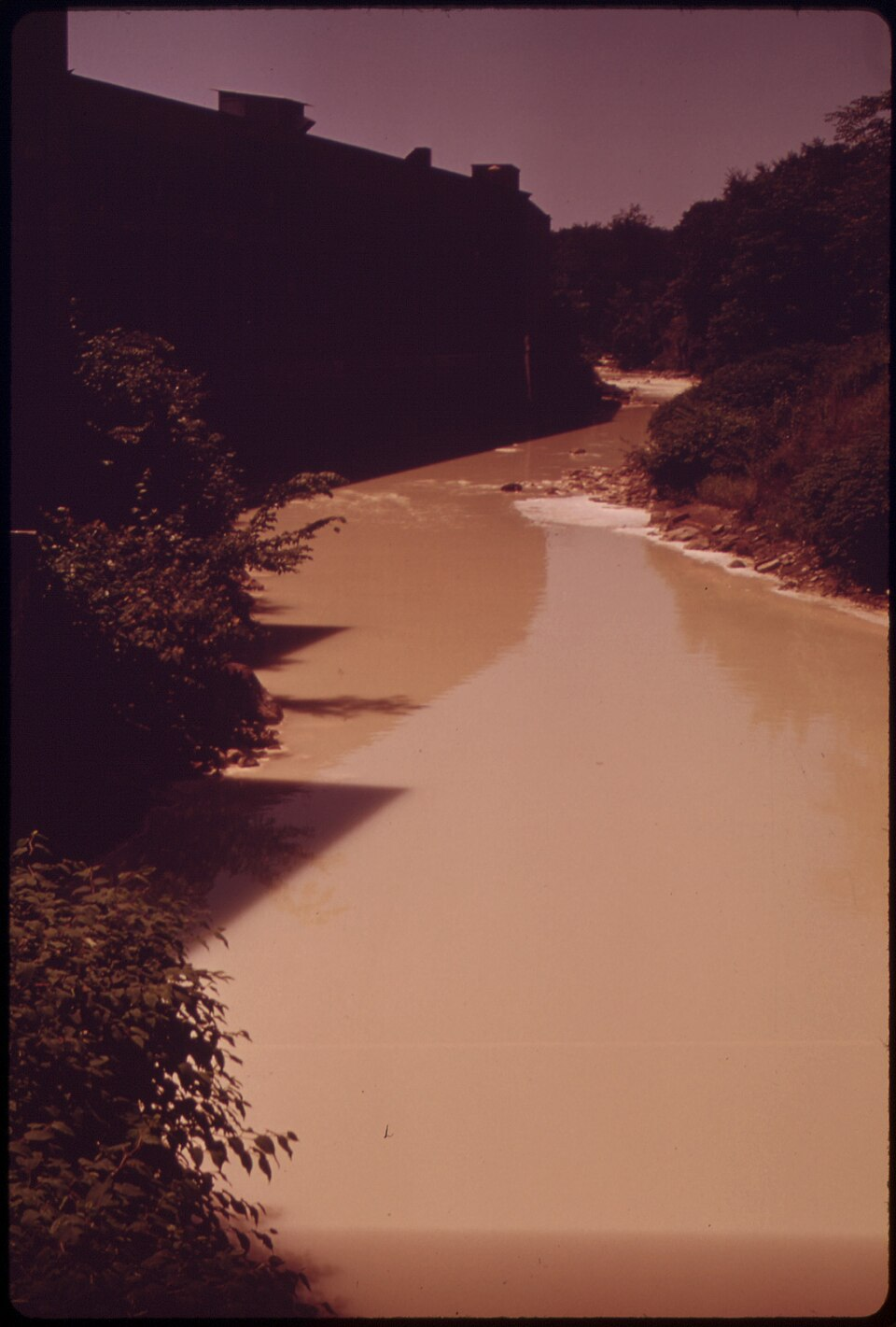
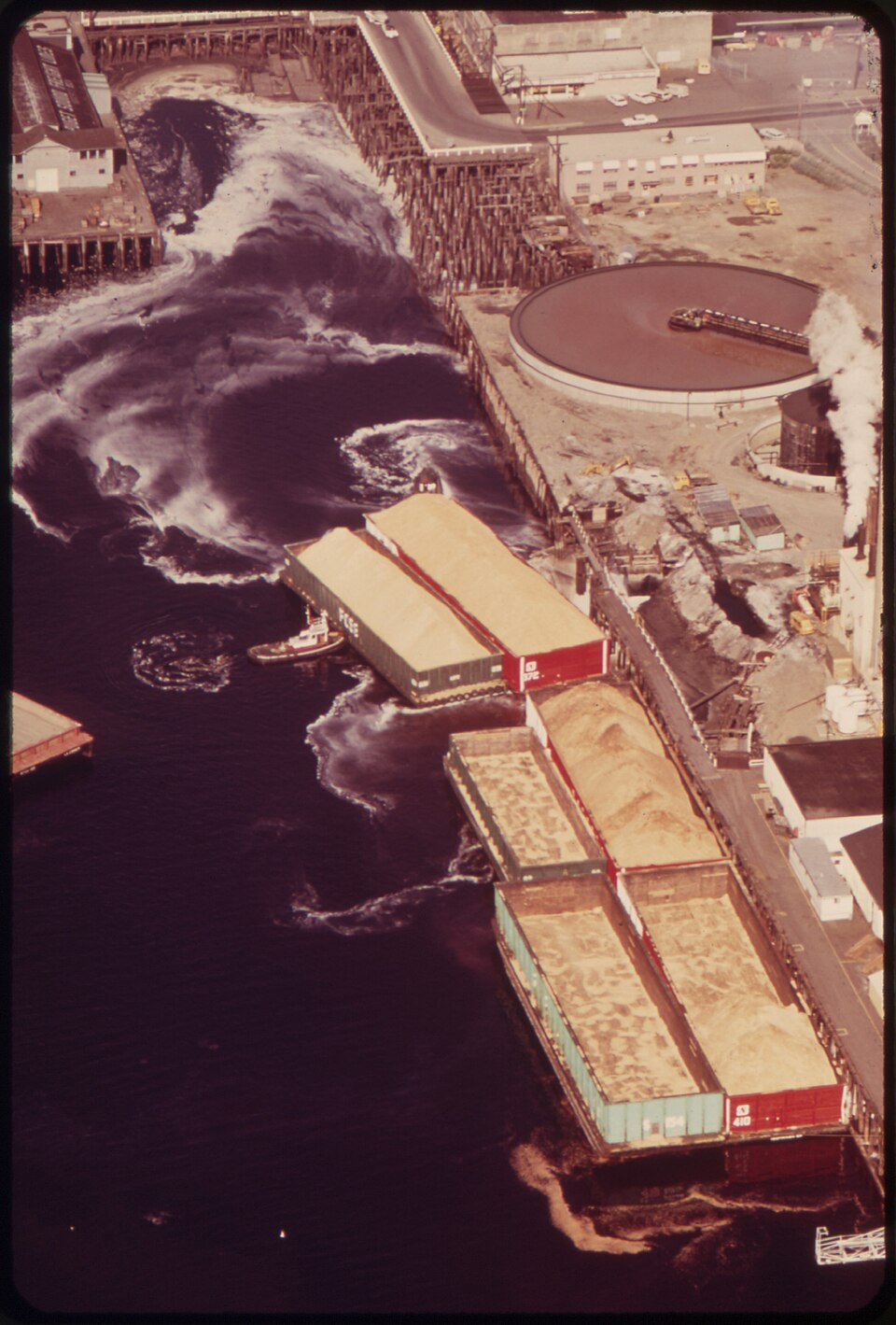
Mills were built on rivers for water and for the discharge, in that order. In 1960 a mill’s effluent went out largely untreated: fibre, spent liquor, bleach plant waste, and a loading of oxygen-demanding material that could strip a river of dissolved oxygen for miles downstream. The visible result was foam and fibre mats and colour, and the invisible result was a stretch of water that supported very little.
The Clean Water Act of 1972 is the hinge. Mills built primary clarification and then biological treatment, and the capital involved was large enough to close some of the older and smaller sites outright. Anybody who knew a mill river before and after describes the change as the most dramatic environmental improvement they have personally witnessed. It is worth saying that the mills did not generally argue that the discharge was harmless. They argued about who would pay and how fast, which is a different argument and the one the statute settled.
Clearing a jam on a running machine
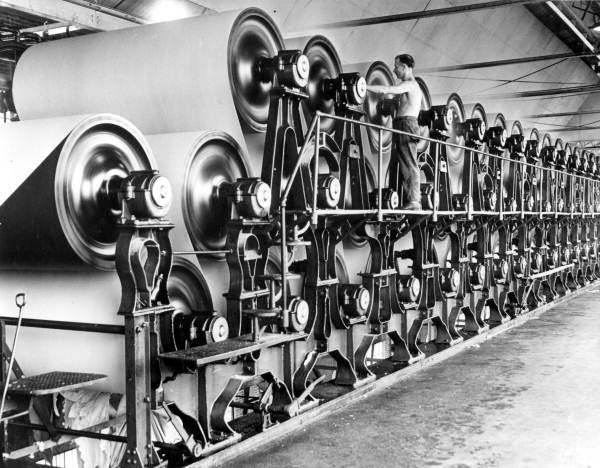
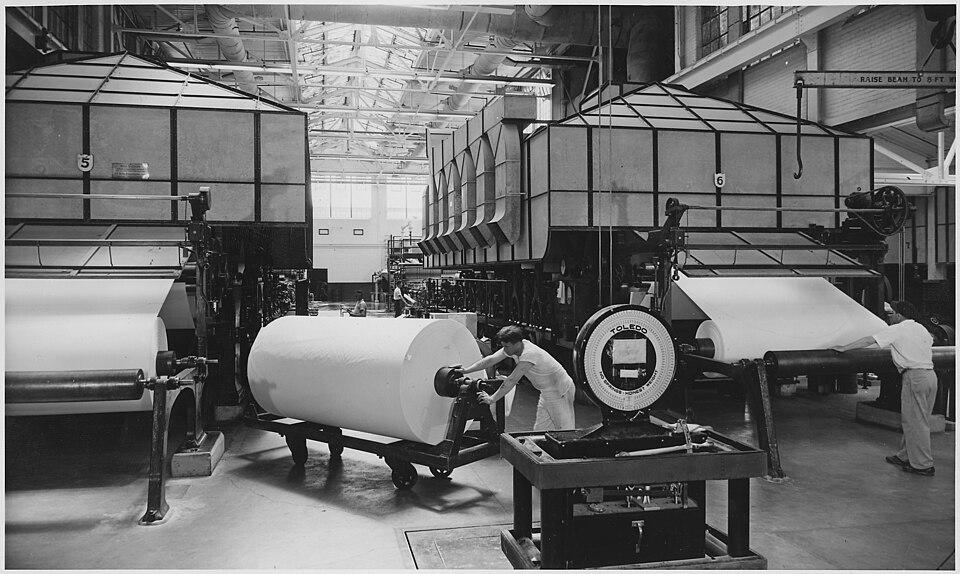
The paper machine is the part a visitor remembers: a sheet of wet fibre a couple of hundred inches wide travelling at speed through presses and over steam-heated drying cylinders, hundreds of feet from one end to the other. The nips between rolls are the hazard, and they are unforgiving in a way that needs no description.
In 1960 a break in the sheet was cleared by hand while the machine ran, because stopping and restarting a paper machine costs hours of production. Men reached in with hooks and with hands. They threaded the sheet through the dryer section by hand. The practice that ended this is lockout and tagout: the federal standard requiring that energy be isolated and the isolation verified before anybody works on equipment, which was issued in 1989. Automatic threading ropes and air systems took over most of the rest. A mill today that found a man clearing a nip on a running machine would treat it as a dismissible offence, and the man’s crew would stop him first.
The recovery boiler
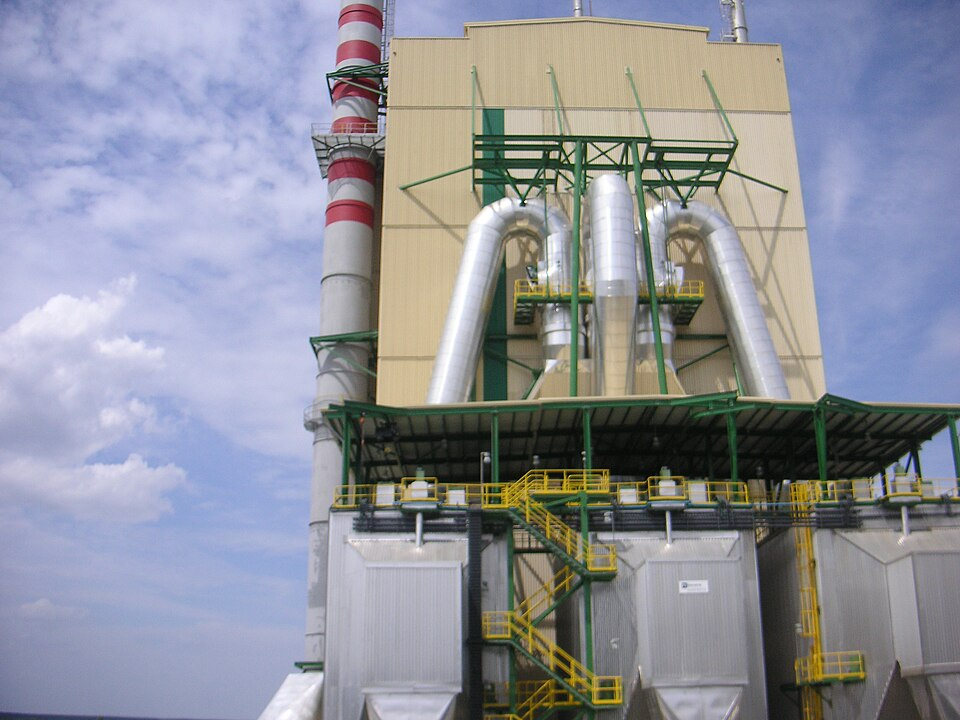
Every kraft mill has a recovery boiler, which burns the spent cooking liquor to recover the chemicals and raise steam. It also contains a pool of molten inorganic smelt, and water reaching that smelt causes a physical explosion. This is the single most serious hazard in the industry and it was understood in 1960, but the operating discipline around it was a matter of local practice.
What exists now is an industry-wide regime built on shared incident data: rules for emergency shutdown procedures when a tube leak is suspected, inspection schedules, and training that is formalised rather than passed down. The change was driven by the mills themselves through a joint committee rather than by statute, which makes it the clearest example of the industry closing a gap on its own. It also means the 1960 answer — an experienced operator’s judgement about whether a noise mattered — has been replaced by a procedure that removes the judgement.
That substitution is the thread running through every section here. In 1960 the mill ran on accumulated personal knowledge: a man who could tell by sound whether a bearing was going, who knew which valve stuck, who could read the sheet by looking at it. None of that was written down, none of it could be inspected, and none of it transferred when he retired. The modern mill distrusts it on principle, not because the knowledge was wrong but because a plant cannot be audited on the contents of somebody’s head, and a hazard that is managed by expertise alone is a hazard that is unmanaged on the day the expert is off shift.
Asbestos, noise and the things nobody counted
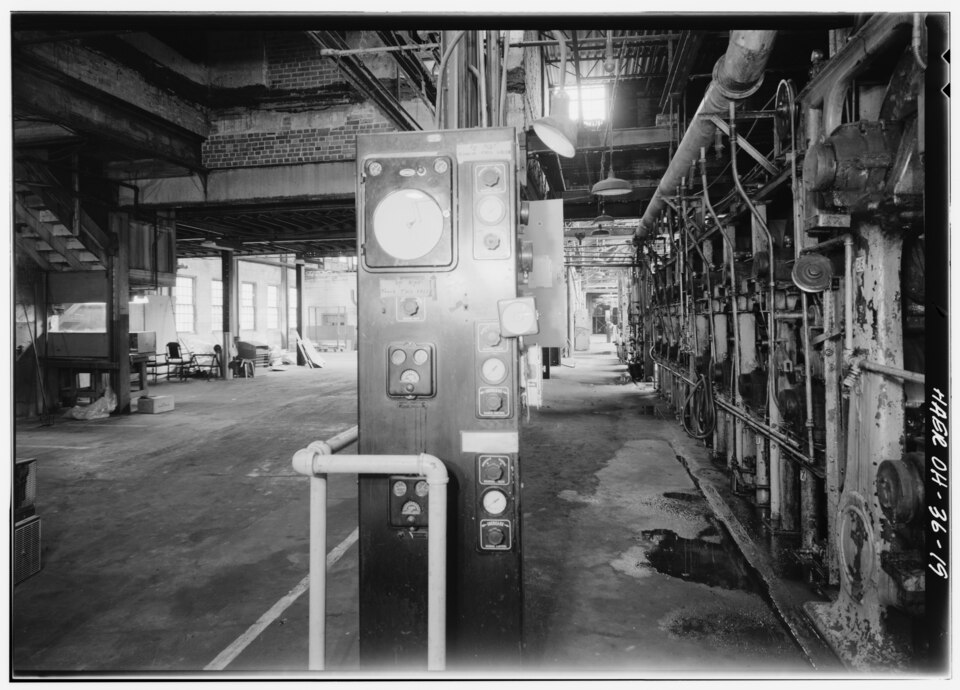
The mill’s background conditions are the ones that produced the longest consequences. Steam lines, dryer hoods and boiler casings were lagged with asbestos, and maintenance work on them was done without respiratory protection by men who were not told what the lagging was. Asbestos regulation in American workplaces tightened from the early 1970s onward and the abatement programmes in older mills ran for decades.
Noise was simply accepted. A paper machine hall and a chip plant are both loud enough to cause permanent hearing loss over a working life, and in 1960 hearing protection was not issued, not required and not worn. Hearing conservation became a federal requirement with a measured threshold and mandatory monitoring, and the result is the single most visible difference in a photograph: everyone on a modern mill floor is wearing ear defenders, and nobody in a 1960 photograph is wearing anything at all.
What the mill was to the town
None of this is a story about bad employers, and it would be a cheap reading to make it one. A 1960 paper mill paid better than anything else within fifty miles, employed three generations of the same families, and was the reason the town had a hospital and a ball field. The men who cleared jams on running machines were proud of being able to, and the skill was real.
The mills that remain are extraordinarily different places: fewer people, far more instrumentation, a control room instead of a machine floor, and a set of constraints that are externally audited. A great many mills did not make the transition, and the towns that lost them lost more than the jobs. Both facts belong in the same account. The practices described here were genuinely untenable, and the thing that replaced them took something from the places that had been built around them.
The mills still running are also, by a wide margin, the cleanest heavy industry those regions have ever had. A river below a modern American kraft mill supports fish. That sentence would have been received as a joke in 1960, in the mill and in the town both, and it is the strongest single answer to the question of whether any of the rebuilding was worth what it cost.
Like our content? Follow us for more.