

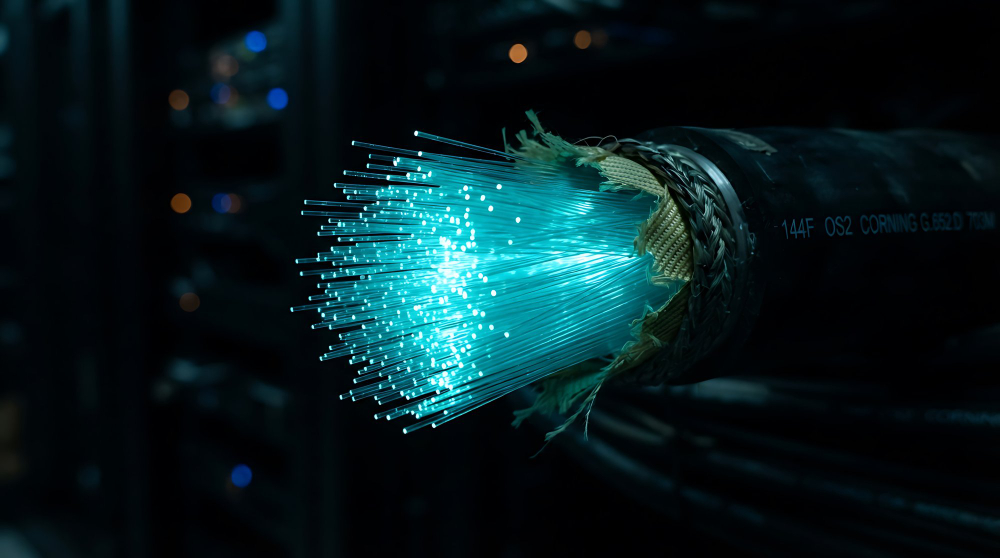
The Light Is Not Being Carried, It Is Trapped
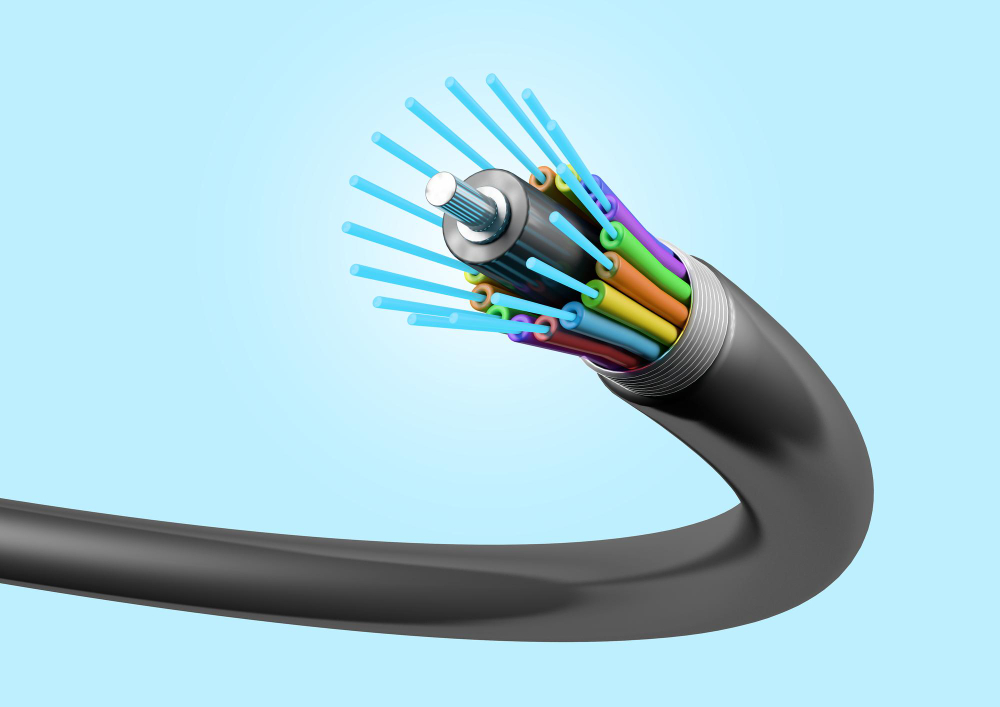
The intuitive picture of a fibre optic cable is a pipe with light shining down it, kept on course by a reflective lining. That picture is wrong in a way that matters, because there is no lining and nothing is reflecting in the ordinary sense.
What is happening is a boundary effect. When light inside a dense transparent material arrives at the boundary with a less dense one, it is normally partly bent out and partly reflected back. As the angle becomes shallower, more is reflected and less escapes. At a particular angle, which depends only on the two materials, the amount escaping reaches zero, and at any angle shallower than that, nothing escapes at all.
Not almost nothing. Nothing. The light is returned with no loss at the boundary itself, which is why the effect is called total internal reflection and why it is not comparable to a mirror. A mirror absorbs a few per cent at every bounce, and a few per cent lost thousands of times would leave nothing. This loses zero, and it can do so thousands of times a metre indefinitely.
So a fibre is not a light pipe. It is a geometry that arranges for every ray entering it to meet the boundary at an angle shallower than the critical one, which means the light is simply unable to leave until the glass stops.
Like our content? Follow us for more.
Why the Angle Is the Whole Design
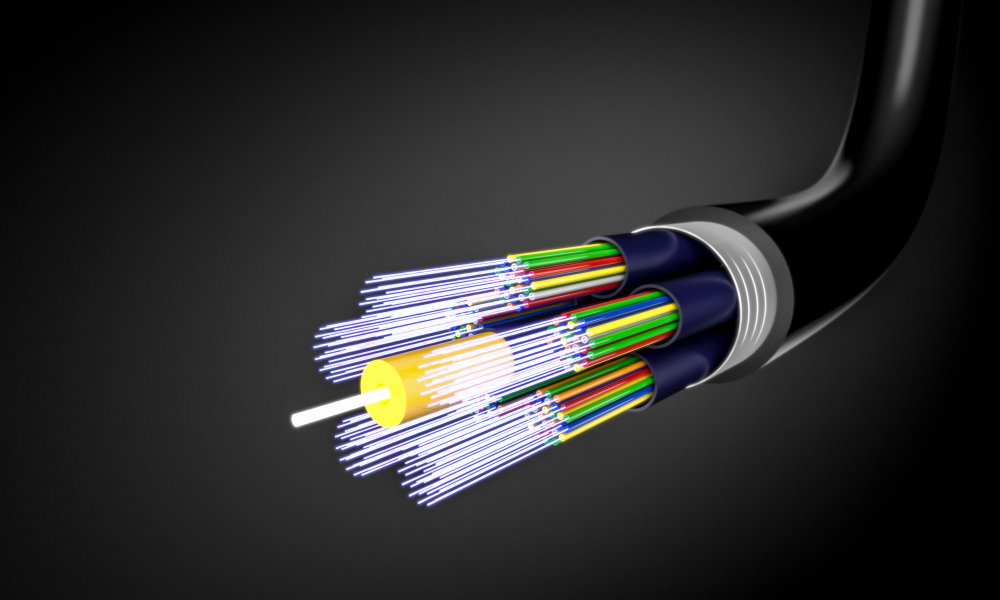
Everything about how a fibre is built and used follows from that critical angle.
The condition is that the inside of the fibre must be optically denser than what immediately surrounds it, and the difference between the two determines how shallow the angle has to be. A large difference permits a wide range of angles; a small difference permits only a narrow range.
That in turn sets what can be sent into the end of the fibre. Only light entering within a certain cone will end up travelling at an acceptable angle inside. Light arriving outside that cone will meet the boundary too steeply, escape immediately and be lost. The size of that acceptance cone is a fixed property of the fibre and is why fibres have to be aligned so precisely when joined, and why the connectors are the expensive part.
And it is why bending has a limit. Bending the fibre changes the angle at which rays meet the boundary on the outside of the curve, making it steeper. Bend it gently and every ray remains within the condition. Bend it too tightly and rays on the outside of the bend exceed the critical angle and leave, which shows up as light glowing faintly out of the side of a sharply bent fibre and as a loss of signal.
There is a specified minimum bend radius for exactly this reason, and it is one of the few cases where a cable’s handling instructions are a direct statement of physics rather than a worry about mechanical damage.
The Cladding Is the Other Half of the Boundary
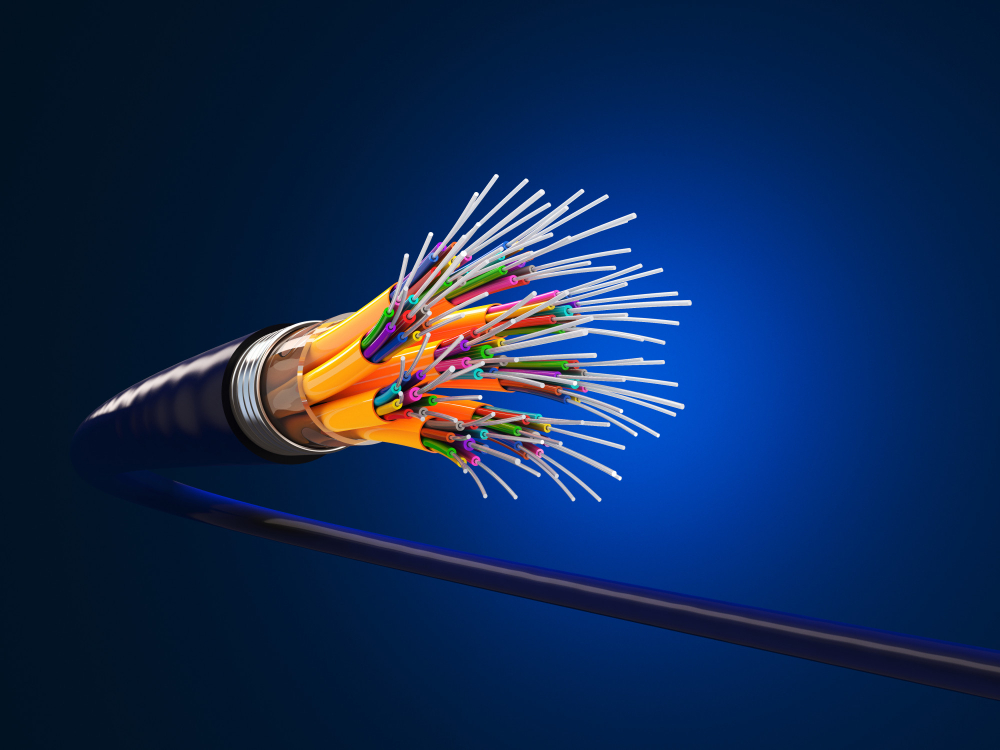
A fibre is not a single material. It is a core surrounded by a cladding of very slightly different composition, and the cladding is not protection or insulation. It is the second half of the optical boundary.
The core is where the light travels. The cladding’s only job is to be slightly less optically dense than the core, so that the boundary between them produces total internal reflection. Without it, the boundary would be between the core and whatever happened to be touching the fibre, which would change every time anything brushed against it.
This is the detail that explains something people find surprising. The light never reaches the outside surface of the fibre. It is confined at the core-cladding boundary, which is buried well inside. So a scratch on the outer surface, a fingerprint, dirt, or the coloured plastic coating applied over everything, has no effect whatsoever on the light. A fibre can be filthy and work perfectly.
What does matter is the end. The ends are where light enters and leaves, and a scratch, a speck of dust or a poor cut at an end face is a serious problem, because it is directly in the path. Which is why fibre work is almost entirely about the quality of the ends and almost not at all about the condition of the rest.
The Core Is Thinner Than a Hair and Purer Than Anything
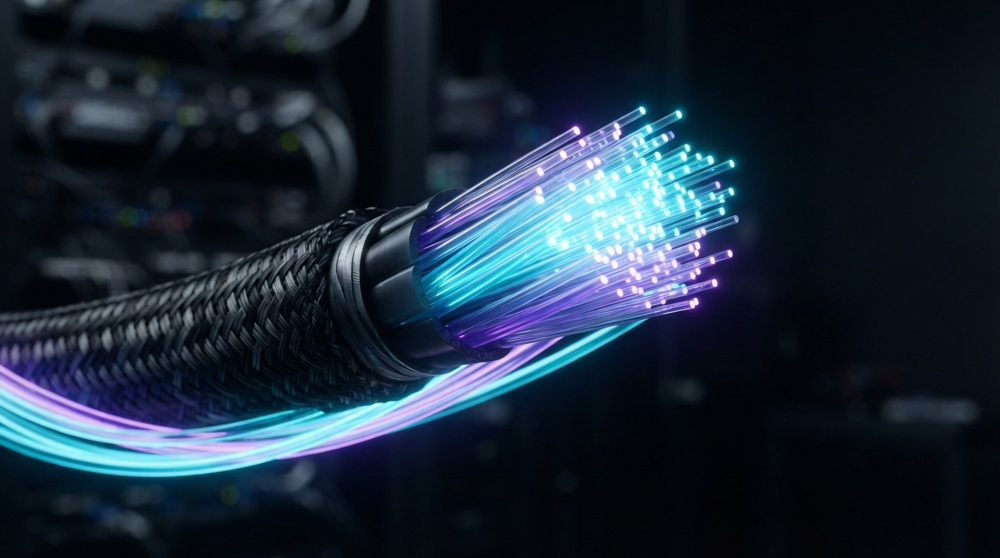
The fibre used for long distances has a core of around a hundredth of a millimetre across, which is roughly a tenth the width of a human hair, surrounded by cladding bringing the whole glass thread to something around a tenth of a millimetre.
That tiny core is deliberate. A core narrow enough relative to the wavelength permits essentially only one path through the fibre, so every part of the signal travels the same distance and arrives together. Wider cores allow many paths of different lengths, so a pulse sent in as a sharp spike arrives spread out, which limits how fast pulses can be sent before they merge into each other. Wide-core fibre is cheaper and easier to join and is used over short distances; narrow-core fibre is what crosses oceans.
The purity is the more remarkable number. The usable distance between amplifiers depends entirely on how much light the glass absorbs, and ordinary glass is far too absorbent. Looking through a metre of window glass is fine; looking through a kilometre of it would be like looking through a wall.
The glass in a fibre is made to a purity at which a signal can travel tens of kilometres and still be detectable. The standard way of putting it is that if the ocean were made of this glass you could see the seabed, and the figure is not far off. Reaching that purity, and specifically removing the last traces of water and metal ions that absorb at the wavelengths used, was the single obstacle that kept the idea impractical for years after the principle was understood.
It is a case where the physics was easy and the materials science was the entire problem.
Why Three Particular Colours of Invisible Light
The light sent down a fibre is not visible. It is in the near infrared, and it is confined to a few narrow bands rather than spread across the spectrum, for a reason that is purely about what the glass does.
Absorption in the glass is not uniform with wavelength. There are peaks where particular impurities and the material itself absorb strongly, and there are troughs between them where loss is much lower. Those troughs are called windows, and the wavelengths used sit inside them.
The lowest-loss window is the one used for long-haul transmission, and essentially all intercontinental traffic runs in it. Shorter, more convenient wavelengths are used over short distances where loss matters less and the components are cheaper.
This is a good illustration of how constrained the engineering is. The choice of wavelength was not made for convenience or because particular lasers existed. The glass dictated three narrow places where a signal could survive, and the entire industry built its lasers, detectors and amplifiers to operate at those wavelengths because there was nowhere else to go.
Why It Carries So Much
A single fibre can carry an amount of information that is difficult to state without sounding careless, and the reason is that light has an enormous frequency and therefore an enormous amount of room.
A signal’s capacity depends on the range of frequencies available to it. Radio and electrical signals operate at frequencies where the available span is modest. Light operates at frequencies hundreds of thousands of times higher, and a small percentage of a very large number is still a very large number.
The practical exploitation of that is to send many separate signals down the same fibre simultaneously at slightly different wavelengths, each carrying its own traffic, combined at one end and separated at the other by what is essentially a very precise prism. Dozens or hundreds of channels in one strand of glass, each one a full-capacity link.
Which is why a cable the diameter of a garden hose, containing a few dozen fibres, can carry the entire traffic between two continents, and why laying one is a smaller engineering problem than it sounds while the thing it replaces was thousands of tonnes of copper carrying a tiny fraction of the load.
It is also why capacity on existing routes keeps increasing without anybody laying anything new. The glass that was buried decades ago is unchanged; the equipment at the ends has got better at packing signals into it.
The Amplifiers That Never Convert Anything
Light fades with distance, so something has to boost it. The early approach was to convert the light back into electricity, amplify that electrically, and generate fresh light — which works and is a great deal of equipment to put on a seabed, and has to be done separately for every channel in the fibre.
The approach that replaced it is a short length of fibre with a rare-earth element added to the glass. Pump energy into that section with a separate laser and it will amplify any signal passing through it directly, as light, without converting anything to electricity at any point.
It amplifies a whole band of wavelengths at once, which means every channel in the fibre is boosted by one device. And it has no electronics in the signal path, so it does not care how the signal is encoded or how fast it is going; upgrading the equipment at the ends does not require touching the amplifiers in between.
That single invention is what made the multi-channel undersea cable practical, and it is the reason the cost of intercontinental capacity collapsed rather than falling gradually. It is also a neat demonstration that the most useful thing to do with light is frequently to leave it as light.
Everything Else It Does
Communication is the application that paid for the technology, but the properties that make a fibre good at it make it useful for several unrelated things.
A bundle of fibres with their relative positions preserved at both ends will transmit an image rather than a signal, each fibre carrying one point of it. That is the basis of every flexible instrument used to look inside something without opening it, from engines to bodies.
A fibre is also a sensor, because anything that stretches, heats or squeezes it changes the light passing through by a measurable amount. Fibres embedded in bridges, dams, aircraft and pipelines report strain and temperature continuously along their whole length, which is a kind of measurement that was not previously available at all: not a reading at a point, but a reading everywhere at once.
And the same confinement that keeps light in keeps interference out. A fibre carries no current, radiates nothing, picks up nothing and cannot be tapped without physically interrupting it or bending it enough to leak, which matters in electrically noisy environments and in places where a conductive cable would be a hazard.
So the final summary is not really about communication. Somebody worked out how to confine light inside a thread, by making sure it never meets the boundary steeply enough to get out, and then somebody else spent years making glass pure enough for that to be useful over distances that mattered. Everything after that was a consequence.
Like our content? Follow us for more.
