

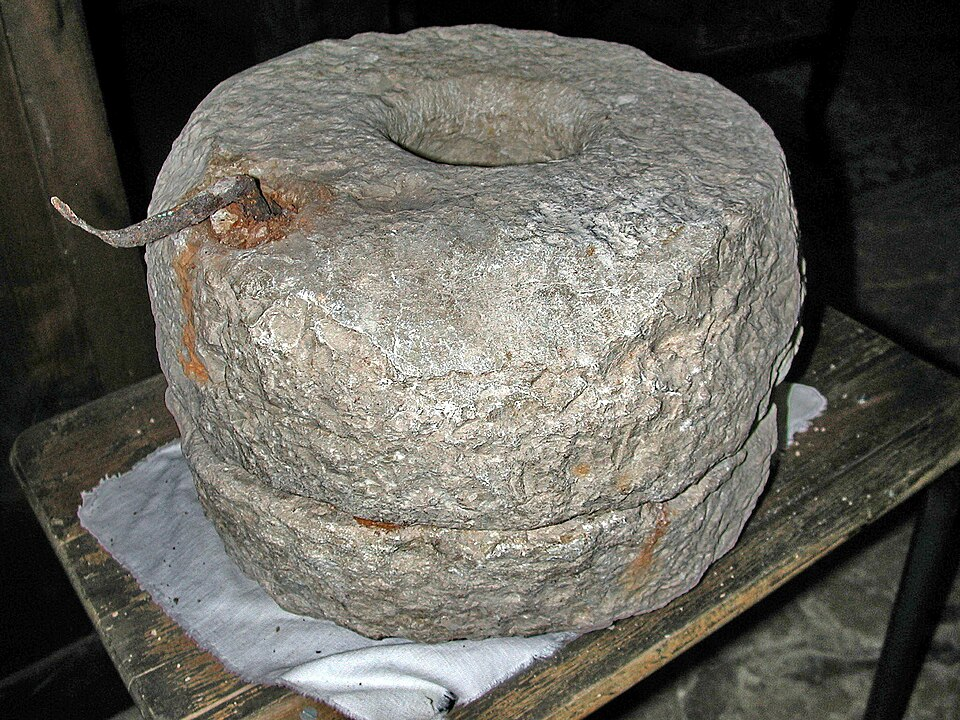
There is an assumption about milling that the word itself encourages, and it is wrong in an interesting way.
The assumption is crushing: two heavy stones pressed together, grain squashed between them, flour produced by sheer pressure.
Stones set to touch would destroy each other and produce heat, scorched flour and a great deal of stone dust. In a working mill the faces are held apart by a small and adjustable gap, and grain is processed in that gap without the stones ever meeting.
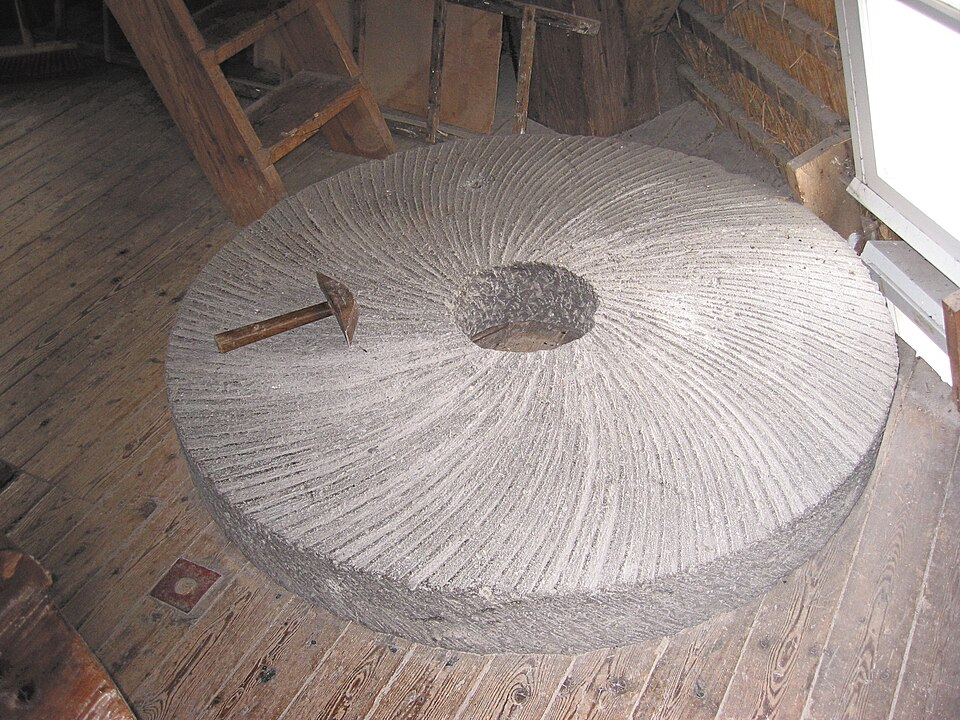
What does the work is a pattern of grooves cut across both faces. As the upper stone turns, the grooves on it pass across those on the stationary stone, and grain caught between the passing edges is cut rather than crushed — repeatedly, as it travels outward from the centre to the rim.
Why the Pattern Is the Whole Thing
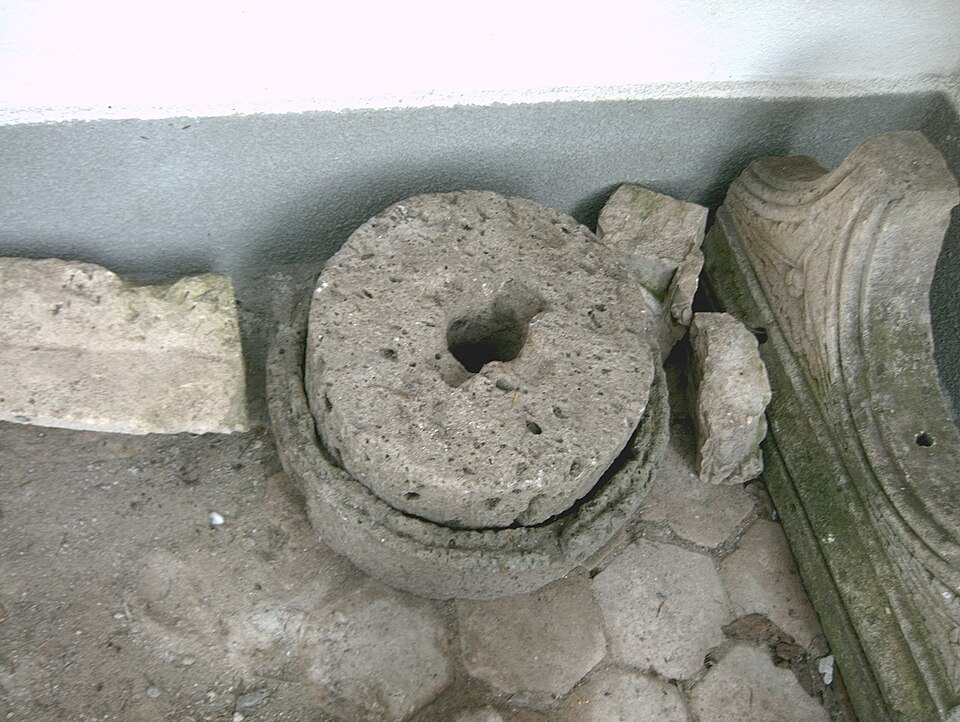
The arrangement of the grooves is precise and every element of it does something.
Grain enters at the centre, through a hole in the upper stone, and must travel outward to escape at the rim.
The grooves are cut in straight lines arranged so that they sweep outward as the stone turns, which pushes material steadily toward the edge — so the pattern is a conveyor as well as a cutting surface.
Between the grooves, the flat land areas do the finer work, reducing what has already been cut into smaller pieces as it passes.
The gap between the stones is widest at the centre and narrows toward the rim, so material is cut progressively finer as it travels, arriving at the edge as flour.
And the cutting edge of each groove is cut at an angle, so one side is sharp and the other slopes — which means the stone works in one direction of rotation only, and a stone dressed for one hand cannot be used the other way round.
Like our content? Follow us for more.
Why It Has to Be Recut
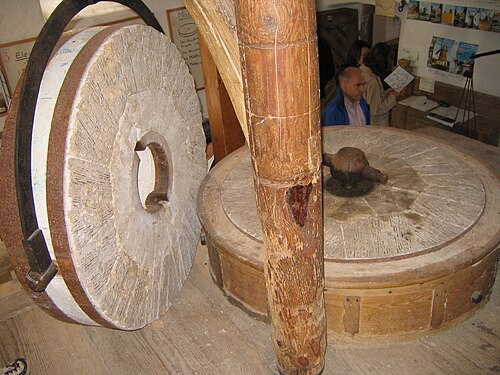
The wear is constant and the consequence is a stoppage.
Grain is abrasive, and the sharp edges of the grooves wear round and the land areas wear smooth, which happens within weeks of steady work.
A worn stone stops cutting and starts rubbing, which produces heat, damages the flour and reduces output — so the mill must stop and the stones must be lifted and re-dressed.
That job involves hammering new grooves and freshening the land areas with a specialised pick, working across the whole face, to a pattern that has to be accurate over the entire surface.
It takes a skilled worker a considerable time, during which the mill earns nothing, which is why dressing was scheduled and why the interval between dressings was a real commercial consideration.
The work also produced small fragments of steel from the pick that embedded in the dresser’s hands, which was regarded as evidence of experience — a detail that says a good deal about the trade.
There is a safety point worth noting. Stones run at speed and carry enormous energy, and a stone that runs dry against its partner can generate sparks in an atmosphere full of fine flour dust – which is why keeping feed flowing was a serious operational rule rather than a matter of output.
Why the Stone Itself Mattered
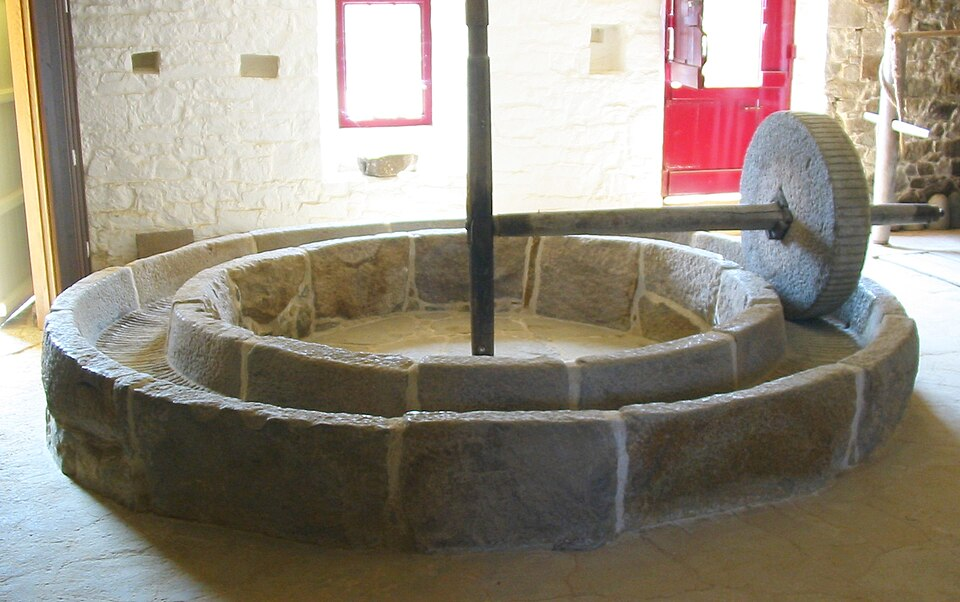
Not all rock is suitable, and the differences are specific.
The stone must be hard enough to hold an edge, coarse enough to have some natural roughness, and must not shed material into the flour.
It also needs to be full of small cavities rather than smooth, because a stone with an open structure presents a continuously renewed cutting surface as it wears.
A dense smooth rock polishes rather than staying rough, and stops working long before it wears out.
Because suitable rock is uncommon, millstones were transported extraordinary distances from a small number of sources, and a good pair represented a major capital investment for a mill.
The best examples were built up from several shaped pieces bound with an iron band rather than cut from one block, because the ideal material was not available in pieces large enough.
There is a feed point worth adding. Grain is delivered to the eye at a controlled rate by a vibrating shoe tapped by the turning stone itself, so the feed rate rises and falls automatically with the speed of the mill.
It is another piece of self-regulation built into the machine.
How the Gap Is Controlled
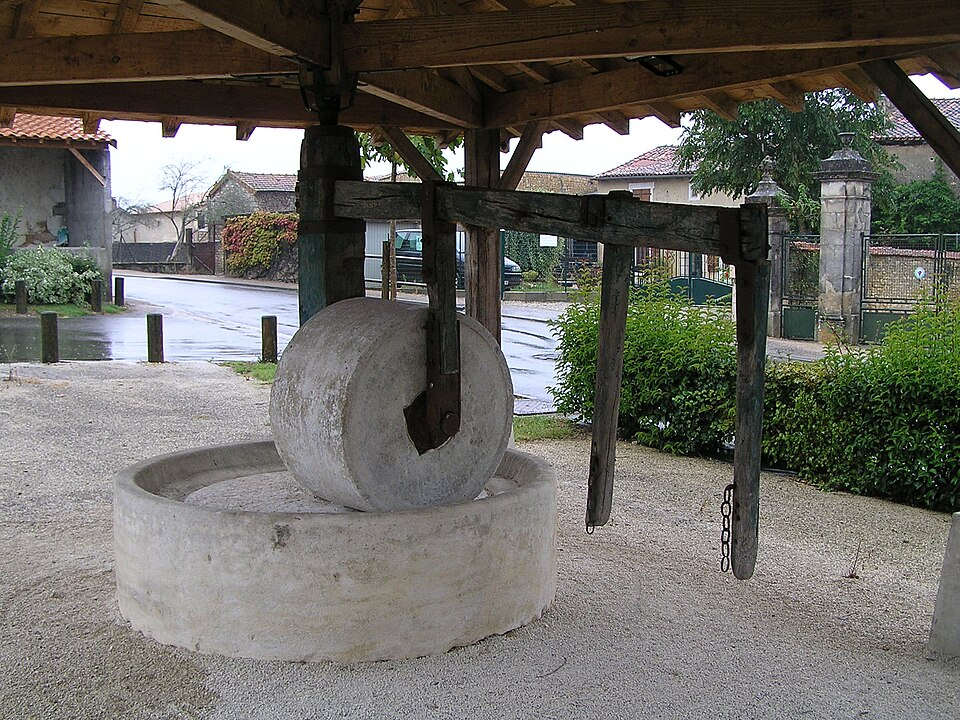
The adjustment is the miller’s main skill and it is continuous.
The gap between the stones determines how finely the grain is processed, and it has to be changed constantly in response to how much grain is flowing and how fast the stones are turning.
Too close and the stones rub, the flour heats and the quality suffers; too far apart and the grain passes through barely touched.
Because water and wind power vary continuously, the speed changes constantly, and the gap must be adjusted to match — which is why a miller was present the entire time the mill was running rather than setting it and leaving.
Mechanisms were developed to do this automatically, using the tendency of a spinning governor to rise as speed increases, which adjusted the gap without intervention.
That device is one of the earliest examples of a machine regulating itself, and it was developed for milling long before it was applied anywhere else.
There is a lifting point worth adding. Dressing requires the upper stone to be turned over and set face upward, which means moving an enormous weight with tackle and levers before any of the skilled work can begin.
The lifting alone took a substantial part of the day.
Listening to the Mill
The judgement was made by ear as much as anything.
A working mill produces a characteristic sound, and a change in it indicates a change in what is happening between the stones.
An empty gap makes a different noise from a full one, a stone running too close chatters, and the feed running out changes the pitch immediately.
Millers also judged the product by feel, taking a handful of flour as it emerged and rubbing it to assess fineness and temperature — a hot handful meaning the stones were too close.
That combination of listening and feeling was the control system, operated continuously, and it is why the job could not be left to anybody who had not learned it.
The Two Stones Are Not the Same
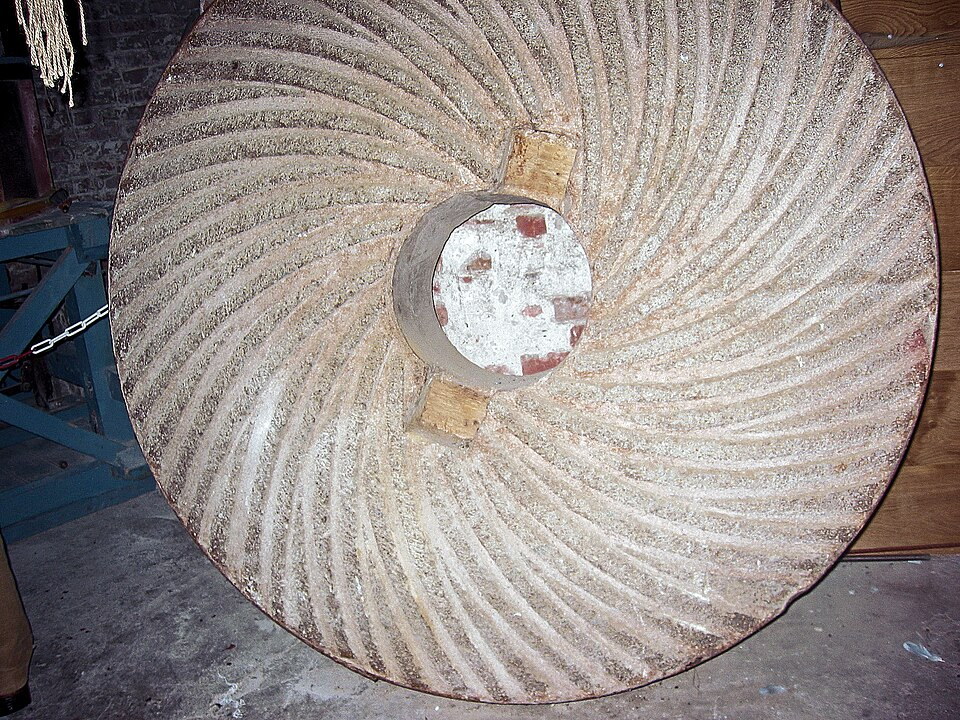
A detail that surprises people is that the pair has a fixed and a moving member, and they are not interchangeable.
The lower stone sits still and takes the weight, and its face wears more evenly because every point on it is passed over equally.
The upper stone turns and carries the feed opening at its centre, which means material enters through it and is thrown outward by rotation.
That upper stone is also the one whose height is adjusted to set the gap, since lifting it a fraction of a millimetre changes the whole output.
Balance matters enormously for the moving stone, because an unbalanced mass turning at speed lifts on one side and produces a varying gap, so the stone must be weighted until it runs true.
The suspension arrangement that supports it allows it to float slightly rather than being rigidly fixed, so it can find its own level against the feed passing beneath.
That combination of a fixed lower stone, a balanced floating upper stone and an adjustable gap is the working mechanism, and everything about the dressing and the feed is arranged around it.
What Replaced It
The change was abrupt and the reason was mechanical rather than culinary.
Rollers made of metal, running in pairs at different speeds, break grain rather than cutting it, and can be set to separate the outer layers from the inner part far more cleanly.
That allowed the whiter, finer product that was wanted, produced faster, with less attention, without stopping to dress anything.
Stones persisted for wholemeal production and in small operations, because a stone processes the whole grain together and the result differs from anything rollers produce.
And the mills themselves largely became something else — houses, restaurants, museums — with the stones frequently left in place or set into a wall outside.
Which is why a great many people have stood beside one without knowing what the pattern on its face is for. Those grooves are not decoration and not wear: they are a cutting tool, cut by hand, that had to be renewed every few weeks for as long as the mill was working.
Which makes the stone a rather different object from the one it appears to be. It looks like something heavy that was used until it wore out, and it was actually a cutting tool maintained on a schedule, by somebody with a pick, for the whole working life of the building.
Like our content? Follow us for more.
