


Pick up a matched pair of shakers and count the holes. They will usually be different.
Then ask somebody which one is the salt, and you will get a confident answer, and roughly half the time it will be the opposite of the answer the next person gives you.
This is not a case of a widely known rule being misremembered. There is no rule. There are two competing conventions, each with a sensible justification, each in genuine use, and a great deal of furious internet certainty built on top of a question that was never settled.
The Case for Fewer Holes in the Salt
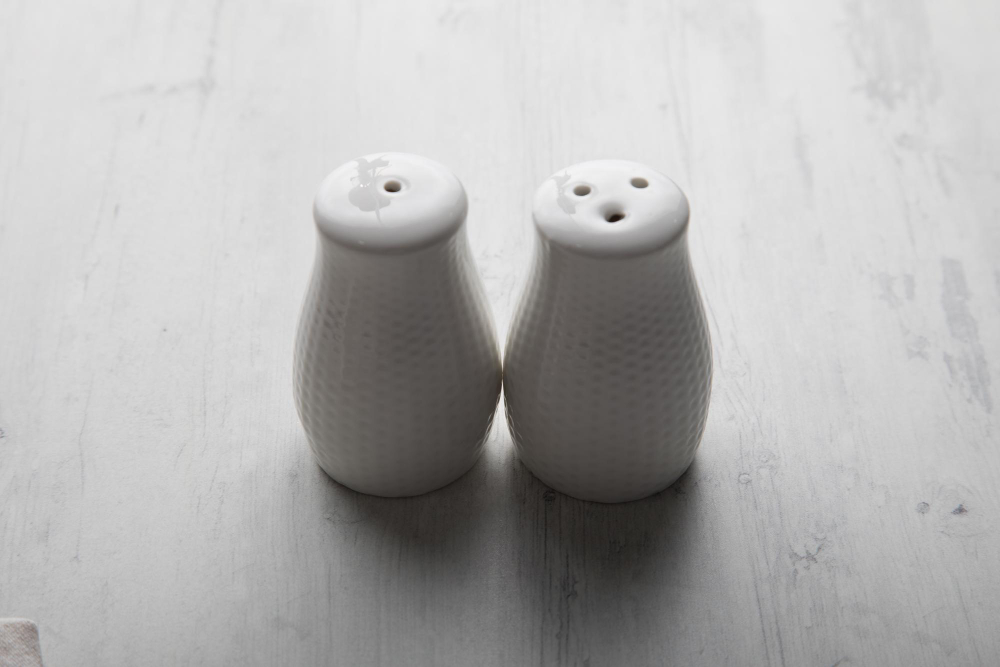
The most commonly given reasoning runs on health. Salt is the ingredient people are advised to use less of, so the shaker that dispenses it should restrict the flow. Fewer holes, less salt, a nudge in the direction of eating better.
There is a second and much older version of the same argument that has nothing to do with health. Salt crystals are denser and flow more freely than ground pepper, so an equal number of equal holes delivers noticeably more salt per shake. Reducing the holes in the salt simply equalises what comes out, so that a given number of shakes of each produces a seasoning balance that tastes about right rather than being dominated by the salt.
That second argument is the stronger one, because it is about the physical behaviour of the two substances rather than about what anybody ought to be eating, and it would have applied equally in any century.
Both arguments point the same way: salt gets fewer holes.
Like our content? Follow us for more.
The Case for More Holes in the Salt
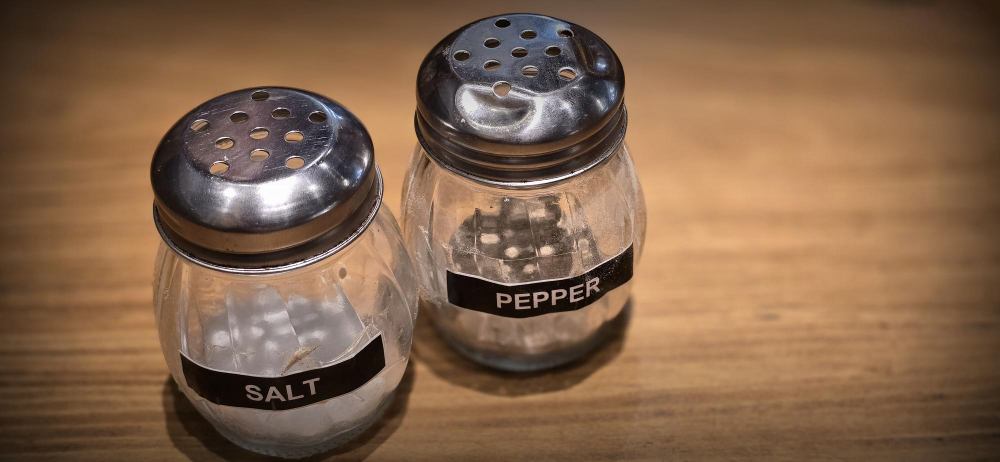
The opposing convention is just as well populated, and its reasoning is just as coherent.
Salt is used in larger quantities than pepper at the table. Most people put salt on most things and pepper on some things, and in smaller amounts. If the shaker is going to be used more, it should dispense more freely, and restricting the one that gets used constantly while leaving the occasional one wide open is simply inconvenient.
There is also a practical argument about clogging. Salt is hygroscopic – it absorbs moisture from the air – and in a humid kitchen it cakes and blocks small holes. Pepper does not do this to anything like the same degree. Giving the salt larger or more numerous holes is a direct response to the fact that it is the one that jams.
So: salt gets more holes.
Both cases are sound. They simply optimise for different things – one for the balance of what lands on the food, the other for how the objects actually behave in a kitchen over months.
The Hole Count Was Never the Real Variable

There is a detail that undercuts the entire argument, and almost nobody raises it.
What comes out of a shaker is governed by the total open area and by the size of each individual hole, not by how many there are. Twelve small holes and six larger ones can deliver identical amounts. A single hole of the right diameter would deliver the same again.
The size matters more than the number, and for a reason that has nothing to do with quantity: a hole must be large enough for the grains to pass and small enough that they do not pour out in a stream when the shaker is tipped. That window is narrow, and it is different for salt and for ground pepper, because the particles are different sizes and behave differently in bulk.
Ground pepper is lighter, less uniform and more inclined to bridge – to form a temporary arch across an opening that holds until the shaker is tapped. Salt flows more readily and, when dry, pours almost like a liquid. A hole sized correctly for pepper may be too generous for salt, and a hole sized for salt may clog with pepper.
So the manufacturers who vary the hole count are frequently varying the hole diameter at the same time, or instead, and the count is simply the part you can see and count. Two shakers with different numbers of holes may be delivering the same amount, and two with identical counts may not be.
Which means the thing the entire argument is conducted over is, on its own, close to meaningless.
Why Nobody Settled It
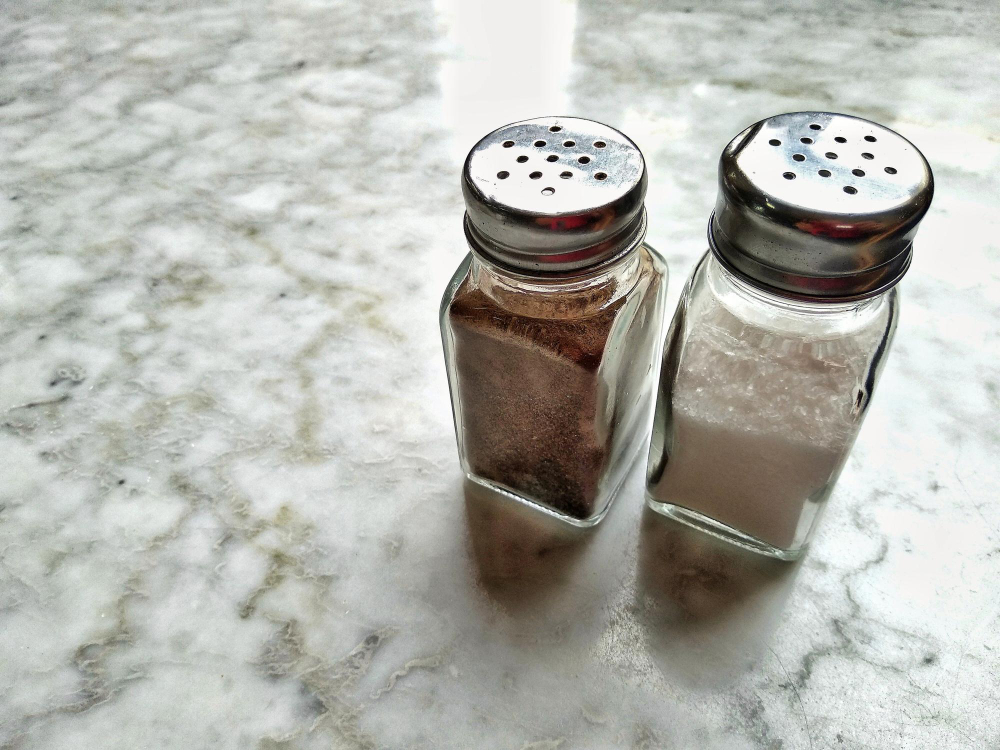
The reason the question has no answer is that shakers are not a regulated object and never were.
A matched pair is made by a manufacturer who decides the hole count, usually for reasons of appearance and mould simplicity rather than seasoning theory. A great many pairs have the same number of holes in both, which resolves nothing. A great many are sold with no indication of which is which at all, relying on the user to fill them and remember. Older sets frequently carry a letter moulded or painted on the base, and that – where it exists – is the only authoritative answer for that particular pair.
Restaurants typically resolve it by using visibly different containers: a shaker for the salt and a mill for the pepper, which makes the question disappear. A mill exists because pepper loses its aroma rapidly once ground, which is a real and significant effect and the single best argument for not keeping ground pepper in a shaker at all.
Where the convention does get standardised is within an organisation rather than across the world. A catering operation will pick one rule and apply it so that staff can work without thinking. That is a local answer to a local problem, and it has never propagated outward into anything general.
The Rice in the Salt Is a Separate Piece of Folklore

Anybody who has eaten in a certain kind of cafe has found grains of rice in the salt shaker, and the explanation given is always the same: the rice absorbs moisture and stops the salt caking.
This is partly true and mostly not. Dry rice does absorb some water, but it is a poor desiccant and the quantity in a shaker is far too small to meaningfully dry the air inside it. What the rice actually does is mechanical. The grains break up the bridges that form between salt crystals as they begin to cake, and they are large enough not to come out of the holes while doing it. It is an agitator, not a drying agent.
The industrial solution is different again and is the reason the problem has largely gone away. Table salt is typically treated with a very small quantity of an anti-caking agent that coats the crystals and stops them bonding to each other in humid air. This is why salt out of a modern packet pours freely in conditions that would have set an untreated salt solid, and it is why the rice trick now belongs mostly to places using coarse or untreated salt, or to habit.
The trick also has a cost, which is that the rice slowly absorbs the salt’s own flavour-carrying properties onto its surface and eventually goes stale, and in a shaker nobody empties it simply sits there for years.
It is a good example of a folk remedy that works for a reason other than the one given, which is the most common kind.
How to Actually Tell Them Apart
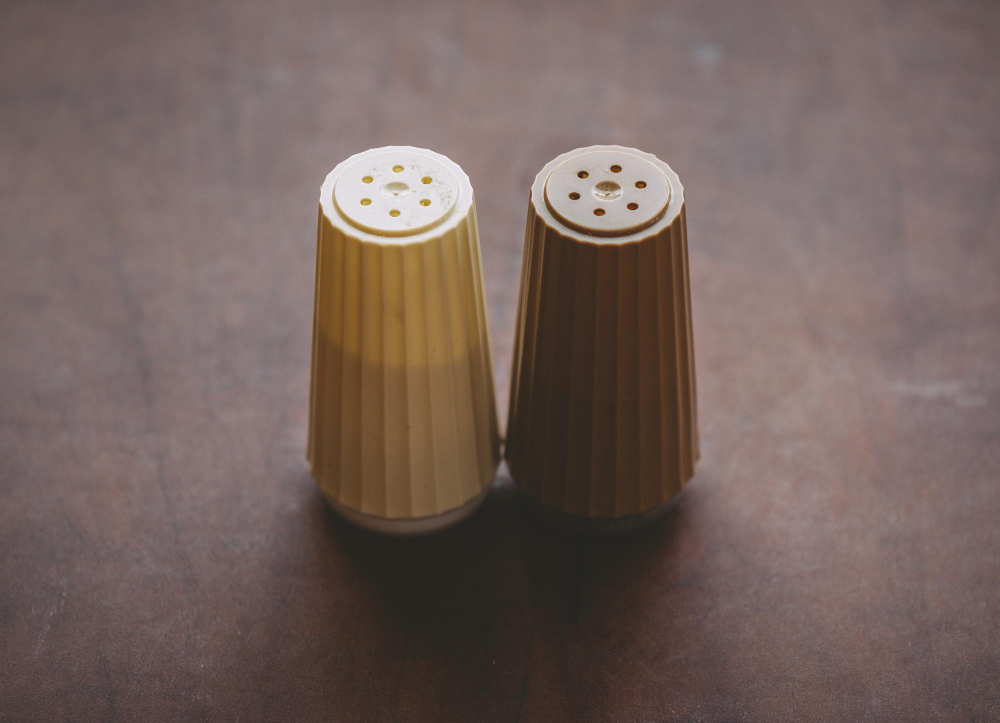
Ignore the hole count. There are three reliable methods.
The first is to look. Table salt is white, uniform and crystalline. Ground black pepper is dark and visibly inconsistent. Through clear glass this takes a second, and clear glass is the reason most shakers are made of it.
The second is to tip a little into your palm. This is the method that works on opaque shakers and the one most people arrive at independently.
The third applies to older sets and is the most satisfying: check the base. Where a letter or a word has been applied by the manufacturer, it reflects how that specific pair was designed to be filled, and it overrides every general theory – including both of the ones above.
What does not work is counting holes and applying a rule, because the rule you apply will be one of two, and the shaker in your hand was made by somebody who may have been following the other one or neither.
The Interesting Part Is Why We Expect a Rule
The genuinely curious thing here is not the shakers. It is how strongly people expect there to be an answer.
Ask about this in any group and somebody will state the rule with complete confidence, and will frequently attribute it to a standard, a regulation, or a piece of received wisdom from the catering trade. The attribution is almost always vague, and that vagueness is the tell. A rule that really existed would come with a source.
Everyday objects attract this kind of invented authority in enormous quantity. The number of holes in a shaker, the direction a roll of paper should hang, the correct side of a sheet of foil, which way up a tin should be stored – all of these generate firm rules, confident explanations and considerable disagreement, and in most cases the honest answer is that it was never specified and both ways work.
What that reveals is a preference, not a fact. People would rather have a rule and be wrong about it than accept that a small daily decision has no correct form. The shakers are a particularly clean example because the two conventions are so evenly matched that neither side can win, and the argument can therefore continue indefinitely with no new information ever arriving.
Which it does, in kitchens, more or less permanently.
So count the holes on your own pair, by all means. It will tell you what your manufacturer thought.
It will not tell you what anybody else’s did.
Like our content? Follow us for more.
