

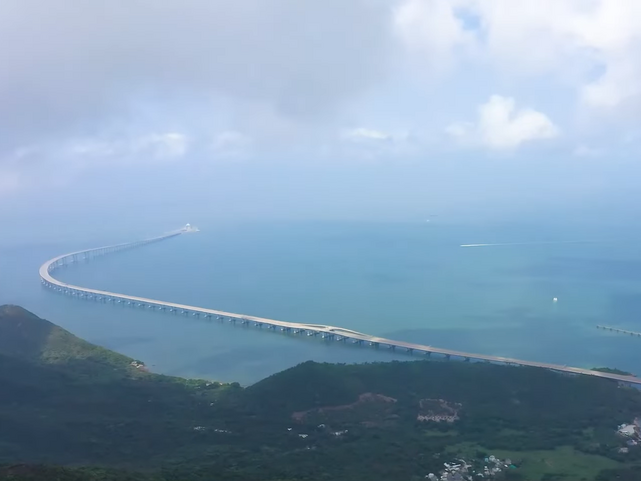
The longest bridge in the world is not over water, is not a landmark, and almost nobody who crosses it knows they are on it. It carries high-speed trains across the flat, wet, intensively farmed country of the Yangtze delta between Shanghai and Nanjing, it runs for roughly 164 kilometres — a little over 102 miles — and it is a bridge for a reason that has nothing to do with crossing anything in particular.
That reason is the most interesting thing about it, because it explains a change in how railways get built that has quietly become the default across an entire continent.
What it actually is
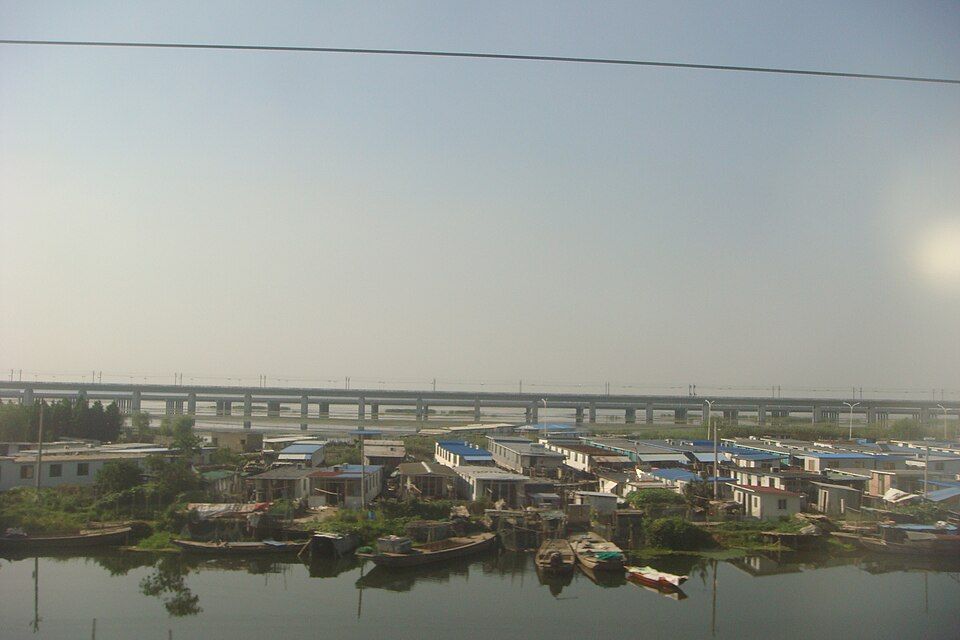
The structure is the Danyang-Kunshan Grand Bridge, a viaduct forming part of the Beijing-Shanghai high-speed railway, which opened in 2011. It is continuous for its full length, which is what makes it a single bridge rather than a sequence of them, and it has held the record for the longest bridge of any kind since it was completed.
It crosses the delta plain: rice fields, canals, fish ponds, villages, roads, existing railways and about nine kilometres of open water at Yangcheng Lake. The water crossing is the part that looks like a bridge in photographs and it is a small fraction of the total.
The deck is a continuous concrete box girder on piers, built in spans of a standard length, the overwhelming majority of them identical. There is nothing exotic in the engineering and that is deliberate: the whole value of the approach depends on the spans being repetitive enough to industrialise.
A passenger on a train crossing it sees fields, at two hundred and something kilometres per hour, from about ten metres up. There is no sensation of being on a bridge at all, which is the intended result.
Like our content? Follow us for more.
Why build a viaduct across dry ground at all
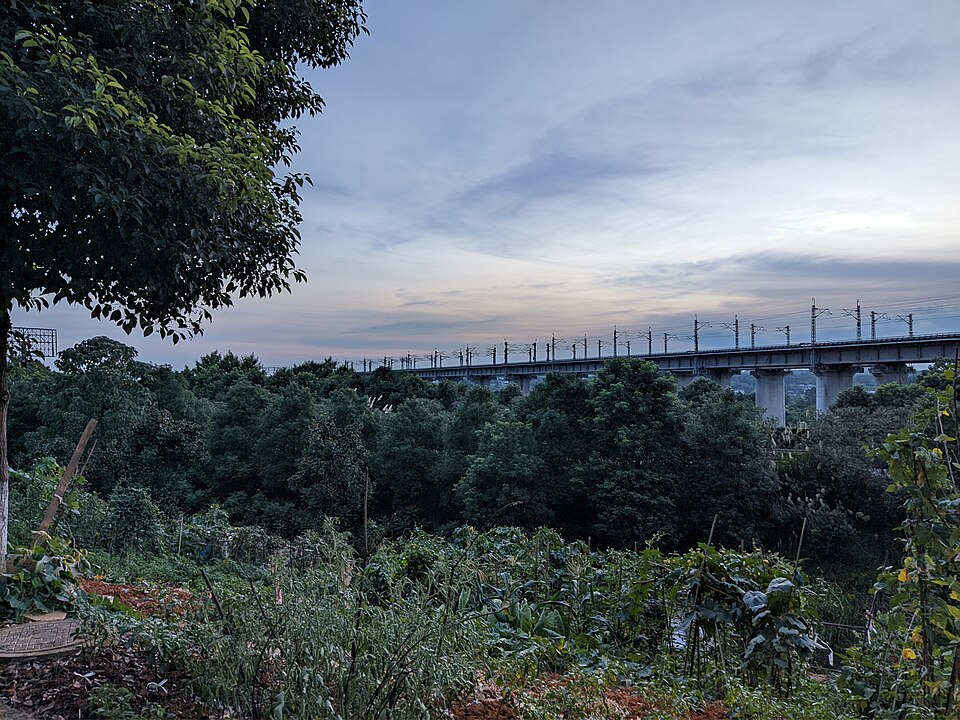
Because on soft, waterlogged, settled ground a viaduct is cheaper and better than an embankment, once the railway has to be flat and straight enough for high speed.
High-speed track has very tight tolerances on level and alignment. A conventional embankment on delta silt settles unevenly for years after construction and has to be continually corrected, which on a line carrying trains at those speeds is both expensive and operationally awkward. Piled piers founded in firmer material below do not settle meaningfully, so the track geometry stays where it was built.
A viaduct also solves the problems a long embankment creates on that kind of landscape. It does not block drainage across a delta where water movement matters agriculturally and in flood. It does not sever roads, paths, canals and field boundaries, because everything passes underneath. And it takes very little land permanently out of use, which matters enormously where the ground is both scarce and productive.
The land argument is the one that drove it. Buying a wide corridor of prime agricultural land, demolishing what is on it and displacing the people who farm it has a cost that does not appear in a bridge-versus-embankment comparison unless somebody puts it there.
How it was built so quickly
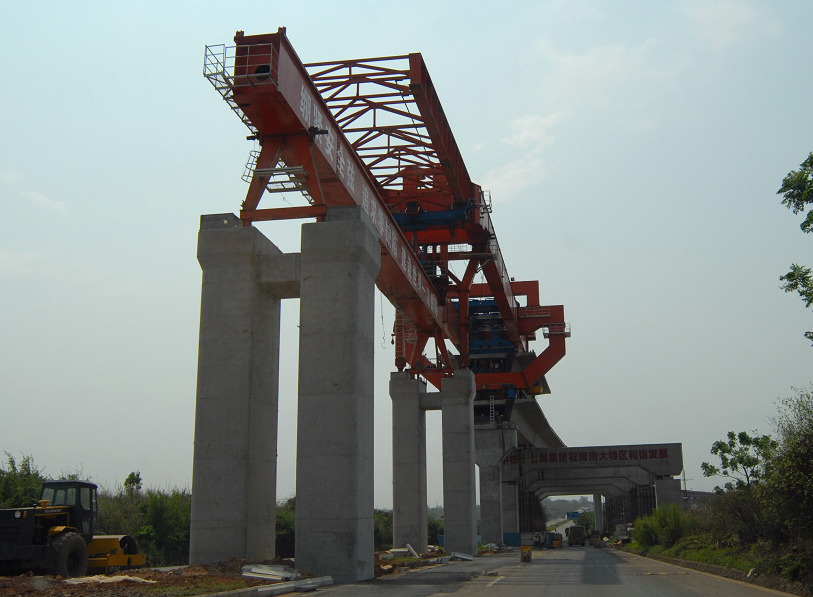
The method is the point. Standard spans were cast in yards near the line, moved into position on the completed structure itself by a launching gantry, and placed one after another in a repeating cycle. Each segment is similar enough to the last that the operation becomes a production line rather than a sequence of individual engineering problems.
That is why the structure was completed in about four years, and why bridge kilometres on Chinese high-speed lines have been built at a rate that engineers elsewhere found hard to credit when it started.
The approach has limits and they are worth stating. It works where the terrain is uniform, where spans can be standardised, where a continuous casting and launching operation can be set up, and where land acquisition and planning can proceed at the pace of construction. Several of those conditions are organisational rather than technical.
It also produces a particular kind of infrastructure: enormous quantities of concrete in a structure with a design life measured in a century, requiring inspection and maintenance along its entire length for that whole period. That maintenance obligation is inherited by somebody for a very long time.
The other bridges on the same list
The record list is dominated by railway viaducts of the same type and for the same reasons, mostly in China, and comparing them is a definitional exercise rather than an engineering one. Several of the longest structures in the world are segments of the same railway.
The longest bridge over water is a different and more meaningful category, and the contenders there are genuinely marine crossings — long causeways and sea bridges where the water is the obstacle. Those are harder structures, exposed to salt, waves, shipping and in some cases earthquake, and the engineering problem is a different one entirely.
The longest bridge carrying road traffic, the longest suspension span, the longest cable-stayed span and the longest single span are four more separate records, and the single span is the one most engineers consider the real contest, because it measures what can be bridged without putting anything in the water.
Anybody comparing bridge records should establish which category they are looking at first. Total length, span length, over water and by traffic type are four different leagues and the same structure rarely appears near the top of more than one, which is why two sources can disagree completely about which bridge is the longest without either of them being wrong.
What it tells you about how railways are built now
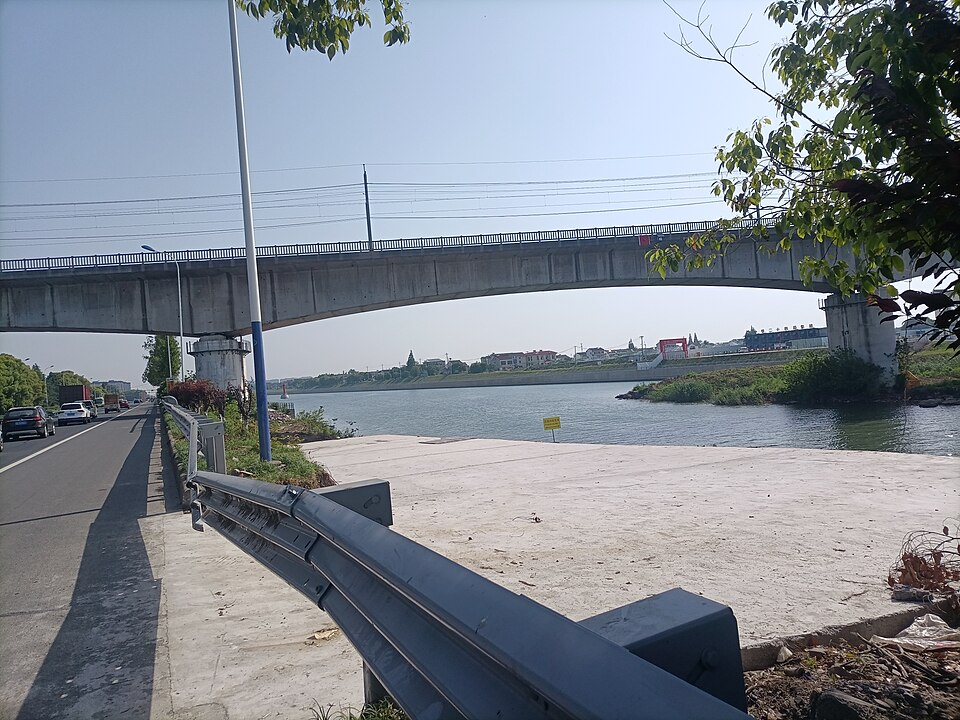
The quiet shift is that elevated construction has become the default for new high-speed railway across a large part of the world, rather than the exception it was when the first high-speed lines were built on embankments in the 1960s and 1970s.
The drivers are consistent wherever it happens: land take, settlement, drainage, severance of existing routes, and the tolerance requirements of fast track. Where those conditions apply, a viaduct wins on whole-life cost even though it loses on the headline construction figure.
There is a visible consequence for anybody travelling on such a line. The view is from above, consistently, for hours, and the railway no longer has the intimacy with the landscape that a ground-level line has — no cuttings, no embankment slopes, no level crossings, no villages at eye level. Passengers notice it and opinions divide sharply.
There is also an argument about reversibility. An embankment can be removed and the land returned. A hundred-kilometre concrete viaduct is a permanent feature of a landscape in a way that very little else built in the last century is, and the people who farm underneath it are the ones living with that decision.
Going to see it, which is harder than it sounds
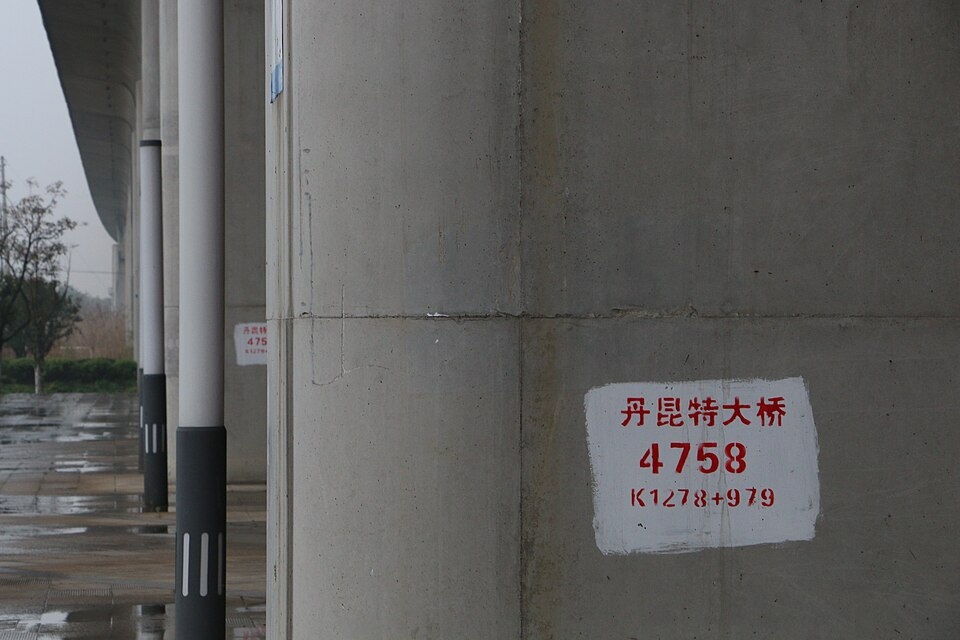
There is no viewpoint, no visitor centre and no vantage point from which the structure reads as the longest bridge in the world, because it is too long and too low for any single view to contain a meaningful fraction of it.
What you can do is ride it, which happens as a matter of course on any high-speed service on that corridor, or stand underneath it, which is easy because it crosses an inhabited and accessible landscape and the local roads pass beneath it constantly.
Underneath is the better experience and it is the one people report as striking: an identical concrete pier, then another, then another, in a line disappearing to a point in both directions across farmland, with trains passing overhead at speed and very little noise reaching the ground.
The lake section near Yangcheng is the photogenic part and is the one that appears in every picture of the bridge, which is slightly misleading about what the structure mostly is. If you want the view that explains it, stand in a field beside a pier and look along the line rather than at it.
What the record actually measures
Not daring, not difficulty, and not engineering ambition. It measures a decision to industrialise the construction of ordinary spans, and a judgement that crossing a soft, crowded, productive landscape on legs is better than crossing it on a mound of imported fill.
The honest summary: the longest bridge in the world is a railway viaduct over farmland, it is a bridge because high-speed track cannot tolerate the settlement an embankment on delta silt produces, the land and drainage arguments mattered as much as the engineering one, the construction record came from standardisation rather than from any novel structure, and the maintenance obligation it created runs for a century.
And if you want to see a bridge that looks like a record, the over-water and single-span categories are where to look. This one is a production line, which is a different and arguably more consequential kind of achievement.
Like our content? Follow us for more.


