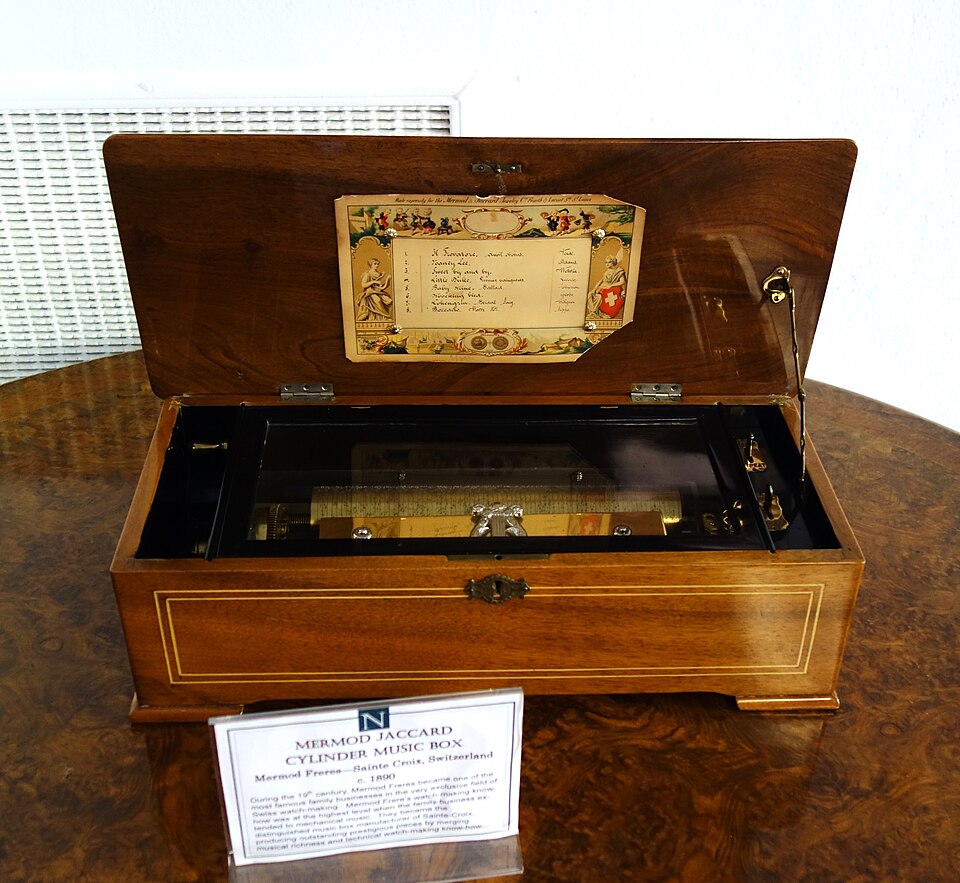
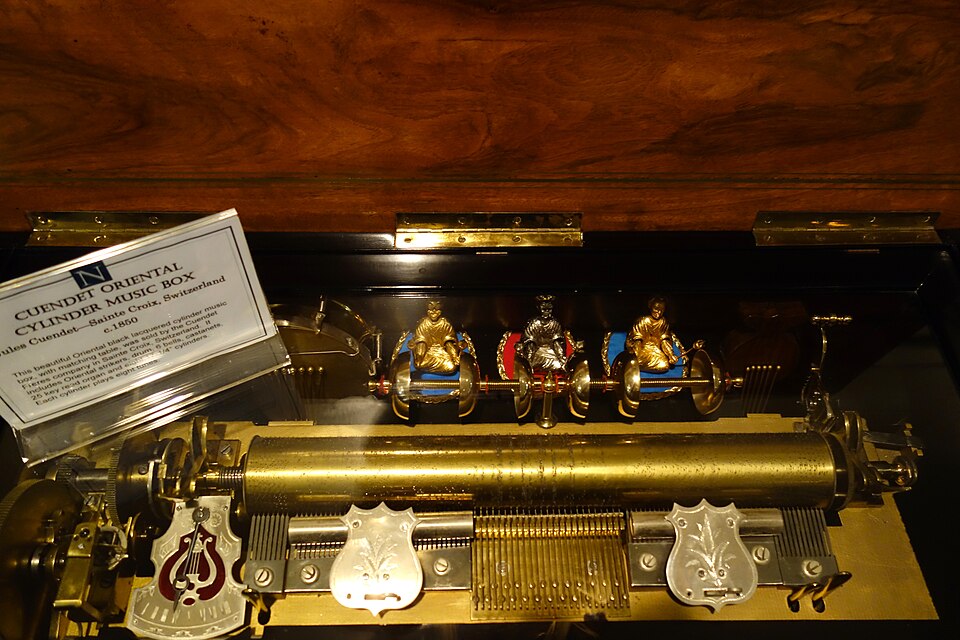
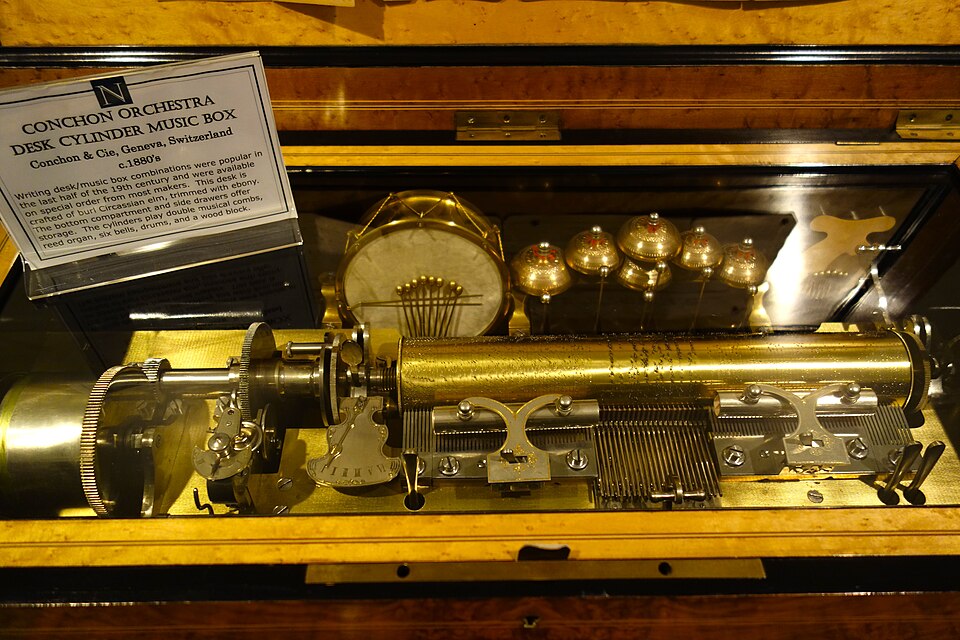
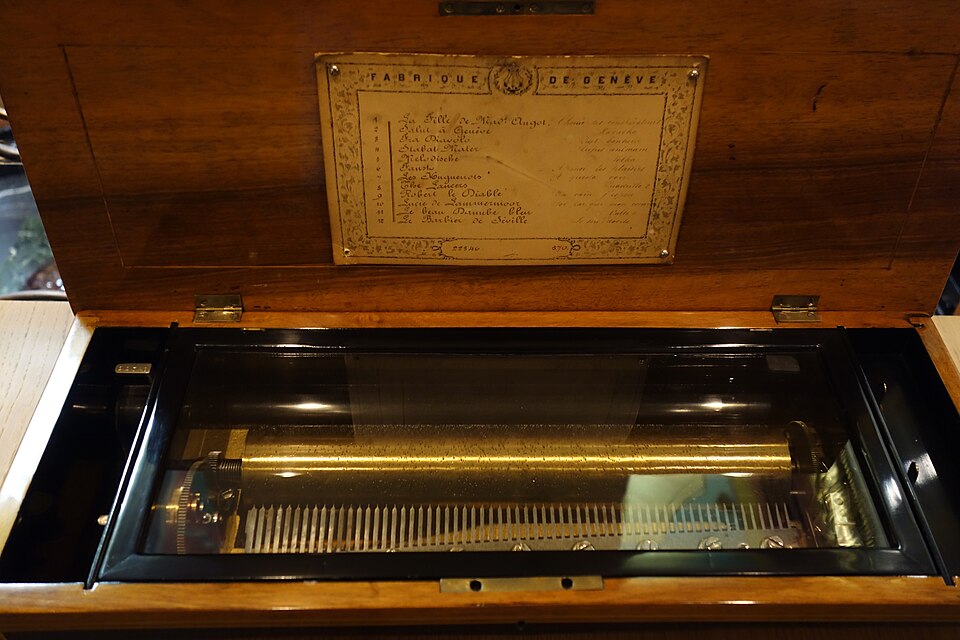
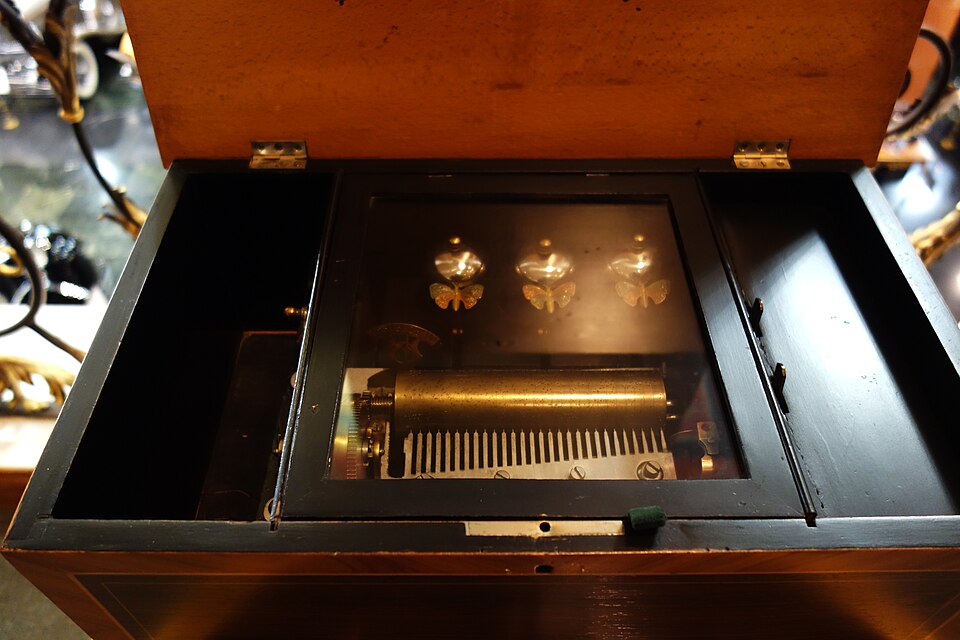
The music box I remember was in a parlour I was not supposed to be alone in, and the thing that fascinated me was not the sound but the fact that you could see how it worked. Lift the lid and there is a brass cylinder covered in tiny pins and a flat steel comb lying alongside it. Nothing is hidden. It is, I think, the most legible machine that was ever commonly found in a house – you can watch the music happening.
The Comb Is the Instrument
Start with the part that makes the sound, because everything else exists to operate it.
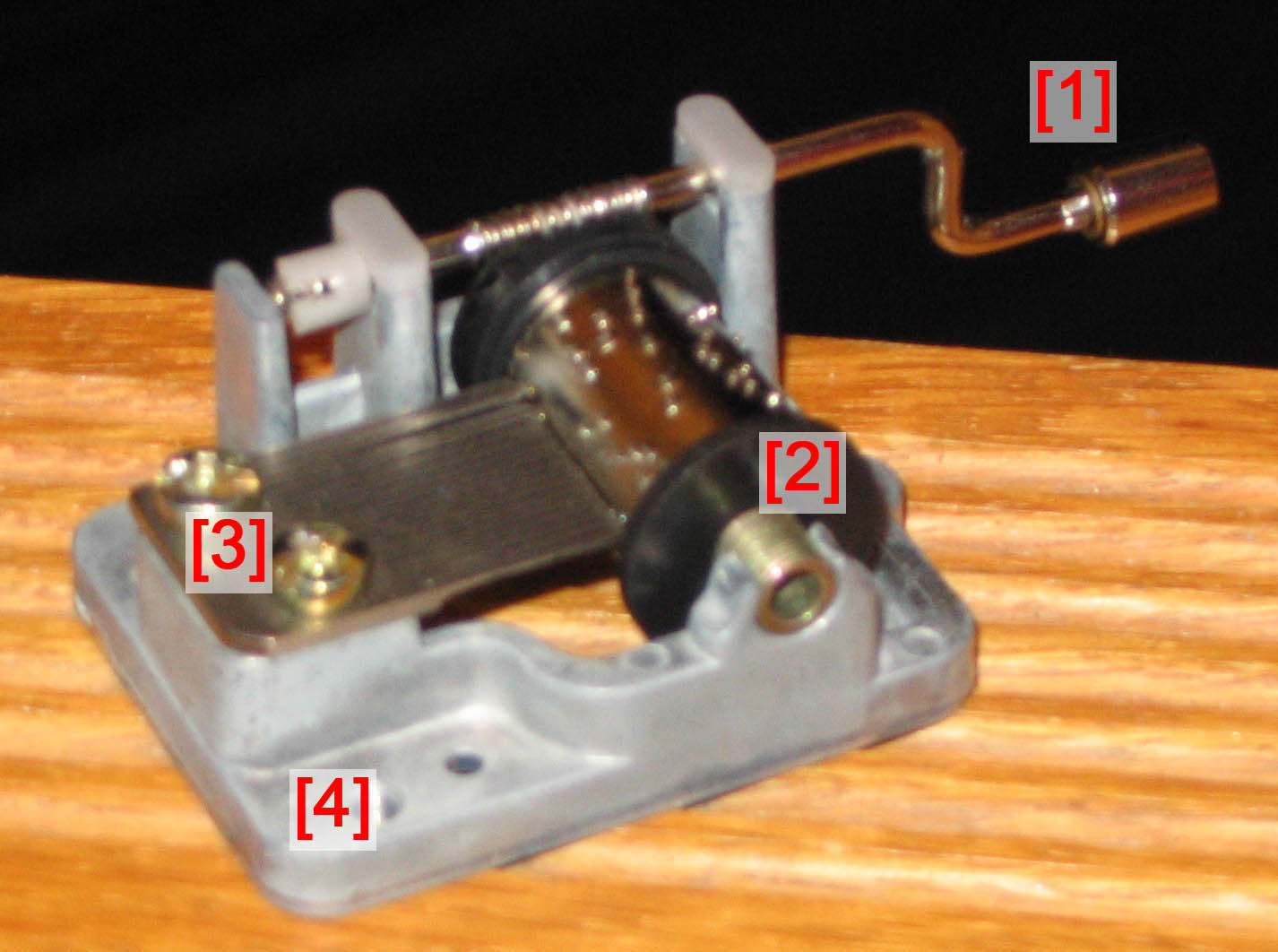
Along one side is a single piece of steel cut into a row of teeth of graduated length, like a comb with the teeth lying flat. Each tooth is tuned: a longer, heavier tooth vibrates slowly and sounds low, a shorter one vibrates fast and sounds high. Pluck one and it rings.
That is the whole instrument. Not a string, not a reed, not a pipe – a row of tuned steel tongues cut from one piece of metal. The tuning was done by filing, removing metal until each tooth reached its note, and on the better boxes the low teeth have lead weights added to their undersides to get them low enough without making the comb absurdly long.
Like our content? Follow us for more.
The Cylinder Is the Score
Now the part that decides what gets played.
The brass cylinder has pins set into its surface, and as it turns each pin passes a particular tooth and plucks it. The position of a pin along the cylinder chooses which note; the position around the cylinder chooses when it sounds. Turn the drum at a constant speed and the pattern of pins becomes a tune.
Which means the music is physically built into the machine. There is no notation being read, nothing interpreting anything – the arrangement of the piece has been converted into the arrangement of several thousand pins in a metal drum, and it will play that and nothing else, identically, every time, forever.
Setting the Pins Was the Real Work
This is the part that changed how I think about these objects.
Somebody had to decide where every pin went. A tune was arranged for the number of teeth available, marked out on the cylinder, and then a hole was drilled and a pin set for every single note. A box playing several airs has thousands of pins, each one positioned to a tolerance of a fraction of a millimetre in two directions.
Get one wrong and that note is early, late, or the wrong note. There is no adjustment afterwards. The cylinder is the master record and the only copy, and the labour in it is the reason these were expensive objects rather than toys.
I find that worth sitting with. The arrangement of the music and the manufacture of the mechanism were the same job, done once, by hand.
The Spring Had to Deliver Even Power
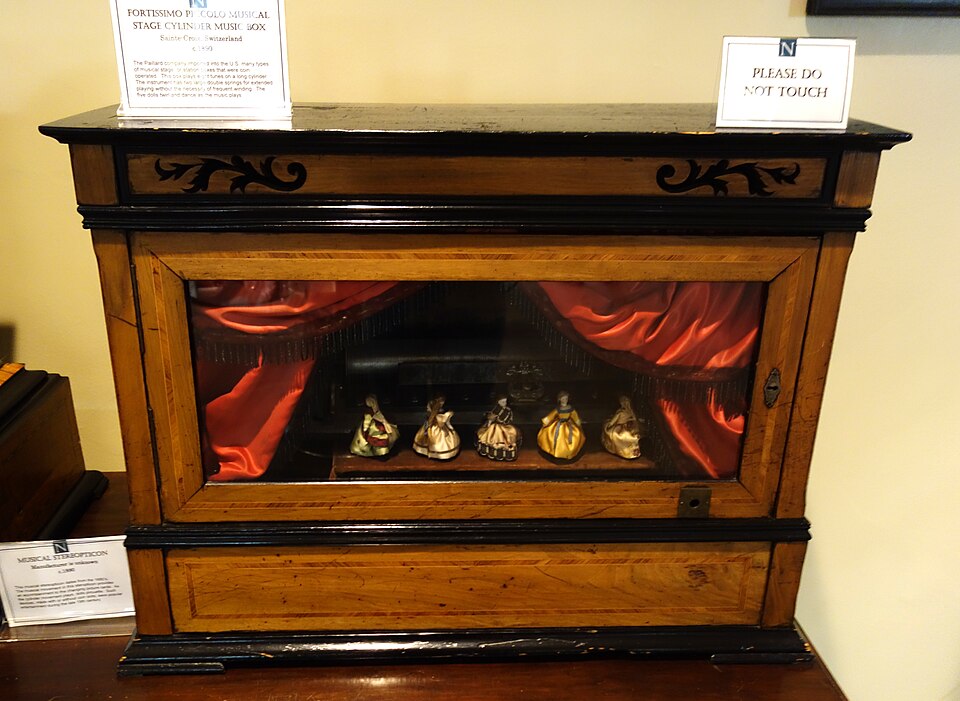
A music box runs on a wound steel spring, and springs have a problem.
A fully wound spring pulls hard; a nearly unwound one pulls weakly. Left alone, that means the drum turns fast at the start and slows as it runs down, so the tune speeds up and then drags – which is intolerable in music, far more than in a clock.
The answer is a governor: a small fan or air brake, geared to spin very fast, whose resistance against the air increases sharply with speed. If the mechanism tries to run quickly the fan resists more; if it slows the fan resists less. The result is a near-constant speed across the whole winding.
That little whirring fan is the cleverest part of the machine and the part nobody looks at. It is also what makes the characteristic sound – the faint continuous whirr behind the notes that every cylinder box has.
Several Tunes on One Drum
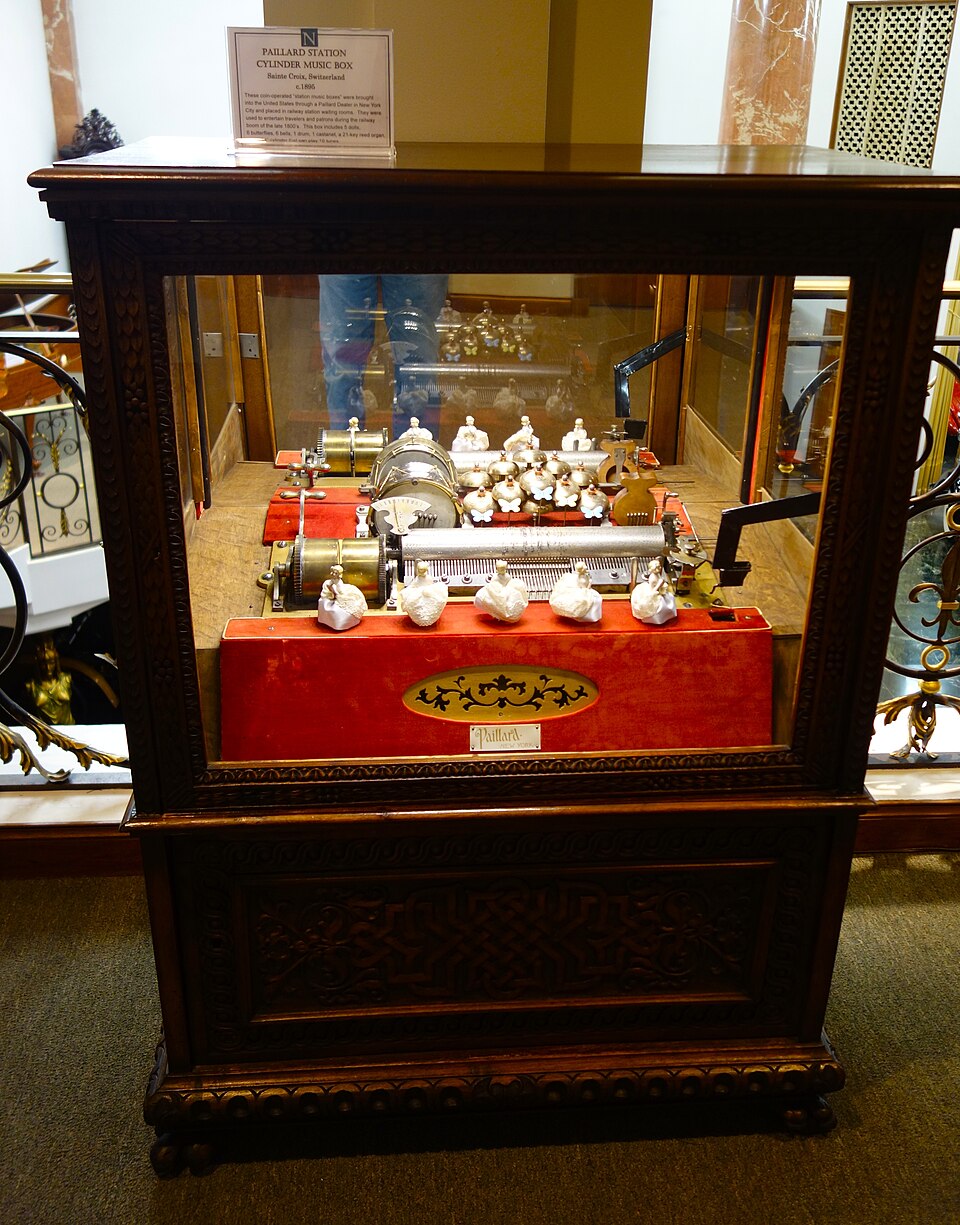
The better boxes played more than one air, and the way they did it is elegant.
The cylinder is shifted sideways by a tiny amount at the end of each tune, so that a different set of pins now lines up with the teeth. The pins for each air are interleaved along the drum, and a slight lateral shift selects between them.
This is why the number of tunes a box plays is a fixed property of it, why the shift happens with an audible click between pieces, and why a worn or damaged shifting mechanism makes a box play two tunes at once – which sounds exactly as bad as you would imagine, and is the commonest fault in surviving examples.
The Case Was Doing Acoustic Work
The wooden box is not just a box.
A plucked steel tooth on its own is almost inaudible. The comb is bolted to a heavy bedplate, the bedplate to the case, and the case acts as a sounding board – taking the vibration and moving a large area of air. The size, the thickness and the stiffness of that case are part of the instrument.
Which is why a mechanism taken out of its case and run on a bench sounds thin and disappointing, and why a box with a cracked case or a loose bedplate loses its voice. The sound people remember is as much the furniture as the mechanics.
The Teeth Broke and Could Not Be Replaced
There is a failure mode worth understanding, because it determines which of these instruments survive.
A steel tooth being plucked thousands of times is a piece of metal being flexed repeatedly, and metal flexed enough eventually cracks. Teeth break off, usually at the root where the stress is highest, and when one goes there is simply a note missing from the instrument for the rest of its existence.
Worse, a broken tooth does not stop the pin that used to pluck it. The pin now passes through empty space, or catches the stump, and a damaged stump can snag and bend a pin – which takes a second note out as well. Damage propagates.
The other half of the problem is the cylinder. If the mechanism is ever allowed to run without its brake, the drum spins at a speed it was never meant to reach and the pins strike the teeth far too hard, bending pins and snapping teeth along the whole length in a few seconds. Almost every badly damaged box in existence was damaged exactly that way, in one moment, by somebody who did not know what the whirring fan was for.
Which is why the surviving instruments in good order are the ones that were in houses where nobody was allowed to touch them.
Then a Disc Replaced the Cylinder
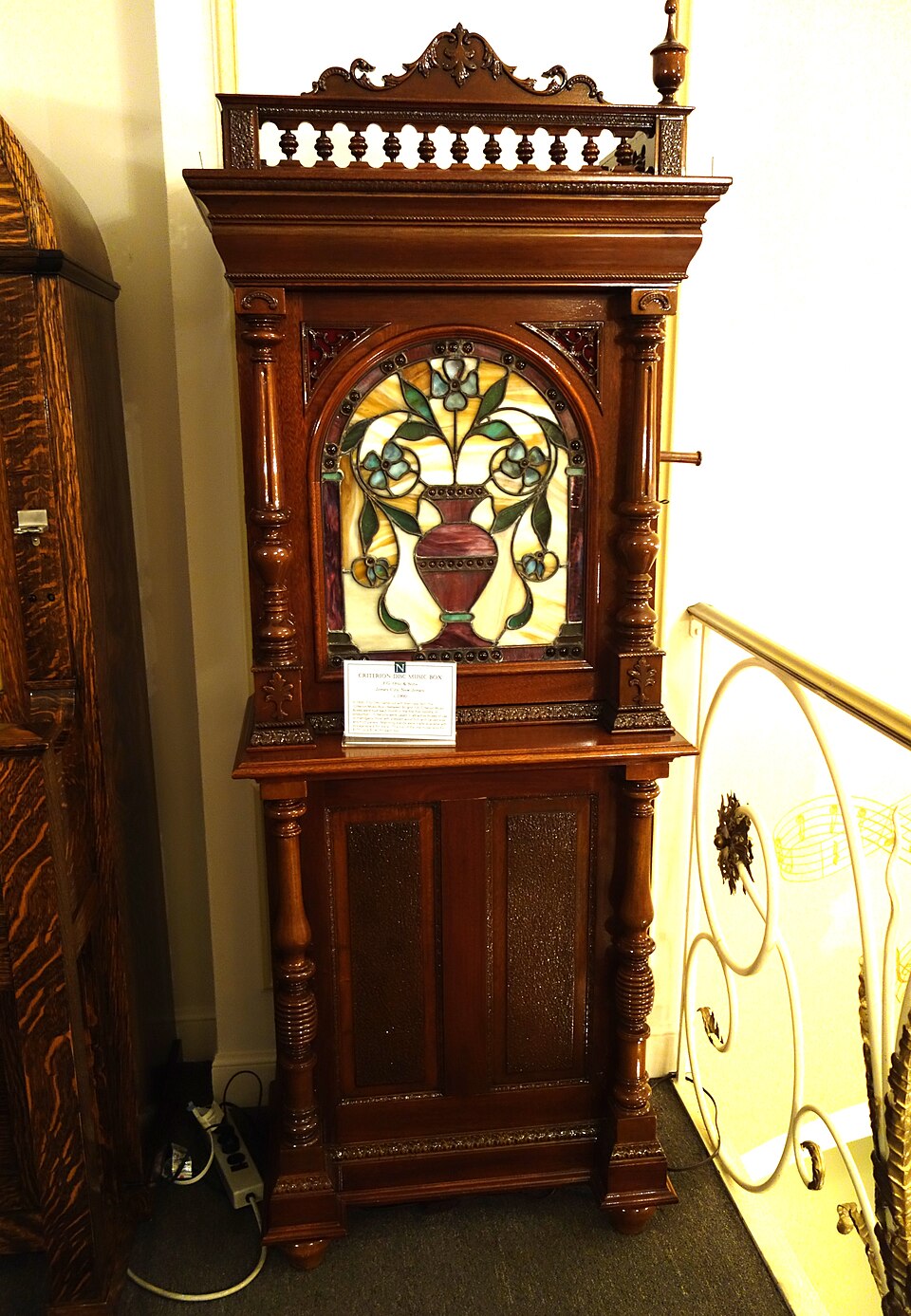
The great limitation was obvious to everybody: you could not change the music.
The answer was to move the pins from a drum onto a flat removable disc, with projections punched out of sheet metal that worked the comb through intermediate levers. Discs were cheap to stamp, they could be sold separately, and a household could buy new ones.
That is a far better product in every commercial sense, and it did to the cylinder box exactly what you would expect. The cylinder machines were expensive, fixed, and had their repertoire decided at the factory; the disc machines were cheaper and open-ended. Making the music a consumable rather than part of the hardware is the whole history of recorded sound in one step, and it happened here first.
Then Recording Made Both Obsolete
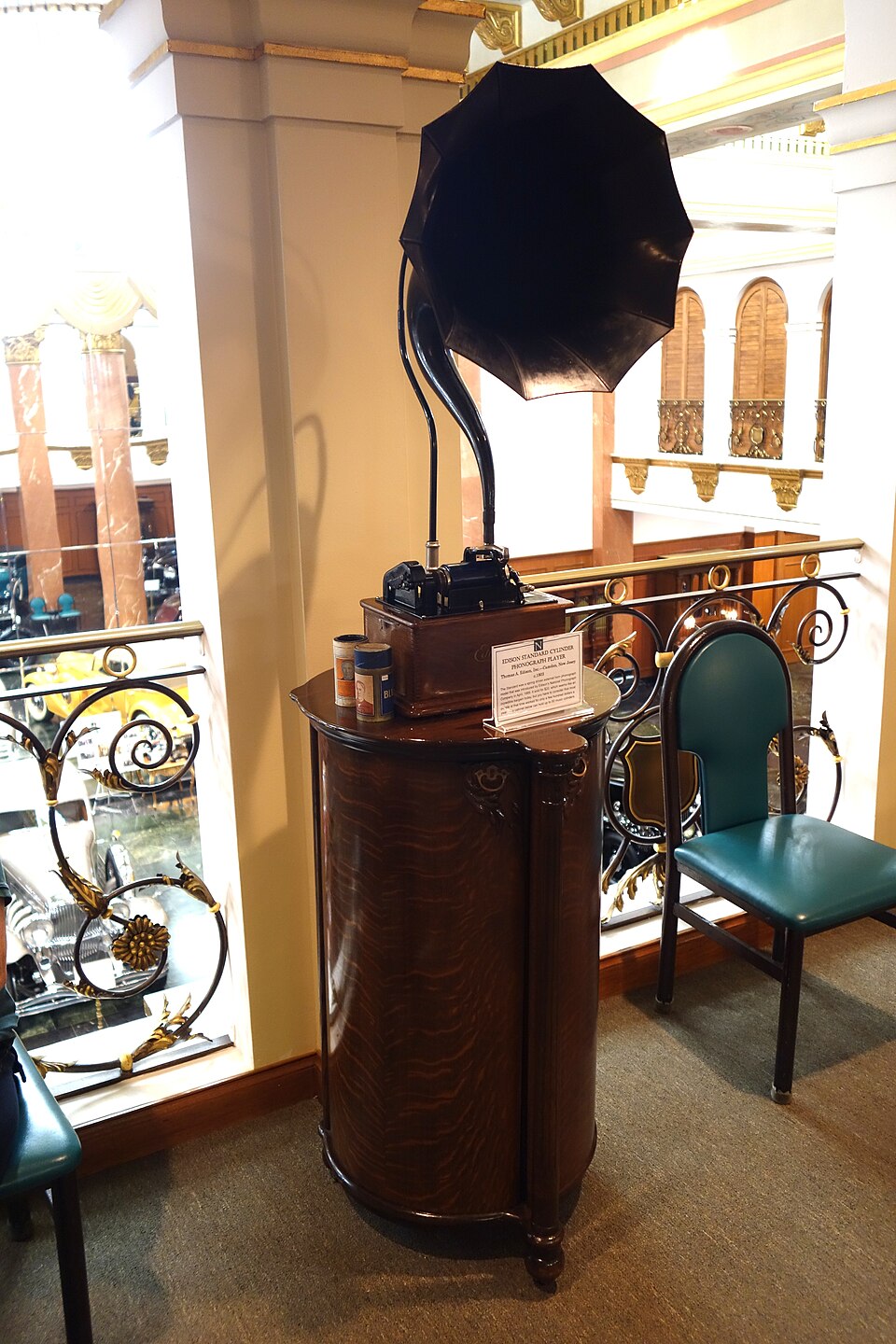
And then both kinds were finished off by something categorically different.
A music box reproduces an arrangement. A phonograph reproduces a performance – an actual sound that happened in a room, including the voice, the instrument and everything else. However good a comb and cylinder are, they can only ever sound like a comb and cylinder, and they cannot sing.
Against that, the music box had nothing to offer except that it needed no electricity and never wore out the recording. So it went from being a serious domestic instrument to being an ornament and a novelty, and the mechanism survived in miniature in jewellery boxes, where it still is.
The Mechanism Is Still Everywhere
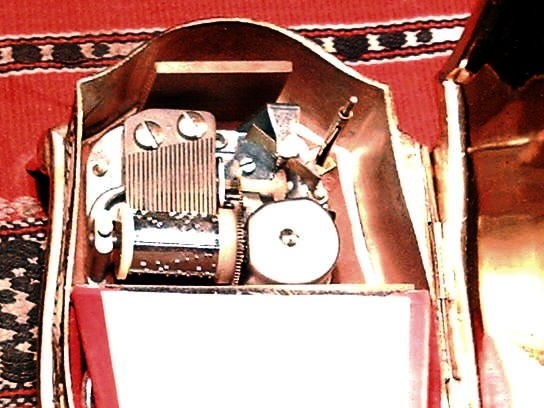
Which is the part I like about the whole story.
The comb and the pinned drum did not disappear. They shrank. The movement inside a jewellery box, a musical ornament or a child’s toy is the identical machine – tuned steel teeth, a pinned cylinder, a spring, a governor – reduced to the size of a matchbox and made for almost nothing.
So the technology was not superseded so much as demoted. Every one of those cheap movements is a direct descendant of a parlour instrument that cost more than a piece of furniture, and it works on exactly the same four principles.
What the Open Lid Showed
I want to end where I started, with the lid open.
Almost nothing else in a nineteenth-century house showed you its working parts. A clock hid them behind a dial. A sewing machine covered them. An organ put them inside a case. The music box, uniquely, was built so that you lifted the lid and looked straight at the mechanism, and a great many were made with a glass panel so that you could watch it running.
That was deliberate, and it tells you something about how the object was sold and understood. Part of what you were buying was the visible fact of the machine – thousands of pins, a tuned comb, a spinning brake – doing something that nobody could do by hand. It was a demonstration as much as an instrument.
Which is presumably why children were drawn to it and were not allowed to touch it, and why the thing I remember about that parlour is not the tune.
Like our content? Follow us for more.