It Is the Remains of a Pipe, Not a Wound
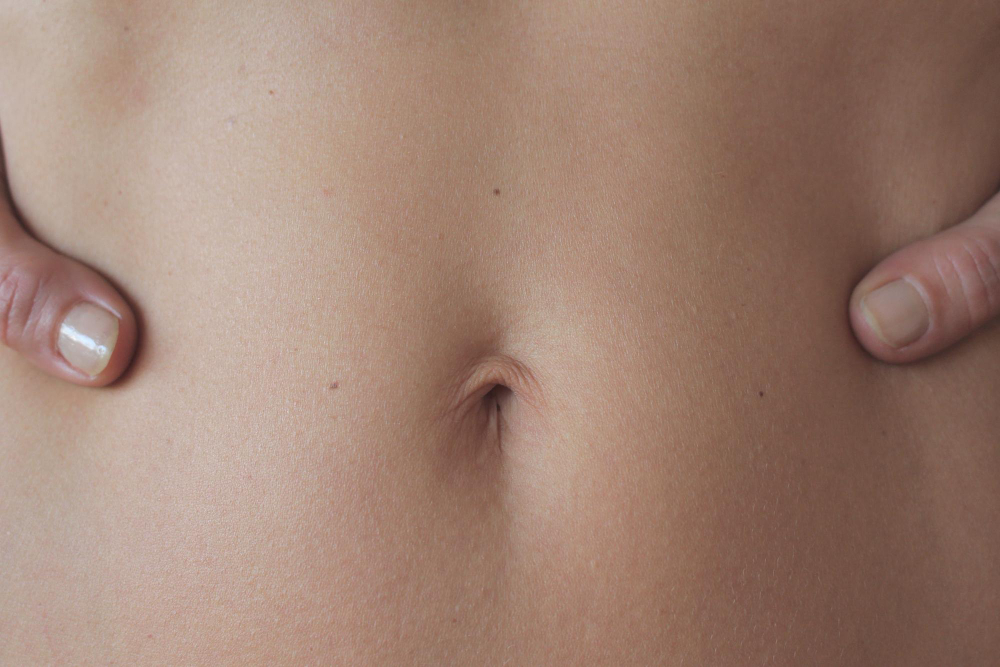
The usual assumption is that a belly button is where a cord was cut and the resulting cut healed over. Almost every part of that sentence is wrong, and the way in which it is wrong is more interesting than the assumption.
The cord that connects a developing mammal to the placenta is not attached to the surface of the abdomen. It passes through the abdominal wall and continues inside the body, where its vessels run to the liver and to the bladder. The visible external cord is the outer section of a structure that was always partly internal, and the abdominal wall grew around it rather than being pierced by it.
When the cord is clamped and cut after birth, the cut is made some distance out along that external section, not at the body. What remains is a stump of several centimetres, and nothing is done to that stump at all. It is not stitched, folded or closed. It is simply left, and over the following days to a couple of weeks it dries out, dies and detaches on its own, because it has no blood supply of its own once the circulation through it stops.
What is underneath when it comes away is not a wound in the ordinary sense. It is the point where a tube that used to pass through the abdominal wall no longer does, and the wall closes over the gap. So the belly button is better described as the sealed end of a decommissioned passage than as a healed cut.
It is still, technically, scar tissue, and it is the one piece of it that every human being carries. But the process that produced it was a controlled shutdown rather than a repair of damage.
Like our content? Follow us for more.
What Was Actually Running Through It

The cord contains three blood vessels, and the arrangement is the reverse of what most people assume. There are two arteries and one vein, and the vein is the one carrying oxygenated blood, which is the opposite of the convention everywhere else in the body. The naming follows direction of flow relative to the heart rather than oxygen content, and in the cord the direction is inverted.
The two arteries carry blood away from the developing body, towards the placenta. The single vein brings oxygenated, nutrient-rich blood back from the placenta to the body. All three are wound around each other in a loose helix, which is not decoration: the spiral makes the cord enormously resistant to kinking, in the same way a coiled telephone cable is.
The vessels are embedded in a remarkable substance with no real equivalent elsewhere in the adult body. It is a gelatinous tissue, firm and slippery at once, and its function is purely mechanical. It holds the vessels apart, resists compression and lets the whole cord bend sharply without the vessels ever being pinched shut. A cord without it would be an extremely vulnerable thing.
And the cord has no nerves. None at all. This is why cutting it causes no sensation whatsoever, and it is also why the stump can dry and fall off without any discomfort. A structure that was going to be discarded within days was not given a sensory supply.
The Shape Was Not Decided by Anybody

There is a widespread belief that whether a person ends up with an inward or an outward belly button depends on how the cord was cut or clamped, or on the skill of whoever did it. It does not. The clamp is placed well out along the cord, and everything from the clamp outward is discarded. Nothing that happens there determines the final shape.
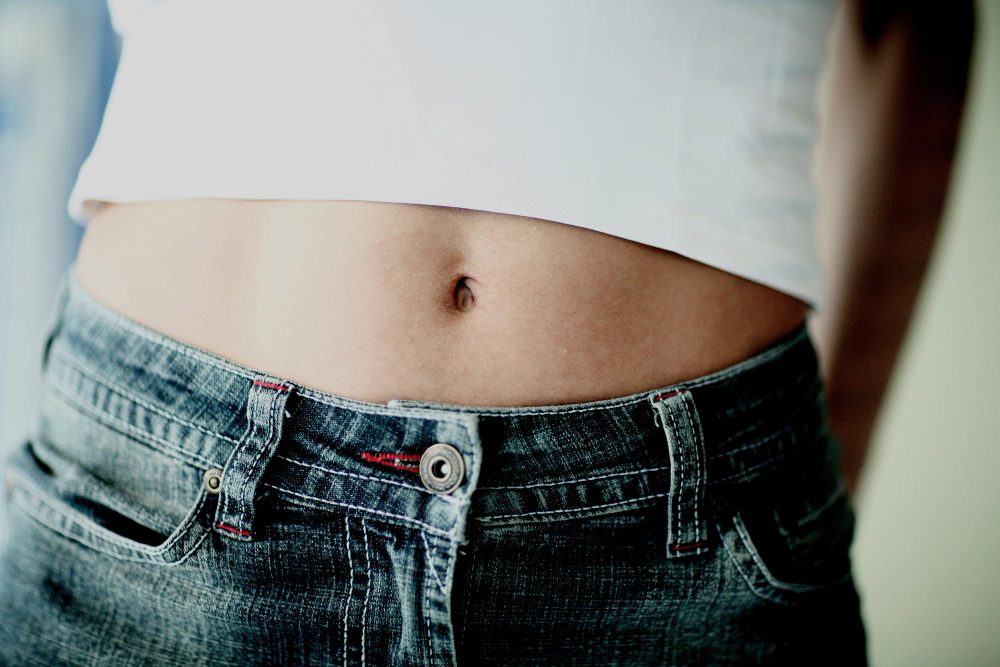
The shape is determined by what happens underneath, as the abdominal wall closes and as scar tissue contracts over the following months. The overwhelming majority of people end up with an inward one, because the contracting tissue pulls the overlying skin down into a depression. The exact form of that depression varies enormously, which is why belly buttons are so individual: they come as vertical slits, horizontal slits, deep pits, shallow dishes and T-shapes, and the variation is in how the surrounding skin folds rather than in the scar itself.
An outward one is a different matter and usually has a specific cause. In most cases it reflects a small umbilical hernia, which is to say a point where the abdominal wall has not fully closed and a little abdominal contents or fat pushes forward against the skin. In infants this is extremely common and the great majority close on their own as the wall completes its development over the first few years.
So the inny-or-outy question, which is normally treated as pure cosmetic chance, is actually a question about how completely one small part of the abdominal wall knitted together. That is a structural fact rather than a decorative one, and it leads directly to the next point.
It Is the Weakest Point in the Abdominal Wall

The abdominal wall is a layered sheet of muscle and tough fibrous tissue, and it is strong. At the navel, it is not. That single spot is where several layers meet around a former opening, and it is composed of scar tissue rather than of continuous muscle and fascia.
This has consequences that are well known to anybody who works on the abdomen. It is the commonest site for a hernia to appear in adults as well as infants, because a weak point in a sheet under pressure is where the sheet gives. Anything that raises pressure inside the abdomen repeatedly over years loads that spot preferentially.
The same weakness is also useful, and it is used deliberately. Keyhole abdominal operations very frequently begin at the navel, for several converging reasons: the wall is thinnest there, there is no muscle to cut through, the layers are already fused so there is less to separate, it sits near the middle of the abdomen so instruments can reach in most directions, and the resulting mark hides inside an existing crease. A feature of the anatomy that is a liability under pressure is an advantage when you want to get in.
It is also the most reliable landmark on the front of the body. In describing where something is on the abdomen, the navel is the fixed reference point, because it sits at a consistent level relative to the spine and the major vessels in most adults. A structure with no function at all turns out to be the coordinate origin.
Two Things Inside You Are Still Attached to It

This is the part that surprises people. The cord’s internal vessels did not vanish. They closed off and became ligaments, and those ligaments are still doing structural work.
The umbilical vein, which carried oxygenated blood from the placenta to the liver, shut down after birth and its remnant became a fibrous cord running from the navel up to the liver. It is now one of the structures associated with holding the liver in position, and it sits in a groove on the liver’s surface that divides one of its lobes. The division of the liver that every anatomy book shows is partly defined by the remains of a blood vessel that stopped working at birth.
The umbilical arteries closed too, and their remnants run from the navel down towards the pelvis, where they are associated with the bladder. A separate structure that drained the bladder towards the cord in early development also closes and leaves a remnant running from the top of the bladder up to the navel.
So the navel is not a dead end. It is the external termination of a small bundle of ligaments connecting the front of the abdominal wall to the liver above and the bladder below, all of which are former plumbing converted into fixings. There are very few places in the body where a redundant system was repurposed quite so thoroughly.
Why There Is So Much Living in There

A belly button is a warm, sheltered, slightly moist recess that is rarely scrubbed with any enthusiasm, which makes it a distinctive habitat. Surveys of the microbial population of human navels have found an unusual degree of variation between individuals, considerably greater than the variation found on flatter, more exposed skin.
The reason is partly geometric. A deep recess is protected from the mechanical abrasion, washing, drying and ultraviolet light that keep the population on exposed skin fairly uniform. Whatever establishes itself in a sheltered pocket can persist without being repeatedly cleared out, and the result is that two people’s navels can host noticeably different communities while their forearms host much the same thing.
The lint is a related phenomenon with a boring and satisfying explanation. Fibres shed from clothing are worked loose by movement, migrate across the abdomen along the directions in which body hair lies, and accumulate in the one depression available. This is why it is more common in people with more abdominal hair, why it is usually the colour of whatever is most often worn, and why it reappears.
None of this requires any intervention and nothing here is advice. It is simply what happens in a sheltered fold of skin, and it is the same reason any other crease on the body behaves differently from a flat surface.
Every Placental Mammal Has One
The navel is not a human peculiarity. Any mammal that develops attached to a placenta has an umbilical cord and therefore has a navel, which covers the overwhelming majority of mammal species.
It is usually invisible, for two reasons. Fur hides it, and in most four-legged mammals the cord separates leaving a flat scar rather than a depression, because the abdominal wall and overlying skin are differently arranged and there is no fold for the scar to retract into. On a shaved abdomen it can generally be found as a faint line or a small flat mark.
The exceptions are the mammals that do not use a placenta in the same way. Egg-laying mammals have no umbilical cord and no navel. Marsupials, whose young complete their development in a pouch attached to a teat rather than to a placenta of the same kind, have at most a very transient structure and no persistent mark.
So the belly button is a reliable external sign of a particular reproductive strategy, which is a reasonable claim to significance for something usually treated as a curiosity. If you can find one, the animal developed inside its mother attached to a placenta, and the mark is the one piece of evidence of that arrangement that lasts a lifetime.
The One Scar Everybody Has
Put all of that together and the belly button turns out to be a really unusual object. It is the only scar that every single human being carries and the only one that nobody acquired through injury. Its shape was set by the contraction of tissue underneath rather than by anything anybody did at birth, and an outward one is usually a small structural gap rather than a cosmetic variant.
It is simultaneously the weakest point in the abdominal wall and the preferred way into it. It is the body’s main surface landmark. It is the external end of a set of ligaments that used to be blood vessels and now help hold the liver and the bladder in position. It has a microbial population unlike anywhere else on the skin for purely geometric reasons. And it is shared with almost every mammal alive, which makes it one of the few features a person can point to on themselves and correctly describe as evidence of how mammals reproduce.
For a structure with no current function whatsoever, that is a considerable amount of content.
Like our content? Follow us for more.