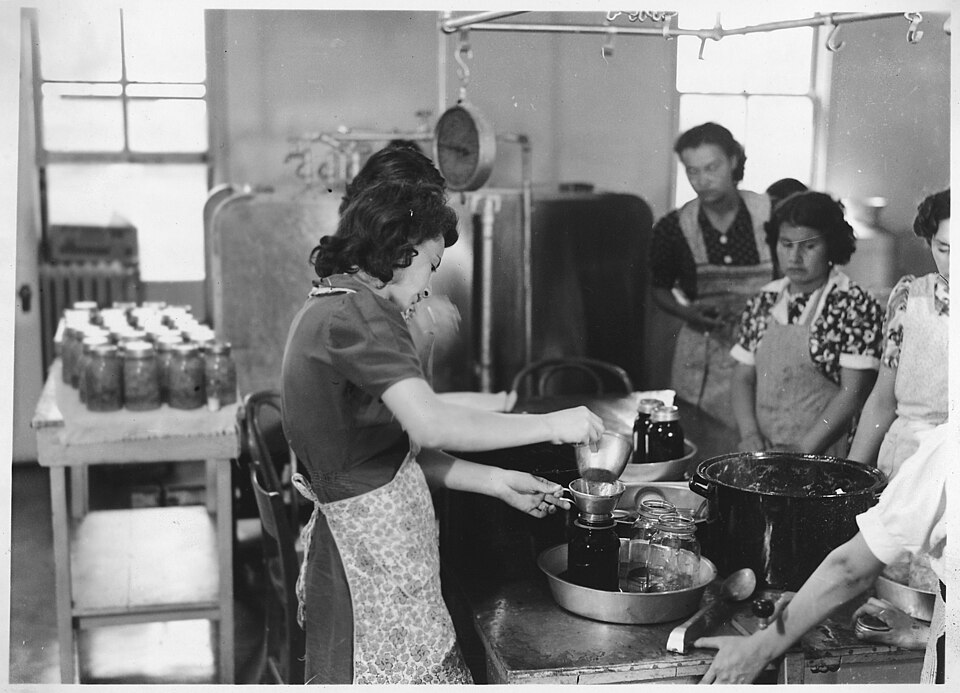
The garden set the schedule, and the household had no say in it.
Crops ripen when they ripen, and a crop that is ready has to be dealt with within a day or two. So the entire household calendar for two months was set by what was coming out of the ground, nothing else could be arranged around it, and the work could not be postponed by a week.
It also ran in waves rather than as one event – early fruit, then beans, then corn and tomatoes, then late fruit, then the last of everything at once. A single hard week is manageable; two months of recurring waves arriving without warning is a different proposition, and the final one comes when everybody is already worn out. In the hottest weeks of the year, with a wood stove running all day. Here are sixteen things every American household knew.
1. The Garden Decided the Schedule, Not the Household

Crops ripen when they ripen, so the work happened when the produce was ready rather than when it was convenient – and a household could not postpone it by a week.
Produce is available year round and preserving is a hobby.
Start with who was in charge, because it was not the people. A crop that is ready has to be dealt with within a day or two before it spoils, which means the entire household calendar for two months was set by what was coming out of the ground – and nothing else could be scheduled around it.
Like our content? Follow us for more.
2. It Ran in Waves Through the Whole Summer

Different crops came in at different times, so the season was not one event but a sequence – early fruit, then beans, then corn and tomatoes, then late fruit, then the last of everything at once.
Not applicable.
The sequence is what makes this exhausting rather than merely hard. A single week of heavy work is manageable; two months of recurring waves, each arriving with no warning and no option to defer, is a different proposition entirely – and the last wave arrives when everybody is already worn out.
3. The Kitchen Was the Worst Place to Be

The work required boiling water and a hot stove for hours, in the hottest weeks of the year, in a room with no ventilation to speak of.
Air conditioning and electric appliances.
The conditions are the part that gets left out of every nostalgic account and they were brutal. A wood stove running all day in August turns a kitchen into something close to unbearable, and the steam from open kettles makes it worse – which is why the summer kitchen, the porch and the yard were pressed into service wherever possible.
4. Everything Had to Be Picked, Washed and Prepared First

Before any preserving happened, the crop had to be gathered, cleaned, trimmed, peeled, cut, pitted or shelled – which was usually more hours than the processing itself.
Mechanised at industrial scale.
The preparation is the hidden bulk of the work. Processing a quantity of produce means handling every single individual item by hand, which is tedious rather than difficult and is where most of the time went – and it is the stage that could be given to children and to anybody sitting down.
5. It Was Done in Batches Because the Equipment Was Limited

A household had a certain number of jars, one or two large kettles and one stove, so the day’s work was organised as a sequence of batches rather than as one operation.
Not applicable.
The batch structure comes from a bottleneck and it shaped the rhythm of the day. One kettle means one load at a time, which means filling, processing, cooling, emptying and refilling in a cycle – and a household’s output per day was set by how many cycles could be fitted in rather than by how much produce was waiting.
6. The Jars Came Back Out of the Cellar Every Year

Empty jars from last year were brought up, inspected, washed and checked for chips before anything went into them.
Not applicable in the same way.
The annual inspection was a real job and a real decision point. Jars were an accumulated capital asset, they do not wear out but they do chip, and a jar with a damaged rim will not seal – so somebody went through several hundred of them before the season started, running a finger round every edge.
7. Everybody in the House Had a Station

The work was divided by capability – somebody peeling, somebody at the stove, somebody filling, somebody carrying, children shelling or pitting – and the arrangement ran for hours.
Not applicable.
The division of labour is what made the volume possible and it is the social heart of the subject. A production line in a kitchen, with the most skilled person at the stove and the least skilled given the repetitive preparation, is how a household processed a quantity that no individual could manage.
8. The Woman of the House Was the Foreman

Decisions about what got processed, in what order, at what stage of ripeness and by which method were made by one person, and the household worked to her direction.
Not applicable.
This deserves stating plainly rather than leaving implicit. The person running a canning season was managing a perishable input stream, a bottlenecked production process, a crew of varying skill and a fixed deadline – which is a job description, and it was performed annually by a very large number of American women with no acknowledgement that it was one.
9. What Got Preserved Was a Planning Decision

A household chose how much of each crop to put up based on what it would actually eat through the winter, what the garden had produced and what it could trade or sell.
Not applicable.
The planning is a forecasting problem performed without any tools. Somebody estimated a family’s consumption of each item over six months, matched that against an unpredictable harvest, and allocated the labour and the jars accordingly – and getting it wrong in either direction meant waste or a hungry February.
10. The Count on the Shelf Was the Point of the Whole Thing

Filled jars were carried to the cellar and arranged, and the total was known, counted and discussed – because it was the measure of whether the household was provided for.
Not applicable.
The shelf is where the abstraction becomes concrete, and that is why it is remembered so vividly. Rows of filled jars are a visible, countable statement of security – and a household looking at a full cellar in October knew exactly what it had done and exactly what it would be eating.
11. A Failed Jar Was Found Months Later

A seal that did not hold spoiled its contents, and the discovery came when the jar was opened in winter rather than at the time.
Not applicable.
The delayed failure is the particular cruelty of this work. Every other kind of labour tells you immediately whether it succeeded; this one waits four months and then informs you that an afternoon’s work in August was wasted – and there is nothing to be done about it in January.
12. Neighbours Helped Each Other Through the Peaks

When a crop came in heavily, households worked together – lending equipment, trading surplus, and sometimes processing side by side.
Not applicable.
The cooperation follows from the bottleneck. A household with more produce than jars or kettles and a neighbour with the opposite problem both benefit from combining, and crops do not all peak in the same week on every farm – so the mutual help was practical rather than merely neighbourly.
13. The Surplus Was Money or Credit

Preserved goods beyond a household’s own needs were sold, traded at a store, taken to a fair or given away, and the income belonged to whoever had done the work.
A commercial industry.
The commercial dimension matters because it turns domestic labour into income. A woman whose surplus went to a store for credit had money of her own derived directly from the season’s work, which is the same arrangement as the egg and poultry trade and was significant for the same reason.
14. Jars Were Judged at the Fair

Preserved goods were entered in competition, judged on clarity, colour, pack and seal, and winning was a public distinction.
Competitions continue at a much smaller scale.
Judging makes the skill visible and that is why it existed. Two households with identical ingredients can produce visibly different results, the differences are matters of technique, and a ribbon is the public record of somebody being better at a difficult job than her neighbours.
15. Then the Freezer Took Most of It

A home freezer preserves by stopping spoilage rather than by processing, which means far less work, far less heat, and no seal to fail.
Standard.
Freezing is the change that mattered most and it is usually overlooked in favour of the supermarket. Putting produce in a freezer requires preparation and nothing else – no boiling, no jars, no processing time, no sealing and no delayed failure – which removes almost the entire labour and almost all of the risk at once.
16. And by 1964 It Was a Choice in Most Households

Canning continued everywhere and was no longer compulsory, because a store carried the same foods year round and a freezer handled the garden with a fraction of the effort.
A substantial and growing hobby, pursued deliberately.
And what deserves the last word is the job description. For two months every year, an American woman managed a perishable input stream arriving on no schedule she controlled, through a bottlenecked process limited by one stove and a fixed number of jars, with a crew of children and whoever else was available, in a room that was close to unbearable, against a deadline set by the produce itself – having first forecast six months of her family’s consumption, inspected several hundred jars by hand, and allocated her labour accordingly. Then she counted the result on a shelf, and four months later found out which of it had failed. Nobody called that management, nobody paid her for it, and the surplus she sold was the only part that ever showed up as income. The freezer and the supermarket removed almost all of that work, which is an unambiguous improvement – and the row of filled jars in a cellar remains one of the few things people of that generation describe with straightforward pride.
Nobody Called It Management and That Is Exactly What It Was

Canning season gets remembered as rows of jars in a cellar, which is the output. The interesting part is the process that produced them, because it is a genuinely demanding piece of operations management that nobody described that way.
Start with the constraint. The garden decided the schedule. A crop that is ready has to be handled within a day or two before it spoils, so the household’s whole calendar for two months was set by what was coming out of the ground – and it arrived in waves rather than all at once, each wave with no warning and no option to defer.
Then the conditions, which every nostalgic account leaves out. Boiling water and a hot stove for hours, in August, in a room with no ventilation, with steam from open kettles making it worse. That is why the summer kitchen, the porch and the yard were pressed into service wherever a household had them.
The bulk of the labour was not the preserving at all. Everything had to be picked, washed, trimmed, peeled, cut, pitted or shelled first, which means handling every individual item by hand – tedious rather than difficult, and where most of the hours went. It is also the stage that could be given to children and to anybody who could sit down.
And the process was bottlenecked. A household had a fixed number of jars, one or two large kettles and one stove, so the day ran as a cycle: fill, process, cool, empty, refill. Output per day was set by how many cycles fitted in rather than by how much produce was waiting.
Before any of that, the jars came up from the cellar to be inspected. They are an accumulated capital asset that does not wear out but does chip, and a damaged rim will not seal – so somebody ran a finger round the edge of several hundred of them before the season started.
The work was then divided by capability: somebody peeling, somebody at the stove, somebody filling, somebody carrying, children shelling or pitting. A production line in a kitchen, with the most skilled person at the stove and the least skilled on the repetitive preparation, is how a household processed a quantity no individual could manage.
Which brings us to the person running it.
Decisions about what got processed, in what order, at what ripeness and by which method were made by one person, and the household worked to her direction. She had also forecast the family’s consumption of each item over six months, matched that against an unpredictable harvest, and allocated the jars and the labour accordingly – with error in either direction meaning waste or a hungry February.
That is a job description. It was performed annually by a very large number of American women and nobody called it one.
The output was counted. Filled jars went to the cellar, were arranged, and the total was known and discussed, because it was the measure of whether the household was provided for. Rows of jars are a visible, countable statement of security, which is why the shelf is remembered so vividly.
And the failures came back months later. A seal that did not hold spoiled its contents, and the discovery happened when the jar was opened in winter. Every other kind of work tells you immediately whether it succeeded; this one waits four months and then reports that an afternoon in August was wasted.
Two things softened it. Neighbours combined through the peaks, lending equipment and trading surplus, because crops do not peak in the same week on every farm and a household short of jars and one short of produce both gain. And the surplus was money – sold or traded at a store for credit, with the income belonging to whoever did the work, which is the same arrangement as the egg trade and mattered for the same reason.
The skill was also judged publicly, at fairs, on clarity, colour, pack and seal – because two households with identical ingredients produce visibly different results, and a ribbon is the public record of being better at a hard job than the neighbours.
What ended the necessity was the freezer rather than the store. Freezing requires preparation and nothing else: no boiling, no jars, no processing time, no seal and no delayed failure. That removes almost the entire labour and almost all of the risk in one step.
Which is an unambiguous improvement. And the row of filled jars in a cellar is still one of the very few things people of that generation describe with straightforward pride.
If somebody in your family canned, ask how many jars they put up in a season.
They will know the number, and it will be larger than you expect.
Like our content? Follow us for more.