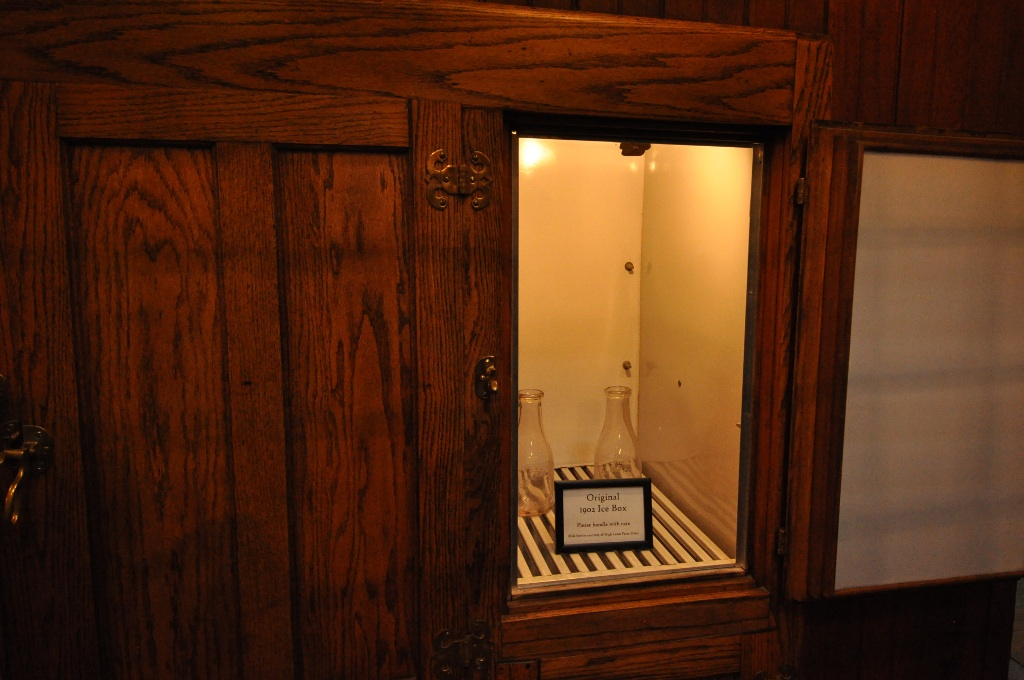
The object itself is familiar enough. An oak cabinet, brass hinges and a brass latch, a compartment at the top for a block of ice, shelves below, a drip pan or a drain pipe at the bottom, and a thick layer of insulation in the walls.
A great many of them survive, usually as drinks cabinets or hall furniture, and they are pleasant pieces of woodwork.
What does not survive, and what hardly anybody thinks about when they see one, is the industry behind it.
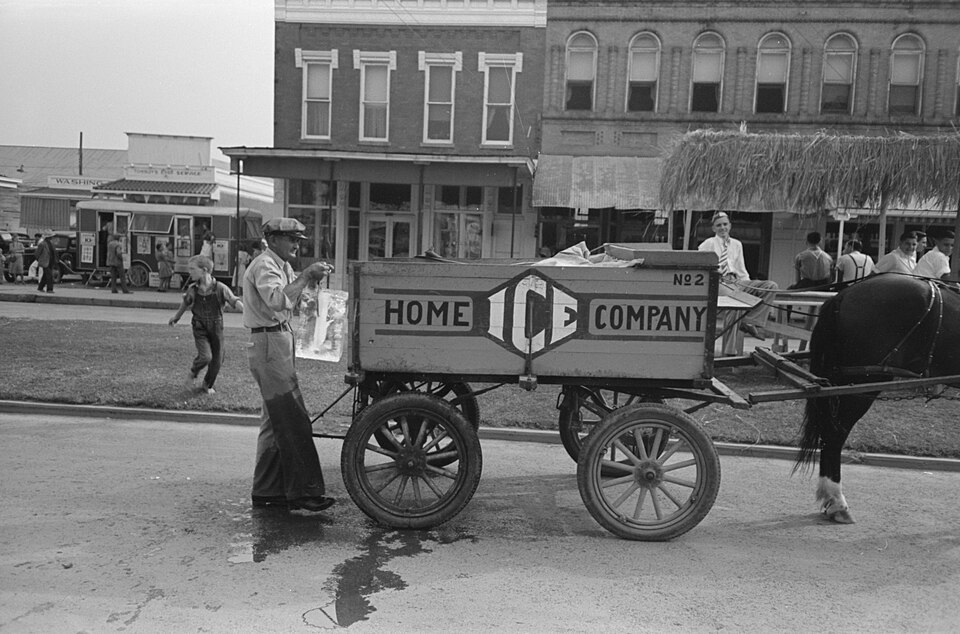
Because the ice in that cabinet did not come from a machine. For most of the time these cabinets were in use, it came from a frozen lake or river, where it had been cut into blocks with saws by crews of men working in winter, hauled out, stacked in enormous insulated buildings packed with sawdust, held there through the entire summer, and then delivered to houses by wagon.
That was a major industry. It employed a great many people, it shipped ice thousands of miles including across oceans, and it was destroyed inside a few decades by mechanical refrigeration.
The Harvest Was a Winter Crop
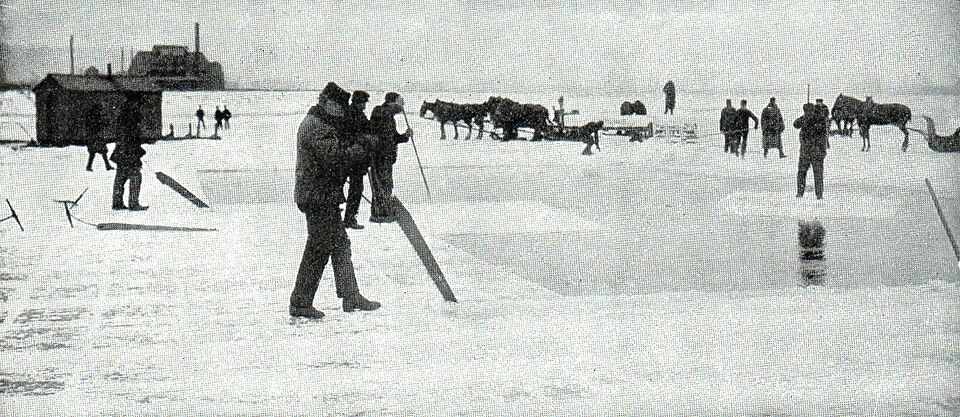
Natural ice was farmed, and the vocabulary used for it was agricultural. There was an ice harvest, an ice crop, a good year and a bad year.
The work began when a lake or pond froze to sufficient thickness. Crews cleared the snow off, scored the surface into a grid with horse-drawn or hand cutters, and then sawed the blocks free and floated them down a channel to a ramp. The blocks went up the ramp on a conveyor powered by horses or later by an engine, and into a storage house at the top.
It was cold, wet, heavy and genuinely dangerous work, done in the worst weather of the year because that was the only time it could be done at all. And it was seasonal in the strictest sense: the entire year’s supply had to be taken in a window of a few weeks, and a warm winter meant a short crop, high prices and shortages the following August.
That dependency is the thing to hold onto. Whether a household in a city could keep milk in July depended on how cold it had been in a lake several hundred miles away in January.
Like our content? Follow us for more.
The Ice House Was an Engineering Problem
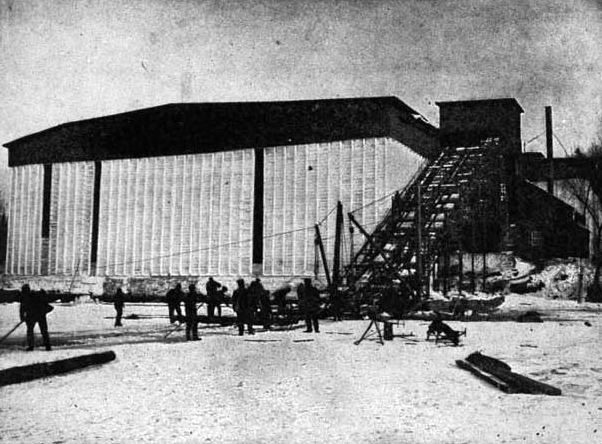
Storing a winter’s ice through a summer without mechanical cooling sounds impossible and it was not, which is the interesting part.
The storage buildings were large, double-walled, and the cavity between the walls was filled with sawdust – a waste product of the lumber industry, available in quantity, and an excellent insulator. Blocks were stacked tightly in a solid mass with sawdust packed around the outside and between layers, and the building was kept shut.
The reason it works is the physics of melting. Ice does not simply warm up; it has to absorb a substantial amount of energy to change from solid to liquid at all, and it stays at freezing point while doing so. A tightly stacked mass of ice has very little surface area relative to its volume, so the melting happens only at the outside, and the meltwater drains away while the core stays frozen.
Losses over a season were real and significant but they were survivable – a well-run ice house could keep a large fraction of what it stored. And the whole arrangement was built out of lake water, sawdust, timber and labour, with no fuel and no machinery beyond a conveyor.
The Trade Went Further Than Anybody Expects
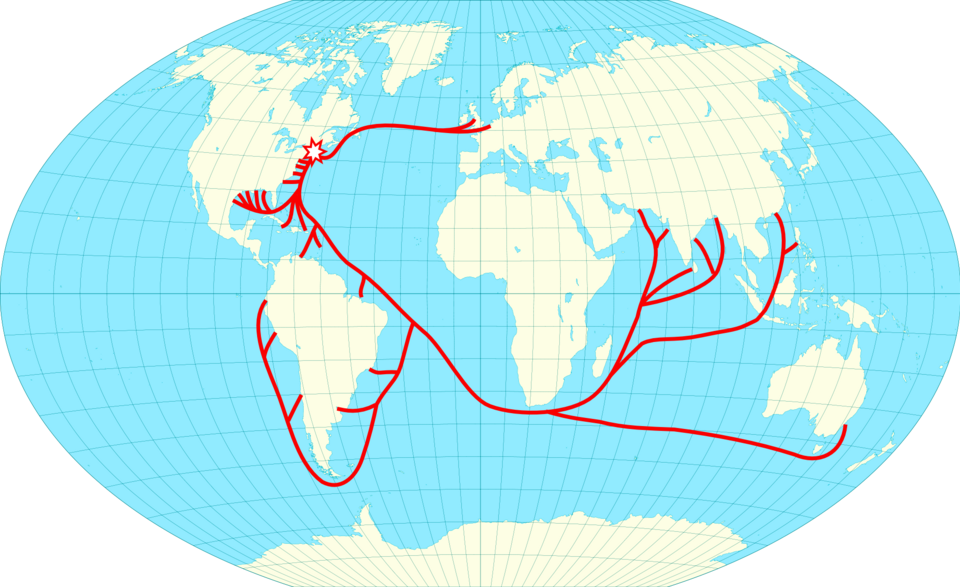
This is where the story stops being a quaint local matter.
Natural ice became a serious export commodity. It was shipped by sea in insulated holds packed with sawdust, over very long distances, to places that had never had ice in any form – tropical ports, southern cities, places where the idea of a cold drink was a novelty worth paying for. A substantial portion of each cargo melted on the voyage and the trade was still profitable, because the ice arriving at the other end was worth that much.
It also built the market that made everything afterwards possible. Before the ice trade, there was no habit of cold food and drink outside of cold climates and wealthy households with ice houses of their own. The trade created the expectation – cold drinks, ice cream, chilled fish, fresh meat shipped long distances, beer brewed and kept at low temperatures – and then mechanical refrigeration arrived to meet a demand that natural ice had spent decades building.
Which is the usual pattern with a superseded technology. The thing that replaced it could only succeed because the old thing had already taught people to want the product.
The Icebox Needed to Be Managed
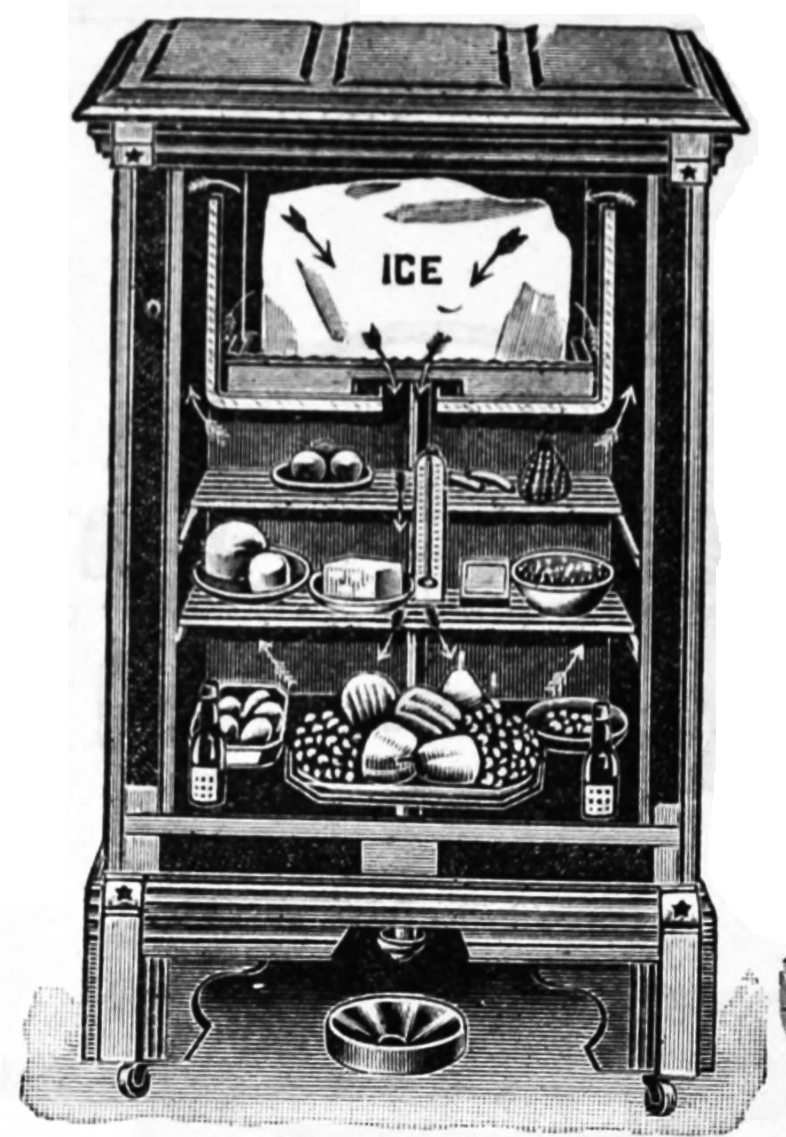
Using one of these cabinets was an active job rather than a passive one.
The ice compartment was at the top, because cold air falls – so the chilled air sank through the food compartment and the warmed air rose back up, circulating by convection with no fan. That is why the ice is never at the bottom of a properly designed icebox, and it is a detail people get wrong when they put the block in the wrong place on a restored one.
The meltwater had to go somewhere. Early and cheaper cabinets had a drip pan underneath, which filled up and had to be emptied, and which overflowed onto the kitchen floor if anybody forgot – a universal and much-resented household failure. Better cabinets had a pipe draining to the outside or to a bucket in the cellar.
The ice itself was ordered in sizes, delivered on a route, carried in with tongs over a leather shoulder pad, and chipped to fit. A household signalled how much it wanted with a card in the window showing a number, which the delivery man read from the street.
And the interior needed cleaning, regularly, because a damp wooden-lined box at just above freezing with food in it will develop a smell and worse if neglected. Keeping an icebox decent was a recognised piece of household work.
Mechanical Refrigeration Ended It With Startling Speed
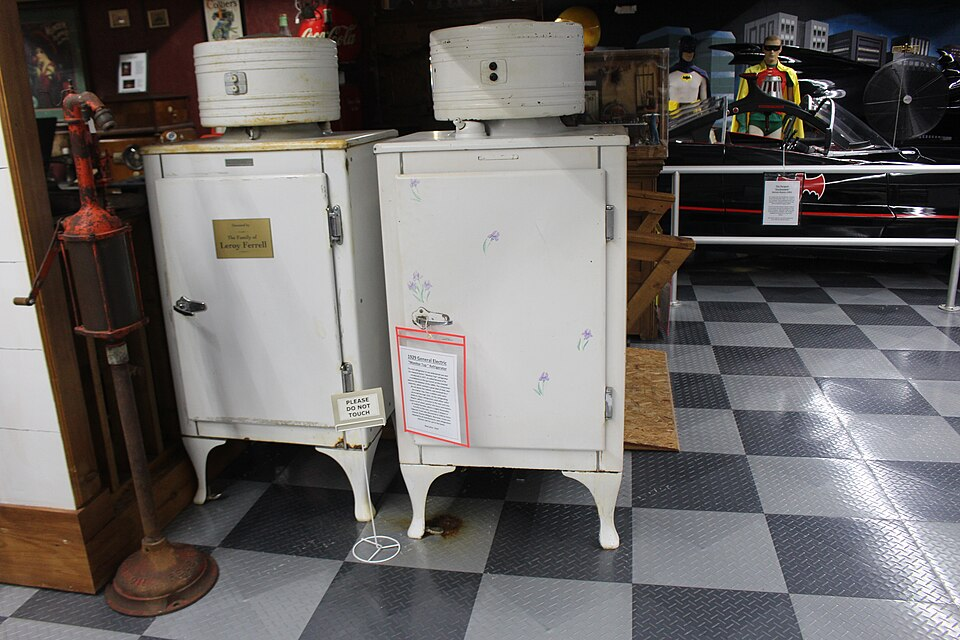
The collapse of the natural ice industry is one of the faster technological displacements on record, and it came in two stages.
First, manufactured ice. Mechanical ice plants could make blocks to order, in any climate, in any month, to a consistent size and clarity, without depending on the weather. That alone was devastating to the harvest trade, because it removed the seasonality, the geography and the uncertainty in one move – and it also removed a persistent quality problem, since ice cut from a lake downstream of a town is ice cut from whatever is in that lake.
Second, the household refrigerator. Once a cabinet could make its own cold continuously from an electrical supply, the entire chain – the harvest, the ice house, the wagon, the route, the tongs, the card in the window, the drip pan – became unnecessary at a stroke. There was nothing to deliver and nothing to manage.
Both stages happened across roughly the first half of the twentieth century, unevenly: cities and electrified areas first, rural areas considerably later, which is why iceboxes were still in genuine use in parts of the United States within living memory while other households had been running refrigerators for twenty years.
The ice houses were abandoned, converted or burned. The lake channels silted up. And an industry that had shipped a frozen commodity across oceans vanished so completely that most people now assume the cabinet in the hallway was always filled by a machine.
The Card in the Window Was a Whole System
The small square card that a household put in the kitchen window is worth a paragraph of its own, because it is a neat piece of design that solved a real problem.
A delivery man on a route could not stop at every house and knock. He needed to know, from the street, which houses wanted ice today and how much. So the ice company supplied each customer with a card – printed with numbers, one to each edge or each corner, so that the household could turn it to show the quantity they wanted and put it in the window facing out.
No ice needed today meant no card, or the card turned blank. A different number meant a different size of block. The driver read the row of windows as he came up the street, loaded what he needed onto his shoulder pad, and worked the block.
The same idea turned up for other route deliveries and it is a genuinely elegant solution to a communication problem in an era with no telephone in most houses and no way to place an order. It also meant the household’s requirements were visible to the entire neighbourhood, which nobody seems to have minded.
What It Left Behind
Three things outlasted the trade, and none of them is the furniture.
The first is the vocabulary. People still say they are putting something in the icebox, long after the object went, and the word survives in American speech as a straightforward synonym for a refrigerator.
The second is the expectation. Cold food and cold drink as an ordinary daily condition rather than a luxury is a habit that natural ice created and refrigeration inherited. The whole modern food system – chilled distribution, frozen goods, fresh produce out of season, meat and fish moved long distances – rests on a public that had already been taught to expect cold, by men with saws on a frozen lake.
The third is the physics lesson sitting inside the design. The ice at the top because cold air falls. The thick walls because insulation is most of the battle. The tight stacking because surface area is what melts. The sawdust because a waste product from one industry was the right material for another. None of that required electricity, refrigerant or a compressor, and all of it worked.
Which is worth remembering when the oak cabinet in somebody’s hall gets described as charming. It was the household end of a continental supply chain that ran on winter.
Like our content? Follow us for more.