

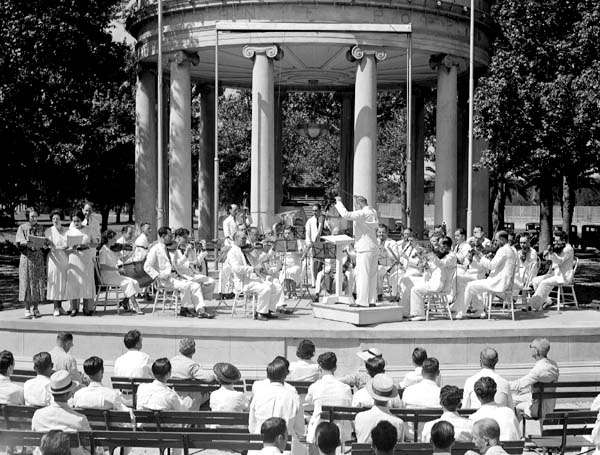
In 1964 an American town of four thousand people had a band, and the band played in the park on the same night every week all summer.
The players were a pharmacist on clarinet, a mail carrier on trombone, a farmer on tuba and a bank teller on cornet – working adults who rehearsed every week of the year in a room over a store. The tubas belonged to the town. The conductor was the school music teacher, who was also the church organist and probably ran the music store.
It was free, the town paid for it out of taxes, children sat on blankets ten feet from the players, and some of the audience never got out of their cars and applauded with the horn. Here are sixteen things every American town did.
1. There Was a Bandstand in the Park and It Was Built for This

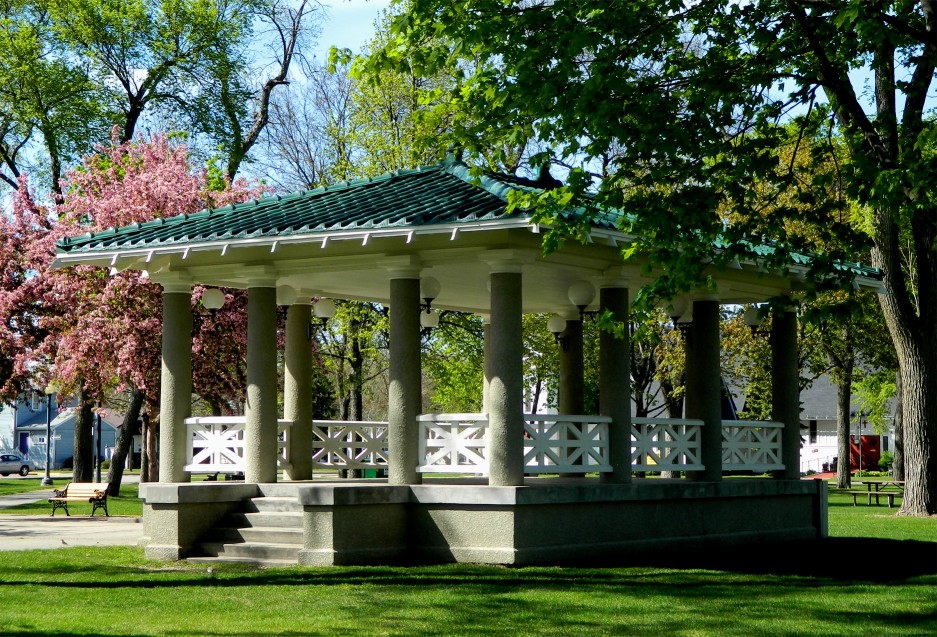
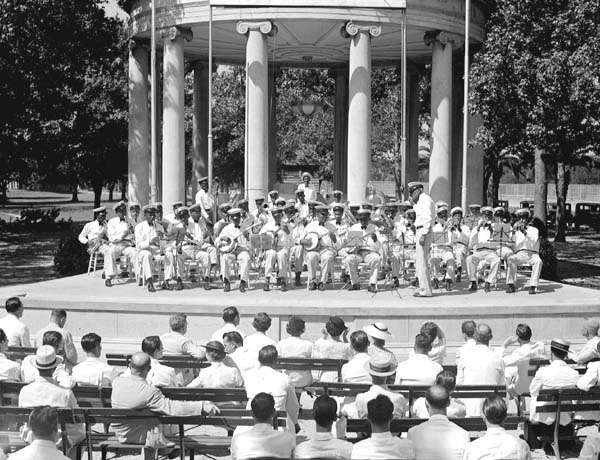
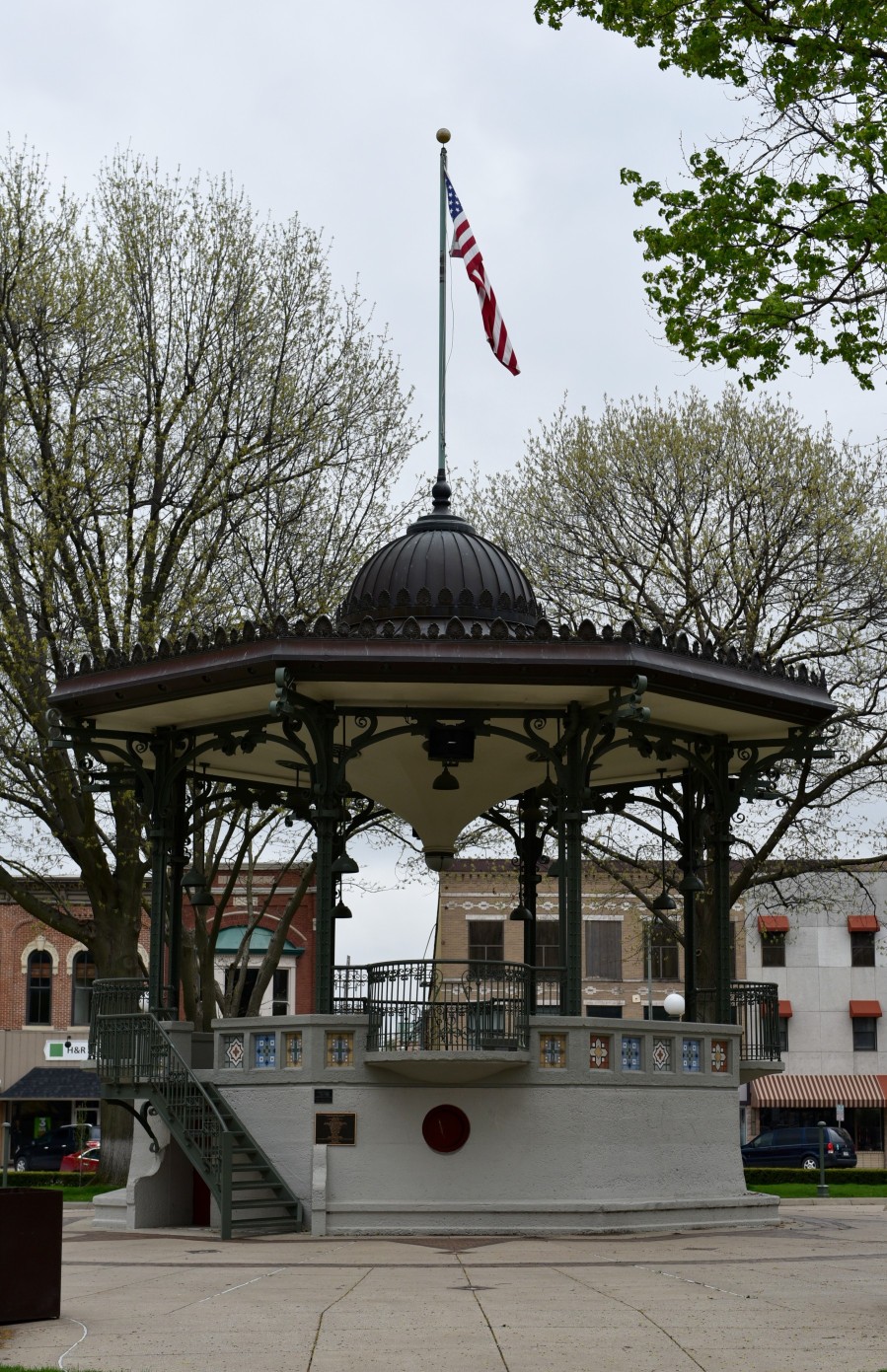
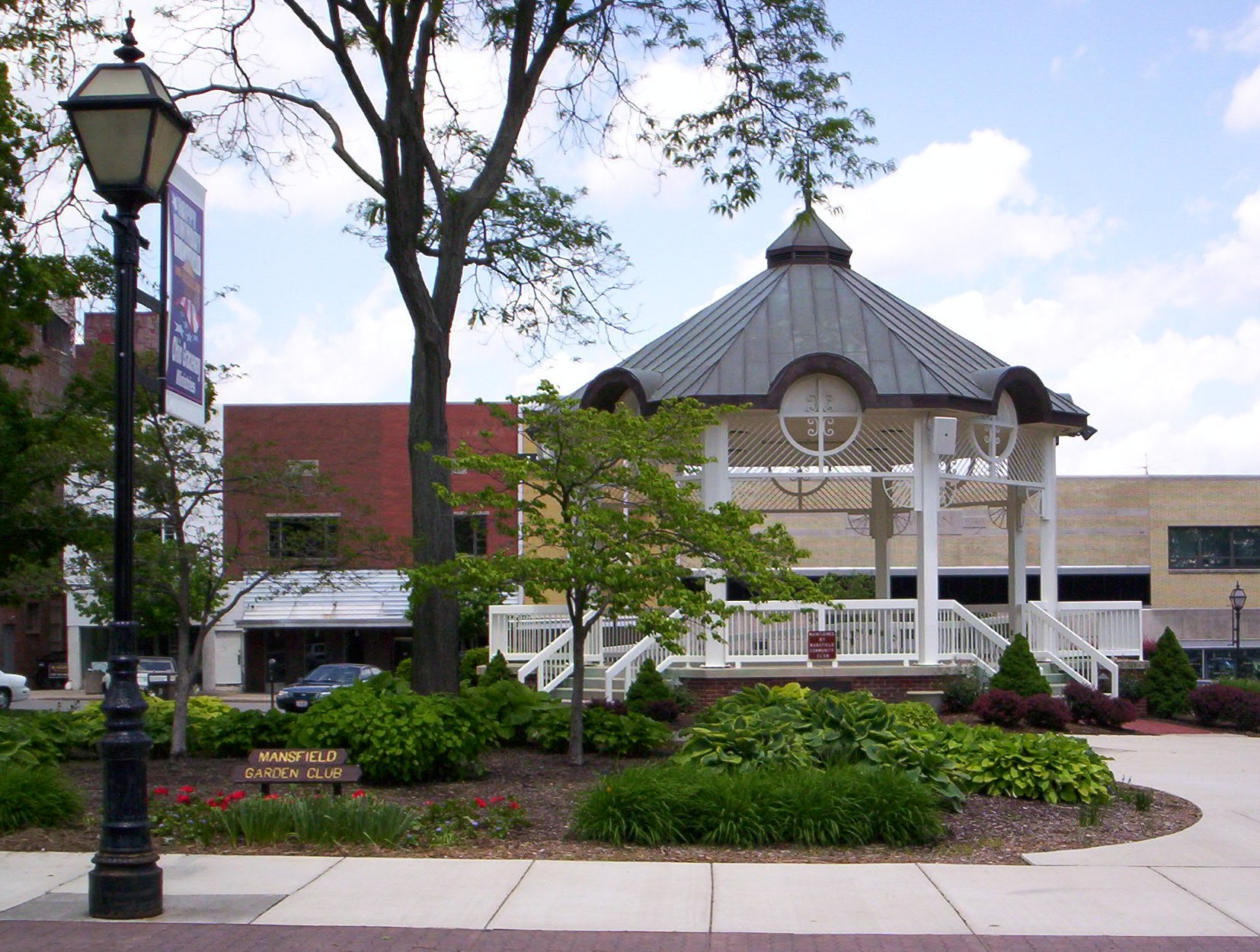
In the town park or on the courthouse square stood a raised octagonal or circular structure with a roof, a railing and steps – purpose-built to hold a seated band of thirty players and to throw their sound outward across open ground.
Those structures still standing in thousands of American towns, used for occasional events, photographs and shade, with nothing happening in them on a regular schedule.
The design is specific and functional rather than decorative. A raised floor projects sound over a standing crowd instead of into it, the roof reflects it forward and keeps rain off instruments worth more than the structure, and the open sides let it go in every direction – which is why these things are the shape they are and why they are all roughly the same size.
Like our content? Follow us for more.
2. The Players Were Your Neighbours
The band was the town’s own ensemble, made up of adults who lived there – a pharmacist on clarinet, a mail carrier on trombone, a farmer on tuba, a bank teller on cornet, a teacher conducting – rehearsing all year and playing all summer.
School bands of excellent standard, community bands in some towns, and in most places no adult ensemble at all.
The membership is the whole point and it is what has disappeared. These were working adults with no musical career, who could read a score, hold a part in a thirty-piece ensemble and perform in public – and there were enough of them in a town of four thousand people to make a band every week.
3. It Happened on the Same Night Every Week, All Summer
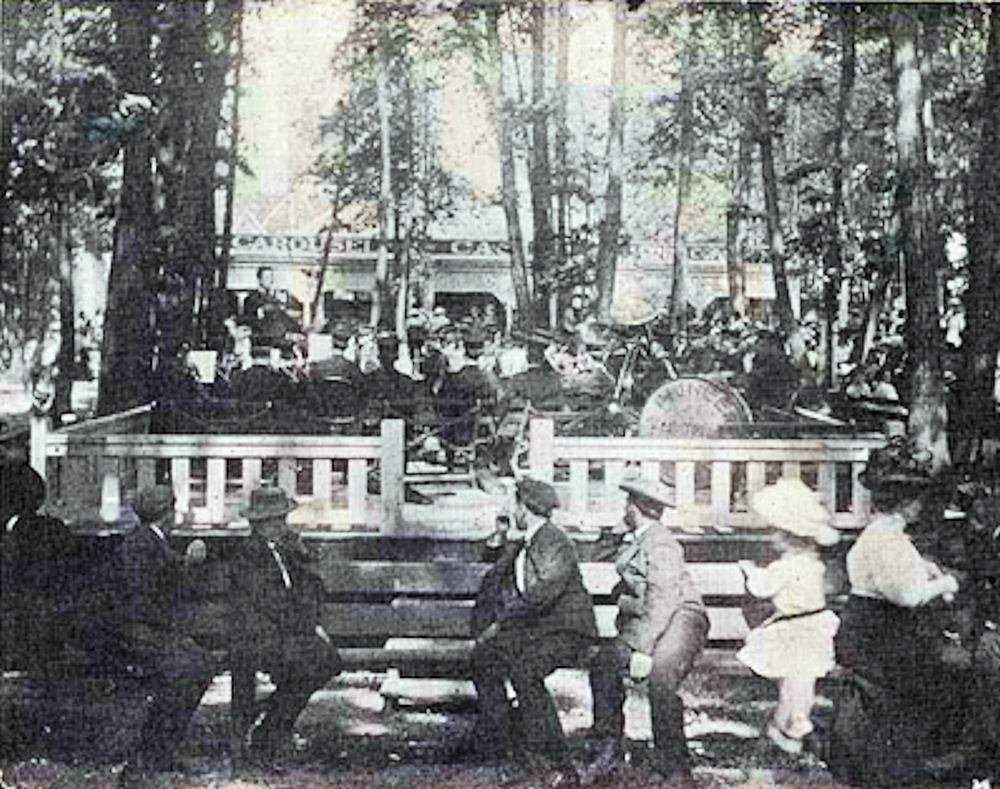
Concerts ran on a fixed evening – Thursday, Friday or Sunday depending on the town – from early summer to late, weekly, at a time everybody knew without being told.
Occasional summer concert series in larger places, on varied dates, publicised in advance because nobody would otherwise know.
The fixity was the institution. An event that happens on the same night at the same place for forty years requires no advertising, no decision and no planning by anybody attending – you simply go, or you do not, and the ones who go are there every week.
4. People Brought Their Own Seating and Spread Out on the Grass
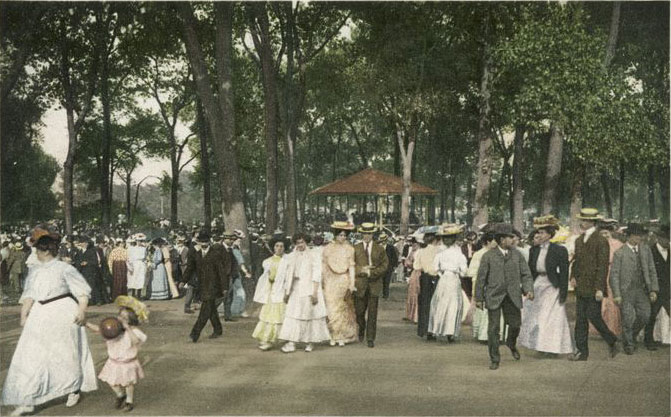
The audience arrived with folding chairs, blankets and cushions and arranged itself in a rough circle on the grass at whatever distance it preferred, with the closest listeners twenty feet from the players.
Fixed seating at ticketed venues, or lawn seating at larger outdoor events with designated areas and in many cases a charge.
The informality shaped what the event was. Nobody was seated, nobody was facing a particular direction, and people moved, talked, got up and came back – which is a completely different relationship with a performance than sitting in a row in the dark, and it suited a programme designed to be listened to in pieces.
5. Some People Stayed in Their Cars and Sounded the Horn
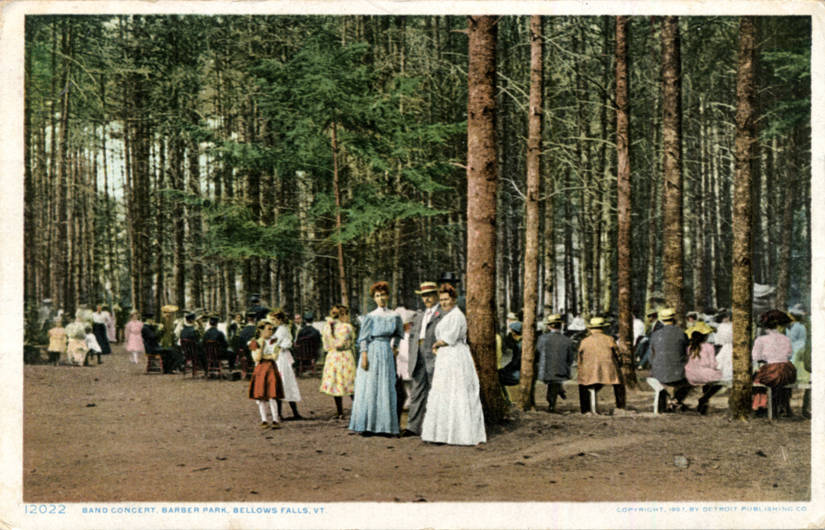
Cars parked in a ring around the park, facing the bandstand, with families sitting in them – windows down, listening from the seats – and applause after a piece included a scatter of car horns.
Nothing comparable, since outdoor concerts are not arranged around a ring of parked vehicles and horn-sounding would now read as hostile rather than appreciative.
The practice is well documented and it had reasons. A car was comfortable, it was private, it contained small children who could fall asleep in it, and it was dry if the weather turned – so a substantial part of the audience at many of these concerts never got out of the vehicle, and the horn was how they joined in.
6. The Program Was Printed and It Was Deliberately Varied
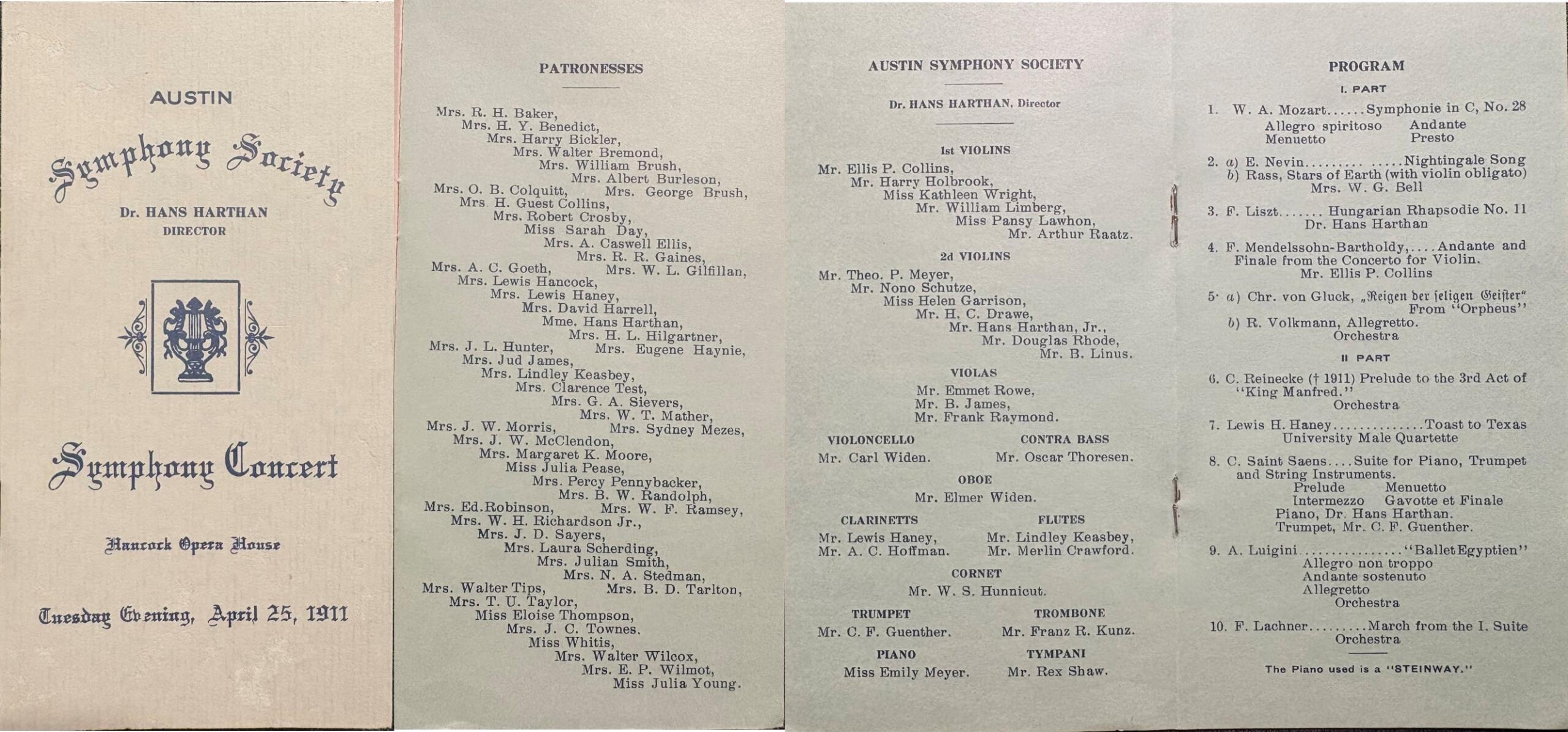
A paper programme listed eight to twelve numbers in a planned order: a march to open, an overture, a waltz, a novelty or a medley, a featured soloist, something patriotic, and a march to close.
Set lists chosen by performers and generally not published, with programming aimed at a consistent genre rather than at deliberate variety.
The variety was a response to the audience. A crowd on grass with children in it, listening casually, at no charge, will not sit through a unified programme of anything – so the running order alternated loud with soft, familiar with new, and fast with slow, on the assumption that everybody present would like roughly a third of it.
7. The Marches Were the Core of the Repertoire
The backbone of every programme was the concert march – a form with a fixed internal structure, written specifically for this kind of ensemble, of which American composers produced an enormous quantity.
The same repertoire, performed almost entirely by school and college bands, with the pieces now encountered mainly in educational settings rather than as public entertainment.
That body of music was composed for exactly this circumstance: an outdoor amateur ensemble, a casual audience, and no amplification. It is written to be loud, rhythmically obvious, melodically memorable and playable by competent amateurs – which is a demanding set of constraints and the reason the best of it is still in use a century later.
8. The Conductor Was the Town’s Music Teacher
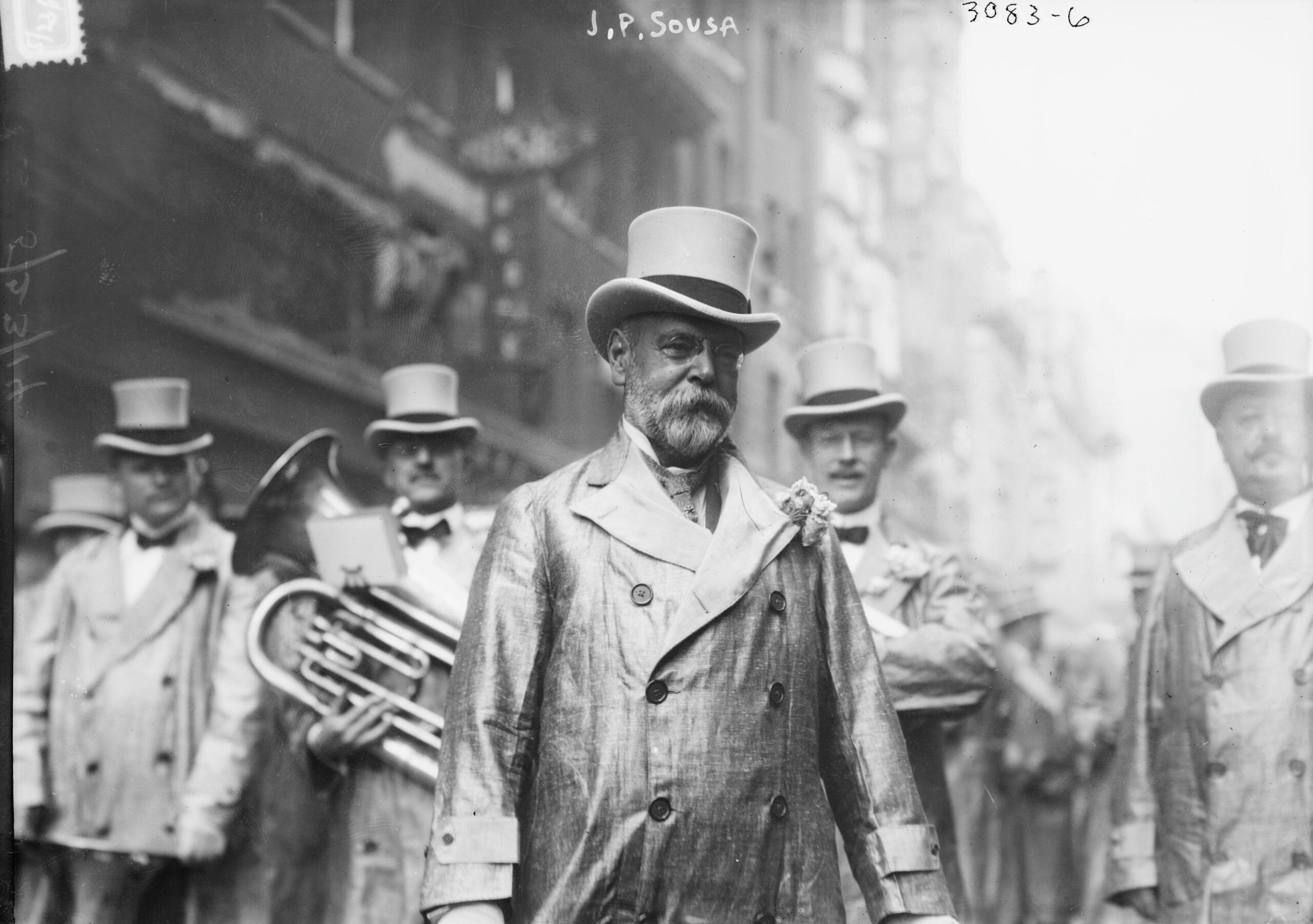
Standing on a podium in the middle of the bandstand was a bandmaster who was, in most towns, also the school music teacher, the church organist, the piano tuner or the proprietor of the music store – frequently all of those at once.
School and college directors as professional educators, with no equivalent single figure holding a town’s whole musical life.
That concentration of roles in one person is what made the whole thing work and also what made it fragile. One individual taught the children, conducted the adults, played the church service, sold the instruments and repaired them – and when that person left a town, the band frequently did not survive the gap.
9. A Featured Soloist Was a Genuine Local Event
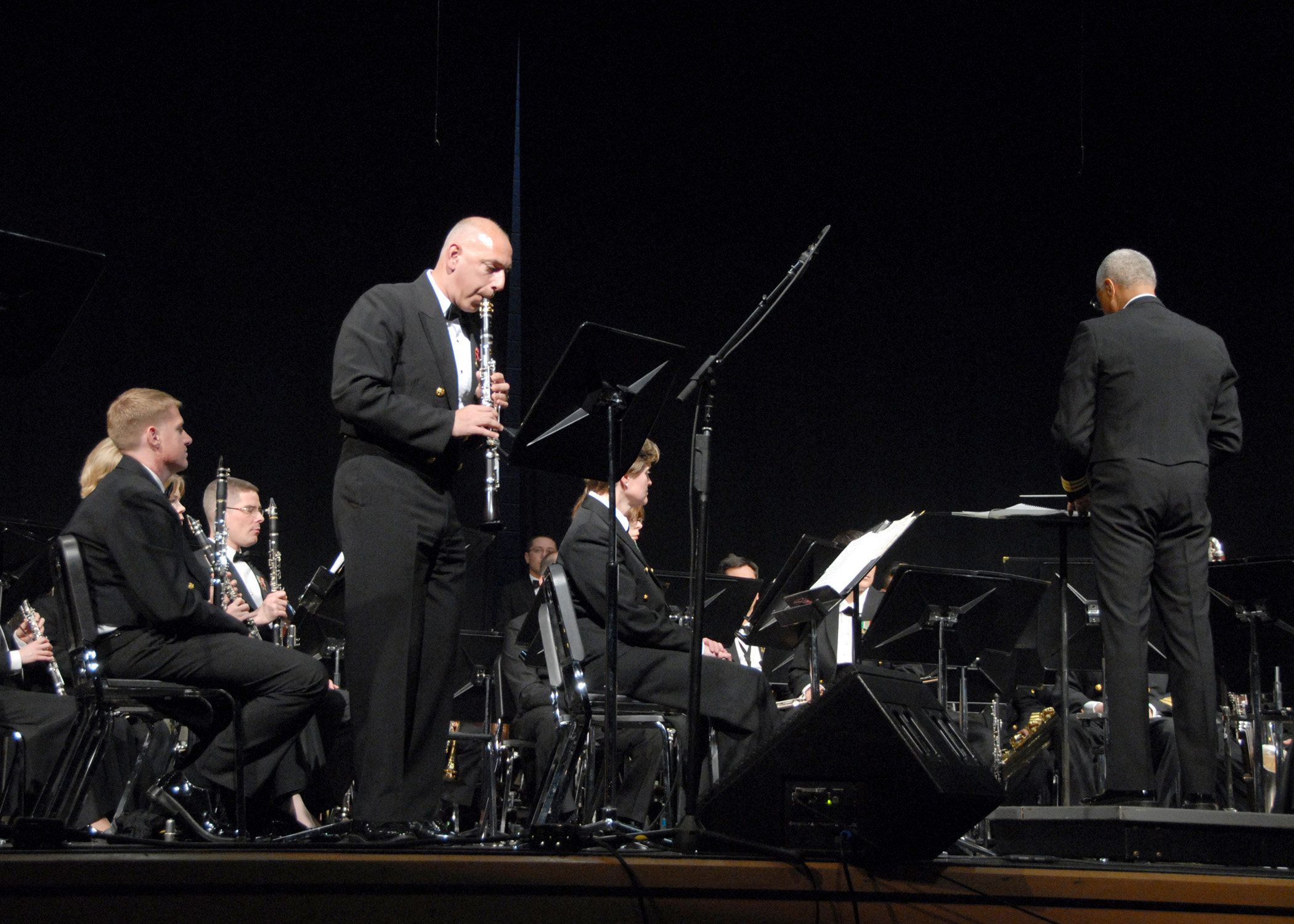
One number each week spotlighted a single player – a cornet, a baritone horn, a clarinet, a xylophone – standing out front of the ensemble performing a piece written to display the instrument.
Soloists in school and professional performance, with the local reputation element gone because there is no continuing local ensemble within which to build one.
Those reputations were real and they were local currency. A town knew which of its residents was the best cornet player and had opinions about it, the solos were discussed afterwards, and a player who had been good for twenty years was a recognised figure – which is a way of being locally distinguished that has no modern equivalent.
10. The Instruments Belonged to the Band, Not the Players
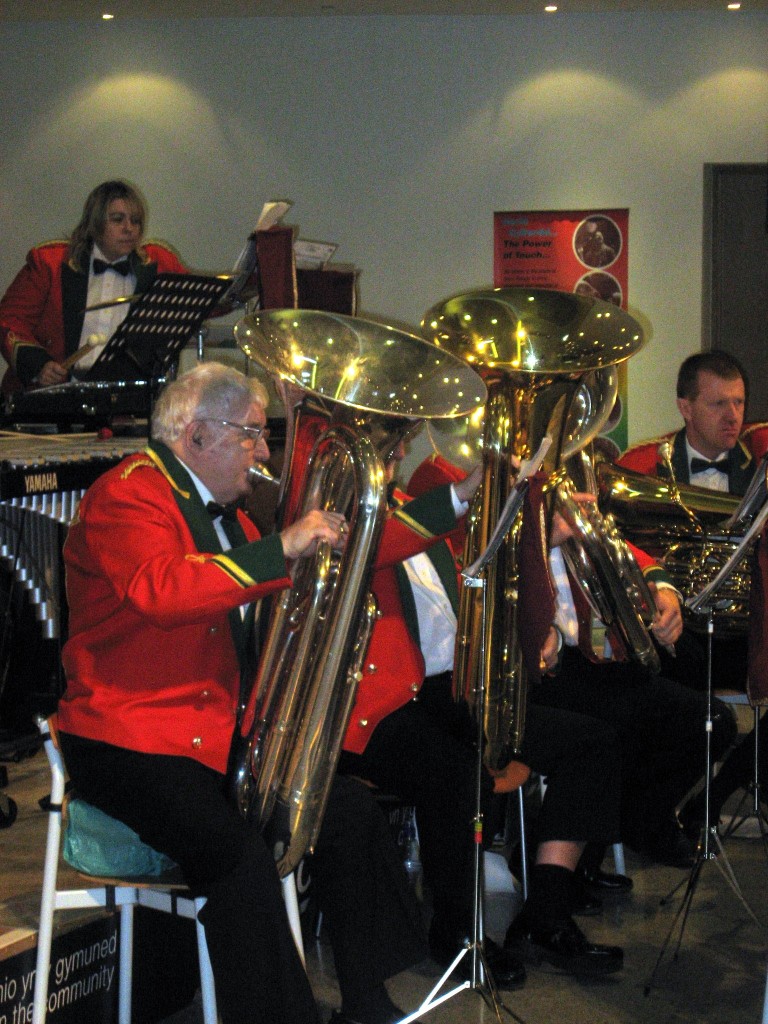
Larger and more expensive instruments – tubas, baritones, bass drums, sousaphones – were owned by the band or by the town, kept in a storeroom, and issued to whoever played them.
Instruments owned by schools and issued to students, which is the same arrangement transferred to a different institution.
Communal ownership is what made membership possible for ordinary people. Nobody on a mail carrier’s wage buys a sousaphone, so the town bought it once, kept it for fifty years, and handed it to whichever resident could play it – and that single arrangement is the reason a working adult could be in a band at all.
11. Children Were Put at the Front and Expected to Sit Still Briefly

Small children were placed on blankets directly in front of the bandstand, where they could see the players and the instruments, and were expected to pay attention for some portion of the evening before being released to run.
Children at concerts in the company of their families, with no customary front position and no expectation of a listening period.
The placement was deliberate and it functioned as recruitment. A child sitting ten feet from a tuba for an hour a week all summer learns what the instruments are, who plays them and what a band sounds like from inside – and the next generation of players came overwhelmingly from the children who had been on those blankets.
12. Intermission Was the Actual Social Event
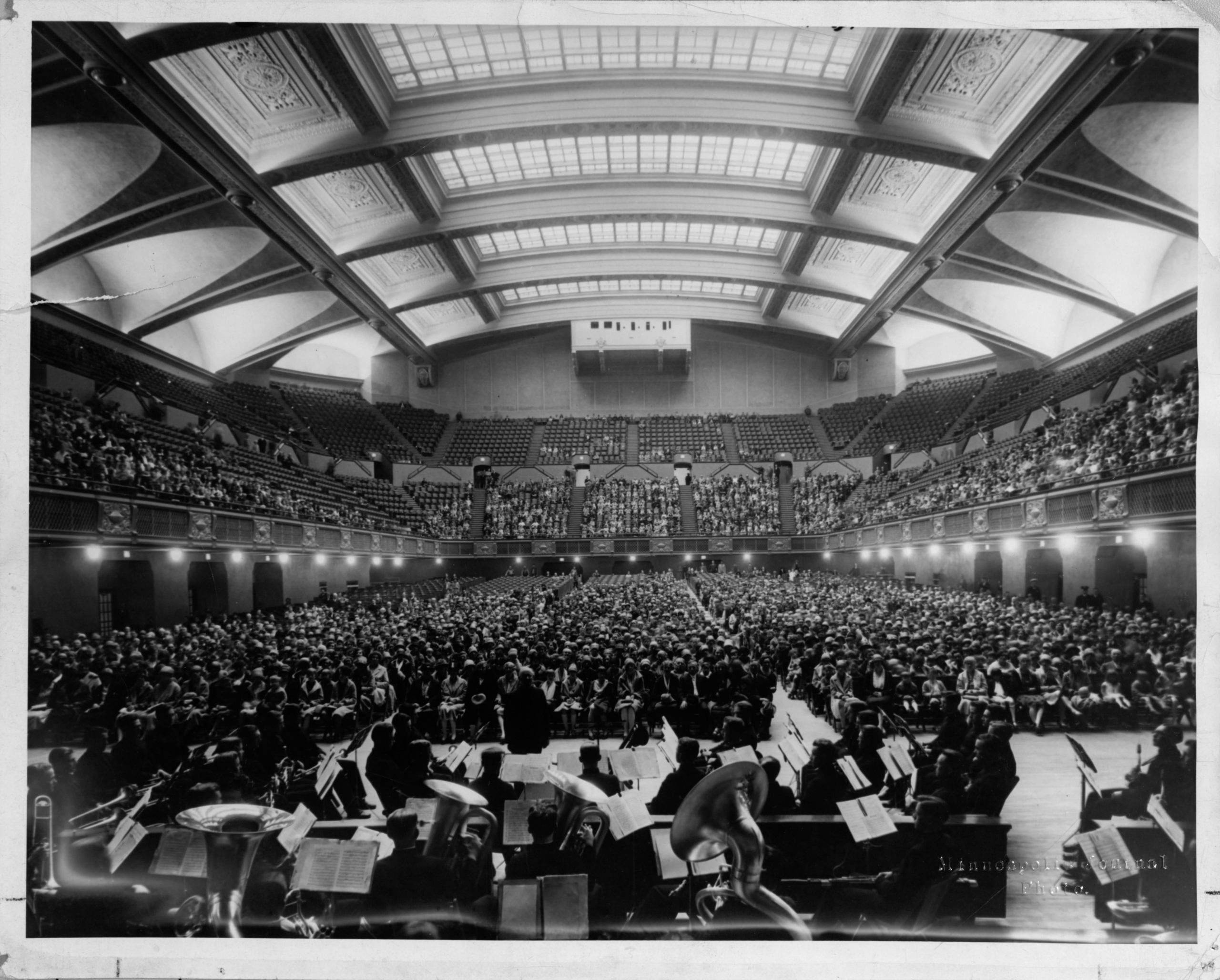
Halfway through, the band broke for fifteen or twenty minutes, the players came down from the bandstand, and the whole audience stood up and circulated – which was, for a great many people present, the reason they had come.
Intervals at indoor performances spent in a lobby, and no equivalent at outdoor events, which generally run straight through.
It is worth naming plainly: a weekly free event in the middle of town that brings out several hundred people and has a twenty-minute break designed into it is a social institution that happens to have music in it. The band was the occasion, and the circulating in the interval was the function.
13. It Was Free, and the Town Paid for It
Admission was never charged. The band’s costs – music, instruments, repairs, uniforms and in many cases a salary for the director – came from the municipality, raised by taxation, on the same basis as a park or a street light.
Funding from school district budgets for educational music, with grants, boosters and ticket revenue supporting community ensembles where they survive.
Public funding for a town band was ordinary and widespread, and in a great many American states it was authorised by specific legislation allowing a municipality to levy for exactly this purpose, sometimes subject to a vote. A town band was not a club. It was a service the town provided, deliberately, out of public money.
14. The Same Band Did the Parade, the Funeral and the Fair
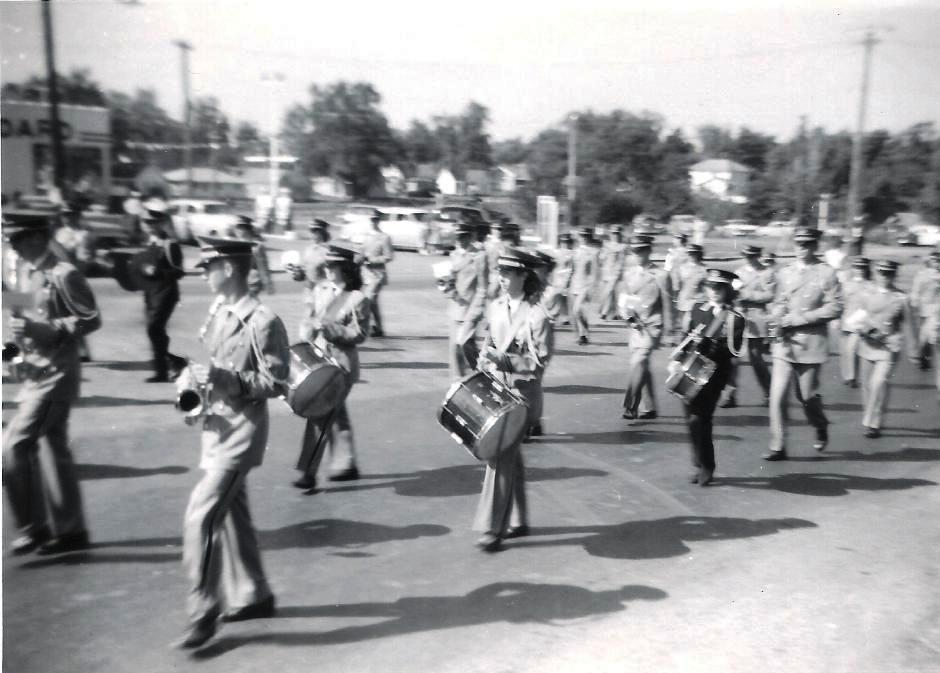
Beyond the summer concerts the ensemble played the holiday parades, the county fair, the dedication of buildings, political events, and the funerals of its own members and of local figures.
School bands performing at parades and athletic events, with the civic and ceremonial functions largely unserved by live music.
The band was the town’s instrument for marking occasions, and that is a function rather than an entertainment. When something happened in a town that required collective acknowledgement, there was an ensemble of thirty adults available to supply it – and a town without one has to mark its occasions some other way or not at all.
15. Rehearsal Was Once a Week, All Year, in a Room Over Something
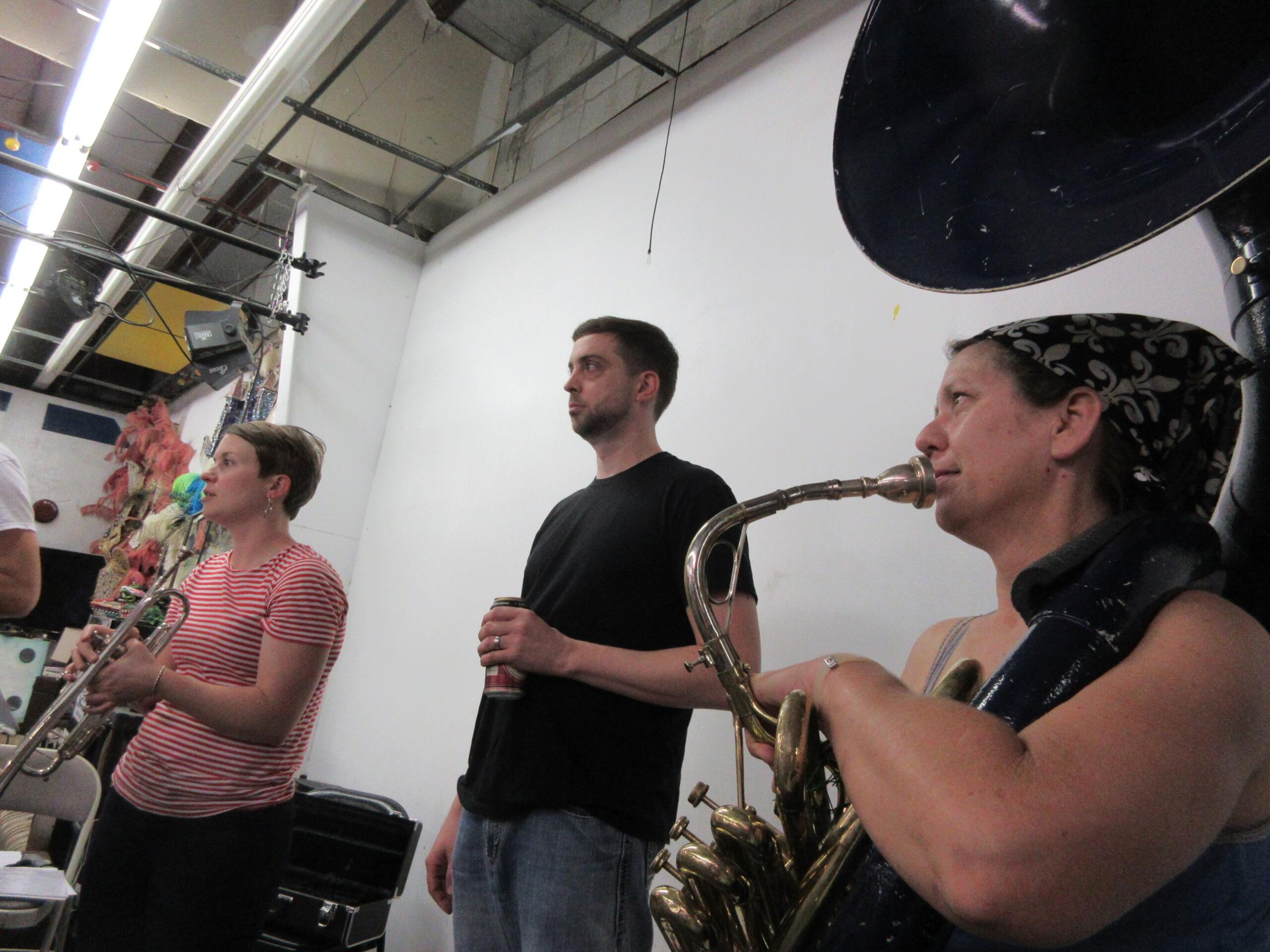
The band met year-round for a weekly evening rehearsal in a hall, a lodge room, a school band room or a space above a store – thirty adults, after work, for two hours, in January as well as June.
School ensembles rehearsing during the school day as a curricular activity, which removes the evening commitment and also removes the adults.
The year-round commitment is the part that is hardest to imagine now and it is the real measure of the institution. Thirty working adults in a small town turned out on the same evening every week for decades, for no payment, to rehearse music for concerts that were free – and they did it because that was simply what the band did.
16. Then the Whole Thing Moved Into the School
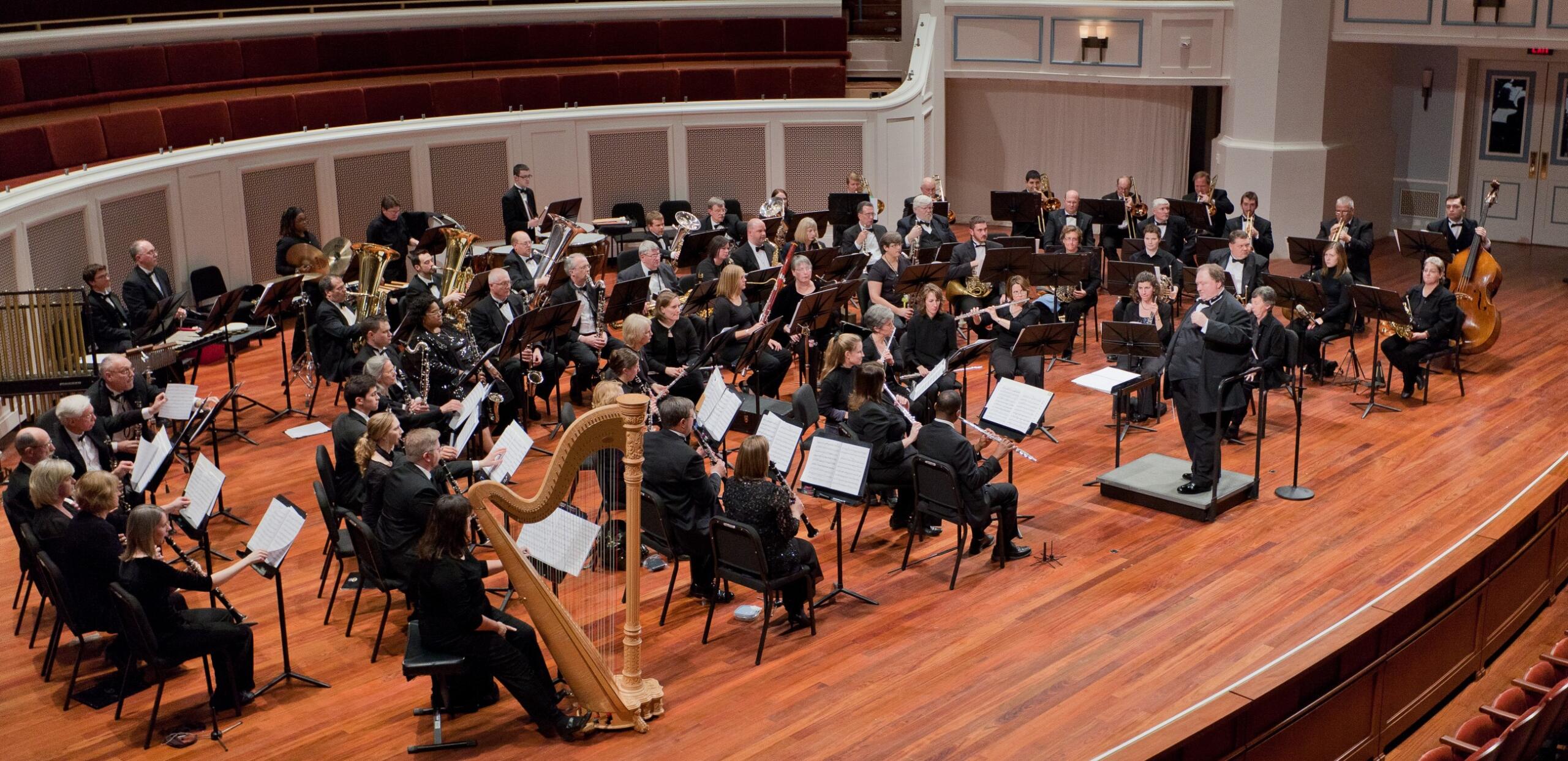
The town band was a municipally funded ensemble of working adults, with town-owned instruments, a town bandmaster, a weekly year-round rehearsal and a free weekly summer concert from a purpose-built structure in the park.
School and college band programmes of genuinely high standard, with instruments, instruction, facilities and repertoire all intact – and with a membership that is entirely composed of people aged eleven to twenty-two.
And that is what actually happened, which is not a decline so much as a transfer that nobody announced. Every component of the town band survives: the instruments are owned institutionally and issued, the music is the same music, the director is a paid professional, the rehearsals happen weekly, and the ensembles are frequently better than the old bands were. What moved is the age. Public music funding migrated from the municipality to the school district across the middle of the century, and once it was inside the school it served students – so the sousaphone that a mail carrier played for thirty years is now played by a sixteen-year-old for four, and then by the next sixteen-year-old. The consequence is quietly enormous. A town of four thousand people in 1964 contained forty adults who could read music and hold a part in public. That town now produces forty teenagers who can do the same thing, every four years, almost all of whom stop entirely on graduating – and the bandstand in the park is still standing, correctly proportioned, acoustically sound, and empty.
It Did Not Die. It Was Transferred to People Under Twenty-Two.
The town band looks like a casualty – an amateur tradition killed off by recorded music, television and the general decline of civic life.
That reading is wrong, and the evidence is that nearly every part of it is still operating at a higher standard than it ever reached in 1964.
Go through the components. Institutionally owned instruments, kept in a storeroom and issued to whoever plays them: still happening, in every school district in the country. A paid professional director: still happening, and better trained. Weekly rehearsal in a dedicated room: still happening, five days a week in many cases rather than one. The repertoire of American concert marches written for exactly this kind of ensemble: still being played, constantly. Free public performance: still happening, at every football game and every spring concert. Public funding out of taxation: still happening, through the school district.
None of that was lost. All of it moved.
Public money for music in an American town shifted across the middle of the century from the municipality to the school board. In a great many states a town had been able to levy a tax specifically to maintain a band, sometimes subject to a vote of the citizens – a municipal band was a service, like a park or a street light, not a club. As school music programmes expanded and consolidated, the instruments, the instruction, the director’s salary, the rehearsal space and eventually the public performances all ended up inside the education system.
Which is a perfectly reasonable place for them, and it produced ensembles of a technical standard that would have astonished the mail carrier on trombone.
But an institution inside a school serves students. And that one structural fact changed the whole character of what the town band had been.
The sousaphone that one adult played for thirty years is now played by a sixteen-year-old for four, and then handed to the next sixteen-year-old. The adults who filled thirty chairs stopped having chairs to fill. And because playing in a band became something you do while you are at school, the overwhelming majority of people who learn an instrument in America now stop the moment they graduate – not through loss of interest but because the ensemble they were in is for people who are enrolled somewhere.
So the arithmetic has inverted in a way worth stating plainly. A town of four thousand people in 1964 contained roughly forty working adults who could read a score, hold a part and perform in public, every week, for decades. That same town now produces roughly forty teenagers who can do the same thing, for four years each, and then almost none of them ever do it again.
The competence is still being taught. It is simply no longer being used after the age of eighteen.
And the structures are still there. There are thousands of bandstands in American town parks – raised to project sound over a standing crowd, roofed to reflect it forward and keep the rain off the instruments, open on all sides, every one of them correctly proportioned for a thirty-piece band.
Most of them have not had a band in them in living memory. They are in exactly the right place, built exactly right, for an audience that still lives there and players who stopped at graduation.
If you grew up with this, you were on a blanket at the front, and you know which instrument you watched the whole time.
And you can probably still name the man who played it.
Like our content? Follow us for more.
