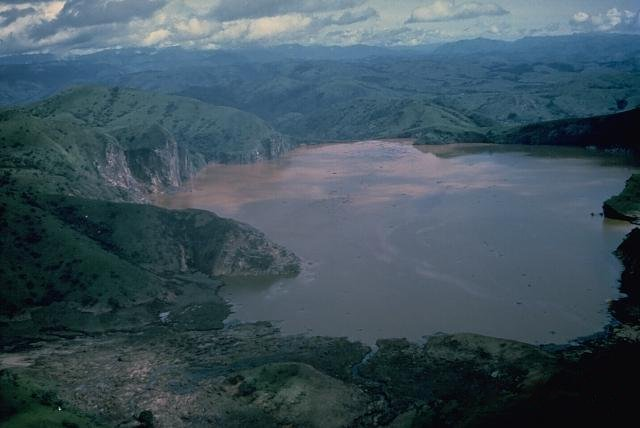
Lake Nyos sits in a volcanic crater in the highlands of northwestern Cameroon, a deep, still body of water that, for generations, the local people knew simply as a large and peaceful lake. There was nothing about its calm blue surface to suggest that it was, in fact, one of the most dangerous lakes on Earth — that beneath its tranquil waters lurked an invisible killer capable of wiping out entire villages in a matter of minutes. But on the night of August 21, 1986, that killer was unleashed, in one of the strangest and deadliest natural disasters of the twentieth century.
What happened at Lake Nyos was so unusual that, at the time, scientists struggled even to explain it, and the phenomenon behind it was so obscure that most people had never heard of it. There was no eruption of lava, no earthquake that toppled buildings, no flood or storm. Instead, the lake released a vast cloud of gas — carbon dioxide, ordinary and invisible — that flowed silently across the landscape and asphyxiated nearly every living thing in its path. In the villages around the lake, more than seventeen hundred people died where they stood, sat, or slept, most never knowing what was happening. It is a haunting story, and also, ultimately, one of scientific detective work and hard-won prevention. Here is what happened at Lake Nyos.
The Night the Lake Turned Deadly
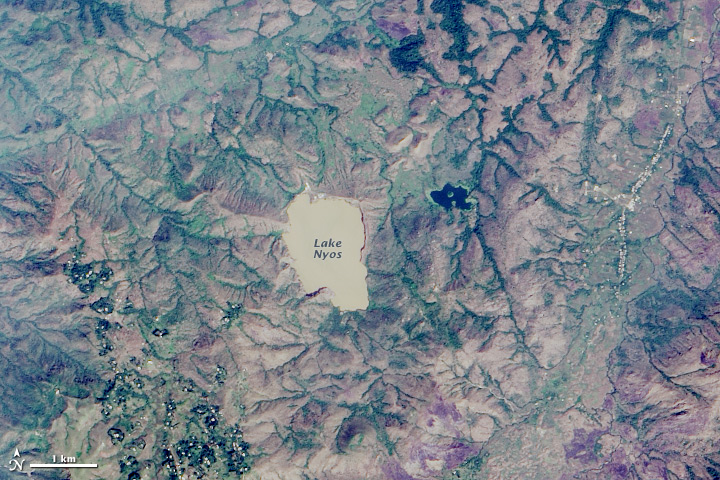
On the evening of August 21, 1986, people living in the villages in the valleys below Lake Nyos went about their ordinary lives. Some reportedly heard a rumbling sound from the direction of the lake. And then, from the depths of Lake Nyos, an enormous quantity of carbon dioxide gas — estimated at somewhere between one hundred thousand and three hundred thousand tons — erupted violently to the surface in a matter of moments, bursting from the water in a way that some described as resembling an explosion, sending a spray of water high into the air.
The gas formed a dense, invisible cloud. Because carbon dioxide is heavier than ordinary air, the cloud did not disperse upward and away. Instead, it hugged the ground and flowed downhill, rushing down the valleys away from the lake at speeds estimated as high as tens of kilometers per hour, spilling into the low-lying areas where people lived. As it moved, it displaced the breathable air, and anyone and anything it enveloped was starved of oxygen. Within a radius of roughly fifteen to twenty-five kilometers of the lake, the cloud suffocated people and animals alike. Most of the victims died quickly and silently, many of them in their sleep, never waking as the oxygen around them was replaced by odorless, invisible gas. Whole villages were affected at once. By the time the cloud dissipated and the sun rose, the scale of the tragedy became horrifyingly clear.
Like our content? Follow us for more.
The Silent Aftermath
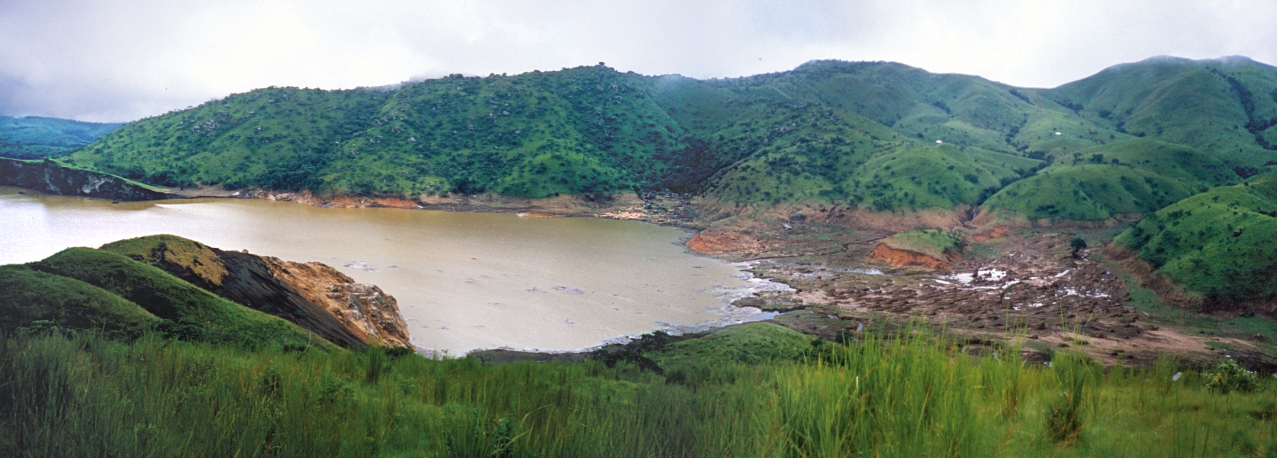
The morning after revealed a scene of almost incomprehensible stillness. In the affected villages, the people were dead — 1,746 of them, according to the most commonly cited figure — along with an estimated 3,500 head of livestock and countless other animals, birds, and insects. The villages closest to the lake lost nearly their entire populations. Survivors described waking hours later, disoriented, to find their families and neighbors dead around them and an eerie, total silence where there had been a living community.
One of the most chilling aspects of the disaster was how peaceful the scene appeared. There was no destruction of buildings, no fire, no visible sign of catastrophe — the homes stood intact, the landscape looked untouched. The only evidence of what had happened was the bodies, which lay where the victims had fallen, often with no sign of struggle, because most had simply lost consciousness and died without understanding the danger. Reporters who reached the remote area described the surreal horror of villages full of the dead with everything else seemingly normal. It was this uncanny quality — mass death with no visible cause and no physical destruction — that made the Lake Nyos disaster so deeply unsettling, and initially so mysterious even to the scientists called in to investigate.
The Science of a “Killer Lake”
To understand what happened, scientists had to piece together an unusual and little-known geological phenomenon, now called a limnic eruption, or sometimes a “lake overturn.” Lake Nyos, it turned out, sits above volcanic activity that slowly leaks carbon dioxide up into the deep waters of the lake. Because the lake is very deep and its layers of water don’t mix much, this carbon dioxide had been accumulating, dissolved under pressure, in the cold, dense water at the bottom of the lake, building up over many years like the gas dissolved in an enormous, unopened bottle of soda.
Under normal conditions, this dissolved gas stayed locked in the deep water. But such a system is precariously balanced, and a sudden disturbance can trigger catastrophe. Some event — possibly a landslide into the lake, an earthquake, or simply the buildup reaching a tipping point — disturbed the deep water, causing some of the gas-saturated water to rise. As it rose, the reduction in pressure allowed the dissolved carbon dioxide to come out of solution and form bubbles, exactly as opening a shaken soda bottle causes it to fizz over. This, in turn, dragged more deep water upward, releasing more gas, in a rapidly accelerating chain reaction that violently “erupted” the enormous store of carbon dioxide from the lake in a very short time. The result was the deadly cloud. It’s a truly rare phenomenon: only a small number of lakes on Earth are known to be capable of it, requiring the specific combination of great depth, stable un-mixing layers, and a volcanic source of carbon dioxide feeding the deep water.
A Warning Two Years Earlier
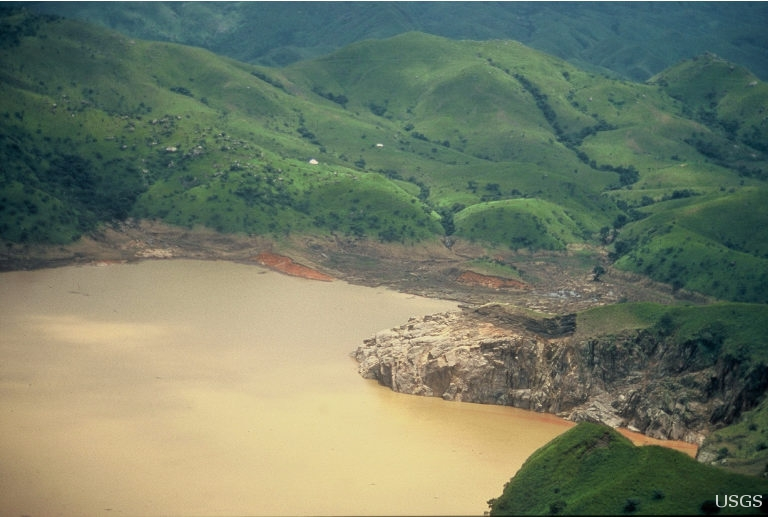
Tragically, Lake Nyos was not the first warning of the danger, and the disaster might have been anticipated. Just two years before, in 1984, a smaller but similar event had occurred at another Cameroonian crater lake, Lake Monoun, not far away. There, a limnic eruption released carbon dioxide that killed a number of people — around three dozen — in a comparable, if smaller-scale, event.
At the time, the cause of the Lake Monoun deaths was not fully understood or widely recognized, and the warning it represented was not acted upon in time to prevent the far greater tragedy at Lake Nyos two years later. In hindsight, the two events together revealed a previously unappreciated hazard: that certain deep, gas-charged crater lakes in the region were capable of these deadly releases. It was a hard lesson, learned at a terrible cost, but it fundamentally changed scientists’ understanding of these lakes and spurred urgent efforts to make sure such a disaster could never happen again — at least not at these particular lakes.
Defusing the Bomb
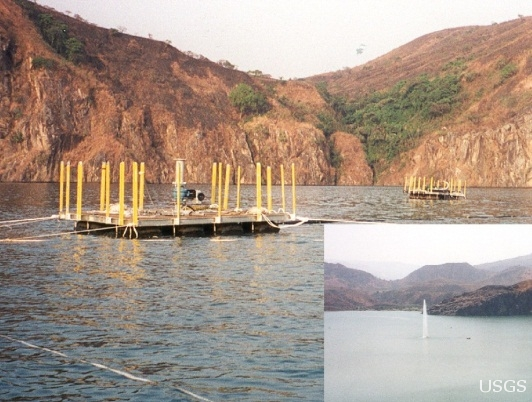
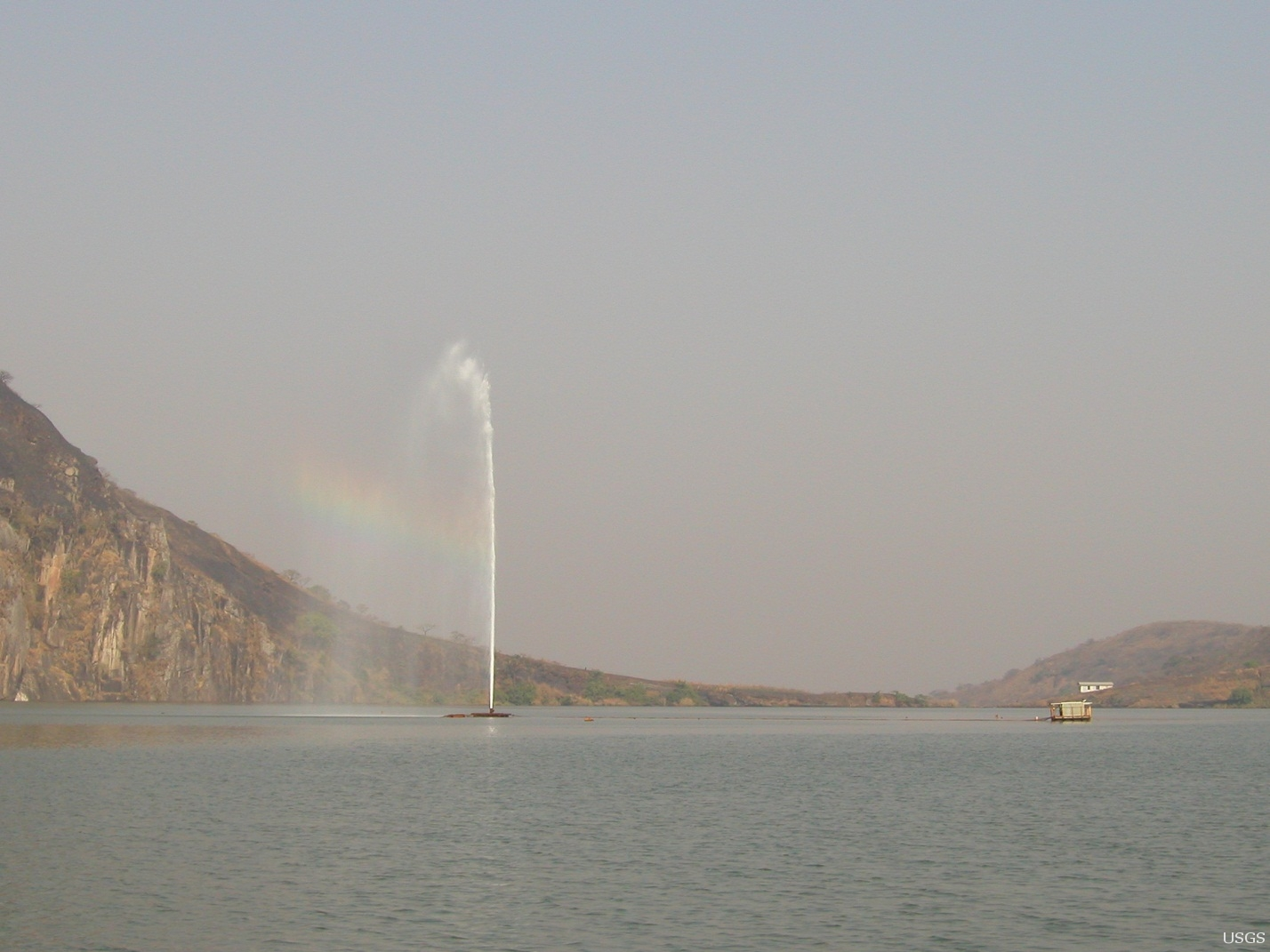
In the years after the disaster, scientists and engineers devised an ingenious solution to prevent Lake Nyos and Lake Monoun from ever again building up a lethal charge of gas: controlled degassing. The idea was to safely and gradually release the accumulated carbon dioxide from the deep water before it could reach dangerous levels, essentially defusing the bomb slowly rather than letting it explode.
The method involves installing pipes that run from the dangerous, gas-saturated deep water up to the surface. Once water from the bottom is drawn up the pipe and the pressure drops, the carbon dioxide begins to fizz out of solution, and the process becomes self-sustaining, driving a fountain of degassing water up and out of the lake in a controlled, harmless stream — a small, deliberate version of the very process that caused the catastrophe, but managed and continuous. The first pipe was installed in Lake Nyos in 2001, with additional pipes added later, and the systems have significantly reduced the amount of dissolved gas in the lakes, greatly lowering the risk of another sudden release. It’s a rare and satisfying example of scientists identifying a deadly natural hazard and then engineering a direct, effective solution to neutralize it.
The Lingering Lesson of Lake Nyos
The Lake Nyos disaster remains one of the most unusual and sobering natural catastrophes in modern history — a reminder that nature holds dangers so rare and strange that we may not even know to look for them until they strike. An ordinary-looking lake, calm and beautiful, harbored an invisible, silent killer that took more than seventeen hundred lives in a single night, through a mechanism that few scientists at the time even recognized. It’s a humbling story about the limits of human knowledge and the hidden hazards of the natural world.
But it is also, importantly, a story with a constructive ending. The disaster drove real scientific understanding of limnic eruptions and led directly to the degassing systems that now protect the communities around these lakes. The knowledge came too late for the 1,746 people who died in 1986, and their loss remains the heart of the story — a tragedy that fell on remote villages whose inhabitants had no way to know the danger they lived beside. But because of what was learned, the specific horror of Lake Nyos is far less likely to be repeated. There remains concern about other gas-charged lakes elsewhere in the world, some near far larger populations, which scientists continue to monitor and study. The lake that killed in silence taught the world a lesson written in loss, and ensured that, at least at Lake Nyos, the invisible killer beneath the water has been, for now, defused.
Like our content? Follow us for more.