

Archaeology depends on context. An object in the ground is surrounded by information — what layer it sat in, what was beside it, how it was arranged, what the soil contained — and that context is frequently worth more than the object.
Which is why the story of the Nebra sky disc is uncomfortable as well as remarkable. One of the most significant prehistoric finds in Europe was extracted by people who had no idea what they had, destroyed a substantial part of the evidence in the process, and then attempted to sell it.
It survived. It was recovered, authenticated, studied intensively, and is now in the UNESCO Memory of the World Register. And a decade-long argument about whether it was real at all has been fought over the exact information that was lost when it came out of the ground.
Here is the object and the story.
What It Shows
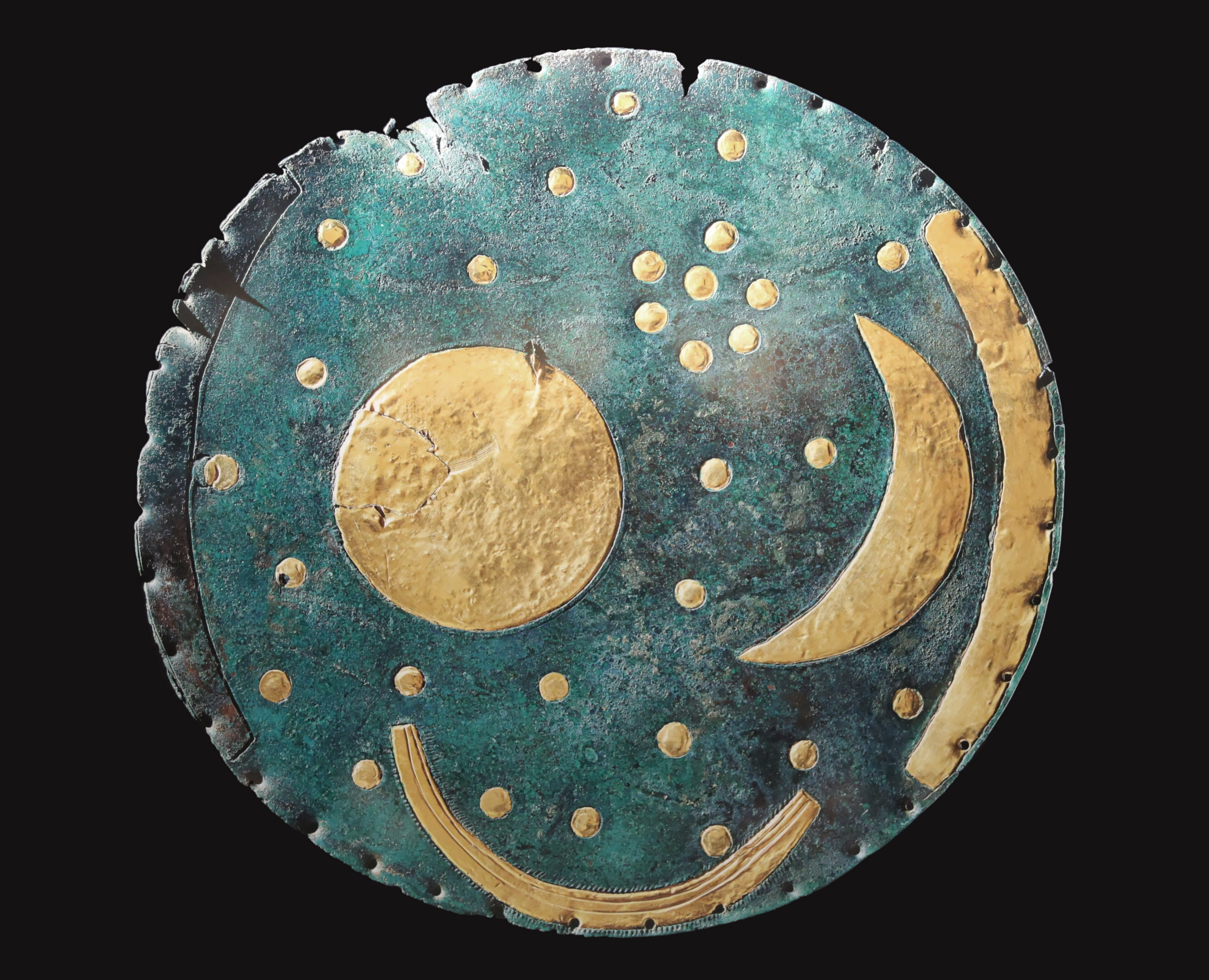
The disc is bronze, roughly 32 centimetres across, and weighs in the region of two kilograms. Its surface, now a blue-green patina, was originally a deep violet-blue produced by a chemical treatment of the metal.
Against that background are symbols in applied gold: a crescent, a circle representing either the full moon or the sun, and a scatter of small dots.
Twenty-three of those dots are distributed apparently at random. Seven more are grouped in a tight cluster, and that cluster is the detail that makes the object famous — it is widely interpreted as the Pleiades, the star group known in English as the Seven Sisters, which is one of the most visually distinctive features of the northern night sky and appears in the mythology of a great many cultures.
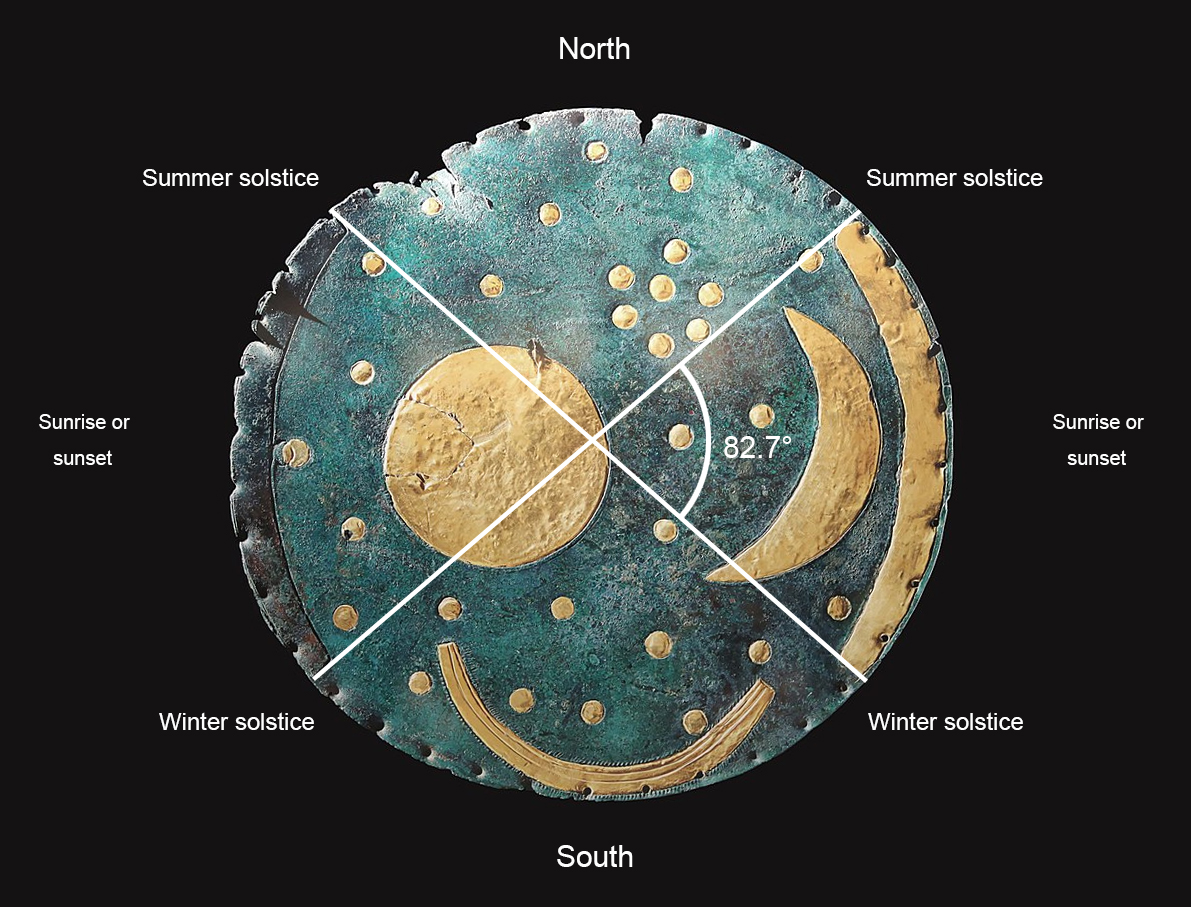
Two golden arcs run along the left and right edges. If the disc is aligned with the horizon from the hilltop where it was found, those arcs correspond to the range across which the sun rises and sets between the solstices — the western arc pointing toward a distant mountain behind which the sun disappears at midsummer.
A further arc along the bottom is usually described as a boat, and has been interpreted as a mythological vessel carrying the sun across the sky and back again.
Like our content? Follow us for more.
Made in Stages
Close examination established something important: the disc was not made in one operation.
It was worked in several distinct phases, and X-ray examination revealed two additional stars hidden beneath the gold of one of the arcs — which means the arcs were added later, over decoration that already existed.
The earliest version carried the circle, the crescent and the stars. The horizon arcs came afterwards, and the boat later still. There is also a ring of holes punched around the outer edge, most likely for attaching it to something.
So the object was modified repeatedly over a period, with new information added to it. Whatever it was for, it was in use long enough for somebody to decide it needed updating.
That progression is part of why the astronomical reading is taken seriously. Adding horizon markers to a sky image is exactly what you would do if the object were being used to track where the sun rises and sets through the year.
How It Came Out of the Ground

The circumstances are the part people remember.
In the summer of 1999, two men were searching a hilltop near the town of Nebra, in Saxony-Anhalt, with a metal detector. They were operating without a licence and knew that archaeological objects are the property of the state there, which made the activity looting rather than a hobby.
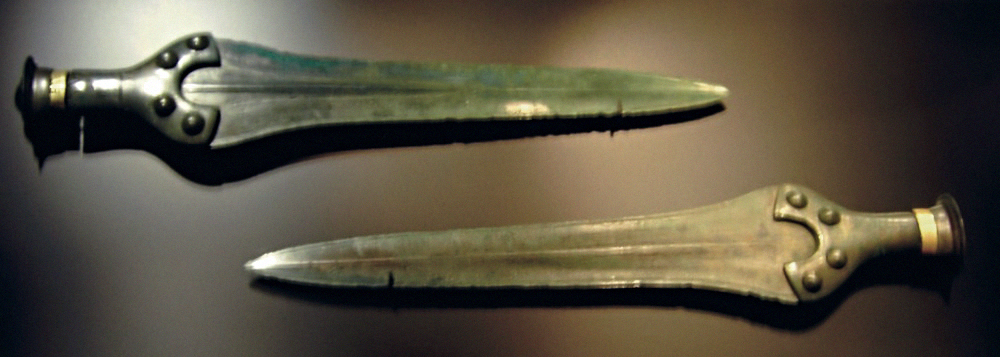
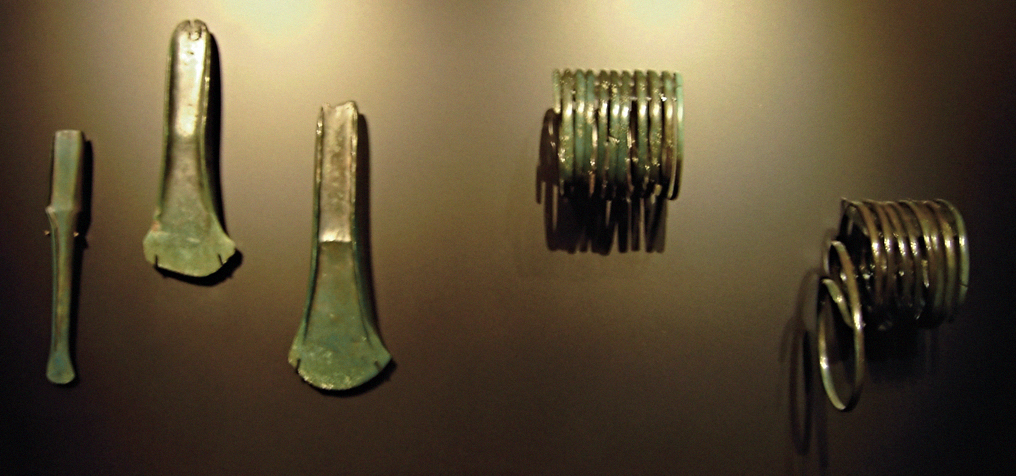
They struck the disc with a spade while digging it out, damaging it, and destroyed a considerable portion of the surrounding site in the process. Alongside the disc they took two swords, two axes, a chisel and fragments of spiral armbands.
The following day they sold the entire hoard to a dealer for a sum in the region of thirty-one thousand marks. It then moved through the black market for several years, changing hands and rising in price.
Recovery came in 2002, when the state archaeologist and Swiss police arranged a sting in the basement of a hotel in Basel, posing as buyers. The men attempting to sell it were arrested and the disc was recovered.
What was not recovered was the context. Precisely how the objects were arranged, what the soil layers showed, whether anything else was present — all of it was destroyed by two people with a spade.
The Argument About Whether It Was Real
That missing context produced exactly the problem you would expect.
In 2020 two German prehistorians published a paper arguing that the hoard was not a closed find, that the disc might not have come from the stated location at all, and that as an object without secure context it should be dated to the Iron Age rather than the Bronze Age — a difference of roughly a thousand years.
That is a serious claim, and it was possible only because the find circumstances had been ruined.
The response was substantial. A team of thirteen researchers published a detailed rebuttal in an Austrian journal, arguing that the earlier paper relied on incomplete and in places incorrect data, and that the authenticity of the find site had long been securely established.
The supporting evidence is chemical and physical rather than circumstantial. The copper has been traced to a Bronze Age mine in the Austrian Alps. The corrosion products on the surface include a distinctive mineral formation consistent with long burial. Soil analysis matched the find location. The style of the axes found with it and radiocarbon dating of wood from the sword hilts both indicate burial around 1600 BC.
The current consensus is firmly that the disc is authentic and Early Bronze Age, with the object itself possibly manufactured somewhat earlier than it was buried — figures up to around 3,800 years old are cited.
Some caution is still appropriate. Dating estimates vary between sources, the interpretation of the symbols involves inference, and a find without stratigraphic context will always carry a caveat that a properly excavated one would not.
What Was Buried With It
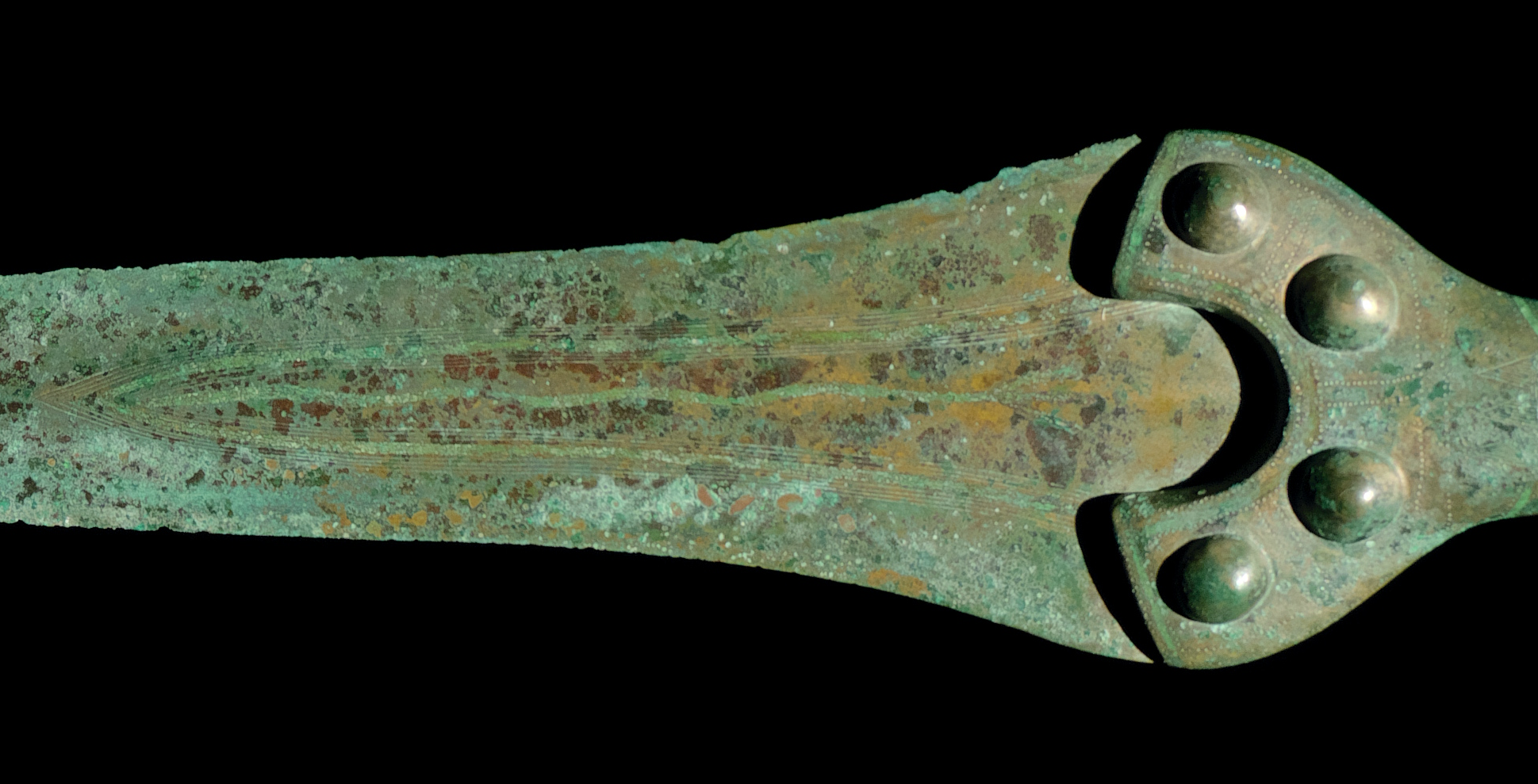
The rest of the hoard is worth attention, because it is doing most of the dating work and is generally ignored in favour of the disc.
Alongside the disc were two bronze swords, two axes, a chisel and fragments of spiral armbands. That is a substantial deposit of valuable metalwork, buried together on a hilltop.
The swords matter most. Their hilts contained wood, and wood can be radiocarbon dated, which is what supplies a direct age for the deposit rather than an inference from style. The axes contribute independently, since axe forms changed over time in ways that are well catalogued.
So the disc is dated largely by its companions – which is precisely why the argument about whether they were truly buried together was so consequential. If the hoard was assembled rather than deposited as a group, the swords date the swords and nothing else.
The burial itself is also informative. Depositing that quantity of metal deliberately, on a prominent hill, is not storage. Hoards of this kind are generally interpreted as offerings or as a deliberate ending, meaning somebody decided the objects should go into the ground and stay there.
If the disc had been in use for a long period before that, as the multi-stage manufacture suggests, then what was buried was not a new object but a working instrument at the end of its life.
Why It Matters
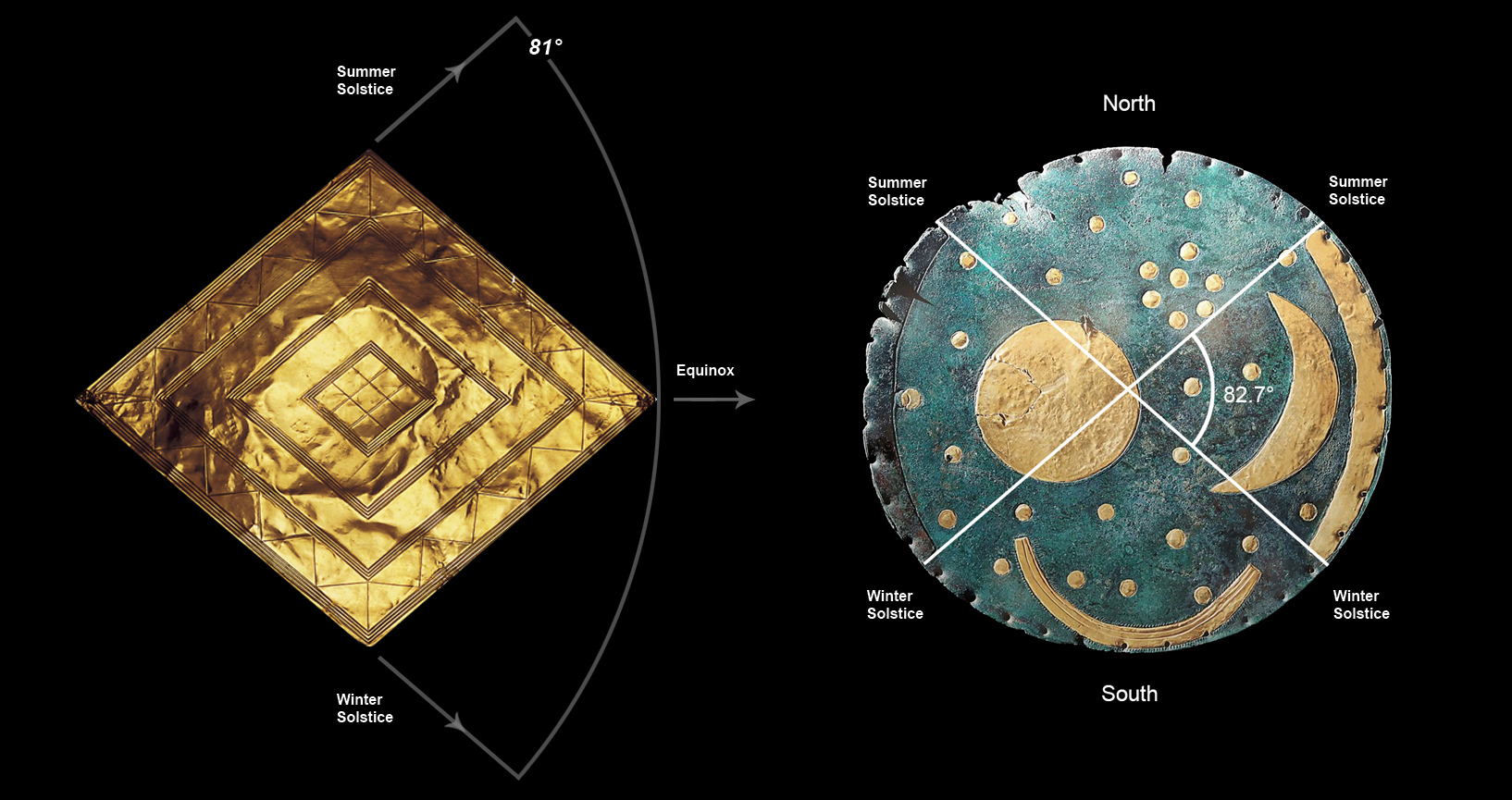
The significance is not that people in Bronze Age Europe looked at the sky. Everybody looks at the sky.
It is that this is a portable, deliberate, physical representation of celestial objects — an attempt to record what is up there rather than simply to observe it. Earlier depictions of the cosmos exist, but they are symbolic or imaginative rather than observational. This one appears to record specific things in specific relationships.
If the horizon arcs are what they seem, the object was also functional: a device for establishing where in the year you were, by checking the sun against fixed markers. That is a calendar, and calendars matter enormously to farming societies.
The Pleiades reading strengthens that. In a great many agricultural traditions the appearance and disappearance of that cluster marks the points at which to sow and harvest, which makes it exactly the star group a farming culture would want to depict.
None of which requires assuming anything exotic about who made it. It requires assuming that people in central Europe three and a half thousand years ago watched the sky carefully, worked out how it behaved, and made an object to hold that knowledge.
An Object That Nearly Was Not
The disc is now in a museum in Halle, and the site where it was found is open to visitors with a modern visitor centre nearby.
What stays with most people is how close the whole thing came to being lost entirely. It was struck with a spade, sold within a day to someone who did not know what it was, traded through several hands over three years, and was in a hotel basement changing owners again when the police arrived.
Had that sting failed, it would most likely have entered a private collection and disappeared, and the oldest known depiction of the night sky would exist as a rumour among dealers.
The reason it is possible to say anything about its age is that laboratories could interrogate the metal itself — the copper source, the corrosion chemistry, the soil traces. In other words, the object had to testify on its own behalf, because the evidence that should have surrounded it had been shovelled away.
Like our content? Follow us for more.

