

There is a category error built into the way most people look at a shallow sea.
Everything green underwater gets filed as seaweed, and seaweed is algae — a fundamentally different kind of organism, with no roots, no vascular system, no flowers and no seeds, attached to rock by a holdfast that grips rather than feeds.
Seagrass is not that. It is a flowering plant, in the same broad group as grasses, lilies and orchids. It has true roots that draw nutrients from sediment, internal vessels that transport water and sugars, and it produces flowers, is pollinated, sets seed and disperses.
It simply does all of this underwater, which is an unusual place for a flowering plant to be, because flowering plants evolved on land.
Here is what that involved and why it matters.
A Return Journey
The evolutionary sequence is worth stating plainly because it is counterintuitive.
Life began in water. Plants moved onto land, which required solving an enormous set of problems — support against gravity, water transport, protection against drying, reproduction without a liquid medium. Flowering plants developed on land, with flowers, pollen and seeds as land-based solutions.
And then a small number of them went back.
Seagrasses are descended from land plants that recolonised the sea, in several separate lineages, roughly a hundred million years ago. They are the only flowering plants that live fully submerged in seawater.
That is a very small club. Of something in the region of three hundred thousand flowering plant species, seagrasses number only around sixty.
Which tells you the return was difficult. Every adaptation to land had to be worked around or undone, and the barrier was evidently high enough that almost nothing managed it.
Like our content? Follow us for more.
The Problems They Had to Solve
Three difficulties are particularly instructive.
Salt is the first. Land plants are generally destroyed by seawater, and seagrasses required mechanisms to tolerate continuous immersion in it — a substantial physiological rebuild.
Support is the second, and here the return was a simplification. Land plants invest heavily in rigid tissue to stand upright against gravity. In water, buoyancy does that work, so seagrasses have flexible blades that bend with the current instead of resisting it. The lignin-heavy structure that costs a land plant so much is largely unnecessary.
Pollination is the third and the strangest. Flowering plants move pollen through air, using wind or animals. Underwater there is no air, and seagrasses developed pollen adapted to travel through water instead — in some species long and thread-like, which increases the chance of contact.
There is a truly surprising finding here. Research has documented small marine invertebrates carrying seagrass pollen between flowers, which is functionally animal pollination occurring underwater. The parallel with insect pollination on land was unexpected and is a good illustration of the same problem producing the same solution in an entirely different medium.
What Eats It
A further consequence of being a plant rather than an alga is worth stating, because it changes the whole food web.
Algae are grazed by a wide range of small organisms. Seagrass, with its tougher structural tissue, supports a different arrangement: a small number of large animals graze the blades directly, while an enormous number of smaller organisms feed on the algae and microorganisms growing on the surface of the blades rather than on the plant itself.
That second route matters more than it sounds. A dense meadow presents an enormous surface area for those growths, so the blades function as a substrate as much as a food source, and much of the productivity passes through organisms living on the plant rather than eating it.
The large grazers are among the few animals anywhere that live principally on a marine flowering plant, and they are correspondingly specialised – which is a direct consequence of seagrass having brought land-plant tissue into the sea, where almost nothing was equipped to process it.
What a Meadow Does
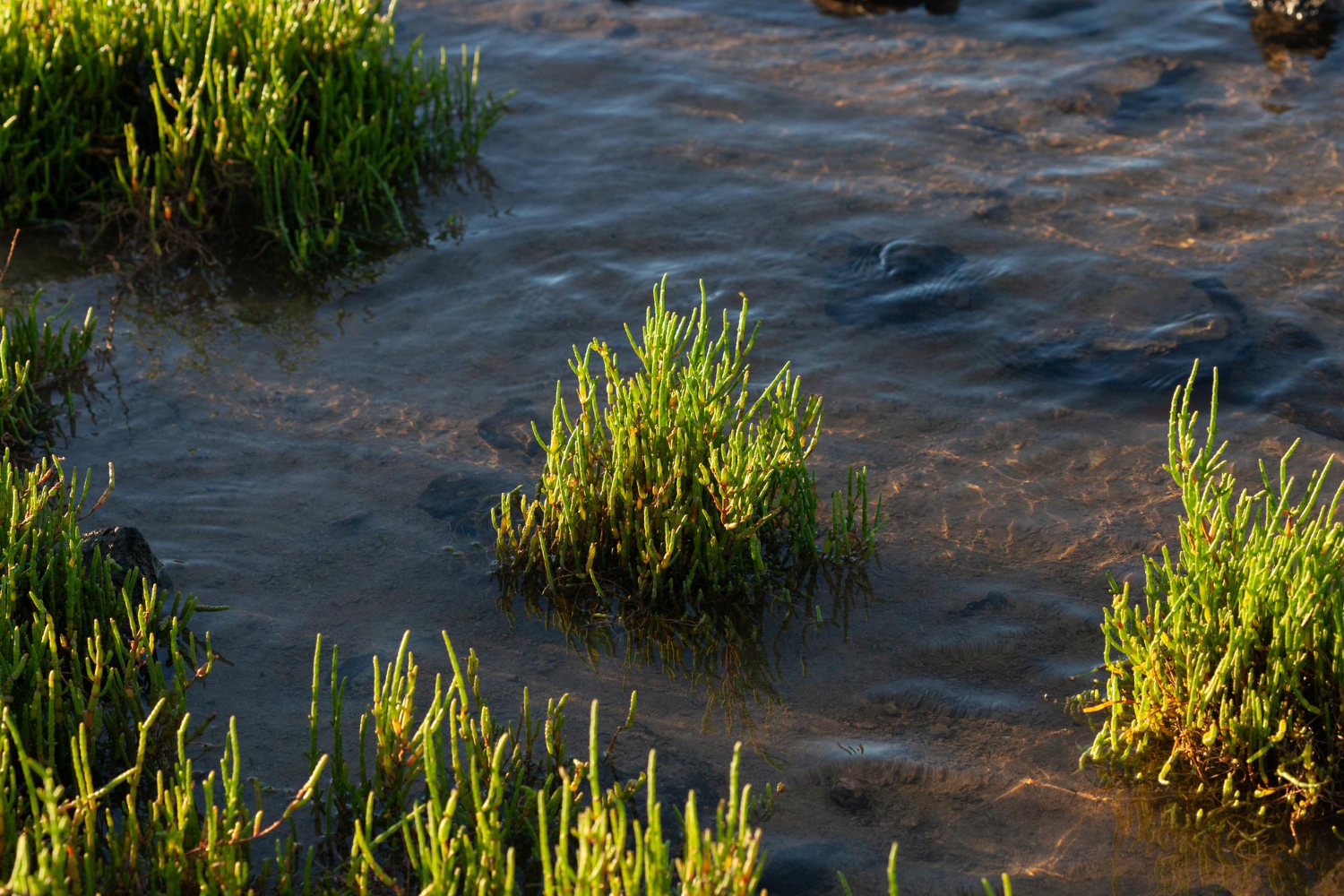
The ecological consequences are substantial and mostly invisible from a beach.
Seagrass meadows are nurseries. An enormous number of fish and invertebrate species spend juvenile stages among the blades, where the structure provides shelter from larger predators that cannot manoeuvre in it.
They stabilise sediment. Roots and rhizomes bind loose material, and the blades slow water movement, which causes suspended particles to settle. That reduces erosion and keeps the water clearer, which in turn allows more light to reach the plants — a self-reinforcing arrangement.
They are also unusually productive, and because the sediment they trap is low in oxygen, organic material accumulating in it decomposes very slowly. The result is that seagrass beds store carbon in the sediment beneath them over long periods, which is why they receive research attention out of proportion to their extent.
And they support species that occur essentially nowhere else, including large grazing animals that feed directly on the blades.
The pollination problem deserves one further note, because it produced a solution with no land equivalent.
Some seagrass pollen is released not as individual grains but in mucilaginous strands or masses that drift and wrap around anything they contact. Others release pollen at the water surface, where it spreads in a film and is carried by surface movement rather than through the water column.
Each of these is a distinct engineering answer to the same difficulty: pollen designed to travel through air is the wrong shape, the wrong density and the wrong surface for water, so the whole delivery system had to be rebuilt.
Different lineages rebuilt it differently, which is what you would expect of several independent returns to the sea rather than one.
The Clonal Question
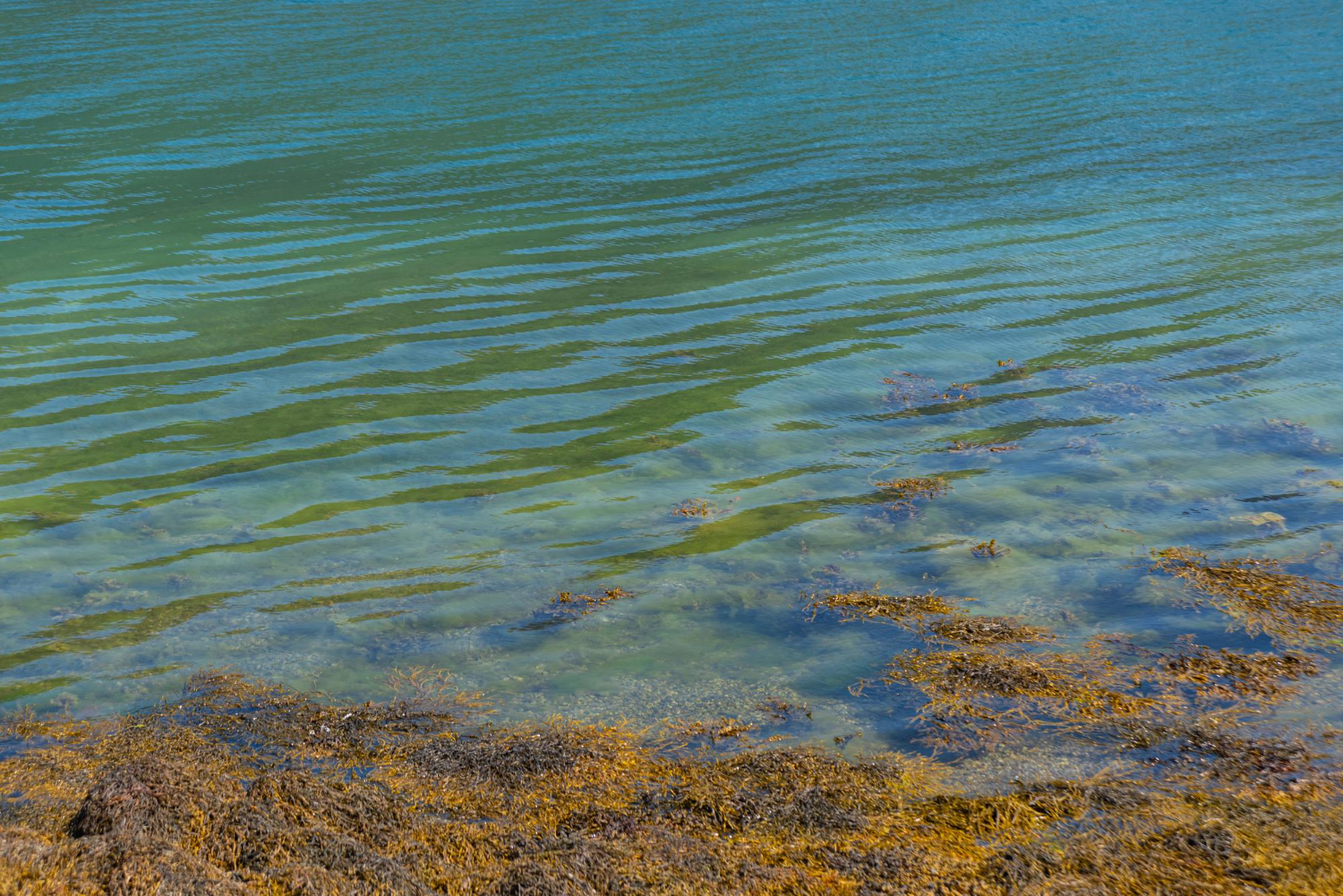
The age claim deserves careful handling, because it is remarkable and frequently repeated without qualification.
Seagrasses spread by rhizome — horizontal underground stems that extend and produce new shoots. A meadow expanding this way is genetically a single individual, however large it becomes, in the same way that a stand of aspen can be one organism.
Genetic work on a Mediterranean seagrass meadow found extremely large clonal patches, and estimates of age based on the rate of spread produced figures in the range of thousands to as much as a hundred thousand years.
That upper figure would make it among the oldest living organisms known, and it should be read as an estimate derived from growth rates over enormous timescales rather than as a measurement. The uncertainty is substantial and researchers present it as such.
What is not in doubt is that these meadows are extremely old and grow extremely slowly, which has a practical implication: a meadow damaged is not a meadow that regrows in a season. Recovery is measured in decades at best.
Not Actually Grass Either
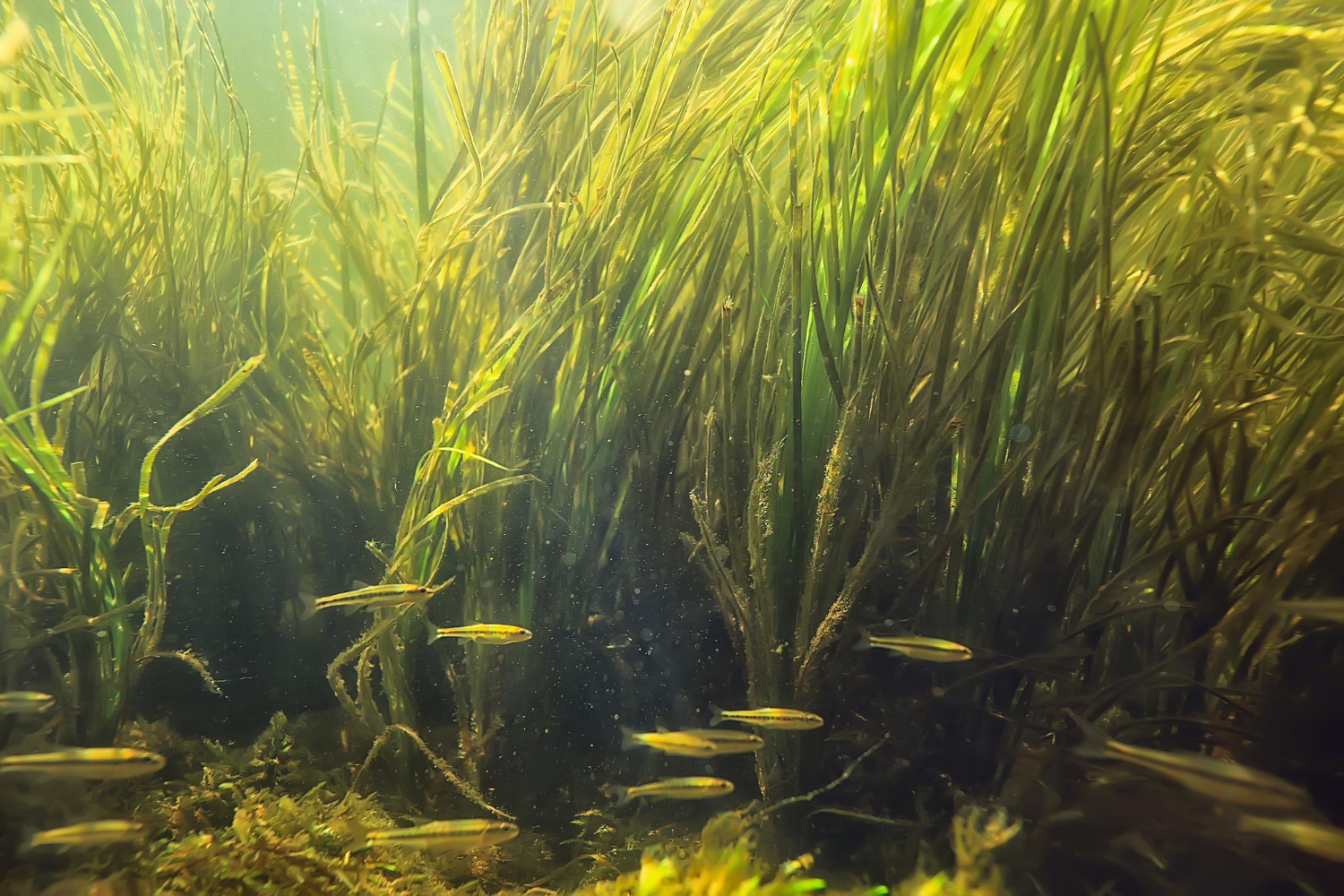
The name compounds the confusion, and untangling it says something about how the group is put together.
Seagrasses are not grasses. True grasses are one family of flowering plants, and seagrasses belong to several different families in a related order — the group that also contains lilies, orchids and palms.
The resemblance is convergent. Long flat blades growing from a base, spreading by rhizome and forming dense low swards is a solution that suits both a windy plain and a current-swept seabed, so unrelated plants arrived at the same form for similar mechanical reasons.
That convergence is the reason for the name and the reason the name misleads. What looks like a meadow of grass underwater is a set of plants that resemble grass without being closely related to it, doing something grasses have never managed.
The separate lineages matter too. Seagrasses are not one group that went to sea; they are several, which recolonised independently. That means the entire suite of adaptations — salt tolerance, submerged pollination, flexible blades — was arrived at more than once, by different plants, facing the same set of obstacles.
Which is a stronger statement than it first appears. A single return to the sea could be a fluke. Several independent returns indicate that the barrier, while high, was crossable given the right starting point — and that the shallow coastal seabed was a niche worth the effort of getting back into.
The Flowering Nobody Sees
There is a detail here worth ending on, because it captures what is strange about the whole group.
Seagrasses flower. Underwater, on the seabed, in shallow coastal water, a flowering plant produces flowers, releases pollen into the water, is pollinated, sets seed and disperses those seeds — the same reproductive sequence occurring in a meadow on land, performed entirely submerged.
The flowers are small and inconspicuous, because there is no advantage in the colour and scent that attract insects through air. So the event is essentially invisible, happens in shallow water off a great many coastlines, and almost nobody has seen it.
Which is the general position with seagrass. It is a flowering plant that solved an enormous set of problems to live in the sea, forms meadows that nurse fish and hold coastlines together, may include among the oldest organisms on the planet, and is routinely mistaken for seaweed by everybody who wades through it.
Like our content? Follow us for more.
