New Orleans welcomes nearly 20 million visitors a year. Its permanent French Quarter residents now number just 3,000. And the people who built this city’s legendary culture are being pushed out — one Airbnb listing at a time.
Walk down Bourbon Street on a Tuesday afternoon and you’ll be shoulder-to-shoulder with strangers. The bars are open, the music is loud, and somewhere nearby, a bachelor party is doing something no one needs to see. For the tourists pouring in from all 50 states, it feels like magic. For the people who actually live here, it increasingly feels like a trap they can’t escape — and can’t afford to stay in.
New Orleans has long sold itself as America’s most unique city. And for a long time, that was true in every meaningful sense. It had its own food, its own music, its own rhythms of life that existed nowhere else on the continent. But today, a growing chorus of locals, historians, urban planners, and culture bearers are sounding the alarm: the very tourism machine that keeps New Orleans alive is quietly killing it.
What you need to know
- Nearly 20 million tourists visit New Orleans annually — the French Quarter has only 3,000 permanent residents
- Airbnb listings in the city surged from 1,905 to over 6,500 in just three years
- Rent in the French Quarter now averages $2,262 per month — unaffordable for most service workers
- An estimated 24,000 residents were displaced from nearby neighborhoods in just three and a half years
- Residents and advocacy groups are now fighting back through documentary films, lawsuits, and city council pressure
A city of 3,000 — and 20 million guests
The numbers tell a story that is almost impossible to believe. The French Quarter, the beating heart of New Orleans tourism and one of the most recognizable neighborhoods in the world, has a permanent residential population of roughly 3,000 people. Yet it absorbs nearly 20 million visitors every year. That ratio — visitors to residents — is five times higher than Venice, Italy, the city that the rest of the world treats as the cautionary tale of overtourism.
Venice at least has an island as a natural barrier. New Orleans has nothing standing between its most fragile neighborhood and the next arriving cruise ship or chartered flight.
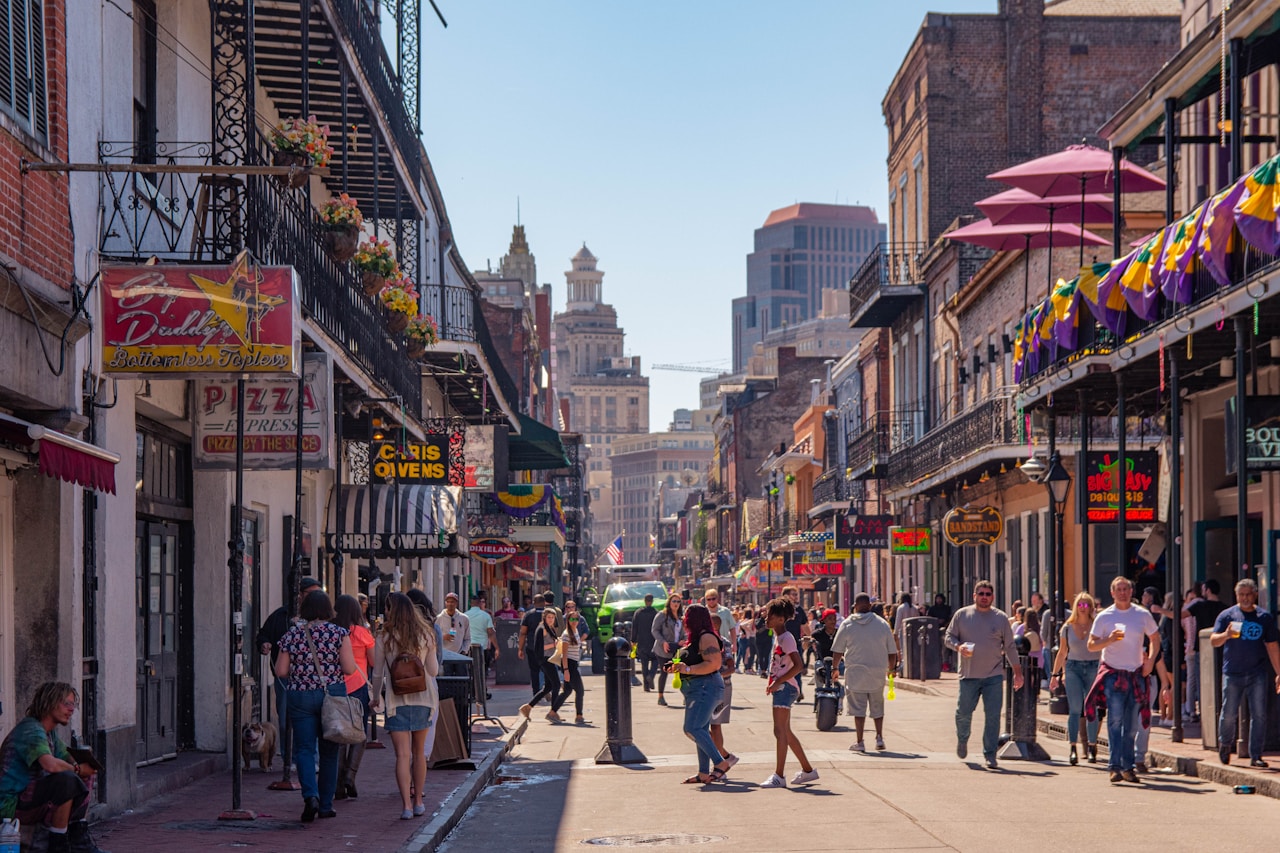
Bourbon Street during peak season. The French Quarter’s ratio of tourists to permanent residents is five times higher than Venice, Italy. (Getty Images)
The consequences of this imbalance show up everywhere. The streets are perpetually congested. The infrastructure — aging water mains, crumbling roads, overwhelmed trash collection — buckles under the pressure. And the culture that tourists come specifically to experience is quietly being hollowed out, pushed from the neighborhood it created by the economic forces its own fame has unleashed.
“The people of New Orleans are the tourist attraction,” says one longtime French Quarter preservationist. “And their voices must be counted in order to find a sustainable path forward.”
The Airbnb takeover no one voted for
In 2015, there were roughly 1,905 Airbnb listings in the city of New Orleans. By 2018 — just three years later — that number had exploded to more than 6,500. Investors, most of them from outside the city, saw the opportunity and moved fast. They bought up houses in Treme, Bywater, Marigny, and other historic neighborhoods clustered around the French Quarter, converted them into short-term rentals, and effectively removed them from the housing supply available to the people who actually work and live in New Orleans.
The result was swift and devastating. Rents in neighborhoods that had been reliably affordable for working-class and middle-class families doubled and then tripled within a few years. Property taxes rose as values climbed, pushing out elderly homeowners and low-income families who had lived in the same houses for generations. Service industry workers — the people who staff the restaurants and bars that tourists come to enjoy — suddenly found themselves unable to afford to live within commuting distance of their jobs.
“If we lose 600 people every four years and we only had 3,000 to begin with, we’re going to be out of people.”— Laura Cayouette, filmmaker and former French Quarter resident, who was herself forced to leave during production of her documentary on overtourism
The city government recognized the problem and passed ordinances restricting short-term rentals, requiring owner-occupancy and licensing. But enforcement has been inconsistent, advocates say. The rules exist on paper. On the ground, the transformation of residential neighborhoods into tourist accommodations has continued largely unchecked.
The culture carriers are leaving — and taking the soul with them
Ask any longtime New Orleans resident what the city is really losing, and they don’t talk about architecture or infrastructure. They talk about people. The Grammy-winning brass band drummer who can no longer afford his neighborhood. The tour guide and cultural historian whose family has lived in the same area for generations and is now watching it transform into an extended hotel district. The chefs who survived the Hard Rock collapse, the pandemic, and Hurricane Ida — only to face an affordability crisis they may not be able to outlast.
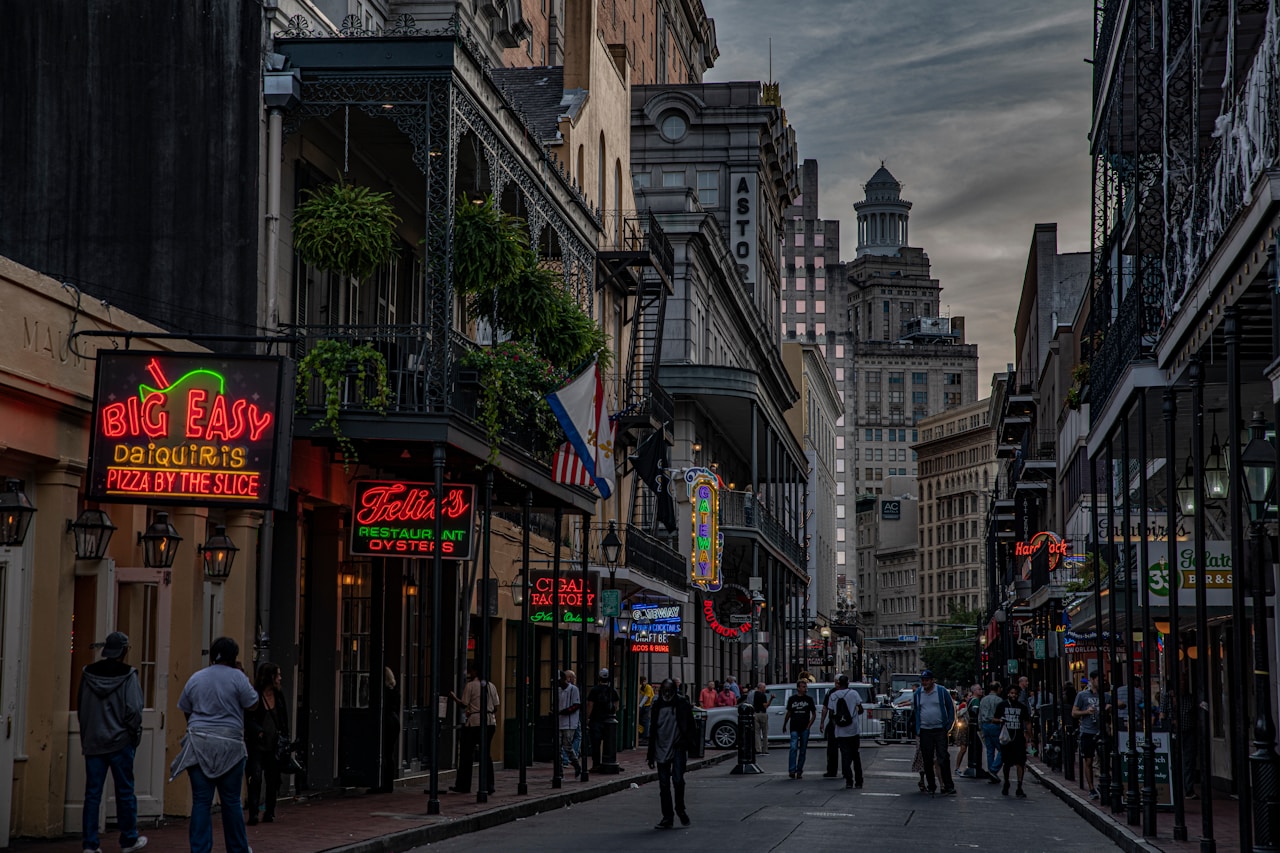
The French Quarter at night. The neighborhood’s music, food, and street culture draw millions — but the people who created that culture are being systematically priced out. (Wikimedia Commons)
These aren’t abstract losses. New Orleans’ identity — its Mardi Gras Indians, its second-line parades, its jazz funerals, its Creole cooking — was built and maintained by communities that have been living in these neighborhoods for generations. When those communities are dispersed to the suburbs or beyond, the traditions begin to fray. The things that make New Orleans irreplaceable can’t be downloaded or franchised. They exist only so long as the people who carry them stay.
A feature-length documentary, “Wasted: Overtourism in the French Quarter,” produced by the Vieux Carré Property Owners and Residents Association, attempts to capture what is being lost before it disappears entirely. The film examines the city’s dependence on an industry that, as the COVID-19 pandemic demonstrated, can evaporate almost overnight — and asks what happens to a city that has sacrificed its residential fabric for tourist dollars, only to have those tourists stop coming.
The locals who are fighting back
Not everyone is surrendering quietly. Organizations like the Jane Place Neighborhood Sustainability Initiative and HousingNOLA have been pushing hard for tenant protections, community land trusts, and inclusionary zoning policies that would require developers to include affordable units in new construction. Neighborhood associations are organizing, filing complaints, and showing up to city council meetings in numbers that have forced local politicians to at least acknowledge the crisis.
Resident advocates have also been pushing the city to crack down on illegal short-term rentals — the ones operating without licenses or in violation of owner-occupancy rules. There are thousands of them, they say, hiding in plain sight on every major booking platform, draining the housing supply one listing at a time.
“When tourism transforms beloved places into overcrowded theme parks, even the world’s greatest cultural institutions can be brought to their knees by the people who love them most.”— VCPORA (Vieux Carré Property Owners and Residents Association)
The city itself has taken some steps. New Mayor Helena Moreno, who took office in early 2026, has signaled an awareness of the affordability crisis. A Housing Trust Fund was established through a ballot measure to support the construction and preservation of affordable units. And the city is exploring zoning updates that would bring more long-term housing stock back to neighborhoods being consumed by tourism infrastructure.
But advocates say it isn’t enough — not yet, and possibly not fast enough. The estimate from Jane Place is that 33,000 affordable housing units are needed to meaningfully reverse the damage. By the end of a five-year commitment, the city had managed to construct just 1,557.
The Treme neighborhood, one of America’s oldest African American communities, has seen waves of displacement as investment properties convert homes into tourist accommodations. (Wikimedia Commons)
Is there a version of this that ends well?
Tourism isn’t the enemy. Even the loudest resident advocates acknowledge that. Louisiana earns nearly $19 billion annually in tourism revenue, with more than half of that coming from New Orleans. That money funds jobs, schools, and city services. The choice is not simply between tourism and no tourism.
The choice — as advocates, planners, and a growing number of tourists themselves are beginning to understand — is between tourism that depletes a city and tourism that sustains it. Barcelona has announced a complete ban on new short-term rentals by 2028, eliminating tens of thousands of tourist apartments in residential neighborhoods. Key West has enacted caps on daily cruise ship passenger disembarkations. Sedona launched free shuttles to reduce vehicle pressure on sensitive areas and resident neighborhoods.
New Orleans has the blueprint. It has the advocates. It has the political will, emerging if not yet fully formed. What it may not have is time. If 600 people leave the French Quarter every four years — and the documentary filmmaker who made that estimate was herself among them — the math runs out sooner than anyone in the tourism industry wants to admit.
The tourists who keep coming to New Orleans are, in most cases, coming for something real: a city unlike any other in America, with a culture forged over three centuries from African, French, Spanish, Native American, and Caribbean traditions. That thing they’re coming for is still here. The question is how much longer the people holding it together can afford to stay.