Decipherment is a statistical exercise before it is anything else.
Every script that has been successfully read was cracked because there was enough of it. Enough text for repeated sequences to emerge from coincidence, enough variation for grammatical patterns to become visible, enough proper nouns to hook the internal structure onto the outside world.
Linear B required thousands of tablets. Egyptian hieroglyphs required an enormous corpus and a bilingual text. Both were solved by people who could test a hypothesis against a large body of material and see whether it held.
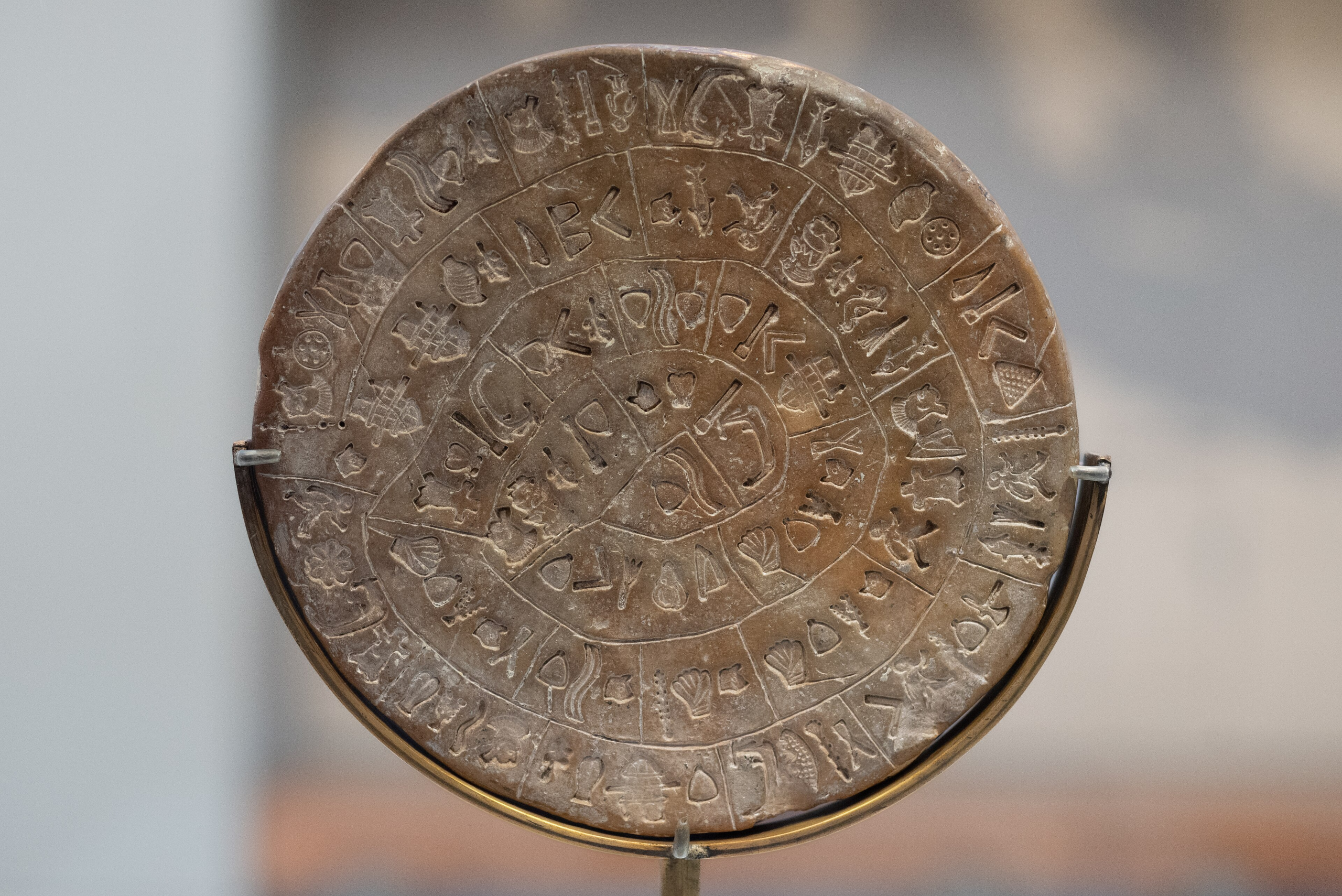
The disc found in a Cretan palace in 1908 offers 241 signs, in one document, in a script attested essentially nowhere else. That is the whole corpus. And it is why the object is likely to remain unread regardless of how clever anybody is.
Here is what it is, what makes it remarkable, and why the puzzle is probably not solvable.
The Object
The physical description is uncontested and unusual.
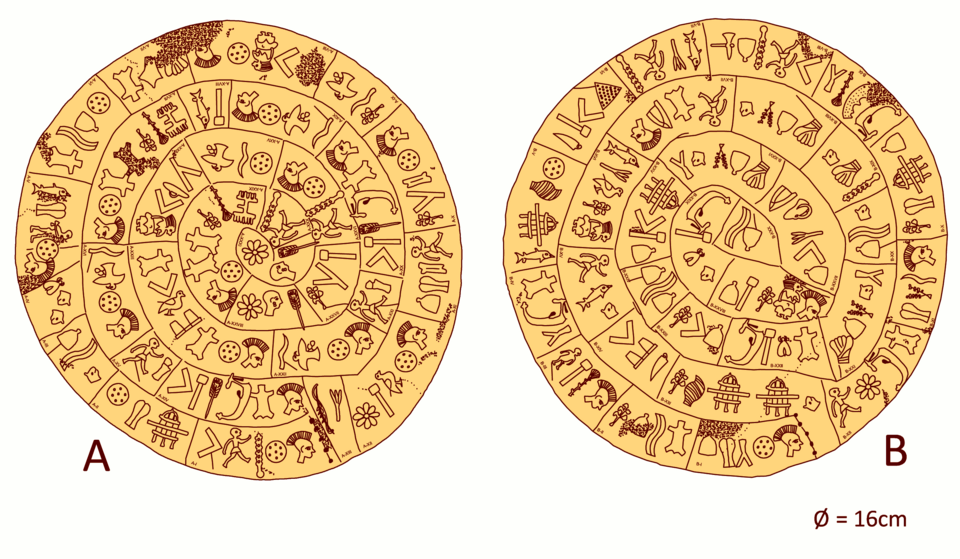
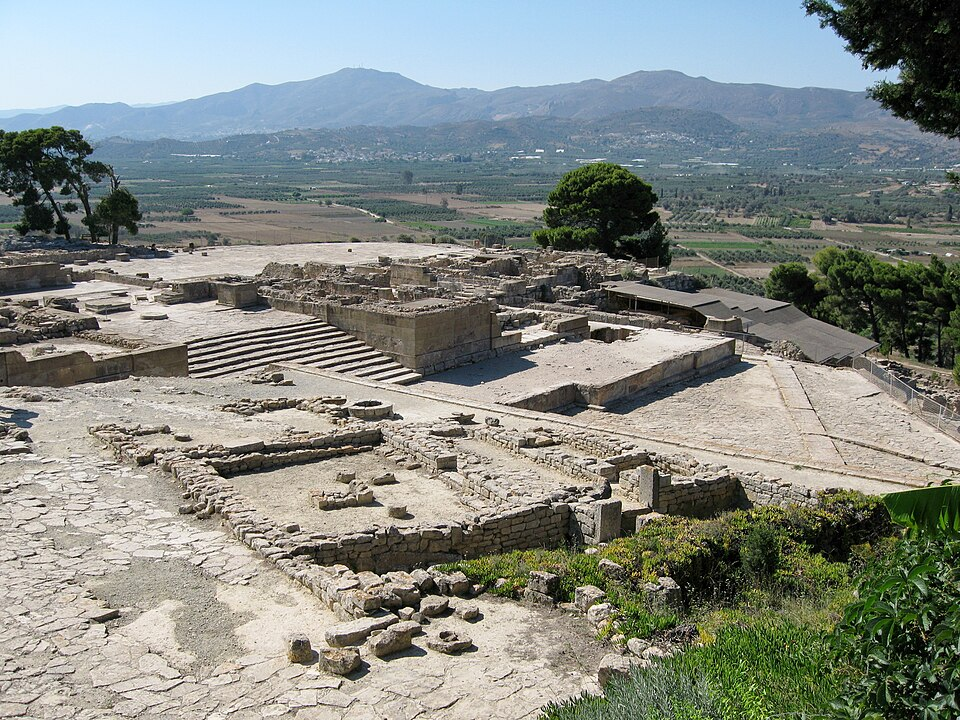
It is fired clay, roughly sixteen centimetres in diameter and about a centimetre thick, recovered from a Minoan palace site on Crete. Both faces are inscribed.
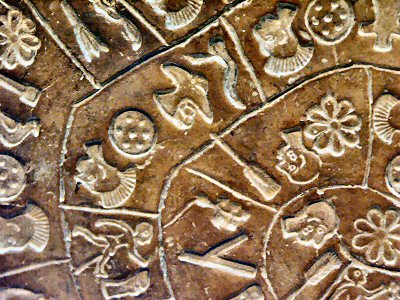
The signs run in a spiral, and they are grouped into sections by incised lines, with each group containing between two and seven signs. There are 241 impressions in total, made up of 45 distinct signs.
The imagery is legible even when the meaning is not: human figures, heads with what appear to be feathered headdresses, walking figures, a shield, a ship, various animals, plants, tools and a range of shapes with no obvious referent.
Dating is generally placed in the second millennium BC, though the estimate depends on the archaeological context, which was recorded to standards that would not satisfy anyone now.
Like our content? Follow us for more.
The Truly Remarkable Part
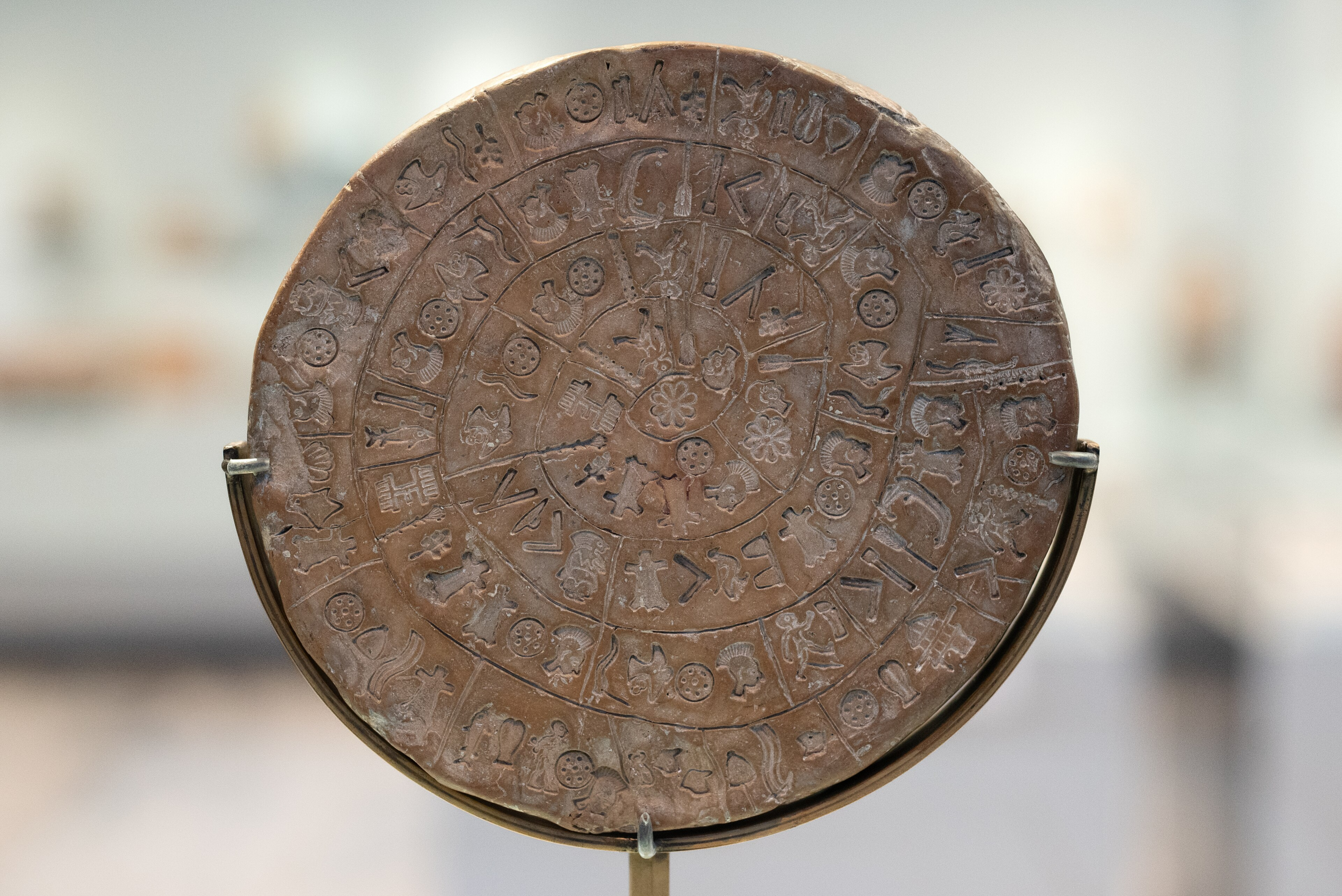
The signs were not written. They were stamped.
Each of the 45 signs was impressed into the soft clay with a separate prepared punch, and the same punch was used repeatedly across the document — which is directly observable, because identical signs show identical fine detail rather than the small variations that hand-drawing produces.
That is movable type. Somebody manufactured a set of 45 reusable character stamps and used them to produce a document.
The significance of that is easy to understate. Movable type is not simply a faster way of writing; it is a fundamentally different concept, in which characters are objects that exist independently of any particular text and can be reassembled indefinitely.
Whoever made those punches had gone to the trouble of manufacturing a reusable typeface, which is not something anyone does for a single document. The obvious inference is that more such documents existed.
None has been found.
Why It Cannot Be Read
The obstacles are not a matter of insufficient effort, and it is worth setting them out because they explain the situation completely.
The corpus is one object. Statistical analysis requires repetition, and 241 signs offer almost nothing to work with. Sequences that appear twice cannot be distinguished from coincidence at that scale.
The script is otherwise unattested. A handful of possible parallels have been proposed on other objects, and none is secure enough to expand the corpus meaningfully.
The language is unknown. Even if the sign values could somehow be established, the resulting sounds would need to correspond to a language, and the languages of Bronze Age Crete are themselves not fully understood — Linear A remains unread for closely related reasons.
There is no bilingual text. Nothing exists giving the same content in a readable script.
And the sign count is ambiguous in its implications. Forty-five distinct signs is too many for an alphabet and too few for a logographic system, which suggests a syllabary — but that is an inference from a number, not evidence.
There is one further structural observation worth making, because it is the closest thing to internal evidence the object offers.
The signs are grouped into fields by incised dividing lines, with each group containing between two and seven signs. If those groups correspond to words, then the sign count per group tells you something about the language — short words in a syllabary suggest one kind of structure, longer ones another.
Some signs appear only in particular positions within a group, which is the sort of distributional pattern that carries grammatical information in any script.
None of this yields a reading. It does indicate that the document has internal structure rather than being decorative, which is itself worth establishing, and it is the sort of evidence that would become powerful immediately if there were more of it.
The Claims That Appear Regularly
Proposed decipherments exist in considerable quantity, and they share a diagnostic feature.
Readings have been offered as a prayer, a calendar, a narrative, a list of places, a game board, a hymn and a great many other things, in several proposed languages.
The problem is that with 241 signs and no constraints, a determined person can produce a reading that fits. The corpus is small enough that almost any hypothesis can be made to work, which means fitting the text is not evidence of anything.
The test that separates a real decipherment from a plausible-looking one is prediction: a correct solution should read material it was not built on. With a single document, that test cannot be applied at all.
This is why specialists are consistently unenthusiastic about proposed solutions, and it is not obstinacy. There is no available method by which any proposal could be confirmed.
The Authenticity Question
A further complication deserves a mention, handled carefully.
Because the object is unique in every respect — unique script, unique technique, no comparanda — a small number of researchers have questioned whether it is real, and the question has been raised in print.
The mainstream position is that it is authentic. The excavation context, the material, the state of the object and the sheer implausibility of an early-twentieth-century forger inventing both a coherent unknown script and a movable-type technique are generally regarded as decisive.
It is mentioned here only because the uniqueness that makes the object fascinating is the same uniqueness that makes the question askable, and because omitting it would leave readers to encounter it elsewhere without context.
What Would Change the Situation
It is worth being specific about what a solution would require, because it clarifies why the object has resisted for over a century.
More text is the only thing that would truly help. A second document in the same script — even a short one, even fragmentary — would immediately allow sign frequencies from one to be tested against the other, which is the beginning of every decipherment method.
A bilingual would be better still, in the way the Rosetta Stone was, though the chance of one existing is remote.
Failing either, an inscription in the same script alongside a recognisable proper noun would help enormously. Place names were the hook that unlocked Linear B, because an administrative document lists locations constantly and locations can be checked against a map.
None of this is impossible. Excavation continues on Crete, material sits unexamined in museum stores, and objects are periodically reidentified. If further stamped documents were made, some may survive.
There is also a technological possibility. Analysis of the punches themselves — the fine detail of individual impressions — has been used to establish how many distinct stamps were used and whether any show wear consistent with heavy prior use, which would indicate the set had produced other documents.
But no amount of computational analysis solves the fundamental problem. Statistical methods need data, and 241 signs is not data. The disc will be read when a second document turns up, and probably not before.
What the Object Is Actually Evidence Of
Set the decipherment aside and something remains that is arguably more interesting.
Somebody in Bronze Age Crete manufactured a set of reusable character stamps and used them to produce a document. That is a conceptual leap — from writing as a continuous manual act to writing as the assembly of reusable components — and it is the same leap that transformed Europe three thousand years later.
It went nowhere. There is no evidence of the technique being developed, no subsequent documents, no tradition. Whatever the punches were made for, the idea did not propagate.
That is not unusual in the history of technology. Ideas appear, work, and vanish because the surrounding conditions to sustain them are absent — no demand, no material, no reason to make a second one.
Which makes the disc a record of two things simultaneously: a message nobody can read, and a technique nobody continued. The second may be the more significant loss.
And the reason the first cannot be recovered is not mysterious at all. There is only one of it, and one of anything is not enough to read.
Like our content? Follow us for more.