

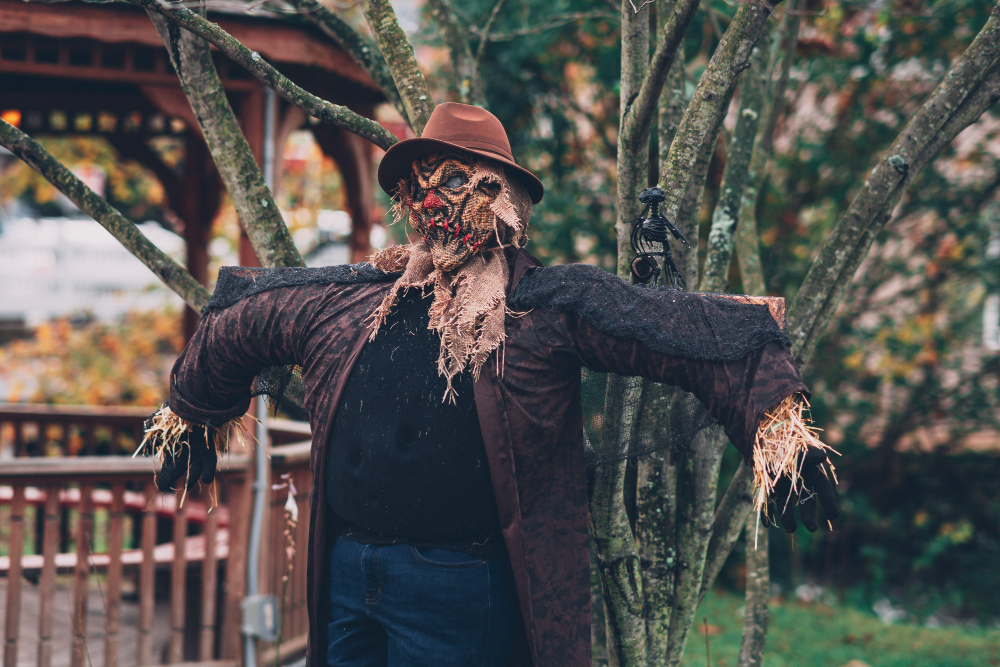
There is a well-documented behaviour in animals that explains the entire history of trying to keep birds off crops, and it is almost never mentioned in that context.
The behaviour is habituation: a response to a stimulus that is repeated without consequence declines and eventually disappears.
A bird encountering an unfamiliar figure in a field responds with caution, because anything unfamiliar might be dangerous. It watches from a distance, approaches gradually, and observes what happens.
If nothing happens, the caution fades. The figure is reclassified from potential threat to part of the landscape, and within a short period birds are feeding at its base — and sometimes perching on it.
Why Birds Learn This Fast
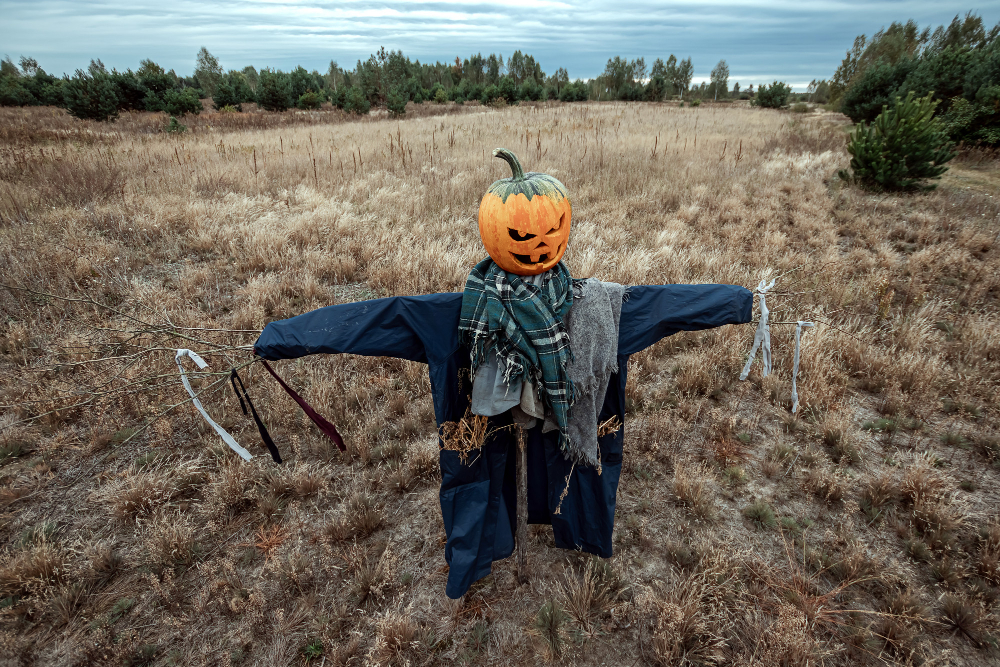
The speed of habituation reflects the cost of being wrong in each direction.
An animal that fled from every unfamiliar object would spend its life fleeing and would never feed, because the world is full of harmless novelties.
An animal that ignored every novelty would eventually meet a predator.
The solution evolution has produced is an initial wariness that is tested and updated. Something unfamiliar is treated as possibly dangerous until experience shows otherwise, and then it is treated as safe.
Birds that feed in flocks update especially quickly, because each individual observes the others. When some birds approach and suffer no harm, the rest follow — so the group learns faster than any single bird would.
That is why a scarecrow is most effective on the first day and least effective after a week, and why its failure is the birds’ success rather than the device’s defect.
There is a size point worth noting. A figure large enough to be seen across a field is more effective initially than a small one, and the effect of size also habituates – a very large figure is learned just as surely, only slightly more slowly.
No dimension escapes the process.
Like our content? Follow us for more.
What Makes a Device Last Longer
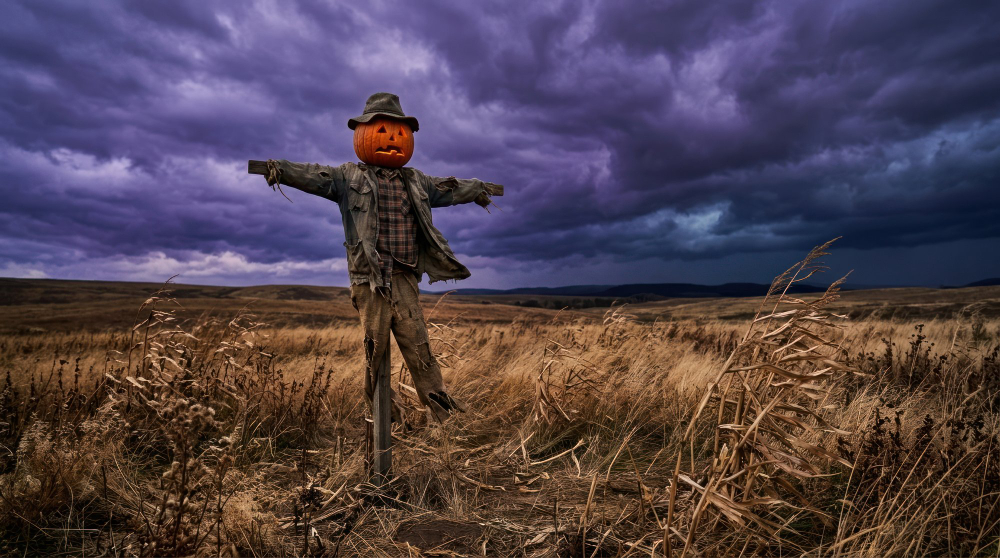
Every improvement in bird-scaring follows from delaying habituation, and the principles are consistent.
Movement helps, because a moving object is harder to classify as inert. A figure with loose clothing that flaps in the wind, or parts that swing, holds attention longer than a rigid one.
Unpredictability helps more. A stimulus that varies in timing, position or form is harder to learn, because the bird cannot establish a pattern of harmlessness.
Moving the device regularly helps, since a figure in a new position is partly novel again.
Sound works on the same basis, and suffers the same fate: a bang at regular intervals is learned and ignored, which is why devices producing noise at random intervals persist longer.
And combining several kinds of stimulus — visual, auditory, positional — resists habituation longer than any one alone, because the bird must learn to ignore each separately.
None of those prevents habituation. They slow it.
There is a landscape point worth noting. Birds judge risk partly by distance to cover, so a figure in the middle of an open field is tested more cautiously than one near a hedge where escape is easy.
Placement changes how long the initial wariness lasts.
Birds feeding near the edge of a field frequently ignore a deterrent sooner than those feeding in the centre, because the route to safety is shorter.
Why Consequences Matter
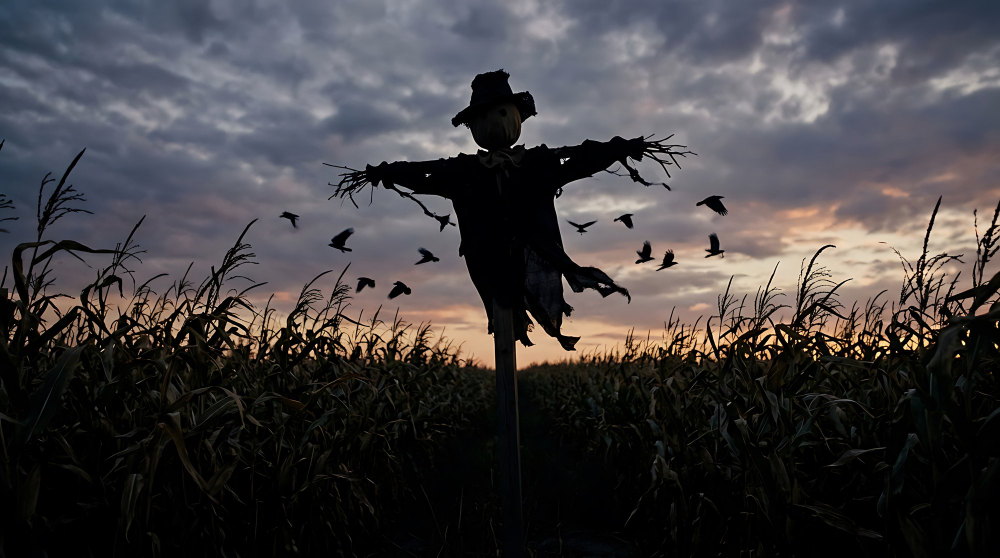
The one thing that reliably resets habituation is a real consequence.
If a stimulus is sometimes followed by something truly unpleasant, the bird learns that the stimulus predicts danger, and the response persists.
That is the basis of the historical practice of human bird-scarers — frequently children — employed to patrol fields, shout, throw stones and make noise, because a human who actually chases birds away is a consequence rather than a signal.
It is also why a figure resembling a human works initially: birds have learned from experience that humans are sometimes dangerous. The scarecrow borrows that learned association.
And it is why the association wears off. A human-shaped figure that never behaves like a human is eventually recognised as a different category of object, and the borrowed fear is withdrawn.
The same logic applies to the practice of displaying dead birds, which was widespread and signals danger in a way birds recognise — and which also habituates when nothing further happens.
There is a crop point worth adding. Deterrence matters most during the short periods when seed is newly sown or fruit is ripening, which is why historical bird-scaring was seasonal work rather than a permanent job.
The device only has to work for a few weeks at a time.
What the Figure Became
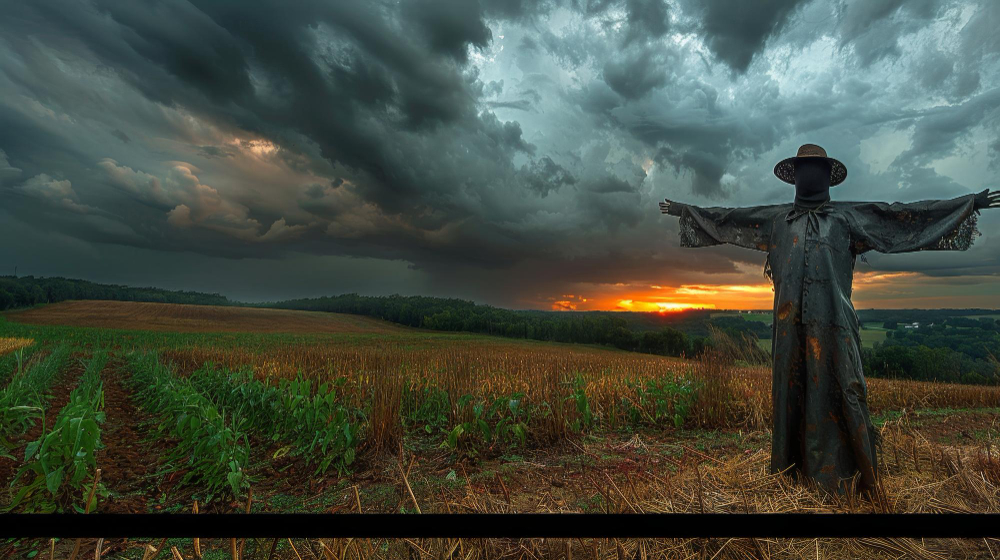
The scarecrow has a second life that has almost nothing to do with birds.
A figure dressed in old clothes, standing in a field, took on a set of associations in folklore, story and seasonal custom that far outgrew its practical role.
It appears in harvest celebrations, in community displays and competitions, in literature and in children’s stories, as a character with a personality rather than as a device.
That transformation is common for obsolete working objects. As the function becomes less important, the object becomes available for other meanings, and the meanings frequently outlast the function by a long time.
Which is why a great many scarecrows now stand in gardens and villages where there is no crop to protect, doing a job entirely unrelated to the one they were invented for.
There is a timing point worth adding. Birds feed most intensively early in the morning and in the evening, which is when deterrents are tested most and when human bird-scarers historically concentrated their effort.
A device that works at midday may already have been learned at dawn.
That is also why the earliest hours of a newly sown field matter most – the first birds to arrive set the pattern for the rest.
What Replaced It
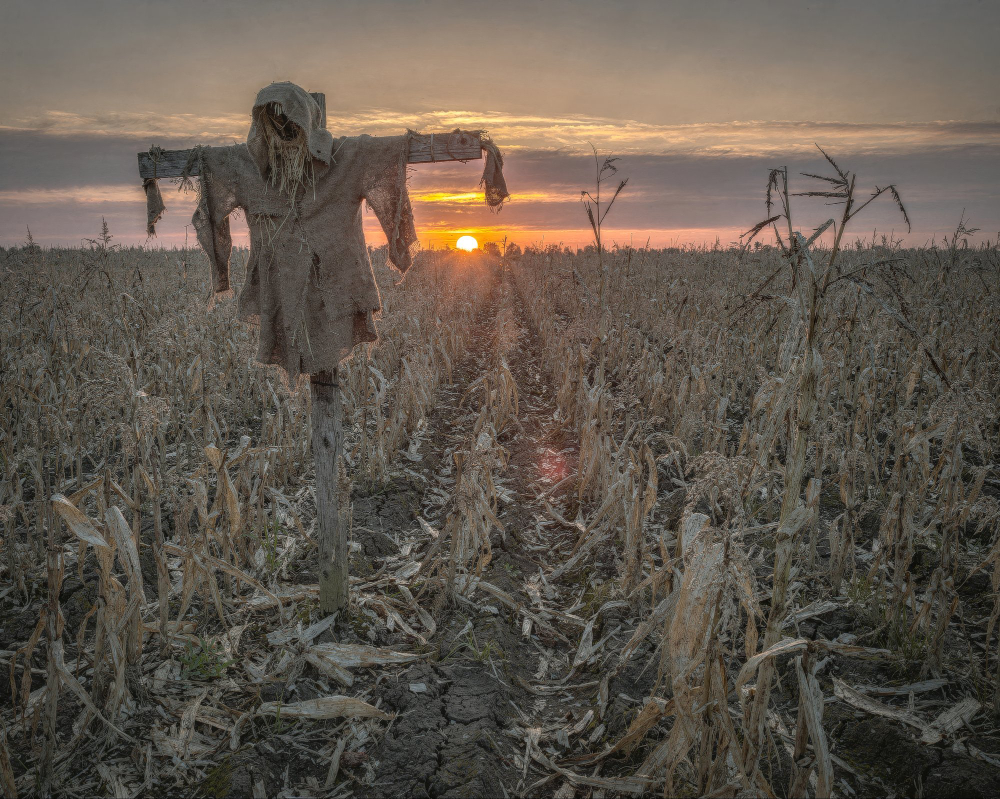
Modern crop protection uses the same principles with different tools.
Devices that produce sounds at random intervals, reflective materials that flash in sunlight, kites and balloons shaped like predators, and moving mechanical figures all aim to present unpredictable stimuli that resist habituation.
Some use recorded calls that birds of the same species produce when alarmed, which carry meaning to them directly rather than borrowing a learned association.
Physical barriers — netting and covers — avoid the problem entirely by preventing access rather than attempting to deter, and they do not habituate because they do not depend on the birds’ response.
And the most effective programmes rotate methods, because a sequence of different stimuli presents novelty repeatedly and extends the period during which any of them works.
None of them solves the problem permanently, and all of them work best when combined and changed.
Why Birds Test Things
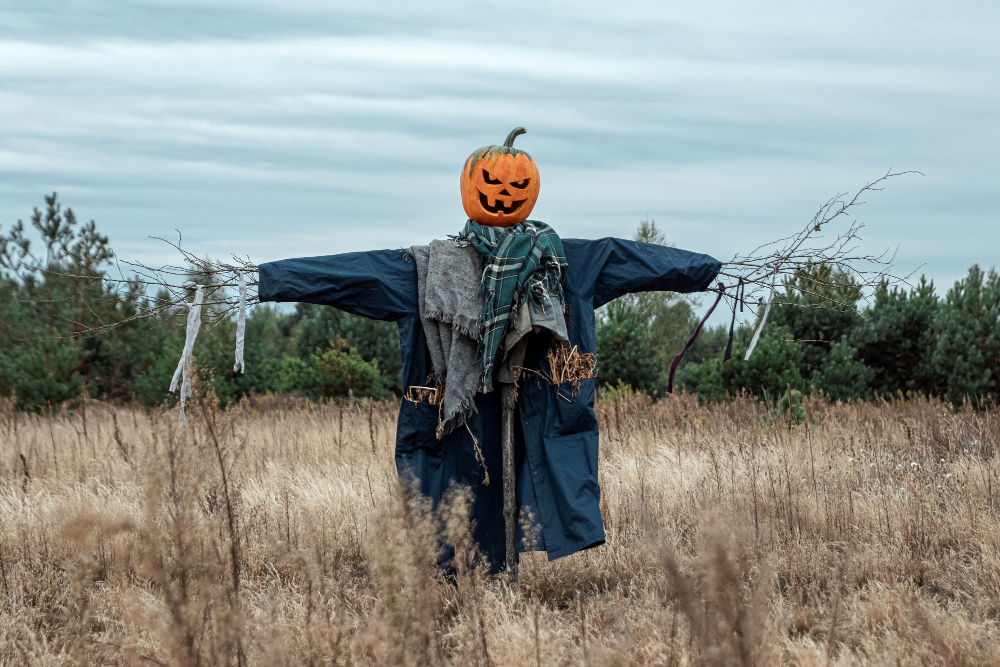
The investigation that defeats a scarecrow is worth describing, because it is an active process rather than passive getting used to something.
A bird approaching an unfamiliar object does so in stages — observing from a distance, moving closer, retreating, approaching again.
Individuals differ in boldness, and the bolder ones approach first and closest, while the more cautious watch what happens to them.
When a bold bird feeds near the object without consequence, the others take that as information and follow, which is why flocks can go from avoiding a figure to ignoring it within a single morning.
Some birds are notably quick at this and some species are known for remarkable problem-solving and for recognising individual humans, which is why deterrents fail especially fast against them.
That combination of individual testing and social transmission means a single successful approach can unlock the whole field for everybody watching.
And it explains why the first days matter most. A deterrent that produces a real consequence during the early testing phase can establish a lasting association, while one that fails that test is effectively finished.
What the Scarecrow Shows About Learning
The general point extends well beyond fields.
Any signal that is never followed by a consequence becomes background — for birds, for other animals and for people.
That is why alarms that sound constantly are ignored, why warnings attached to everything lose their force, and why a threat that is never carried out stops being a threat.
The scarecrow is the clearest possible demonstration: an object designed to signal danger, which signals nothing, and which is correctly identified as harmless by the animals it was meant to frighten — within days.
Which gives it a certain honesty as an emblem. It stands in the field doing nothing, the birds work out that it is doing nothing, and they return to exactly what they were doing before it arrived — which is a perfectly sound piece of reasoning on their part.
And there is something to take from that beyond the field. A warning is only as good as what stands behind it, and the birds are simply the most honest demonstration available of what happens to a signal that never means anything.
Like our content? Follow us for more.
