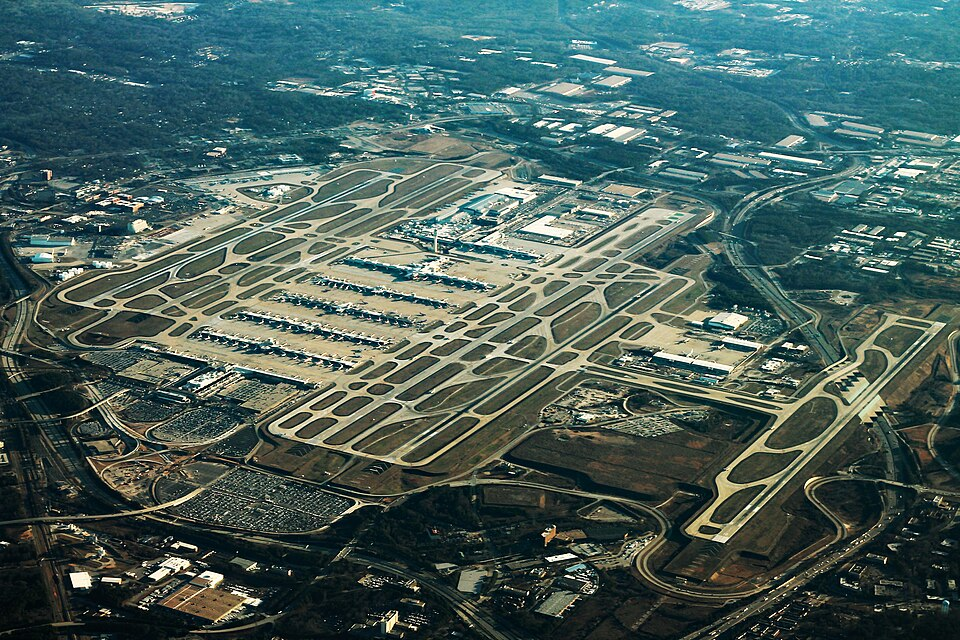
The busiest airport in the world is in a city that is not among the largest in its own country, and the explanation is the whole of the interest in it. Atlanta’s position is a consequence of a deliberate commercial design: a hub-and-spoke network, built by an airline, on a site chosen because of what can be reached from it rather than because of who wants to go there.
It has held the top position for passenger numbers in almost every year since 1998, and in most of those years it has also led for aircraft movements, which is a harder record and a more revealing one.
Why Atlanta and not somewhere bigger
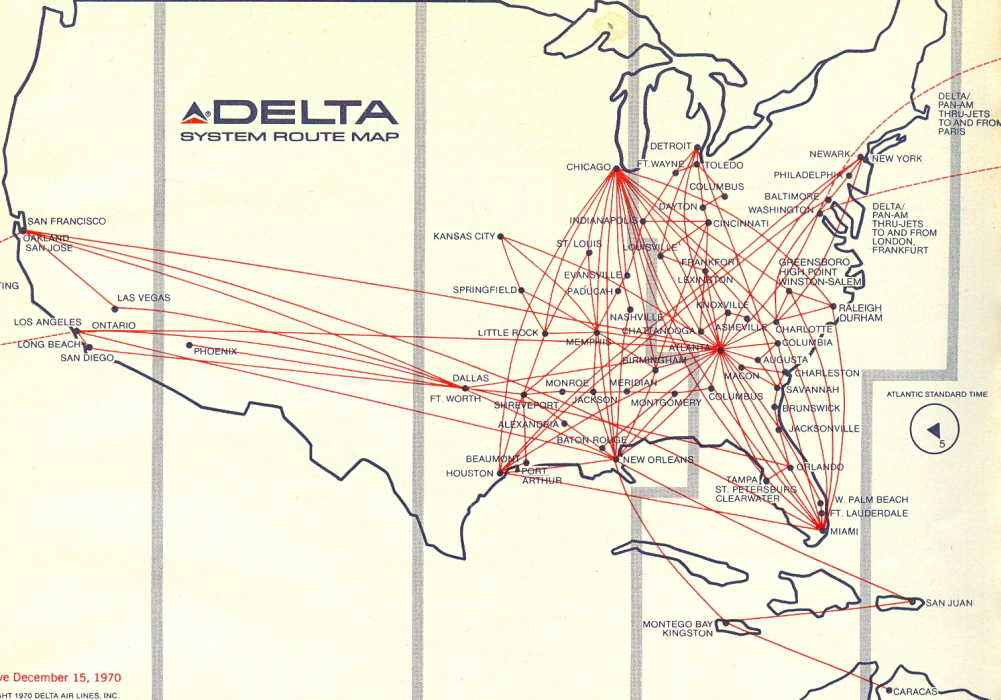
The airport’s advantage is geometric. A very large proportion of the population of the United States lives within a short flight of it, which means an aircraft can collect passengers from a wide spread of small and medium cities, land them all at the same place at the same time, and redistribute them to their actual destinations in a single coordinated wave.
That is the hub-and-spoke model and Atlanta is its most complete expression. The airline operating it built the system there, and the airport’s layout — a single landside terminal feeding a row of parallel concourses — was designed around the requirement to move very large numbers of people between aircraft rather than between the kerb and a gate.
The measure that demonstrates it is the connection share. A substantial proportion of the passengers counted in Atlanta’s total are changing planes, which means the airport’s ranking is a statement about the network rather than about the city, and a city with far more visitors can appear further down the list. London and New York both move more people through their airport systems in total, spread across several airports, which is a different kind of achievement and does not produce a single-facility record.
What busiest actually means
There are at least four different busiest airports depending on the question. By total passengers, Atlanta leads. By aircraft movements — take-offs and landings — Atlanta frequently leads as well, which reflects a large number of smaller aircraft rather than a few very large ones. By international passengers it has never led: that position belongs to Dubai, which is built on exactly the same connecting logic applied to intercontinental traffic. And by cargo tonnage the leaders are different again, with Memphis and Hong Kong at the top for reasons that have nothing to do with passengers.
The cargo ranking is the one most people find surprising, and it has the same explanation as the passenger one. A city becomes a freight hub because an integrator built a sorting operation there, and the tonnage follows the network. The same is true of the position for international passengers, which belongs to an airport whose home market is small relative to the number of people passing through it, for exactly the reason Atlanta’s does.
The rankings also moved sharply in 2020, when international travel collapsed and a predominantly domestic airport in China took the top passenger position for a year. That single year is the best available demonstration of what the normal ranking is actually measuring.
The runways and the ground
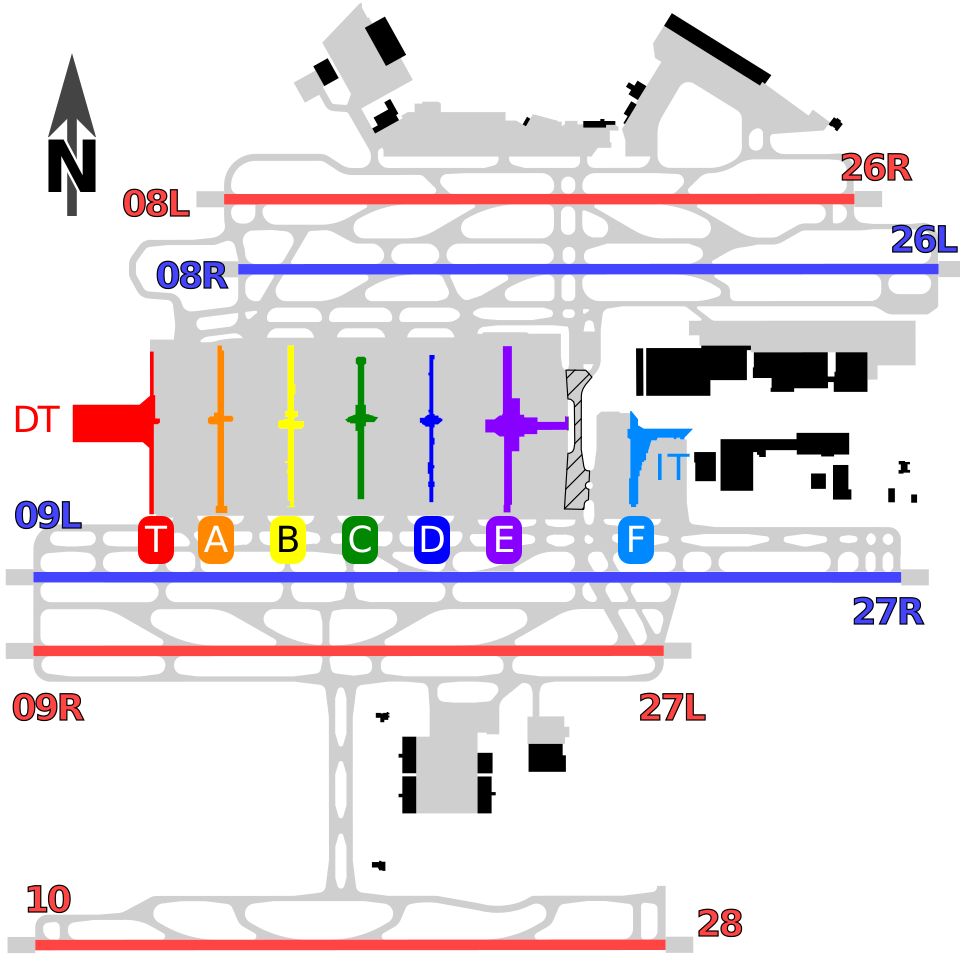
Atlanta operates five parallel runways, which is the physical reason it can handle the movement count. Parallel runways spaced sufficiently far apart can be used simultaneously, and the arithmetic of a hub — a wave of arrivals, a connection interval, a wave of departures — depends entirely on being able to land and launch a great many aircraft in a short period.
The constraint on a hub is rarely the terminal and almost always the airfield and the airspace. Adding gates is comparatively easy; adding a runway requires land, approach paths and a political process that can run for decades.
The passenger-facing consequence is the underground train that runs the length of the concourses, which exists because the row-of-concourses layout puts a long distance between the furthest gates. It is among the busiest people-movers anywhere, it runs continuously, and it is the piece of the airport most travellers actually remember. The decision to build the concourses in a row rather than as satellites around a central point is what makes the train necessary, and it was taken because a row is simple to extend: each new concourse goes on the end, and the train is simply extended to reach it. A satellite layout reaches a limit once the ring is full, which is why several older airports built that way have had to construct entirely separate terminals with their own road access and their own security, splitting the operation in a way Atlanta never had to.
The day it all stopped
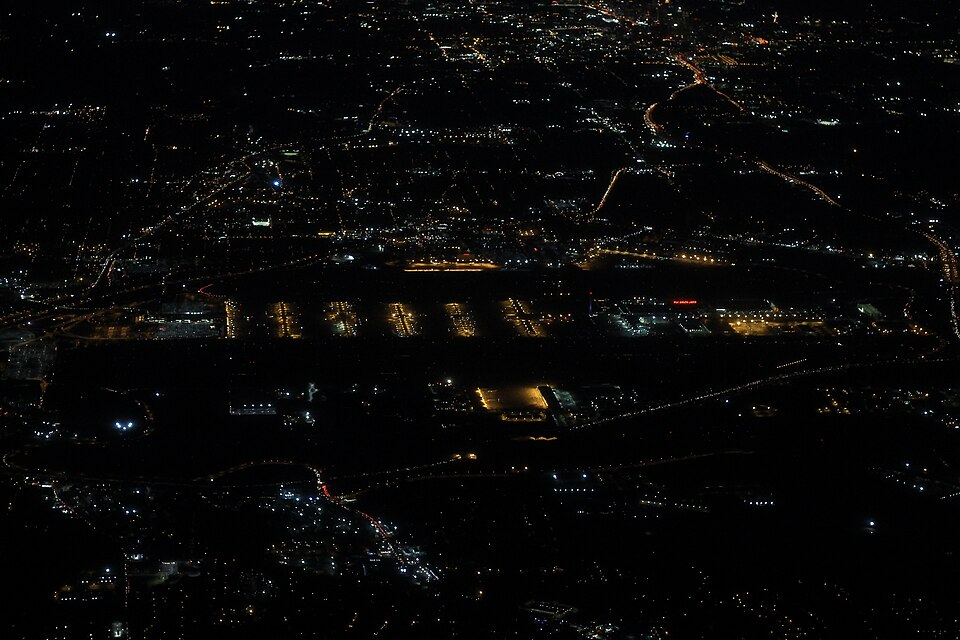
In December 2017 a fire in an underground electrical facility took out the airport’s power, including the redundant supply, for most of a day. Around a thousand flights were cancelled, aircraft sat on the ground with passengers aboard, and the effects propagated across the American network for days afterwards.
The incident is instructive rather than dramatic. The redundancy had been designed, and both the primary and the backup supply ran through the same tunnel, which meant a single event took both. The subsequent work separated them, and the episode is now a standard case study in infrastructure dependency.
It also demonstrated what a hub is. A disruption at a point-to-point airport affects the people going there; a disruption at a hub affects everybody whose itinerary happened to route through it, which in Atlanta’s case is a significant fraction of all domestic American travel on any given day.
What it is like to be in it
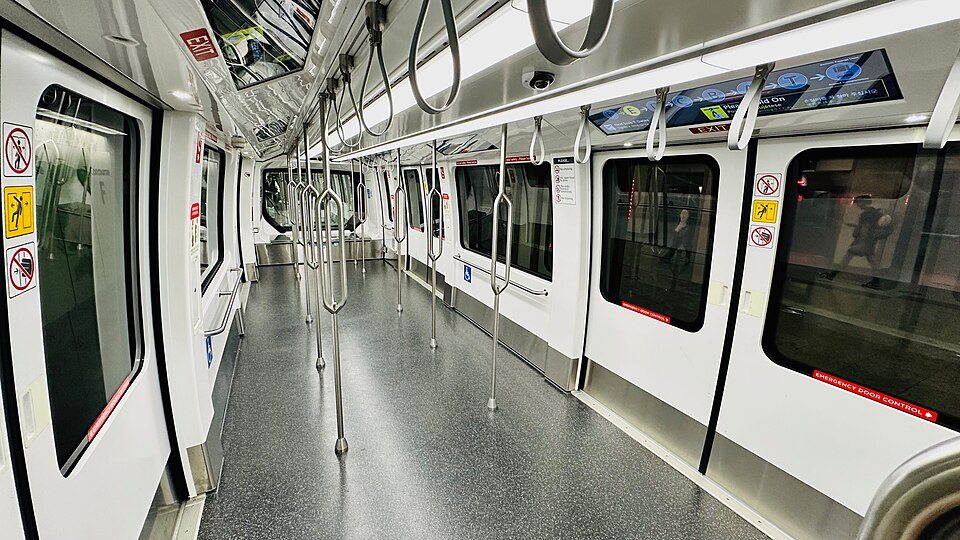
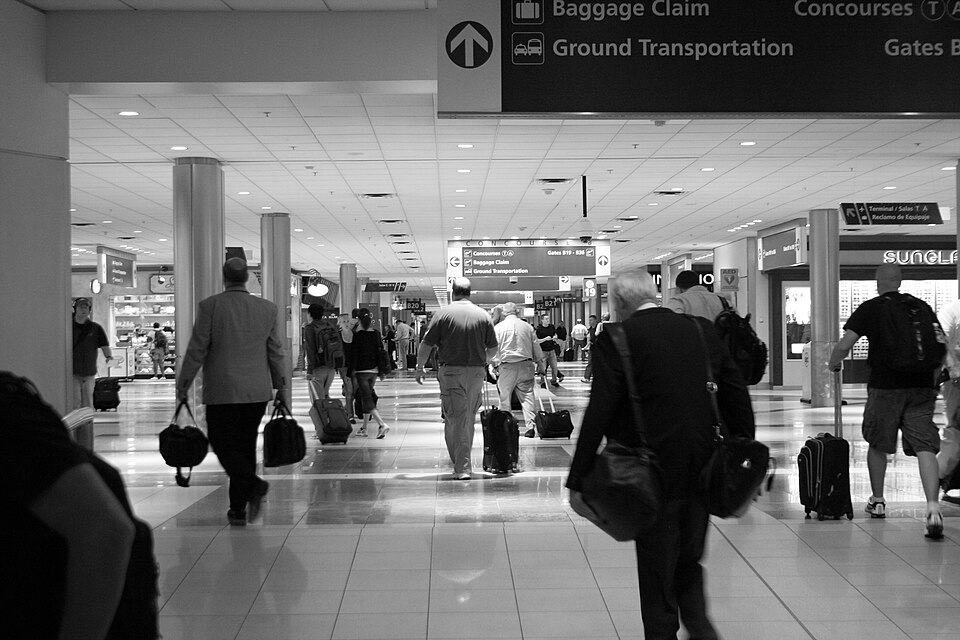
For a traveller the practical facts are straightforward. Connection times are generous by design rather than optional, the train is faster than walking for anything beyond the adjacent concourse, and the airport’s own guidance on minimum connection times reflects the real distances rather than an optimistic estimate.
The sheer scale produces one genuine piece of advice: the gate number tells you how far you have to go, and the difference between a connection in the same concourse and one at the far end of the row is substantial. Anybody with a tight connection should establish which concourse they are arriving in and which they are leaving from before the aircraft doors open.
The airport is also unusual in being comparatively easy to get into and out of, with a rail connection into the city, which is a function of having been built where there was room rather than of any particular virtue. That is a recurring theme in airport design. The facilities that work well on the ground are generally the ones that were given space early, and the ones that do not are generally hemmed in by a city that grew around them.
The thing the ranking does not measure

Passenger counts say nothing about the experience, and the airports that top satisfaction surveys are almost never the ones that top volume tables. The hubs are the busiest precisely because they are optimised for throughput, and throughput and comfort are in tension.
The ranking also says nothing about importance in any other sense. A small airport that is the only link to an island or a remote region matters more to the people who use it than a hub matters to any individual traveller, and the hub’s significance is systemic rather than personal.
What the ranking does measure well is network design, and that is why it has been so stable. Atlanta has held the position for a quarter of a century not because anything about the city changed but because the network built around it has not.
Why the record is likely to move eventually
Two pressures work against it. The long-term growth in air travel is concentrated in Asia, and the airports being built there are being designed with capacity that no American facility can match on an existing site. And the hub model itself is under some pressure from longer-range aircraft capable of flying city pairs directly rather than through a connecting point.
Neither is immediate. Hub economics remain strong for the enormous number of city pairs that cannot support a direct service, and the physical capacity Atlanta has in its five runways is not easily replicated.
The interesting thing about this record, in the end, is that it is the only one in this series that was deliberately created. A desert is the driest place because of where the mountains are; a cave is the longest because of where the sandstone sits. Atlanta is the busiest airport in the world because an airline decided to make it one, and then arranged several decades of its operations to keep it that way.
That makes it a different kind of superlative from the rest. The natural records in this series are facts about the planet that nobody chose and nobody can move. This one is a fact about a commercial decision, it has been defended continuously for a quarter of a century by the organisation that benefits from it, and it will change when that organisation’s economics change rather than when anything about Atlanta does.
Like our content? Follow us for more.