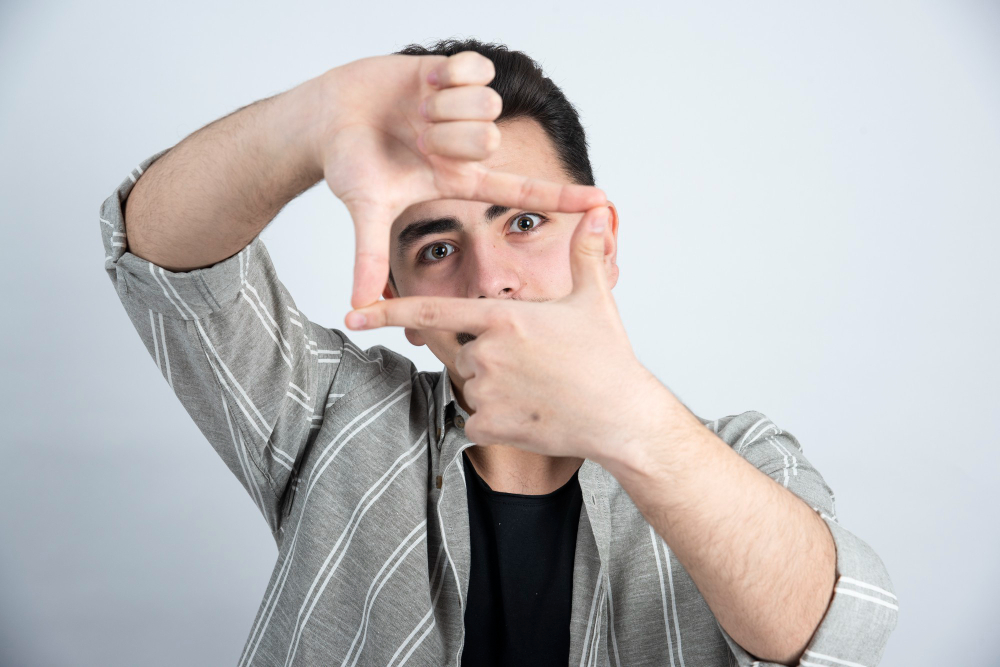
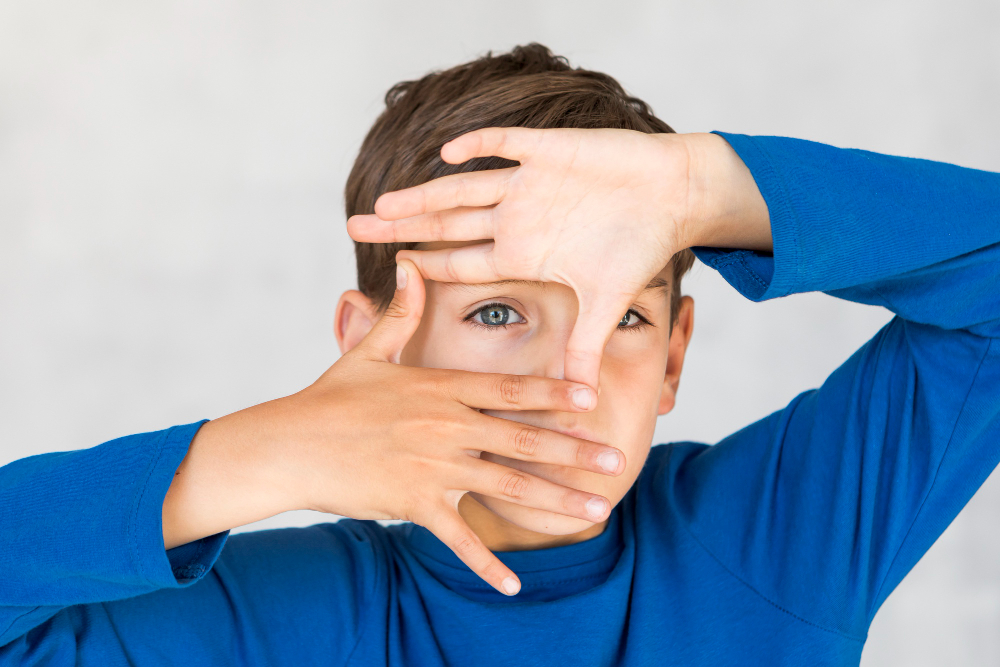
Hold both arms straight out in front of you and make a small triangle between your thumbs and forefingers, about the size of a coin.
Keeping both eyes open, move the triangle so that something small and distant sits in the middle of it – a light switch across the room, a door handle, a chimney out of the window. Hold it there.
Now close your left eye. Then open it and close your right eye instead.
With one eye closed the object stays in the triangle. With the other it jumps out of frame entirely. The eye that keeps the object where it was is your dominant eye, and for roughly two people in three it is the right one.
Nothing moved. Both hands stayed exactly where they were. The object did not move. What happened is that your brain revealed which of two slightly different images it had been using all along.
Like our content? Follow us for more.
Why the Object Jumps Out of the Frame
The reason the test works is that your hands were never pointing where you thought they were pointing.
When you framed the object with both eyes open, you were not aligning the triangle with the object. You were aligning it with the object as seen from one particular eye – the dominant one – because that is the eye your brain was using to do the aiming. Your hands went wherever that eye’s line required.
So the triangle is sitting on a straight line running from your dominant eye, through the gap, to the object. Close the other eye and nothing changes, because that eye was never on the line and was contributing nothing to the alignment.
Close the dominant eye, though, and you are now looking down a completely different line, from a point several centimetres to one side. The triangle is still where your hands put it, which is on the old line, so the object is no longer behind it. It has not moved. You have.
That is also why the jump is so large and so unambiguous. The further away the object, the bigger the apparent displacement, which is why the test works better on a chimney across the street than on something on the table in front of you.
It Is Not the Eye That Sees Better
This is the part people get wrong immediately, and it is worth being clear about: the test says nothing whatever about visual quality.
Your dominant eye may be the weaker of the two. A person can have noticeably better vision in the left eye and still be firmly right-eye dominant, and plenty of people are. The thing being measured is not sharpness, not acuity and not health.
What it measures is which eye the brain uses when it has to pick a single line of sight. That is a question about arbitration, not about resolution. The brain is not choosing the better picture; it is choosing a default, and it sticks with it.
The distinction matters because people who discover they are left-eye dominant frequently conclude that their left eye must be the stronger one, and go looking for confirmation. There is no reason to expect it. The two properties are set by different things and measured by different means, and they coincide no more often than chance would arrange anyway.
Why You Have One at All
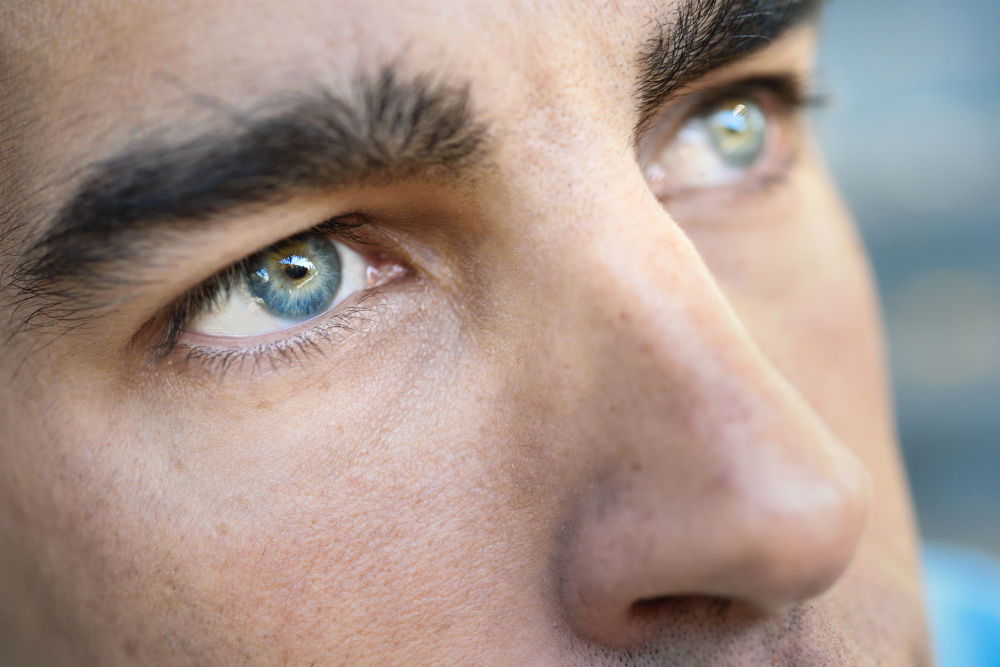
The reason is a geometry problem your eyes cannot solve on their own: they are in different places.
Because the two eyes sit a few centimetres apart, they see the world from two different positions and therefore produce two slightly different images. For most purposes this is a gift – the difference between them is exactly what the brain uses to judge depth and distance.
But it fails completely for one category of task. If you need to point at something, aim at something, or line two things up, there is no single answer available. Your left eye reports one alignment and your right eye reports another, and both are correct from where they sit. Average them and you point at nothing.
So the brain does not average. It picks one eye and uses that eye’s line, and suppresses the conflicting information from the other in the specific region where the two disagree. That is what a dominant eye is: a tie-breaking rule, applied automatically, for the cases where two correct answers cannot both be right.
It Barely Matters, Which Is Why Nobody Knows
Here is the explanation for the strangest thing about this – that a stable, measurable, lifelong feature of your own nervous system is something most people reach adulthood without discovering.
It barely has consequences. Walking, reading, driving, recognising faces, catching something thrown at you, judging a gap – all of these use both eyes together, and the dominance arbitration never has to be invoked. You go decades without encountering a situation that forces the question.
Compare that with handedness, which declares itself the first time a child is given a spoon and then announces itself several hundred times a day for the rest of their life. Eye dominance produces no equivalent signal. There is nothing in ordinary life that cannot be done perfectly well with the wrong eye in charge, because in ordinary life no eye is in charge.
Which means this is a real piece of self-knowledge sitting in plain view, requiring no equipment and ten seconds of attention, that the overwhelming majority of people have simply never been prompted to collect.
Except in the Few Places Where It Decides Everything
There is a short list of activities where the arbitration suddenly becomes the whole task, and in all of them eye dominance is treated as basic information.
Anything involving a sight line down a barrel or along an arrow. Anything looked at through a single eyepiece – a microscope, a telescope, a camera viewfinder, a surveying instrument. Anything where you lower your head to line up a shot across a table. Anything aimed.
In each case using the non-dominant eye produces a consistent error in one direction, and it cannot be corrected by trying harder, because the brain is not making a mistake – it is using the eye you told it to use rather than the one it would have chosen. People who are taught these skills properly are told their dominant eye early, and it is one of the few pieces of anatomical self-knowledge routinely handed out on a sports field.
It is also why a certain kind of photograph is slightly off-centre. Somebody raised a camera to the eye that happened to be nearer, rather than the eye their brain aims with, and framed the shot with the wrong one.
It Does Not Reliably Follow Your Hands

The obvious assumption is that the two go together – right-handed, right-eyed – and it is only loosely true.
Right-handed people are mostly right-eye dominant. But a substantial share of left-handed people are also right-eye dominant, which is to say the relationship is weak enough that you cannot predict one from the other with confidence in an individual.
The mismatch has a name in the activities above – a right-handed person with a left dominant eye is described as cross-dominant – and it is common. It is not a disorder, a defect or an imbalance. It is simply what you get when two separate preferences are settled by two separate processes that do not consult each other closely.
Which is another reason it goes unnoticed. People who assume their eye follows their hand never test it, and are frequently wrong.
There Is More Than One Kind of Dominance, and They Disagree
The triangle test measures one specific thing, and the picture gets more complicated the moment anybody measures anything else.
The kind you have just tested is sighting dominance: which eye the brain uses to aim. There is also a measurable preference in which eye’s image wins when the two are in direct competition, and a measurable preference in which eye is used when one is to be closed or occluded.
These do not always agree. A person can come out one way on one measure and the other way on another, and the proportion for whom all the measures line up is not as high as the single phrase dominant eye suggests. Some people show no clear preference on some tests at all.
So the honest version is that there is no single switch labelled dominant eye. There is a set of related preferences that usually but not always point the same way, and the triangle test samples the one that matters most for anything you would actually do.
The Thing It Was Once Wrongly Blamed For
For a period in the twentieth century, a mismatch between the preferred hand and the preferred eye was widely proposed as a cause of reading difficulty in children, and it was taken seriously enough to generate recommendations about which eye children should be encouraged to use.
It did not survive examination. Cross-dominance is extremely common among people who read perfectly well, and the association with reading difficulty did not hold up when it was looked at carefully. The idea has been abandoned in that form for a long time, though it still surfaces occasionally.
It is a good example of a pattern worth recognising in general. A real, measurable, slightly surprising biological asymmetry turned up; something unexplained needed a cause; the two were connected because both involved sides of the body; and the connection lasted decades on no good evidence.
The dominant eye is a real thing, and you now know which of yours it is. What it tells you about anything else is very close to nothing – which is, in its own way, the more interesting finding.
Like our content? Follow us for more.