


There is a horizontal bar across almost every exit door in a public American building. You have pushed thousands of them without looking at one.
It is worth looking, because that bar is the answer to a problem that killed a very large number of people in a very short time, and the reason it is designed the way it is – rather than as a handle, a button or a key – is one of the clearest pieces of reasoning in the history of building safety.
The Problem With a Door
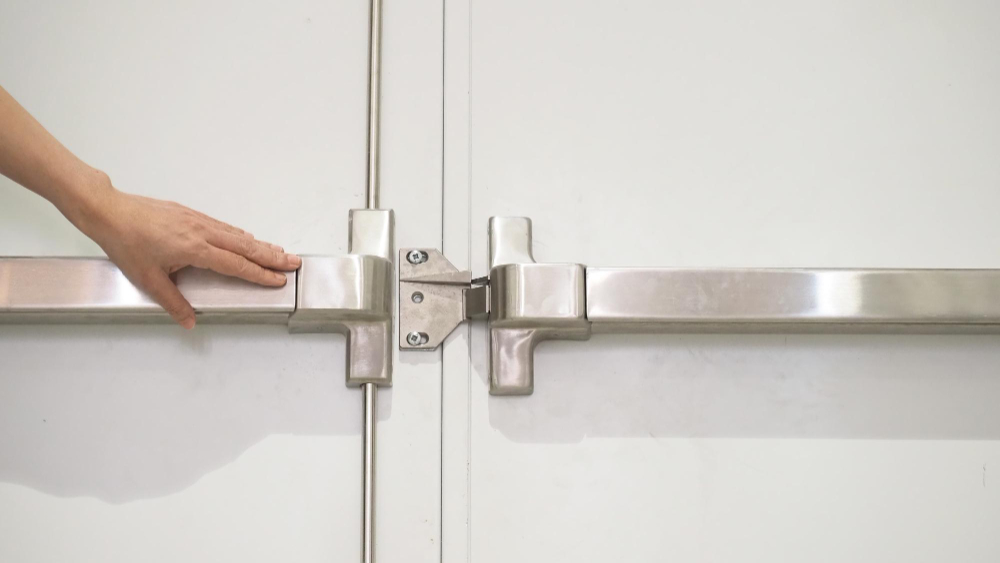
Start with what a door has to do, because the two requirements are in direct conflict.
An exterior door on a public building has to be secure. It must keep people out when the building is closed, and in a theatre or an auditorium it must stop people entering without paying while a performance is on. That argues for a door that is locked, or at minimum one that cannot simply be pushed open from inside.
The same door also has to let everybody out, very quickly, in conditions where nobody can see, nobody is thinking clearly, and the people at the front are being pushed by the people behind.
For most of the nineteenth century the solution to the first requirement was simply applied and the second was not considered. Doors on public buildings were commonly locked, bolted, or fitted with hardware that required a deliberate operation – a key, a latch to lift, a bolt to draw – and they frequently opened inward, because an inward-opening door is easier to weatherproof and does not obstruct a pavement.
Like our content? Follow us for more.
Why an Inward-Opening Door Is the Fatal Detail
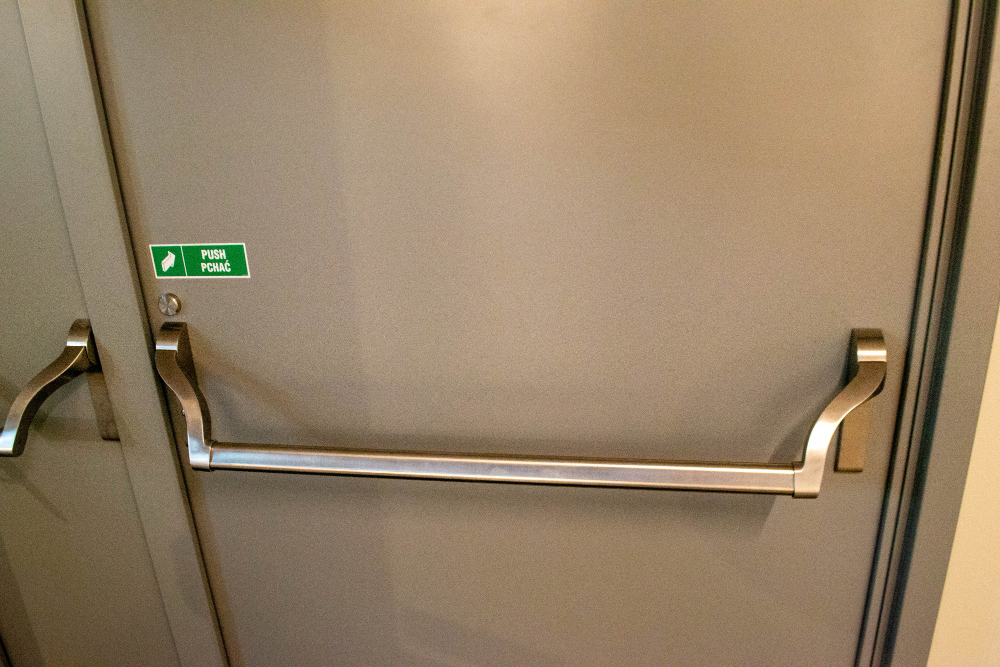
The inward swing is the part that deserves the most attention, because it is the single mechanical fact that turns a crowd into a catastrophe.
A crowd moving toward an exit arrives at the door and presses against it. If the door opens outward, that pressure helps – the weight of the crowd is doing exactly what the door needs to have done to it.
If the door opens inward, the pressure is the problem. To open it, somebody has to pull it toward themselves, into the space occupied by the crowd, which means the crowd has to move backward first. A crowd under pressure cannot move backward. The people at the front are held against the door by the mass behind them, and the door becomes, in effect, a wall.
That is not a failure of anybody’s nerve or judgement. It is mechanics. A few hundred people pressing forward generate a force against the leaves of a door that no individual at the front can overcome, and the door cannot be opened until the pressure comes off – which, in an emergency, it does not.
The Night That Changed It
In December 1903 a newly built and widely praised theatre in Chicago caught fire during a matinee performance with a capacity audience, a very large proportion of them children, and the loss of life was enormous – the worst single-building fire in American history.
What the investigation found was not that the building had been cheaply made. It was that almost every provision intended to let the audience out had failed, and had failed in ways that were predictable.
Some exits were locked or bolted to prevent people slipping in without a ticket. Some were concealed behind drapery, so that an audience looking for a way out could not see them. Some were fitted with unfamiliar hardware – a latch that had to be operated in a particular way, which nobody in the dark and the smoke could work out. Some opened inward. And the routes to several of them were obstructed.
The details were specific, they were documented, and they were almost all about doors.
What Was Done About It
The response was a change in the rules, and then in the hardware, and the hardware is the part that lasted.
The rule changes came first and were widely adopted across American jurisdictions: exits must open in the direction of travel, must be unlocked while a building is occupied, must be marked and lit, must not be obstructed, and must be provided in a number and width proportional to the number of people inside.
But a rule that says a door must be unlocked while the building is occupied depends on somebody unlocking it, and the whole lesson of 1903 is that you cannot depend on that. The exits were locked because a member of staff had locked them, for a reason that made sense to him.
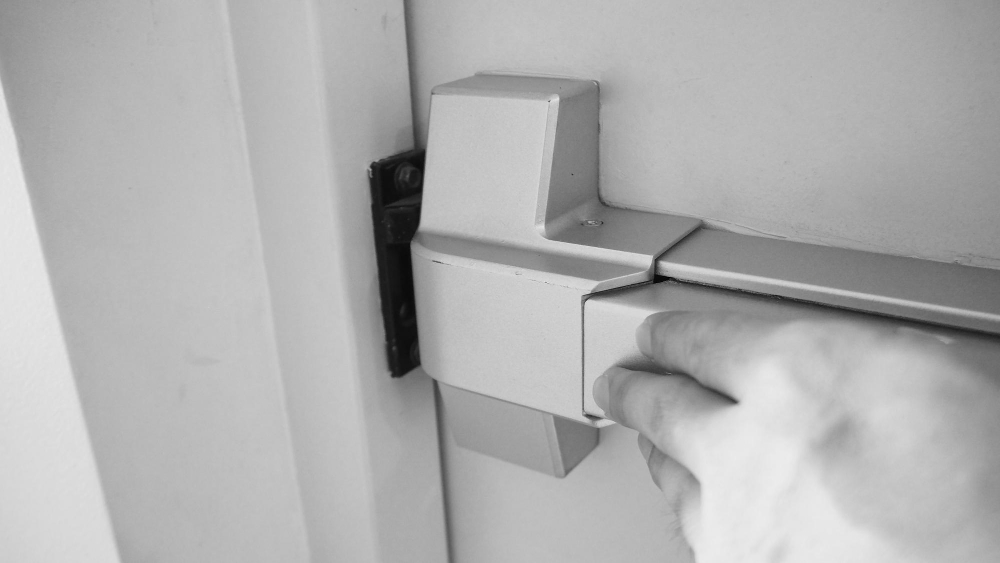
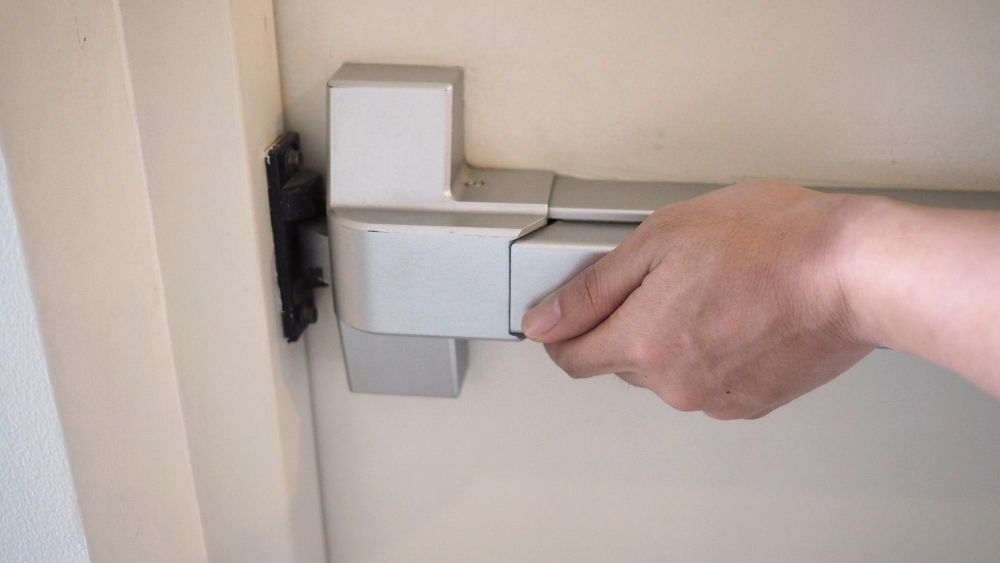
So the real solution was a device, and the device is the bar. A push-bar exit latch is mechanically locked from the outside at all times and releases from the inside under pressure anywhere along its length. It cannot be left locked, because it is not locked from the inside in the first place. It requires no knowledge, no decision, no hand position and no light. A person falling against it opens it.
Why the Bar Is Shaped Like That
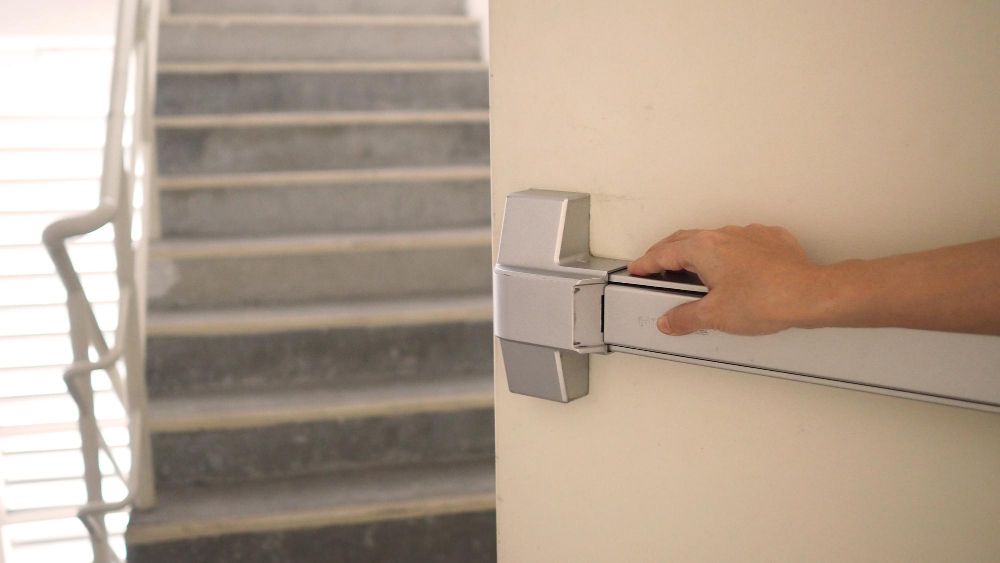
Every feature of the device is a response to how people behave in a crowd, and none of it is styling.
It is horizontal and it runs most of the width of the door, which means there is no part of the door a person can arrive at without hitting it. A knob or a button has to be found; a bar cannot be missed.
It is at roughly waist height, which is where a body pressed forward by a crowd makes contact, and is reachable by a child and by somebody who has fallen.
It releases on force applied in the direction of escape. There is no twist, no lift, no pull and no sequence. The only motion required is the one the person is already making.
And it releases at a low force, specified deliberately low so that it can be operated by a child, by somebody injured, or by a person being pushed who cannot use their arms at all.
That last point is the whole philosophy. The device does not assume a competent adult who has read a sign. It assumes somebody who cannot see, does not know where they are, cannot use their hands and is not in control of their own movement – and it works for that person.
The Other Half of the Problem Was Knowing Where to Go
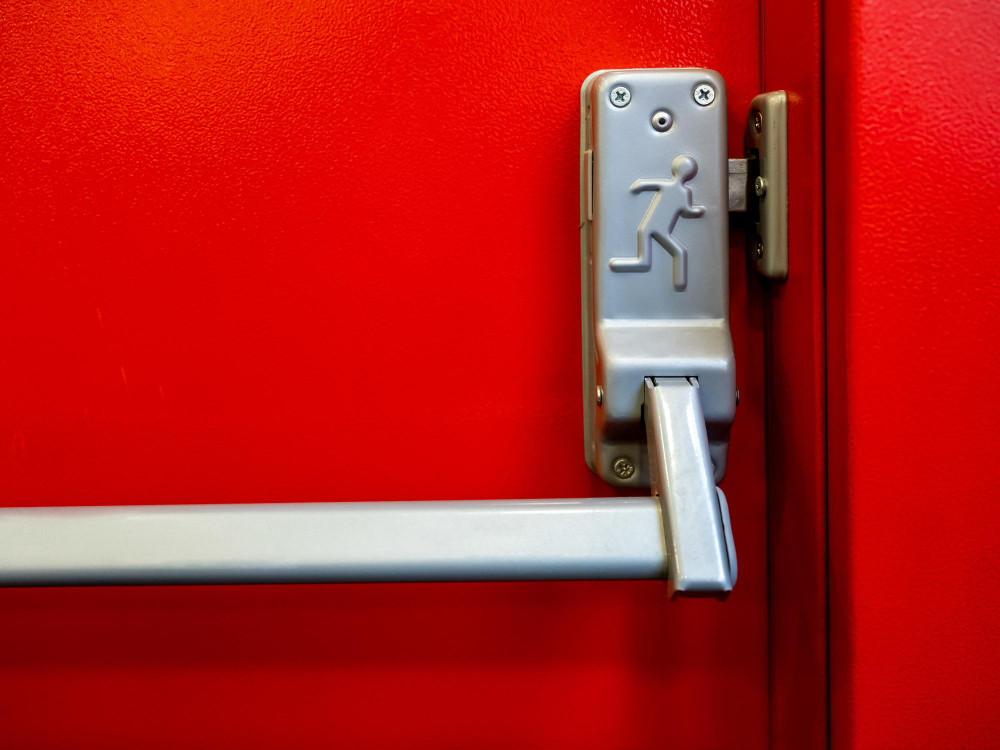
A door that opens is useless if nobody can find it, and the second half of the American egress system is about information rather than mechanics.
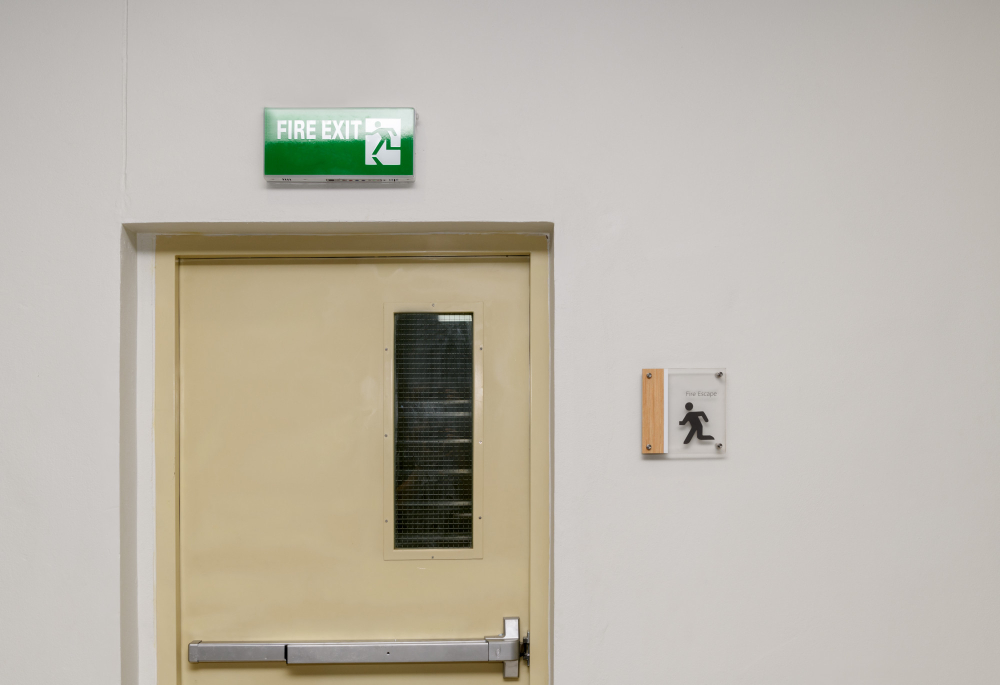
The 1903 findings included exits concealed behind drapery, which is the detail that explains the modern illuminated sign. An exit marker in a public American building is lit, is lit from its own power supply so that it survives the failure of the building’s supply, is required to remain legible in smoke, and is placed so that from any point in the space at least one of them is visible.
That last requirement is the subtle one. The rule is not that exits must be signed; it is that a person standing anywhere in the room must be able to see a sign without moving. Which means the sign layout is derived from the room’s geometry rather than fixed to the doors, and is why signs appear in corridors, at corners and suspended from ceilings in places where there is no door at all.
The same logic produced marked floor-level routes in some settings, on the observation that smoke fills a room from the top and that a person who has gone low can no longer see anything mounted high.
And it produced the requirement that any space have more than one way out, placed apart from each other. One exit is a single point of failure, and the 1903 audience had several exits that were all, for different reasons, unavailable at once.
Why It Took Another Fire to Finish the Job
The uncomfortable part of this history is that the lesson had to be learned more than once.
Four decades later a crowded nightclub in Boston caught fire and a large number of people died, and the findings were recognisably the same: a principal exit was a revolving door that jammed when the crowd hit it, other exits were locked or concealed, and some opened inward.
That second event produced the next layer of rules – the prohibition of a revolving door as a required exit unless it is flanked by conventional ones, restrictions on interior finishes that spread flame, occupancy limits enforced by inspection rather than by the operator’s judgement, and a requirement for more than one independent way out of any space.
The pattern is consistent across the whole history of this subject and it is not a flattering one. The rules are written after the event, they are written specifically, and they are written because somebody documented exactly which door did not open.
The Honest Summary
The bar on an American exit door is there because in 1903 a theatre full of people, mostly children, could not get out of a new building through doors that were locked to stop ticket evasion, hidden behind curtains, fitted with hardware nobody could operate in the dark, and in some cases hinged to open inward against the crowd.
The rules that followed required exits to open outward, be unlocked, be marked and be unobstructed. The device that followed made the rule physically self-enforcing: a latch that is always locked from outside, always open from inside, needs no instruction and releases under the weight of a body.
It is one of the very few safety systems in ordinary life that cannot be defeated by somebody forgetting, and it is the reason that every time you leave a public building in America you do so by leaning on something.
Like our content? Follow us for more.
