

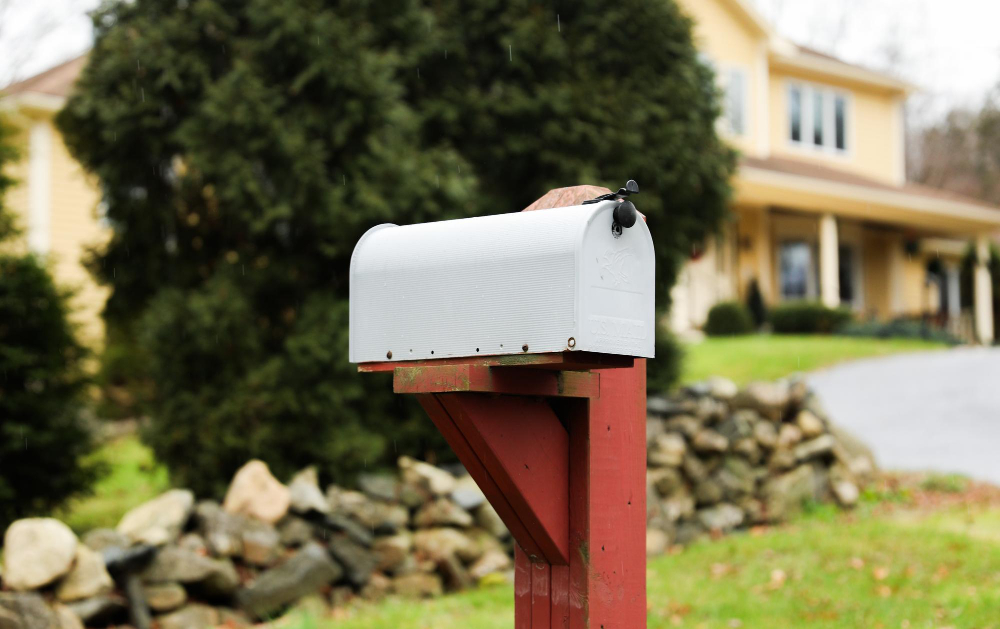
The American roadside mailbox is such a fixed feature of the landscape that it reads as a natural object. It is on a wooden post, it has a curved top and a hinged door, it has a small red flag on the side, and it is at the property line rather than at the house.
Every one of those features is the answer to a specific operational problem, the whole arrangement was a bargain rather than a design, and the thing that made it necessary is that for most of the nineteenth century a farmer in America did not get post at all.
Before It Existed, You Collected Your Own
The starting position is the one that is hardest to imagine now.
Through most of the nineteenth century American postal delivery to the door happened only in cities, and only in cities above a certain size. Everybody else – which at the time meant the majority of the population – had mail held at the nearest post office, and had to go and get it.
For a farming household that meant a trip into town, by horse or on foot, whenever somebody judged there might be something waiting. The post office was frequently a counter in a general store, the mail might be there for weeks, and there was no way to know whether a journey would be worth making.
The consequences were substantial and they were not merely inconvenient. A farmer was effectively outside the information system of his own country: newspapers arrived late or not at all, market prices were stale by the time he read them, correspondence took as long as somebody’s next errand, and anything official took longer still.
And a very large share of the American population lived that way, which is why the campaign to change it was a political movement rather than a postal reform.
Like our content? Follow us for more.
The Bargain
The service that eventually arrived was free delivery to rural households, and it came with conditions, because the arithmetic was brutal.
A city carrier on foot can serve several hundred addresses in a few miles. A rural carrier covers a route of many miles to reach a few dozen households, most of them at the end of a track. The cost per delivery is an order of magnitude higher, and the Post Office knew exactly what it would cost because it ran trials before committing.
So the deal was explicit. The service would come to the road. The householder would provide a receptacle, at their own expense, placed where the carrier could reach it without leaving the vehicle, at a specified height and position, and maintained in good condition. If you wanted your mail, you put up a box where the carrier could get at it from the seat.
That is the whole explanation for the location, and it is a transaction rather than a preference. The box is at the road because the carrier is not getting out of the vehicle, and the carrier is not getting out of the vehicle because the route is forty miles long and there are three hundred boxes on it.
Why the Box Looks Like That
The familiar shape was not left to the householder’s imagination for long, and every element of it solves something.
The early period produced chaos. People used whatever they had: wooden crates, tin cans, lard pails, soap boxes, bird houses. Mail got wet, got blown away and got stolen, and carriers had to work out how to open an unfamiliar container at every stop.
So the Post Office specified an approved design and then approved manufacturers to make it, and the shape that emerged – a tunnel vault of sheet metal with a hinged door at one end – is the solution to four problems at once. The curved top sheds rain and snow and will not hold standing water. The arch is structurally rigid in sheet metal without any framing, which makes it cheap and light. The door is at the end rather than the top, so it can be opened from a vehicle alongside. And the shape stacks and ships efficiently, which mattered to a manufacturer selling them nationally.
The standardisation is the real achievement. A carrier arriving at a box knows exactly how it opens, which saves a few seconds at each of three hundred stops – and a few seconds times three hundred stops times every day is the difference between a route being viable and not.
The Flag Is a Signalling System
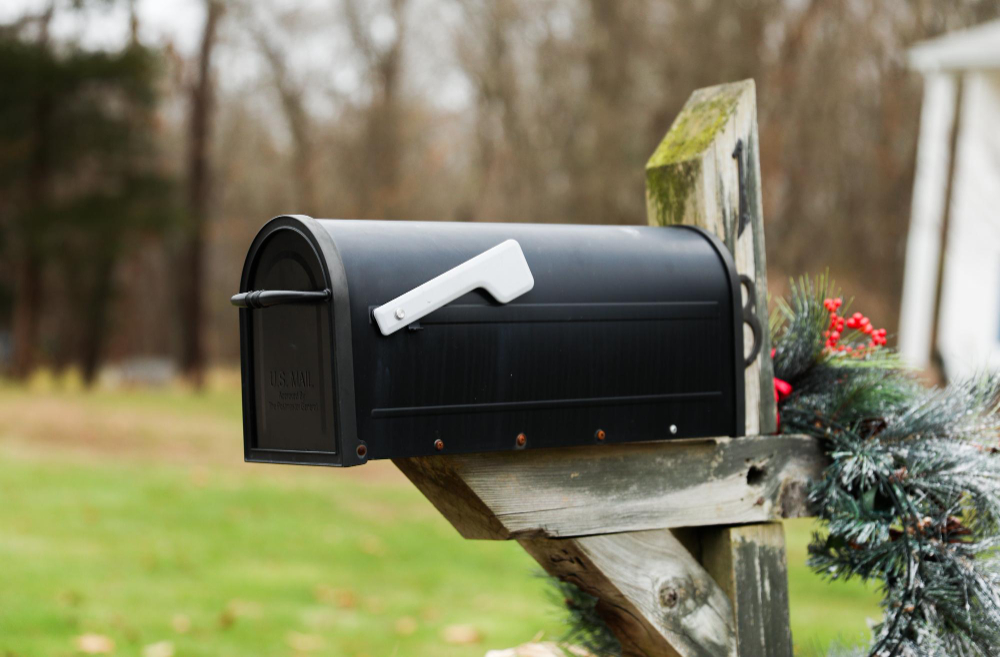
The small flag on the side is the part that most people have never thought about, and it is a neat piece of design.
It solves a problem specific to rural delivery: the carrier needs to know whether to stop. On a route of many miles with widely spaced boxes, stopping at a box with nothing in it wastes the time that the whole arrangement was built to save.
So the flag is raised by the householder to signal that there is outgoing mail to be collected. The carrier can see it from a distance, at speed, and decides whether to stop before arriving. If the flag is down and there is nothing to deliver, the carrier drives past.
It is a one-bit communication channel, visible at range, requiring no power, no literacy and no interaction, and it means the household can post a letter without going anywhere. For a farm twelve miles from town that is not a minor convenience – it is access to the postal system from the end of your own driveway.
The convention of which way the flag means what, and the fact that in most usage it is for outgoing rather than incoming mail, is the single most commonly misunderstood thing about the object.
What the Service Did to the Country
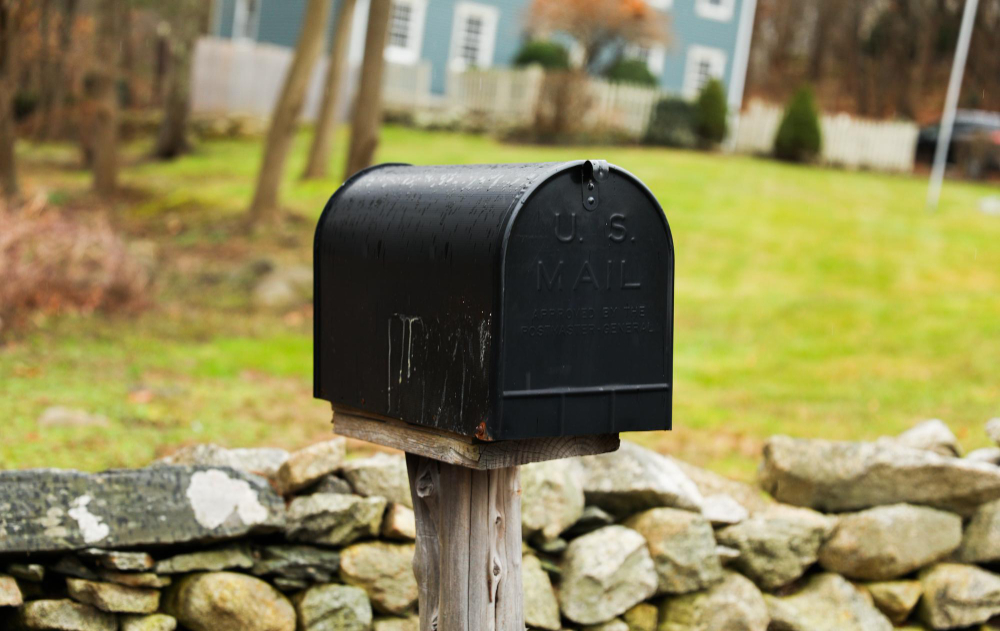
Rural delivery is one of those infrastructure decisions whose effects ran far beyond its stated purpose.
The most direct effect was on roads. The Post Office would only extend a route along a road that was passable year-round, which gave every rural community a concrete, immediate and local reason to improve its own roads – and they did, in enormous numbers, specifically to get delivery. A great deal of early American rural road improvement was driven by postal eligibility rather than by traffic.
The second effect was commercial. Once a parcel could reach a farmhouse, the mail-order catalogue became a viable way to sell almost anything to almost anybody, and the catalogue houses grew into some of the largest retailers in the world on the back of it. A farm family could buy from a national market at national prices rather than from the one store within reach, which broke a great many local monopolies.
The third was informational. Daily newspapers reached the countryside while still current, which changed rural politics, agricultural practice and the speed at which anything was known.
And the fourth was that it is the reason the box is at the road, which is where this started.
Why Europe Went the Other Way
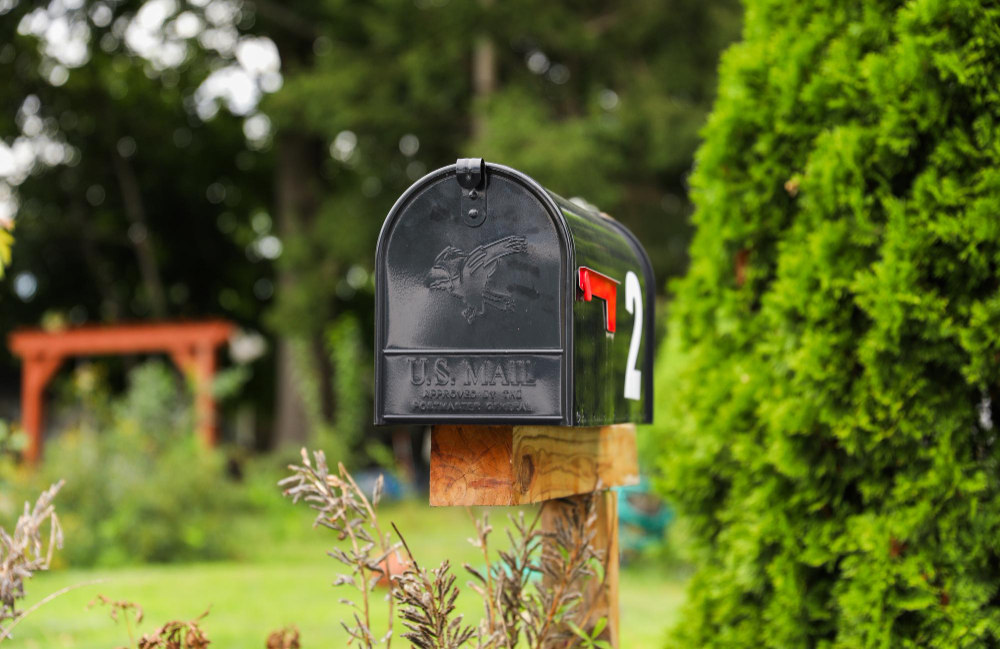
The contrast is not an accident either, and it comes down to density and sequence.
European postal systems were delivering to the door in towns and villages before the American rural service existed, in countries where settlement is dense, villages are nucleated and houses front directly onto streets. A carrier on foot can serve a European village without ever leaving the pavement, so there was never a reason to move the receptacle away from the building.
The letter slot in the door follows from that: if delivery is to the building, the receptacle is in the building, and the mail ends up inside and dry without anybody providing anything.
America had the opposite problem – low density, dispersed farmsteads, long tracks – and solved it by moving the receptacle to the carrier rather than the carrier to the receptacle. Both are correct answers to their own geography, and the fact that American suburbs built later kept the roadside box is simply inheritance: the hardware, the habit and the carrier’s vehicle-based route were already standard.
The Honest Summary
The American mailbox is at the road because rural free delivery was granted on the condition that the household put a receptacle where a carrier could reach it from a moving vehicle, and pay for it themselves.
Its shape is a specification: a sheet-metal arch because that is rigid without framing and sheds snow, a door at the end because it is opened from alongside, and a standard design because a carrier making three hundred stops cannot work out an unfamiliar container at each one. The flag is a one-bit signal telling the carrier whether stopping is worth it, which is what lets a farm post a letter without going into town.
And the service it was the price of admission for did considerably more than deliver letters. It got rural roads improved so that routes could be extended, it made the mail-order catalogue possible and with it national retailing, and it put a current newspaper on a farm porch for the first time.
Europe put the slot in the door because the carrier was already walking past it. America put the box at the gate because he was never going to.
Like our content? Follow us for more.
