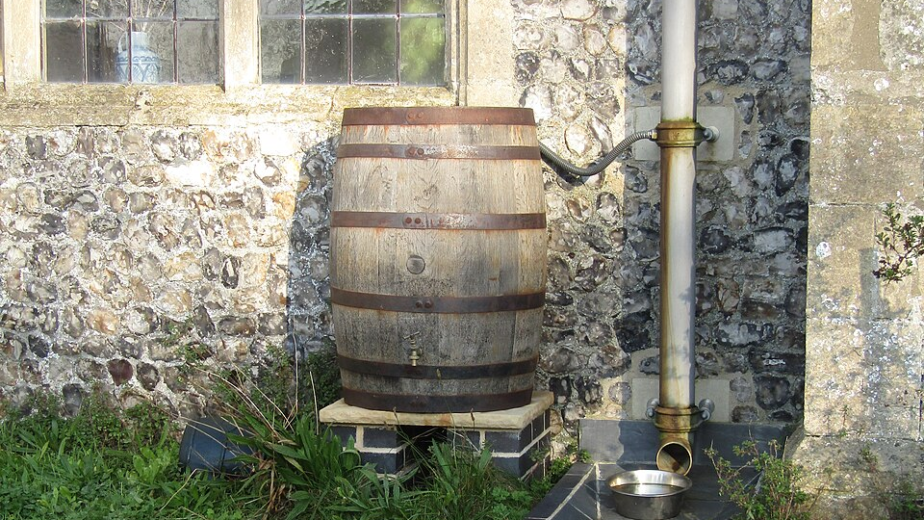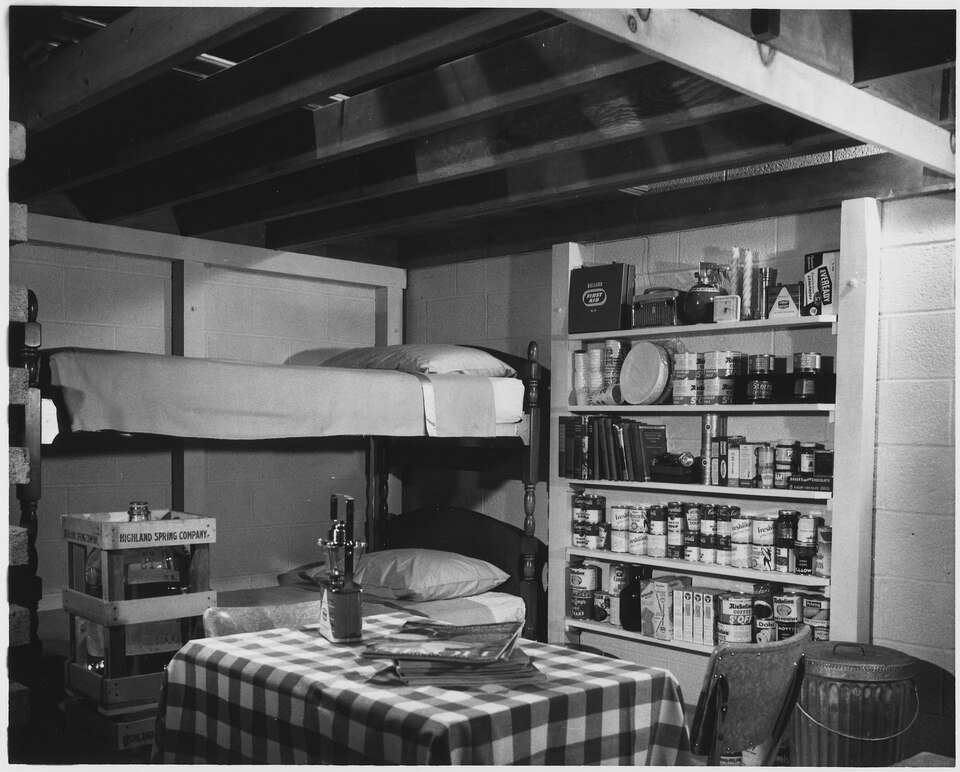
For about three years in the early 1960s, a substantial number of American households were actively engaged in stocking a room to survive in. The push was official, specific and unusually practical. The federal government published lists. Magazines ran plans. Lumber yards sold kits. And the contents of the resulting shelters were determined by printed recommendations that were revised, quietly abandoned, and in several particulars reversed.
What makes the shelter stock worth examining is that it was not folk practice. It was a considered national programme, assembled by people with access to the best available information, and almost every line of it has since been replaced. Looking at the list is a reasonably clean way to see how much of what feels like permanent official wisdom is in fact the current draft.
The programme that produced the list
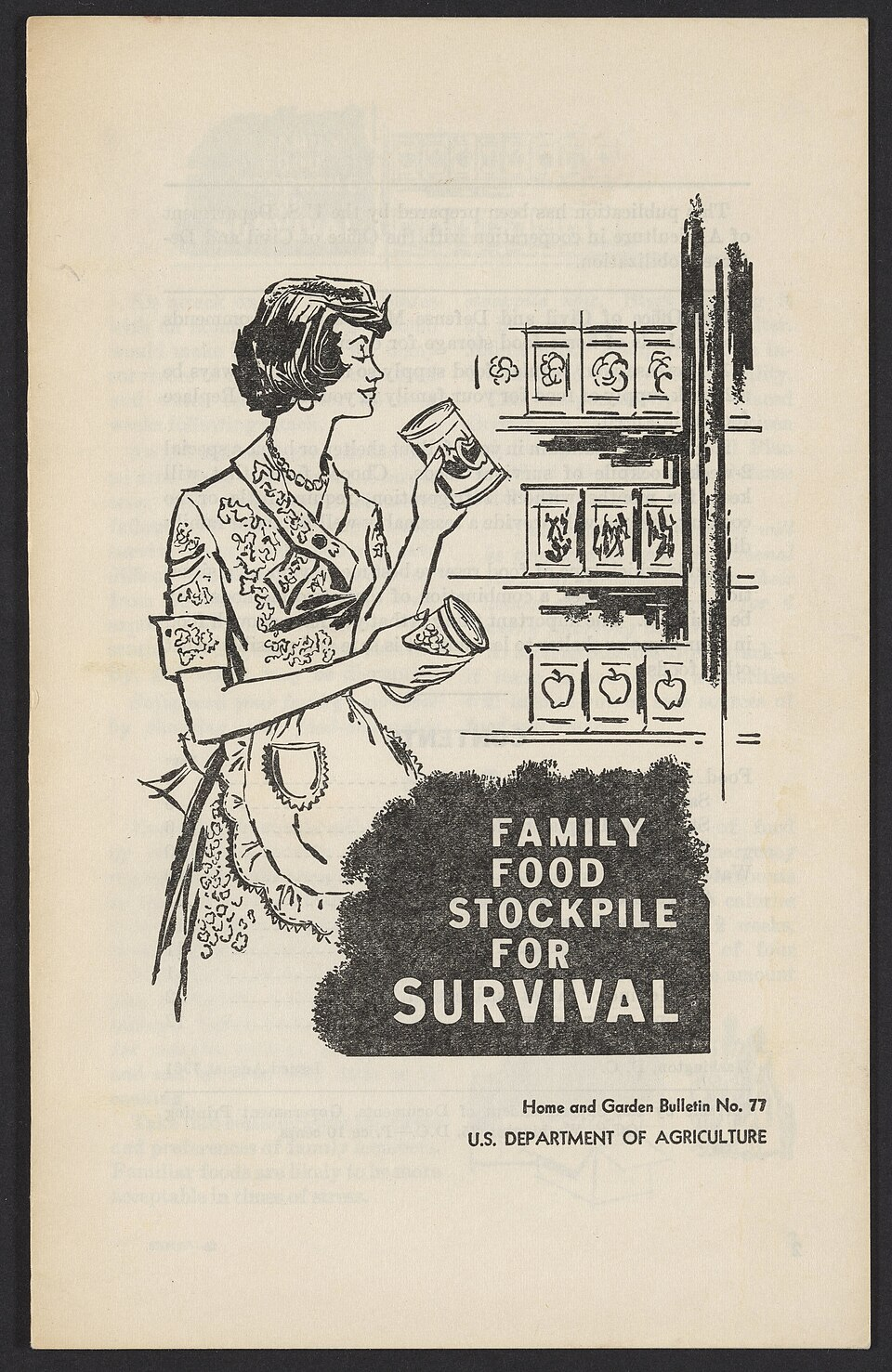
The modern shelter campaign dates to 1961. President Kennedy addressed civil defence directly that year, and a message on family protection appeared in Life magazine in September 1961 under a headline promising that readers could survive fallout. Federal booklets on the family fallout shelter had been circulating since the late 1950s and were reissued and expanded.
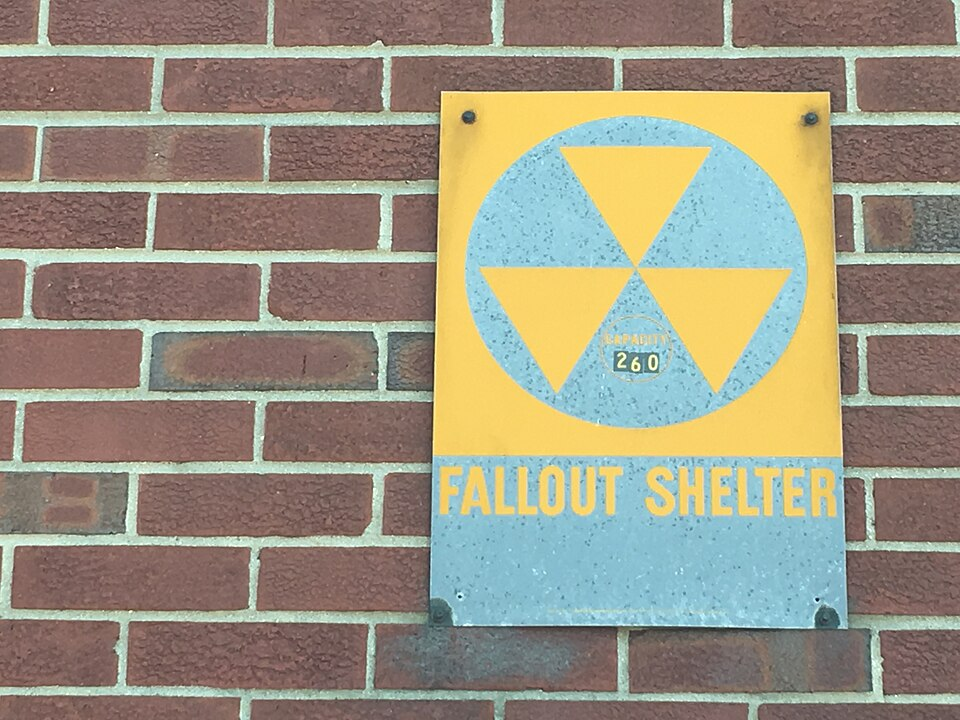
Alongside the private shelter came the public shelter marking programme, which is why the black-and-yellow trefoil sign bolted to the side of so many American schools, courthouses and apartment blocks is still there sixty years later. Buildings were surveyed, rated for the protection their mass offered, marked, and stocked. The private basement shelter and the marked public shelter were two halves of one plan, and the household list was written on the assumption that a family might be in there for two weeks.
Like our content? Follow us for more.
Water in a drum that was also the toilet
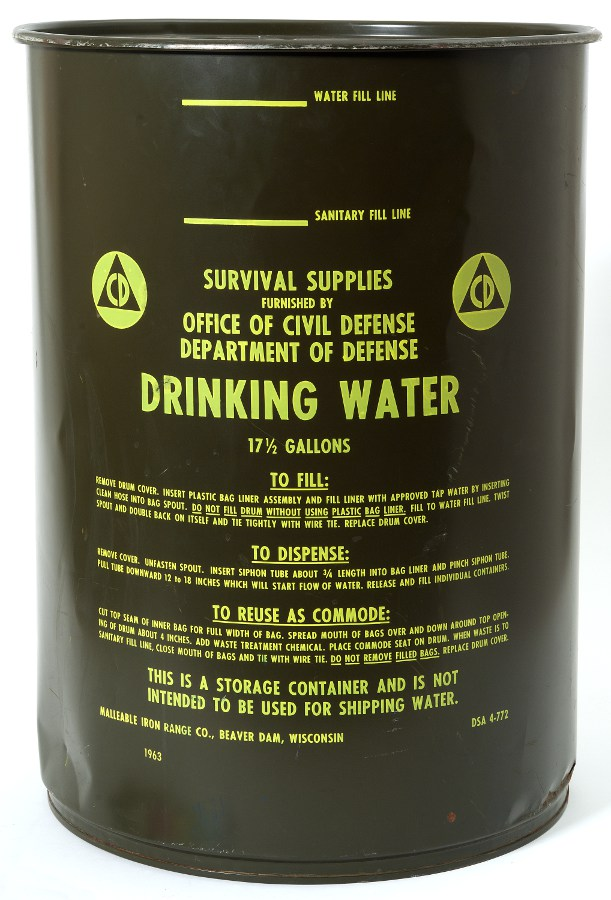
The centrepiece of the recommended stock was a steel drum of roughly seventeen gallons, filled with water, with a fitted lid. The same drum, emptied, was the sanitation arrangement. Commodity kits distributed to public shelters paired the water drum with a seat and chemical sachets for exactly that purpose, and the household literature described the same dual use.
No current emergency guidance recommends anything of the kind. Potable water storage and waste containment are now treated as separate problems with separate containers, for reasons that need no elaboration. The seventeen-gallon figure also assumed a ration far below what modern guidance considers adequate, and the drums themselves, being bare steel, imparted a taste that people who drank from them remembered for decades. The modern recommendation is a far larger volume of water in food-grade containers, rotated on a schedule.
There is a detail in the dual-use arrangement that explains a great deal about the thinking of the period. The drum was specified that way not through carelessness but because volume and weight were the binding constraints on a basement room, and a container that did two jobs halved the floor space. The planners were optimising hard against the limits of an ordinary American house, and in doing so they accepted a trade that no public health authority would now accept at any price. When the constraint is the size of a basement, the answer is a drum with two uses. When the constraint is the standard of care, the answer is that the question was wrong.
Crackers engineered for five years
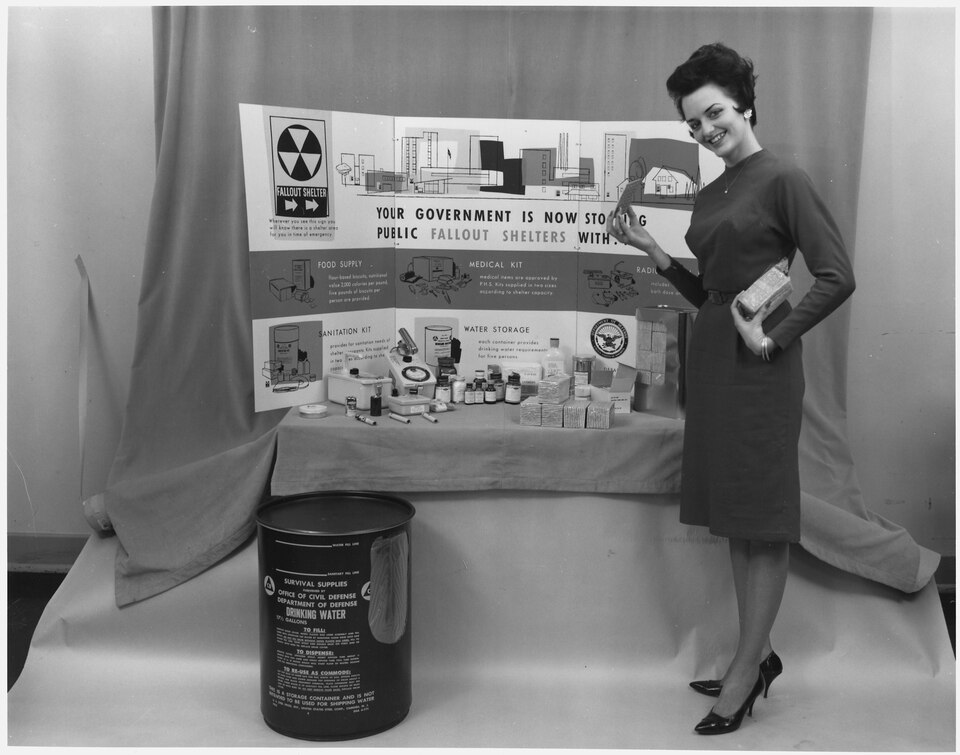
Public shelters were stocked with survival biscuits: dense wafers of bulgur wheat in sealed tins, formulated for shelf stability rather than for eating, calculated to deliver a bare maintenance ration. They were supplemented by a hard carbohydrate candy in tins. Millions of pounds of both were produced and distributed through the 1960s.
The stocks did not age well, in either sense. The biscuits became a standing joke among the generation that tasted them, and as the tins passed their intended life the federal stockpile was progressively written off and disposed of through the 1970s. Current guidance has moved entirely away from purpose-built survival rations for household use and toward a rotated supply of ordinary shelf-stable food that a family actually eats, on the grounds that food nobody will touch is not a supply.
The ration arithmetic was equally austere. The calculation behind the biscuit tins was a maintenance figure rather than a comfortable one, built to keep a person alive and functional in a confined space for the assumed fortnight rather than to feed them properly. Nothing in the stock accounted for a child who would refuse the biscuits outright, for anybody who could not eat wheat, or for the fact that two weeks of the same dense wafer is a thing most people will stop doing before they are physically compelled to. Current household guidance handles all three by abandoning the special-purpose ration altogether.
A radiation meter on the kitchen table
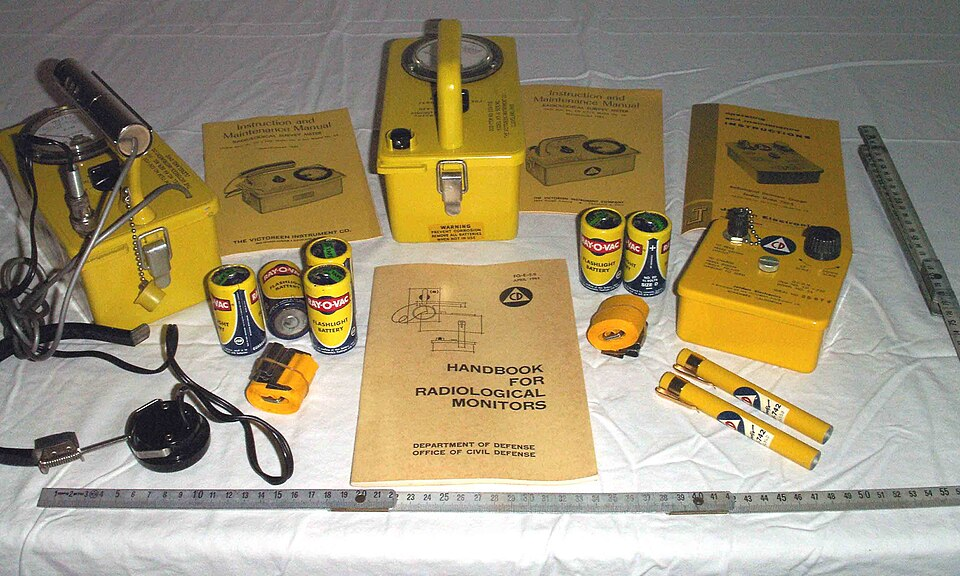
This is the item that would be most unthinkable now. Civil defence instruments were issued in very large numbers, including a survey meter and a higher-range instrument intended to be read by whoever was present, with a dosimeter and a charger. Households were encouraged to understand readings and to use them to decide when it was acceptable to leave the shelter.
No modern agency asks a householder to make that judgement, or to own the instrument for making it. The current model is the reverse: official monitoring, official instruction to shelter or evacuate, and no expectation that a member of the public interprets a dial. The shift is not about the instruments, which worked. It is about an assumption that was abandoned — that in the relevant scenario there would be no functioning authority to tell anybody anything, so each family had better be able to work it out alone.
That assumption is the real content of the 1962 shelter, and it is the reason the room feels so strange now. A family was being handed the whole decision. Not just the stocking of a room, but the reading of an instrument and the judgement of when the thing outside had passed. Public information of the period leaned into the self-reliance, because self-reliance was the only thing on offer. Modern emergency planning in the United States is built the opposite way round, on the premise that the system survives the event and issues instructions, and that the public’s job is to receive them. Whether that premise is better founded than the 1962 one is a genuine question, but it is the premise the current guidance rests on, and it is why none of the 1962 equipment list has a modern descendant.
What the kits did not contain

The omission is as instructive as the contents. Potassium iodide, the thyroid-blocking agent that features in modern guidance for populations near nuclear power stations, was not part of the 1962 family shelter stock. The protective rationale for it in a civil context was developed later, and the American distribution programmes around reactor sites belong to the period after the accident at Three Mile Island in 1979 and the reassessments that followed Chernobyl in 1986.
So the household that stocked carefully to the 1962 list, and then stocked again to current guidance, would end up with two almost entirely different rooms. The overlap amounts to a flashlight, a battery radio, a first aid kit and canned food. Everything that was distinctive about the 1962 shelter — the drum, the biscuits, the meter, the two-week assumption, the do-it-yourself dose calculation — has gone.
The shelter as a household object
It is easy to read the shelter campaign as pure anxiety, and that misses something about how it actually sat in a house. A great many of these rooms were built and then used for other things almost immediately. The shelves took the canning jars. The cot became the spare bed. Children were told not to play in there and played in there. Within a decade a large share of American basement shelters had been fully absorbed into the ordinary storage life of the house, and the only sign of the original purpose was a reinforced ceiling and a door that was heavier than it needed to be.
The same is true at the civic scale. The trefoil signs stayed up long after the stocks were cleared out, bolted to brickwork, repainted around. Several generations of American schoolchildren walked past one every day without ever being told what it meant.
Why the list was replaced rather than corrected
The useful conclusion is not that the 1962 planners were wrong in detail, though in detail they were. It is that the list was built on a specific set of assumptions about the scenario, and when the assumed scenario changed the list did not survive being patched.
Current American guidance on radiological emergencies is written around different events, a different expected duration, an intact communications system, and a population that is instructed rather than self-directing. Under those assumptions a steel drum of drinking water with a toilet seat for a lid is not a slightly outdated recommendation. It is an answer to a question that is no longer being asked. That is the usual way official advice dies: not refuted, but quietly made irrelevant by a change in the premise underneath it.
Like our content? Follow us for more.