There is a four-lane road in southwestern China that runs 625 metres, about 2,051 feet, above the bottom of a gorge. That is higher than the Empire State Building is tall, and the drivers crossing it are doing so at normal highway speed with a concrete parapet between them and the drop.
The Huajiang Canyon Bridge opened on 28 September 2025 and took a record that had been held, since 2016, by another bridge over the same river about 200 kilometres upstream. Both are in Guizhou province, which is the detail that explains almost everything about why the world’s highest bridges are where they are.
The figures, and which of them is the record
The deck sits 625 metres above the bottom of the gorge. The main span between the towers is 1,420 metres, about 4,660 feet, and the whole structure is 2,890 metres long, a little over nine thousand feet. The north tower stands 262 metres above its foundation and the south tower 205 metres.
The record being claimed is deck height above the terrain below, which is the measure the bridge-ranking community uses and is not the same as the height of the towers, the length of the span or the depth of the water. A bridge can be enormously long and sit twenty feet above a river.
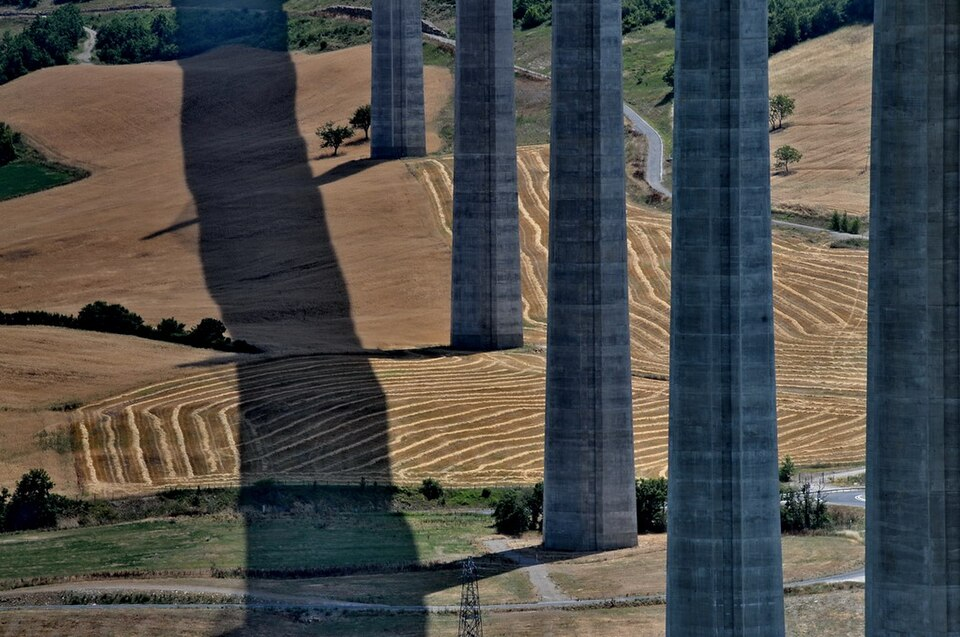
This matters because lists of tall bridges routinely mix the measures. The tallest bridge in the world by structural height is a different bridge entirely, in France, because its towers rise further from base to tip even though its deck is nowhere near this high.
So there are two separate records in circulation and they belong to two different structures. The one at stake here is how far it is from the road surface to the ground.
A third figure people reach for is the span, which measures the distance between supports rather than any height at all. The longest span in the world belongs to a bridge over a strait, where the problem being solved is getting across deep water without putting a tower in it. None of the three quantities predicts the others, and a bridge can lead on one while being unremarkable on the other two.
Like our content? Follow us for more.
Why Guizhou
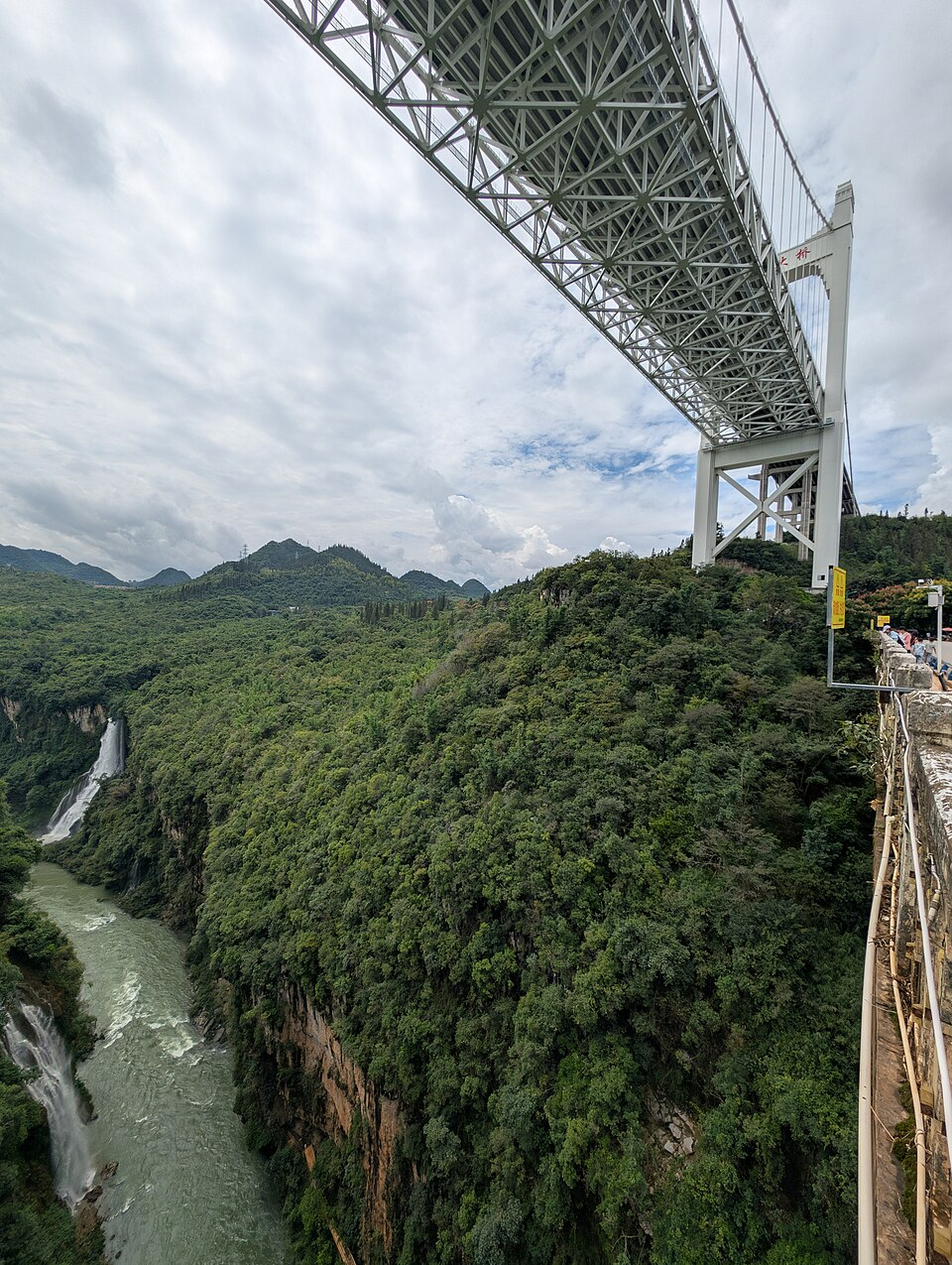
Guizhou is a limestone plateau cut by deep, narrow gorges. The rock dissolves along fractures over geological time, which produces vertical-sided canyons rather than the gentle valleys a river would carve in softer ground.
That landscape makes road building almost impossible by conventional means. A route that followed the ground would descend 600 metres, cross a river and climb 600 metres again, which costs time, fuel and road length, and is dangerous in bad weather.
The province’s answer has been to go straight across, repeatedly. Guizhou now contains a remarkable proportion of the world’s highest bridges, not because anybody set out to collect records but because the alternative was for a large population to stay several hours from the nearest city.
The bridge cut a journey that took around two hours down to a couple of minutes, which is the figure that actually justified the 2.1 billion yuan it cost. The record was a by-product.
It is worth sitting with what that two hours meant before the bridge. For anybody living on the far rim it governed whether a hospital was reachable in an emergency, whether perishable produce could be sold in a city, and whether a child could attend a school that was, in a straight line, close enough to see. Infrastructure arguments in difficult terrain are rarely about convenience.
How you build a deck that high
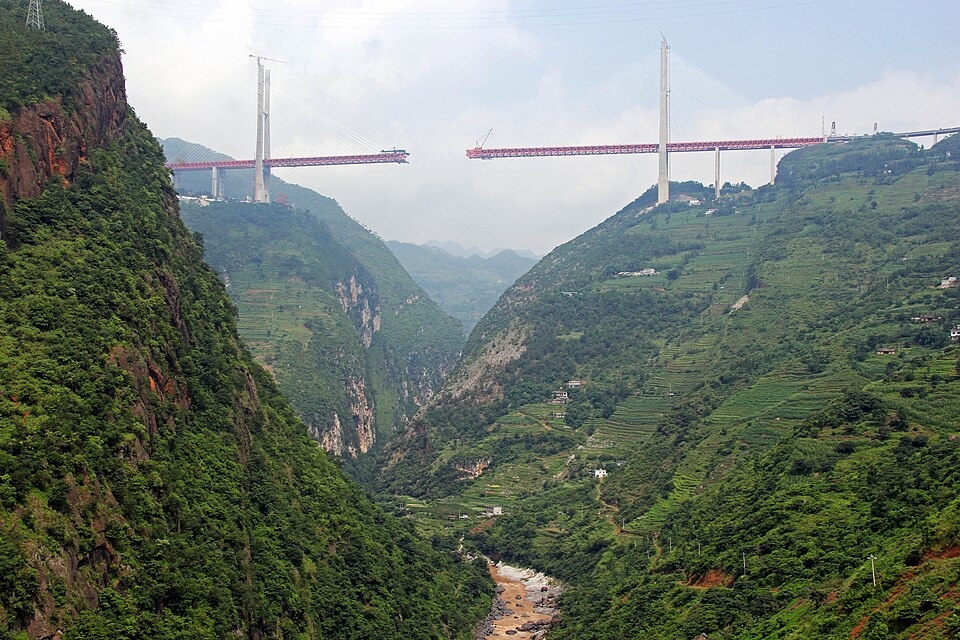
You do not build upward from the valley floor. The towers go up on each rim, cables are strung between them, and the deck is assembled in sections that are lifted from below or run out along the cables already in place.
That means the critical structure exists before the road does. The main cables carry everything, and the sequence of assembly has to be calculated so that the partially built bridge is stable at every intermediate stage rather than only when finished.
The steel truss deck here used around 22,000 tonnes of steel, which is in the region of three Eiffel Towers’ worth. Each section had to be hoisted from the valley and connected while hanging, with the tolerance for error measured in millimetres across a span of well over a kilometre.
Construction ran from 18 January 2022 to the opening in September 2025, about three years and eight months, with load testing conducted in the last week of August 2025 before traffic was allowed on.
Wind is the problem, not weight
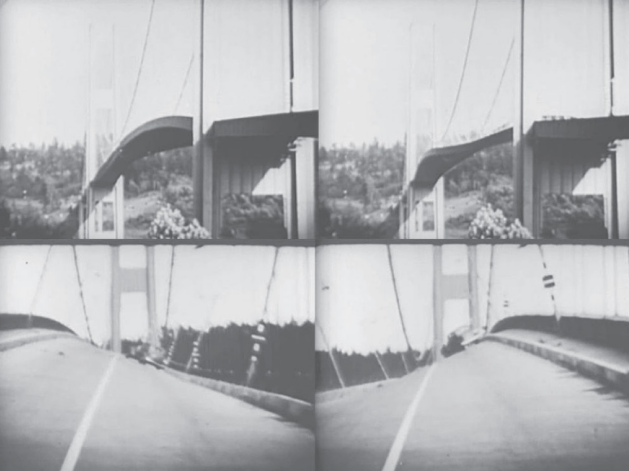
A suspension deck a kilometre and a half long and 625 metres up is a very large surface in a very exposed position. Wind loading, and more importantly the aerodynamic behaviour of the deck in wind, governs the design far more than the weight of the traffic does.
The failure mode engineers design against is not the bridge being pushed sideways but the deck beginning to oscillate, where wind energy feeds a twisting motion that grows rather than damping out. The lesson was learned expensively in the twentieth century and every long-span deck since has been shaped and tested against it.
The tools are wind tunnel testing of scale models, open truss or slotted deck forms that let air through rather than presenting a solid face, and in some designs added damping. A gorge complicates it, because the canyon walls channel and accelerate the wind in ways open country does not.
This is also why high bridges close in high winds while the road either side stays open. The closure threshold is a design output, not an excess of caution.
What they built on top of it
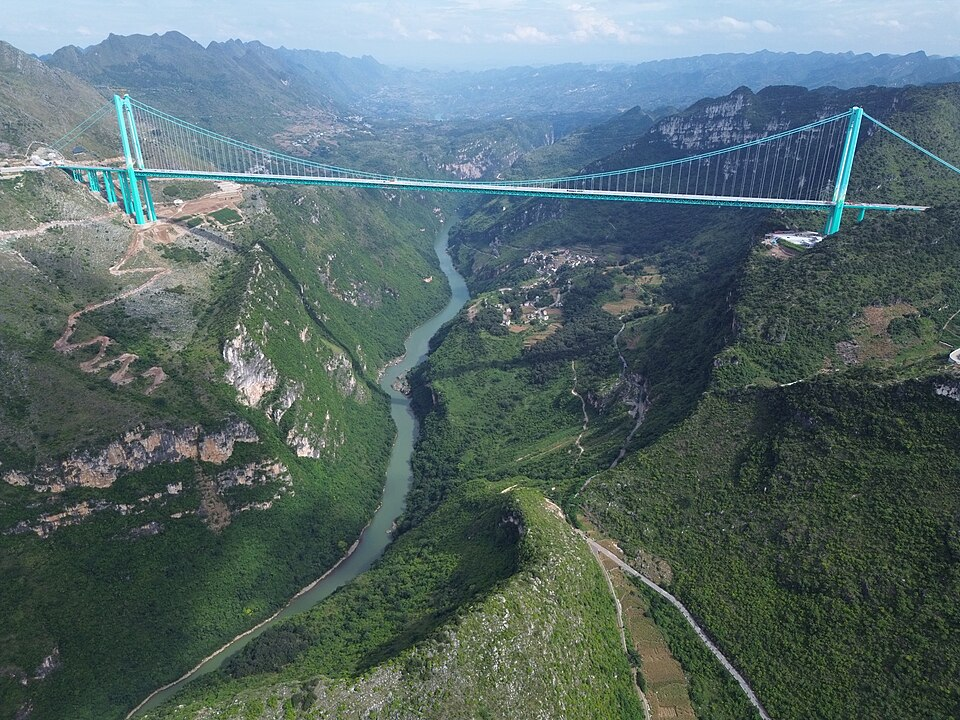
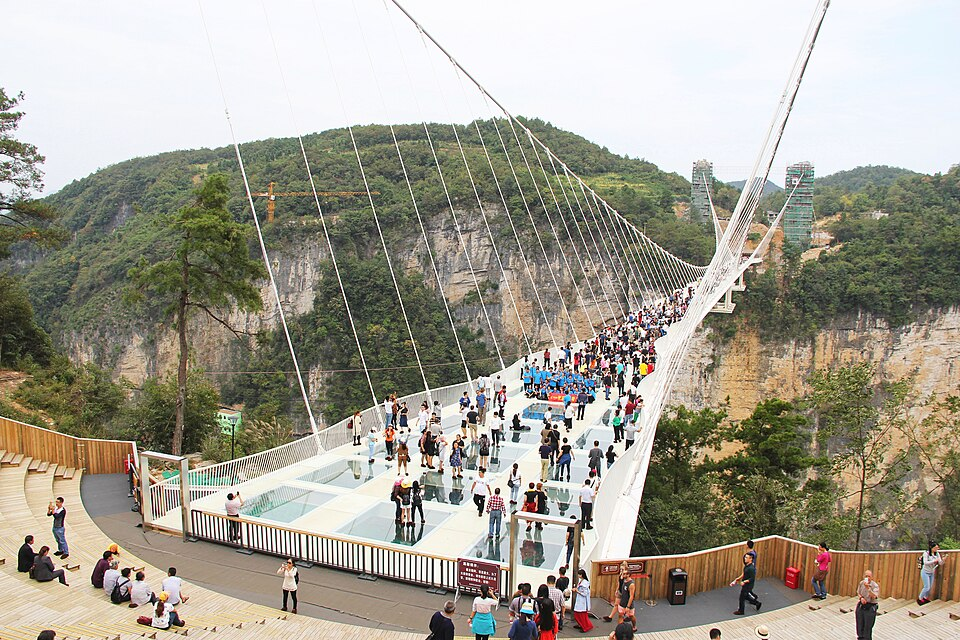
The bridge was designed from the start as a destination as well as a crossing, which is a more recent idea than it sounds. There is a glass sightseeing walkway slung below the vehicle deck, so visitors stand under the traffic with the gorge beneath their feet.
A glass-enclosed lift and staircase run up one tower, and at the top of it there is a coffee house roughly 800 metres above the valley floor. Facilities for bungee jumping and paragliding were integrated into the structure rather than added afterwards.
There is also a water-curtain installation about 300 metres wide falling nearly 100 metres from the structure, used for light and sound shows after dark.
Whether that belongs on a piece of transport infrastructure is a matter of taste, but the commercial logic is plain: a bridge that carries a few thousand vehicles a day in a thinly populated province is a difficult thing to pay for, and visitors are revenue.
The record will not last
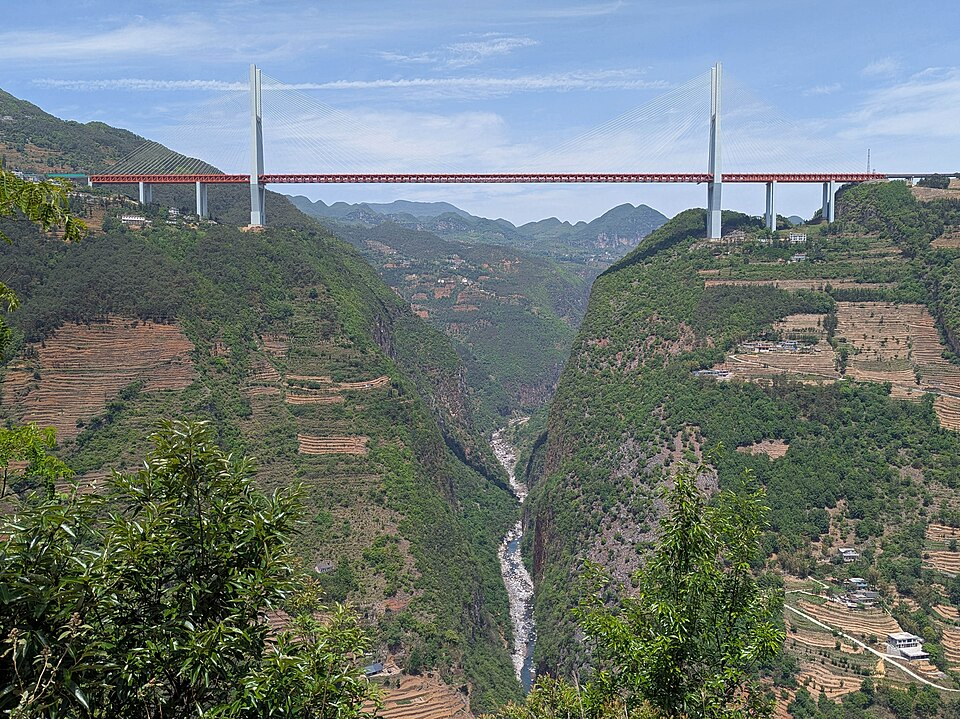
The previous holder lasted nine years. Before that the title had moved several times within the same two decades, and almost every move was to another bridge in the same region of China.
There are higher crossings already under design, and the engineering constraint is no longer really height. Modern cable technology can hold a deck at these heights without difficulty, and the limiting factors are the geology of the two anchorages, access for construction and whether the road the bridge serves justifies the cost.
Anybody writing down the current record should expect to revise it. The useful thing to know is not which bridge is highest this year but why the answer keeps being Guizhou, and that is a question about limestone rather than about engineering ambition.
It is also worth knowing that the world’s tall-bridge rankings are maintained by enthusiasts rather than by any official body, which is part of why the measures get mixed up. There is no bridge authority issuing certificates, and the lists disagree with each other at the margins about which structures qualify and how the ground beneath an irregular gorge should be measured in the first place.
What it is like to cross
Less dramatic than the numbers suggest, which is the common experience of high bridges. The parapet and the structural members block the downward view from a car, and at highway speed the crossing is over in under two minutes.
The view that makes the pictures is from the walkway, from the tower lift, or from the valley looking up. Drivers mostly report that it feels like an ordinary viaduct until they stop and look.
For a traveller the practical notes are ordinary ones: the visitor facilities have their own opening hours and charges, which are separate from the road; high winds can close the deck; and the nearest substantial towns are some distance away, so this is a destination you drive to rather than pass through.
The honest summary: the Huajiang Canyon Bridge opened on 28 September 2025 in Guizhou province, China, with its deck 625 metres or 2,051 feet above the Beipan River, a main span of 1,420 metres and a total length of 2,890 metres; it took the record from the Duge Bridge over the same river; the record measures deck height above terrain, which is not the same as structural height, a separate record held by a bridge in France; and the reason the answer is almost always Guizhou is that a dissolved limestone plateau produces vertical gorges that a road cannot otherwise cross.
Like our content? Follow us for more.