

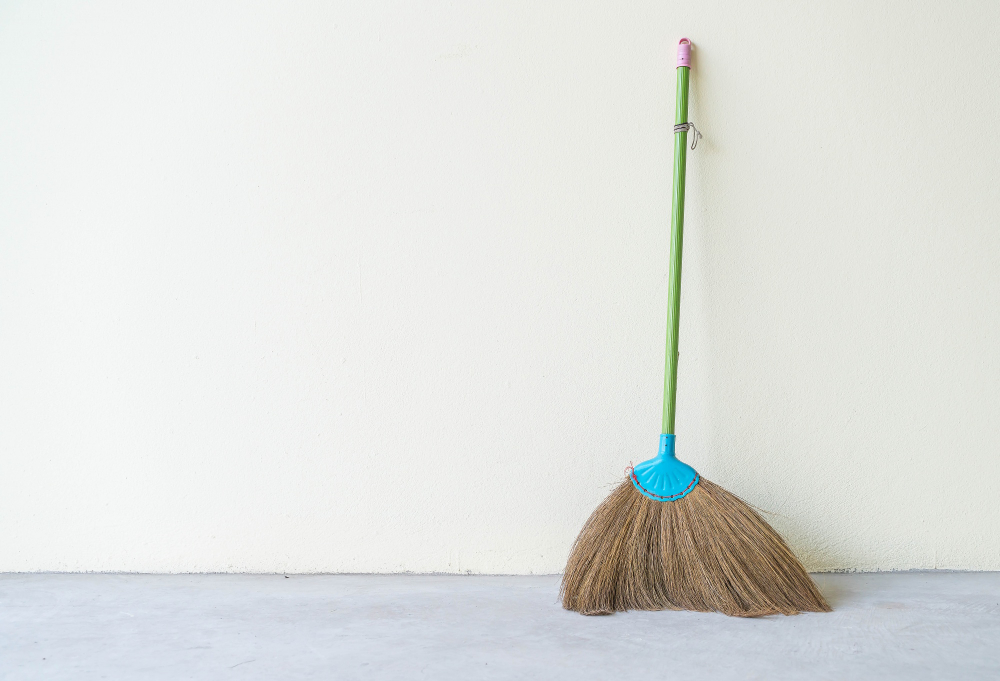
There is a tool so ordinary that almost nobody has considered how it works, and the answer turns out to be more particular than expected.
The obvious model is a bulldozer. Bristles form a wall, the wall is dragged across the floor, and dirt is pushed ahead of it in a heap.
That is not quite what happens, and the difference explains why a worn broom fails, why different brooms are made for different surfaces, and why a stiff yard brush is useless indoors.
What a broom actually does is trap. Each bristle flexes as it meets resistance, particles lodge against it and between neighbouring bristles, and as the broom moves they are carried, released and caught again. Sweeping is thousands of very small captures rather than one continuous push.
Why Stiffness Is the Specification
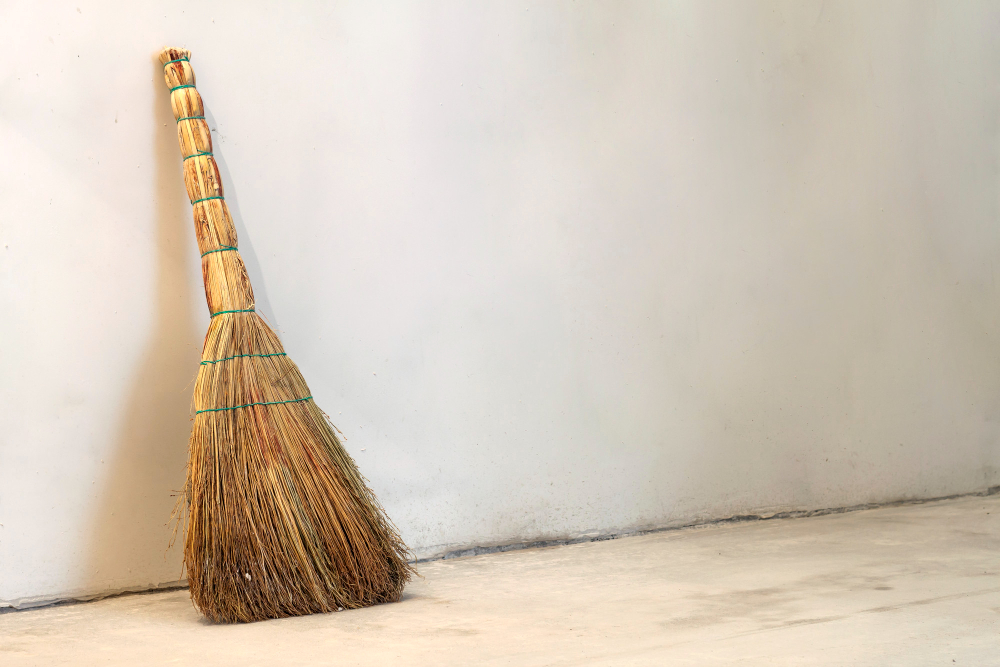
The bristle has two failure modes and the useful range sits between them.
A bristle that is too stiff does not flex when it meets the floor, so it rides over fine particles and over anything sitting in a crack, sweeping only the largest debris.
A bristle that is too soft folds over flat under the weight of the broom, presenting its length to the floor instead of its tip, and it drags without catching anything.
Between those, a bristle bends a little, maintains contact under pressure, and springs back — which is what allows it to catch, hold and release repeatedly.
That is why brooms are matched to surfaces. A rough outdoor surface needs stiff bristles to reach into the texture and move heavy debris; a smooth indoor floor needs soft fine ones that will not scatter fine dust; and a carpet needs something different again, which is why brushing a carpet with a floor broom achieves very little.
The bristle length matters too, since a longer bristle bends more readily at the same stiffness, which is why a broom worn short becomes stiffer in behaviour even though the material has not changed.
Like our content? Follow us for more.
Why a Worn Broom Stops Working
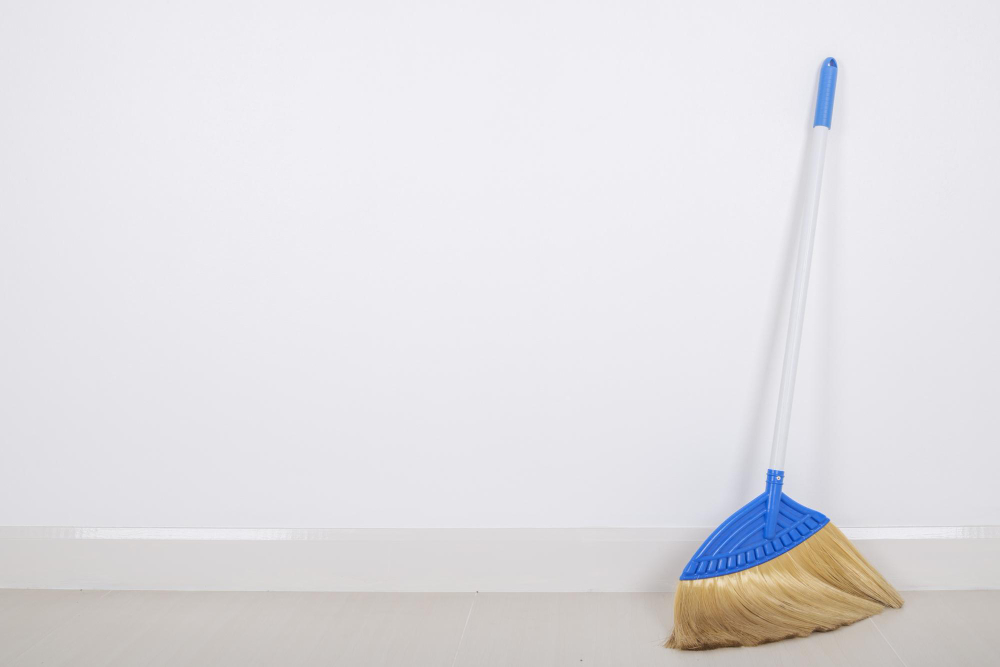
The failure is specific and everybody has experienced it.
Bristles wear at the tips, and they wear unevenly, because the part of the broom that does most of the work is used hardest.
That produces a face that is no longer flat, so only part of the broom touches the floor at any angle, and the effective width shrinks.
The remaining bristles are shorter, therefore stiffer in behaviour, and they splay outward because the wear removes support from the outer rows first.
A splayed broom has bristles at an angle to the floor, which means they cannot flex and release in the intended way, and they flick material sideways instead of forward.
That is the point at which sweeping becomes an argument, and it is not laziness on the part of the sweeper — the tool has truly stopped doing the thing it was shaped to do.
There is an angle point worth adding. A broom held too upright presents the bristle tips and skips; held too flat it presents their length and drags – so the working angle is narrow and is found by feel within a few strokes.
What the Bristles Were Made Of
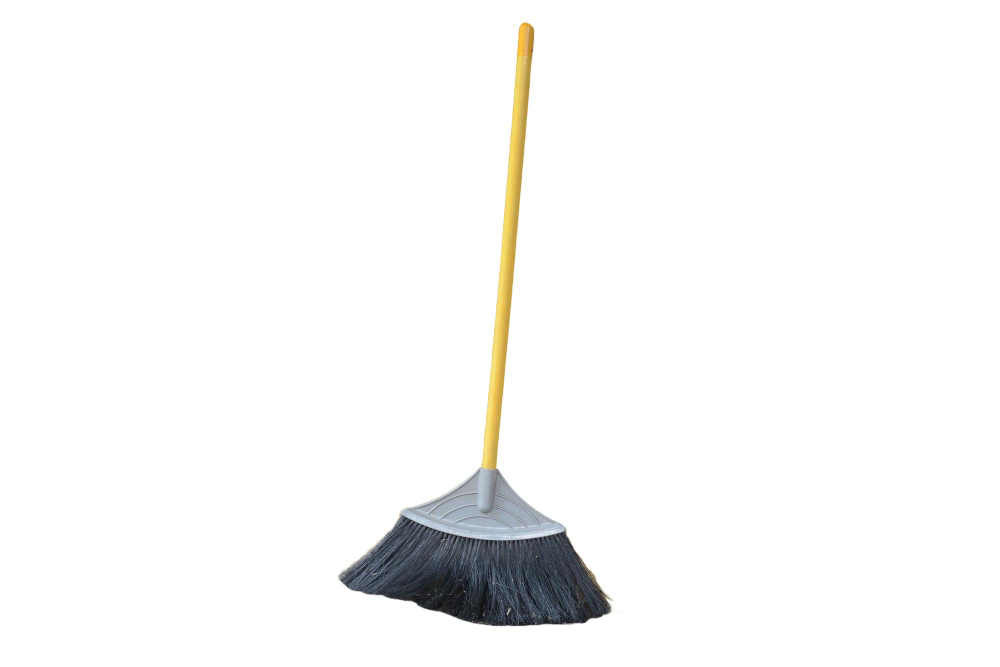
The materials chosen reveal what properties were wanted.
Plant stems and fibres supplied most traditional brooms, bundled and bound to a handle, with different plants giving different stiffness and different durability.
One plant in particular was grown specifically for the purpose, producing long straight stiff fibres that made the familiar flat household broom shape.
Animal hair produced softer brushes for fine indoor work, chosen because it is fine, flexible, springy and slightly rough along its length, which helps it hold dust.
Split cane, twigs and heather made rough outdoor brooms in places where those were what grew, bound into a bundle around a stick.
Synthetic filaments replaced most of them, because their stiffness can be specified exactly, they do not rot, they do not absorb water and they can be produced identically in enormous quantity.
The one property the synthetics took time to match was the slight surface roughness that helps natural fibres hold fine dust, which is why some fine brushes still use natural hair.
There is a storage point worth adding. A broom left standing on its bristles takes a permanent set and splays, which is why brooms were hung or stood on the handle end – a small habit that doubled the useful life of the tool.
Why the Shape Is What It Is
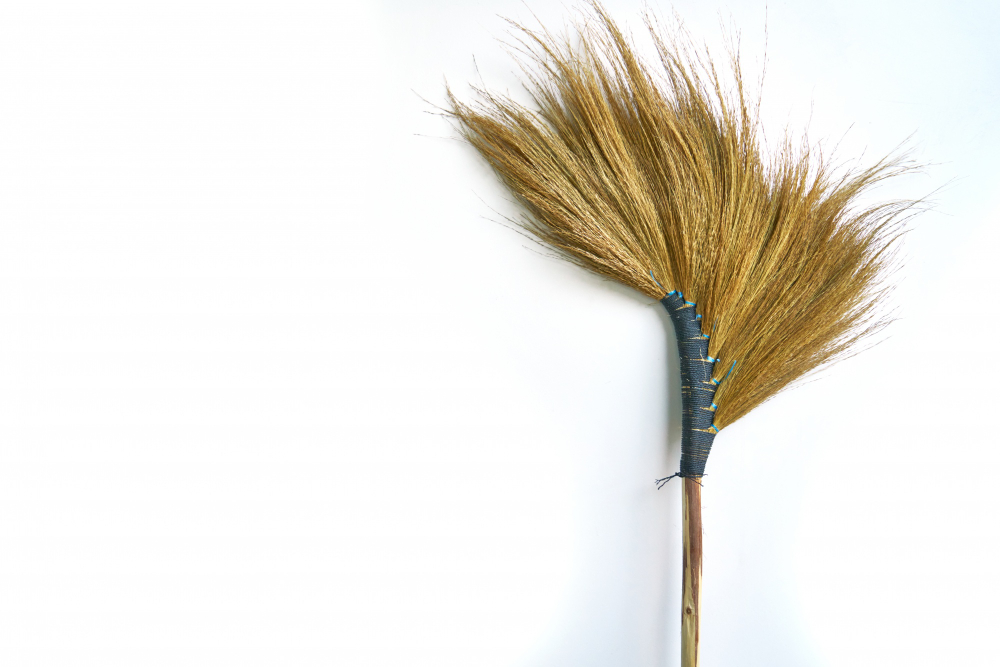
Every element of the construction has a reason.
The bristles are set in rows rather than as a solid mass, because the gaps between rows are where material is held, and a solid block of bristle would have nowhere to trap anything.
They are frequently cut at an angle at the outer edge, which lets the broom reach into corners and along skirting without turning the whole tool.
The head is wide to cover ground and narrow front-to-back so that it can be pushed under furniture, which is why a broom is not simply square.
The handle enters at an angle rather than vertically, so that the user can stand upright while the head lies flat — and a handle at the wrong angle forces either a bent back or a tilted head.
And the handle is long for leverage and reach, with the length historically matched to the user rather than standardised, which is why old brooms vary so much.
There is a width point worth adding. A wider head covers more ground per stroke and is harder to control and to press evenly onto the floor, which is why very wide brooms are used on open smooth surfaces and narrow ones anywhere cluttered.
The Other Kind of Sweeping
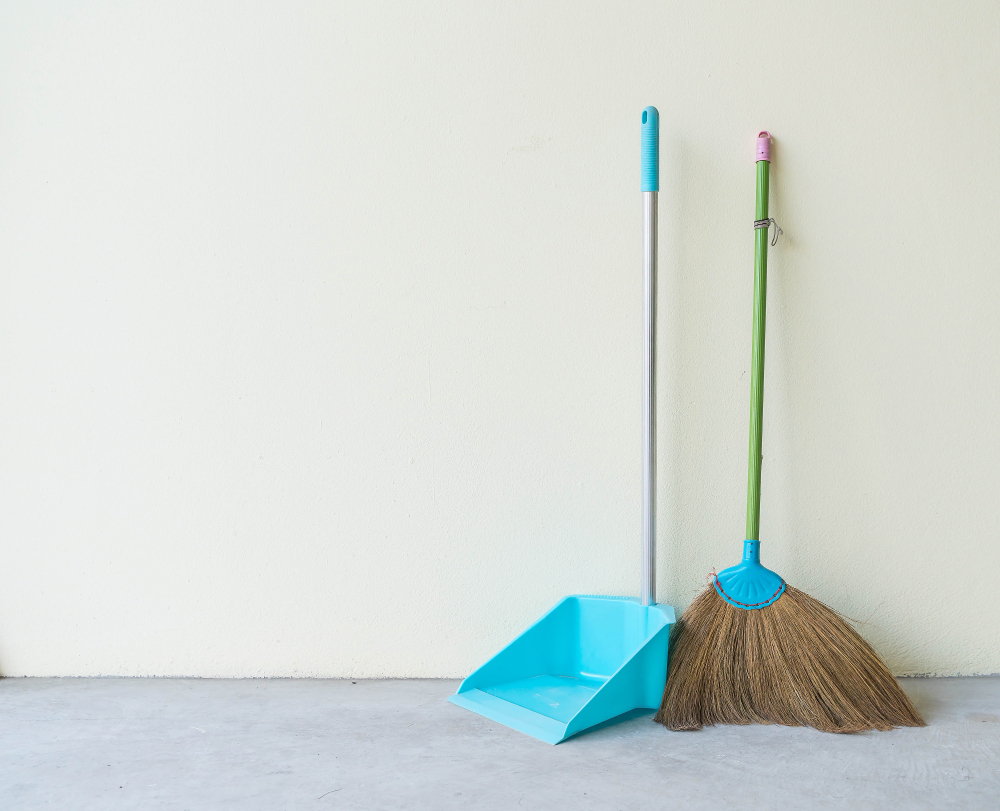
A different approach deserves mention because it explains a category of tool.
Rather than trapping between bristles, some tools work by gathering dust onto a surface that holds it, using either texture or an electrostatic charge.
That works well for fine dust on smooth surfaces and poorly for anything larger, which is the opposite of a stiff broom.
Mechanical sweepers use rotating brushes to flick material into a container rather than along the floor, which removes the need to gather it at the end.
And vacuum cleaners abandon the principle entirely, using moving air rather than contact — which is why they handle fine dust and textiles far better and why they need power.
Each of those does one part of the job better than a broom and none of them replaced it, because a broom needs nothing, works anywhere, handles debris of any size and costs almost nothing.
Why the Dust Goes Everywhere
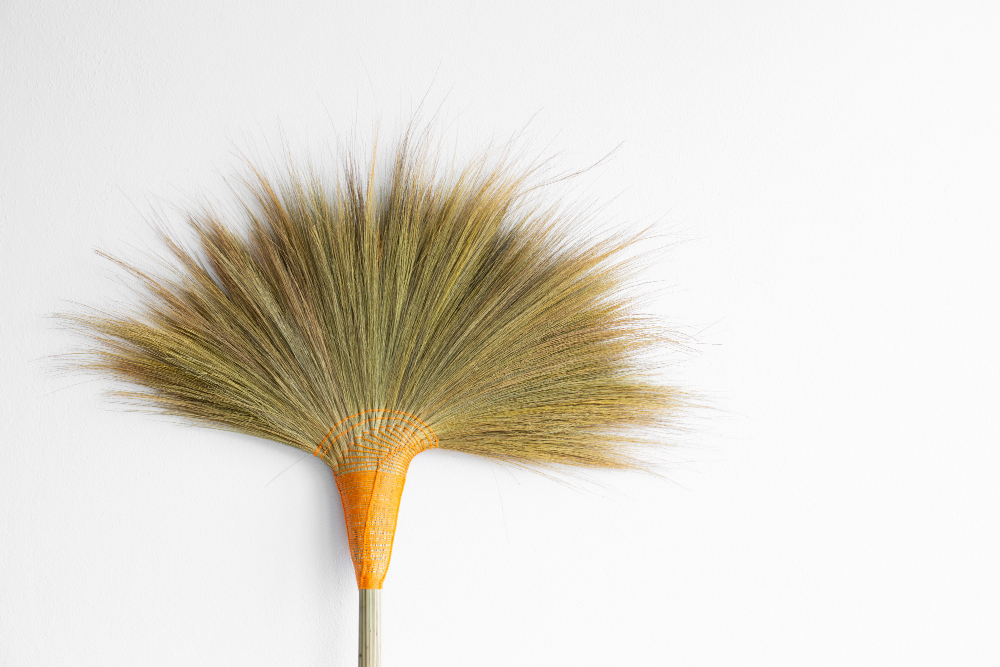
The failure people complain about most has a specific cause.
Fine particles are light enough that the air moved by a sweeping stroke lifts them, so a vigorous sweep puts a proportion of the dust into the air rather than onto the pile.
That airborne fraction settles again afterwards, over a wide area, which is why a room can look worse an hour after sweeping than before.
Slower strokes move less air and lift less; short strokes keep the material contained; and sweeping toward a collection point rather than around the room reduces how far anything travels.
Dampening the surface slightly, where that is appropriate, holds fine particles down and stops them lifting at all, which is why floors were sprinkled before sweeping in many traditions.
Soft fine bristles also lift less than stiff ones, because they disturb less air and hold particles more effectively between them.
That is the trade running through the whole subject: the stiffness that moves heavy debris is the stiffness that throws fine dust into the air, and no single broom does both jobs well.
Why It Survived Everything
The persistence of such a simple tool is worth accounting for.
It has no mechanism, so nothing can break in a way that cannot be seen.
It requires no power, no consumables and no maintenance beyond occasional cleaning.
It works on any surface, indoors and out, on debris from fine dust to broken glass, at any scale from a doorstep to a factory floor.
It can be made from whatever is locally available, which is why versions of it exist everywhere independently.
And the one thing it does badly — very fine dust, which it lifts into the air rather than gathering — was the specific gap that other tools filled, without ever removing the need for the broom itself.
Which is a reasonable summary of a tool nobody thinks about. It is a row of springs dragged across a floor, catching and releasing many times a second, and the entire design problem is choosing exactly how springy they should be.
Which is a fair description of a great many simple tools. They look as though there is nothing to them, and the one variable they do have has been tuned by several thousand years of people finding out what did not work.
Like our content? Follow us for more.
