

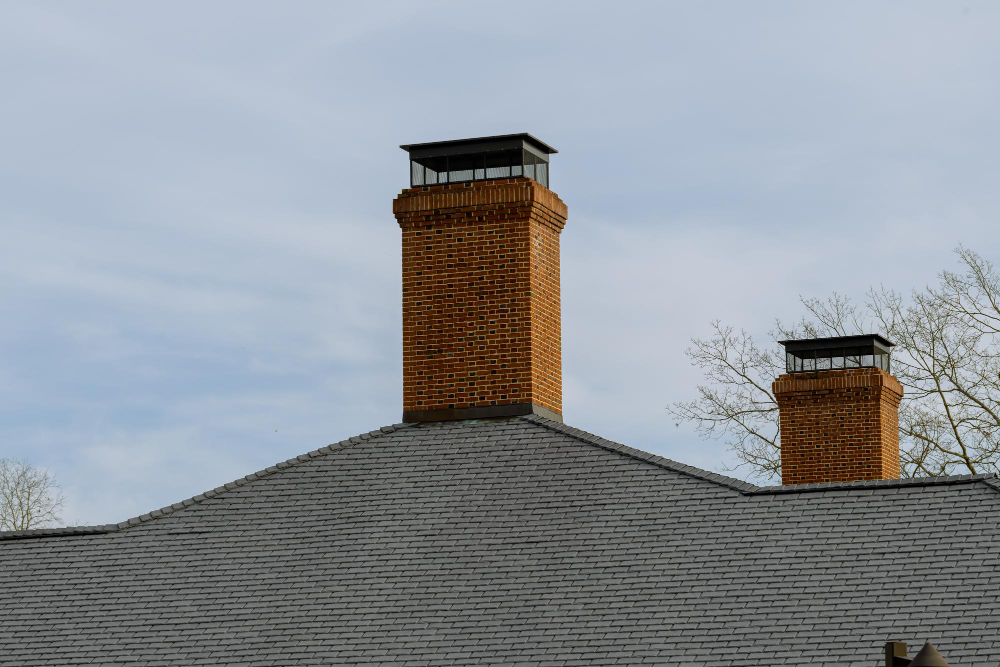
There is a common way of describing chimneys that gets the direction of the mechanism backwards and consequently makes every practical problem inexplicable.
The description is that smoke rises and the chimney provides a route for it to escape. That treats the chimney as a pipe and the smoke as the thing with the initiative.
What actually happens is that the chimney generates a pressure difference which draws air in at the bottom, through the fire, and up the flue. The smoke is carried along by that flow rather than driving it.
The distinction matters because every chimney problem — smoking back into a room, a fire that will not catch, a flue that works in one weather and not another — is a failure of that pressure difference, and none of it makes sense if you think smoke is doing the work.
Where the Force Comes From
The physics is straightforward and worth being precise about.
Warm air is less dense than cold air, which means a column of it weighs less. A flue containing warm gases therefore exerts less downward pressure at its base than a column of outside air of the same height.
That difference produces a net upward force on the gases in the flue, and a corresponding low pressure at the bottom, which draws replacement air in through the appliance.
Two things determine its strength. The temperature difference between the flue gases and the outside air, and the height of the column.
Both are multiplicative rather than additive, so a tall chimney with hot gases produces a strong effect, and a short chimney with cool gases produces almost none.
That single relationship accounts for the majority of chimney behaviour, including several things that seem contradictory.
Like our content? Follow us for more.
Why Cold Chimneys Fail
The most common problem follows directly and is the one everybody has experienced.
A chimney that has been unused is at the temperature of its surroundings, which means there is no temperature difference and therefore no draw.
Worse, a cold flue frequently contains a column of cold air that is denser than the air outside, which produces a downward flow — so the chimney is actively pulling air the wrong way before anything is lit.
Lighting a fire into that produces smoke entering the room, because the flow is downward and the fire is not yet hot enough to reverse it.
That is why a cold chimney needs to be warmed before the main fire is established, and why the first few minutes are the difficult ones. Once the flue gases are hot, the effect establishes itself and reinforces — more draw produces a hotter fire which produces more draw.
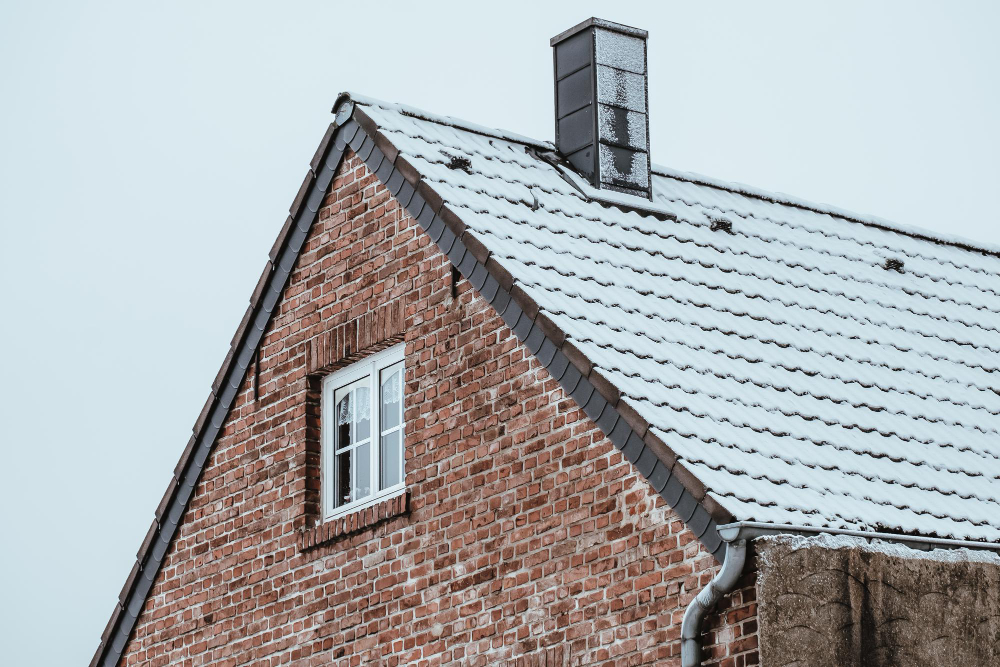
The same explains why chimneys on outside walls perform worse than those running through the middle of a building. An external flue loses heat to the outside continuously, so the gases inside cool as they rise, reducing the effect precisely where it is most needed.
The Air Has to Come From Somewhere
A requirement that is easy to overlook determines whether the whole thing works.
Air drawn up the chimney must be replaced, which means an equal volume has to enter the building from outside.
In a draughty building that happens without anybody noticing. In a well-sealed one it may not, and the result is that the chimney cannot draw because there is no air available to draw.
The symptom is a fire that smokes when doors and windows are closed and behaves perfectly when one is opened, which is frequently misdiagnosed as a chimney problem and is an air supply problem.
The same effect is produced by anything else extracting air from the building — a mechanical extractor competing with the chimney will win, because it has a fan and the chimney has only a temperature difference.
That competition is the explanation for a substantial proportion of smoking complaints in modern buildings, and it is a consequence of sealing rather than of anything about the fire.
There is a seasonal point worth adding. The draw depends on the difference between flue and outside temperature, which means a chimney works better on a cold day than a mild one with an identical fire.
That is why the same appliance can be difficult in autumn and faultless in midwinter, and why mild damp weather is the hardest condition for any flue.
Height, Position and the Roof
The external arrangement matters as much as the flue, for reasons involving wind rather than temperature.
A chimney must terminate in air that is not being pressurised by wind striking the building, because pressure at the top opposes the draw directly.
Wind flowing over a roof produces regions of higher and lower pressure, and a chimney terminating in a high-pressure region will be pushed down rather than drawn up.
That is why chimneys are required to project a certain distance above the roof and above nearby obstructions, and why a chimney that has always worked may stop when something is built nearby or a tree grows.
It also explains why the problem is wind-direction dependent. A chimney affected this way works in most conditions and fails in one particular wind, which makes it look intermittent and mysterious.
Terminals that spin, deflect or shelter the opening address this by ensuring that wind produces low pressure at the top regardless of direction, which assists the draw rather than opposing it.
Size, Shape and Why Bigger Is Worse
A counterintuitive point completes the picture.
An oversized flue is a common cause of poor performance, which surprises people who assume more area means more flow.
The reason is that the gases must stay hot to maintain the effect, and a large flue presents more surface area to lose heat through while carrying the same quantity of gas — so the gases cool, the effect weakens and the draw fails.
A large flue also permits the gases to move slowly, which gives them more time to cool and allows a downward current to establish alongside the upward one.
That is why lining a large old flue with a smaller liner frequently improves a fire dramatically, which appears to be restricting it and is actually keeping it hot.
Bends and changes of direction reduce the effect as well, by adding resistance and by creating places where gases slow and deposit, which is why a straight vertical flue outperforms one that steps around obstructions.
And a smooth interior matters for the same reason, since roughness adds friction and accumulation adds both friction and a hazard.
Why Two Fires Cannot Share
A specific problem is worth explaining because it is a common cause of trouble in older buildings.
Two appliances connected to the same flue interfere with each other, because the draw is a single pressure difference acting on all the openings into that flue.
If one appliance is running and another is not, the idle one becomes an air inlet — the flue draws through it, which means air is being pulled through an appliance that is not in use, and anything in it that could be carried is carried into the flue.
Worse, if the idle opening offers an easier path than the intended air supply, the working appliance may be starved while air enters through the wrong route entirely.
And if both are running, they compete, with each reducing the other’s draw.
That is why flues are generally required to serve one appliance, why old chimney stacks contain multiple separate flues rather than one large one, and why the stack on an old building has several pots on it — one per fireplace, each with its own passage all the way down.
Those separate flues run alongside each other within the same masonry, which is a considerable piece of bricklaying and is invisible from outside except in the number of pots.
Blocking an unused fireplace without sealing or ventilating its flue produces a different problem, since a sealed flue with no airflow accumulates moisture, which damages the masonry from within — so a disused flue needs to be either working or properly dealt with rather than simply closed off.
What It All Comes Down To
The subject reduces to a short list, and it is worth stating because the list explains essentially every problem.
The gases must be hot, so the flue must be warm, insulated where possible and not oversized.
The column must be tall enough, and must terminate where the wind does not press on it.
Replacement air must be available, in the quantity the chimney is drawing.
And the path must be clear, straight and smooth enough that resistance does not consume the modest force available.
Failures are always one of those four, which is why the diagnostic questions are the same everywhere and why the answers so frequently concern something other than the chimney itself.
Which is the point worth carrying. The fire is not being vented by a hole in the roof. It is being fed by a column of warm air that weighs slightly less than the sky outside, and everything about how a fireplace behaves follows from how carefully that small difference has been protected.
And that is what makes it a satisfying thing to understand. Every symptom – the smoke in the room, the fire that will not draw, the flue that works in one wind – is a small failure of one column of warm air, and knowing that turns a mysterious object into a legible one.
Like our content? Follow us for more.
