
There is a useful test for whether an ability is special: look at what the nearest relatives can do.
For most human capabilities, the answer is that they do something similar, less well. Other primates walk, manipulate objects, solve problems and communicate, and the human versions are extensions rather than departures.
Throwing is different. Other primates throw, and the gap is enormous — not a matter of degree but of a different mechanism being available.
An adult chimpanzee, substantially stronger than a person in every ordinary measure, throws at a fraction of the speed a human child manages, with far less accuracy.
That discrepancy is what makes the subject interesting. Strength is not the limiting factor, and whatever is doing the work in a human throw is not simply more muscle.
There is a measurement worth stating for scale. The rotational speed of the upper arm during a throw is the highest angular velocity recorded for any human joint movement, and it occurs over a period shorter than a blink.
Almost none of that is under conscious control at the moment it happens. The sequence is set up beforehand and then runs.
What the Arm Is Actually Doing

The mechanism is elastic storage, and understanding it resolves the puzzle.
A muscle contracting can only shorten so fast, which places a ceiling on how quickly it can accelerate anything directly. That ceiling is well below the speeds a thrown object reaches.
The solution, in human throwing, is not to drive the arm with muscle at the moment of release but to load elastic structures beforehand and let them release.
During the wind-up, the arm rotates backward while the torso begins rotating forward, which stretches the tendons and ligaments crossing the shoulder. Energy goes into those structures and is held there.
When the arm comes forward, that stored energy is released in a very short period, accelerating the upper arm into rotation at a rate no muscle could produce directly.
That rotation — the upper arm turning about its own axis — is the fastest motion the human body performs, and it happens in a fraction of a second.
The forearm and hand are then whipped forward by that rotation rather than being driven independently, which is why the release feels passive and why the motion is so difficult to perform slowly.
Like our content? Follow us for more.
The Anatomical Changes
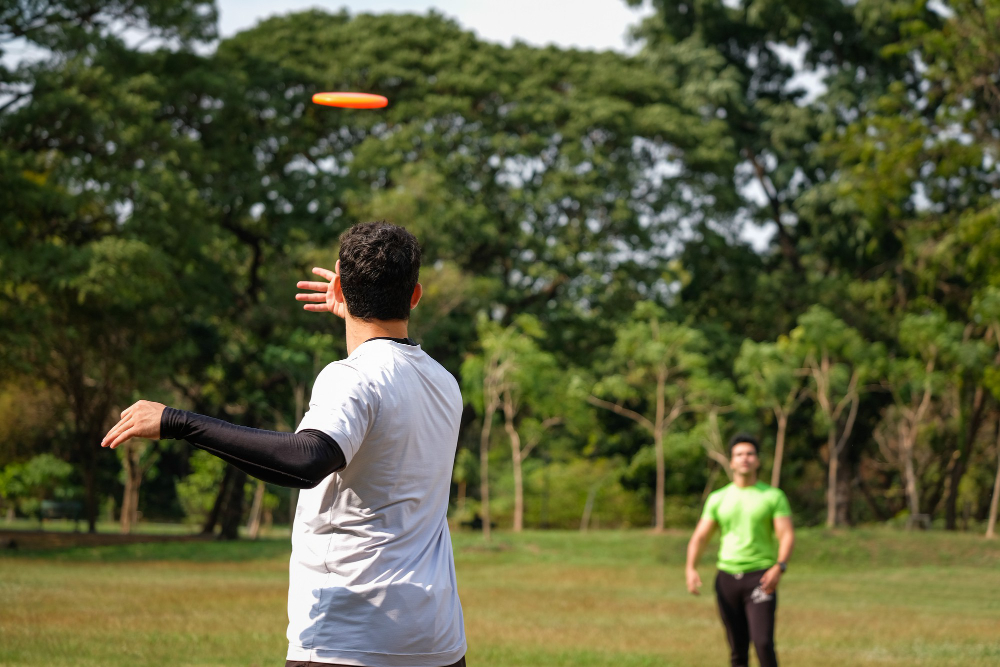
Several specific features distinguish the human arrangement, and they appear in the fossil record at different times.
The shoulder sits lower and faces more to the side than in other apes, whose shoulders are oriented upward for climbing. That reorientation is what allows the arm to be cocked backward into the loading position at all.
The upper arm bone is less twisted along its length than in other apes, which changes how rotation is transmitted.
The waist is more flexible, allowing the torso to rotate independently of the hips — which is essential, because the initial rotation of the torso against a held-back arm is what loads the spring.
And the wrist and hand allow a grip that can release cleanly at high speed without the object being deflected.
Each of those is a modification of something that other apes have, arranged differently — which is the usual pattern, and it means no single change accounts for the ability.
There is a comparison worth making. The same elastic principle operates in the legs during running, where tendons store and return energy with each stride, and in the jump of various animals.
What distinguishes throwing is that the energy is delivered into an object that then leaves, rather than into moving the body itself – which is a use of the mechanism that appears to have no equivalent elsewhere.
The Trade

There is a cost, and it explains something about human shoulders.
The arrangement that permits throwing is a shoulder with an unusually large range of motion and correspondingly less inherent stability. The joint is held together substantially by soft tissue rather than by bone geometry.
That is why the human shoulder is the most mobile joint in the body and also the one most prone to problems — the mobility and the vulnerability are the same design decision.
Other apes have more stable shoulders, better suited to bearing weight during climbing, and cannot throw.
So the ability was acquired at the cost of a joint that is easier to injure, which is a reasonable indication that it was worth something substantial.
Why It Might Have Mattered

The functional argument is plausible and is not directly demonstrable, which is worth stating clearly.
The proposal is that accurate high-speed throwing allowed an animal with no natural weapons to affect something at a distance, which changes the possible relationships with other animals entirely.
That would apply to obtaining food, to deterring competitors and to defending a group, and it does not require any particular technology beyond something to throw.
The timing is suggestive. The anatomical features associated with throwing appear in the fossil record at a period broadly associated with other substantial changes in diet and behaviour.
The honest position is that the anatomy is documented, the capability is real and unusual, and the account of what it was for is an inference from the anatomy rather than an independent finding. Arguments about behaviour from skeletal evidence are necessarily indirect.
Why Accuracy Is the Harder Half

Speed is impressive and accuracy is the part that is truly difficult, and it is frequently overlooked.
Releasing an object at high speed requires the release to occur within an extremely narrow time window, because the hand is travelling so fast that a small timing error translates into a large directional error.
The window for a throw at an ordinary target is measured in a very small number of milliseconds, which is at the limit of what the nervous system can control.
That means throwing is as much a timing problem as a power problem, and the neural control involved is substantial — which is one reason it takes years of practice to do well and why the skill is so unevenly distributed between individuals.
It also means the capability required both the anatomy and the control to develop, and either without the other would be useless.
Why It Takes So Long to Learn
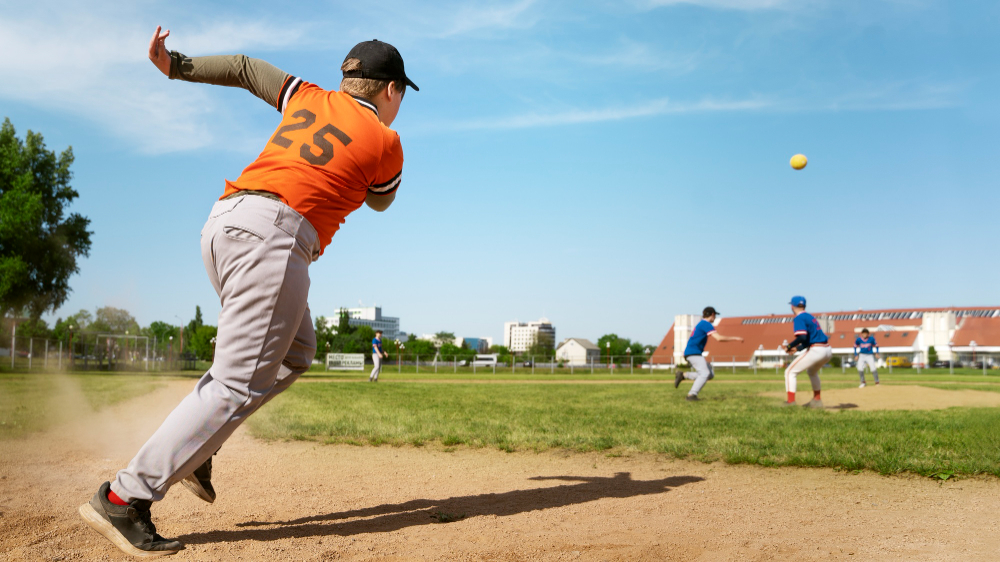
The developmental picture supports the argument and is worth including.
Throwing is not present at birth and does not arrive in a single step. Young children throw with the arm alone, without the torso rotation that loads the elastic structures, which produces very little speed regardless of effort.
The full sequence — legs, hips, torso, shoulder, arm, hand, in that order, each beginning before the previous one finishes — takes years to assemble and is not something anybody is taught explicitly.
That ordering is the critical part. The energy is passed up the body in a chain, with each segment accelerating and then decelerating to transfer momentum to the next, and the timing has to be precise for the transfer to work.
A throw where the segments move together rather than in sequence produces a fraction of the speed, which is why a beginner throwing with full effort achieves less than an experienced thrower throwing lightly.
That is a coordination problem rather than a strength problem, which is why children get substantially better at throwing during years when they are not getting substantially stronger.
And it explains the individual variation. The anatomy is common to everybody; the coordination is learned, is learned at different rates, and does not develop at all without practice — which is why the distribution of ability is so wide compared with most physical capabilities.
What It Demonstrates
The general point is worth taking beyond the specific case.
A capability can be the product of an arrangement rather than of any component. Nothing in the human arm is stronger, faster or more remarkable than the equivalent in another ape; the parts are arranged so that energy can be stored and released, and that arrangement produces an ability that strength alone cannot.
It also illustrates the elastic principle generally. Storing energy slowly and releasing it quickly is how a great many biological systems exceed what muscle can do directly, and it appears wherever an animal needs to move faster than muscle contracts.
And it is a reminder that the interesting questions about the body are frequently mechanical rather than physiological. The reason a person can throw and a stronger animal cannot has nothing to do with the muscles and everything to do with where the shoulder sits, how the torso turns and what happens to the tendons in between.
Which is a reasonable way to think about a great many human capabilities. The question is rarely what the parts can do, and usually how they have been arranged to work together – and the arrangement is the part that does not show up in any measurement of a component.
Like our content? Follow us for more.