

There is a category of vanished industry that seems impossible in retrospect, and the ice trade is the clearest example.
The proposition was to cut a perishable product out of a frozen lake, store it through a summer, load it onto a sailing ship, carry it across an ocean into tropical heat, unload it and sell it — at a profit, reliably, for decades.
Everything about that sounds like it should not work. The product is made of the thing that destroys it, the destination is the worst possible environment for it, and the journey takes months.
It worked, at substantial scale, and understanding why is a lesson in physics that applies well beyond ice.
Why Big Blocks Survive
The physical principle is the foundation of the whole business.
Melting happens at the surface, where heat enters. The amount of melting therefore depends on surface area, while the amount of ice depends on volume.
Doubling the dimensions of a block multiplies its surface area by four and its volume by eight, which means a larger block has proportionally less surface exposed per unit of ice.
That relationship is why a large block lasts disproportionately longer than a small one, and why ice was moved in the largest pieces that could be handled rather than being broken down.
Stacking compounds it. Blocks packed tightly together present only the outside of the stack to the surroundings, and the interior blocks are surrounded by other ice.
A large well-packed cargo therefore loses only its outer layer, which melts and forms a protective sacrificial shell around everything behind it.
Losses on long voyages were substantial and were a predictable fraction rather than a catastrophe, and the arithmetic worked because the surviving proportion was large enough.
Like our content? Follow us for more.
The Harvest
The winter operation was industrial in scale and had its own equipment.
Ice was allowed to thicken to a usable depth, cleared of snow — which insulates and slows thickening — and then marked out in a grid using a horse-drawn cutter that scored parallel grooves.
Scoring a second set of grooves at right angles produced a field of squares, which were then split along the scores and floated to a collection point.
Floating was the key to handling. Ice moves easily on water and is extremely heavy to lift, so the whole operation was designed around keeping blocks in the water until the last moment, when they were hauled up an inclined ramp.
The work was seasonal, weather-dependent and dangerous, and it employed large numbers of people for a short intense period each year.
The Storage Problem
Keeping ice through a summer required buildings designed for one purpose.
An ice house has thick insulated walls, minimal openings, drainage for meltwater, and crucially a large volume, because the same surface-to-volume principle applies to the stored mass as to individual blocks.
Sawdust was the standard insulation between and around blocks, being cheap, available as a by-product of timber, and effective because it traps air.
Drainage mattered more than it appears. Meltwater sitting against the remaining ice conducts heat far better than air does, so removing it promptly slows further melting substantially.
A well-built ice house could hold a substantial proportion of its stored ice from one winter to the next, which is what made the trade possible rather than merely seasonal.
Shipping It
The transport is the part that seems least plausible and was the most carefully engineered.
Ships carrying ice were insulated, packed tightly and loaded to minimise air space, and the cargo was arranged as a single mass rather than as separate parcels.
Sawdust filled the gaps. It served as insulation, absorbed some meltwater and prevented blocks freezing together into an unmanageable single piece.
Routes and timing were chosen to reduce exposure, and the voyages were long — a cargo might be at sea for months.
The economics worked because ice was worth a great deal at the destination and almost nothing at the source. A product with essentially no raw material cost, cut by seasonal labour from something that formed on its own, could absorb enormous losses and remain profitable.
And there was a return-cargo advantage. Ships carrying a low-value bulk cargo outward could carry high-value goods back, which improved the economics of the whole route rather than only the ice.
Who Actually Used It
The domestic market is worth separating from the industrial one, because they developed differently.
Commercial users came first and remained the bulk of the trade — fishmongers, butchers, brewers, dairies and anybody handling perishable goods, for whom ice was an input rather than a luxury.
Ice also permitted long-distance movement of perishables, which changed what could be sold where. Fish could travel inland, meat could travel from where animals were raised to where people lived, and dairy could be collected over a wider area.
Domestic use developed later and required a container. The domestic ice box was an insulated cabinet with a compartment for a block and a drain for meltwater, delivered to and restocked regularly by somebody on a round.
That delivery arrangement is the direct ancestor of every doorstep round that followed, and the rhythm of it — a person, a vehicle, a fixed schedule, a household that left something out — persisted long after the ice itself stopped arriving.
And the vocabulary persisted furthest of all. The word for the domestic appliance in several languages still refers to ice rather than to refrigeration, describing a technology that was replaced within living memory by something that works on an entirely different principle.
What It Created

The consequences went beyond the product itself.
Demand for cold changed food supply in the places it reached. Fresh produce, dairy, fish and meat could be moved and stored in ways that had not previously been possible, which altered what people could eat and where it could come from.
Medical use was substantial in an era with few alternatives for reducing fever or preserving specimens.
And the trade created the expectation of cold, which is the part that mattered most. A population accustomed to chilled drinks, ice cream and preserved food represented a market, and that market is what mechanical refrigeration arrived into.
That is a common pattern. A difficult, expensive, physically improbable method establishes a demand, and the technology that replaces it succeeds partly because the demand already exists.
The Buildings It Left
The physical remains are more widespread than people realise and are frequently unrecognised.
Ice houses were built wherever ice was stored, which included estates, breweries, fish markets, hospitals and any substantial household that could afford one.
The typical form is a chamber sunk into the ground, with an insulated roof, a drain at the base and an entrance arranged so that opening it admits as little warm air as possible — frequently a passage with two doors rather than one.
Siting was deliberate. North-facing slopes, shaded positions and ground where the surrounding earth stays cool all extend the storage period substantially, and the ground itself provides most of the insulation.
That is why so many survive. A structure built largely below ground, with thick walls and a small opening, is difficult to demolish and easy to ignore, so a great many were simply abandoned or converted.
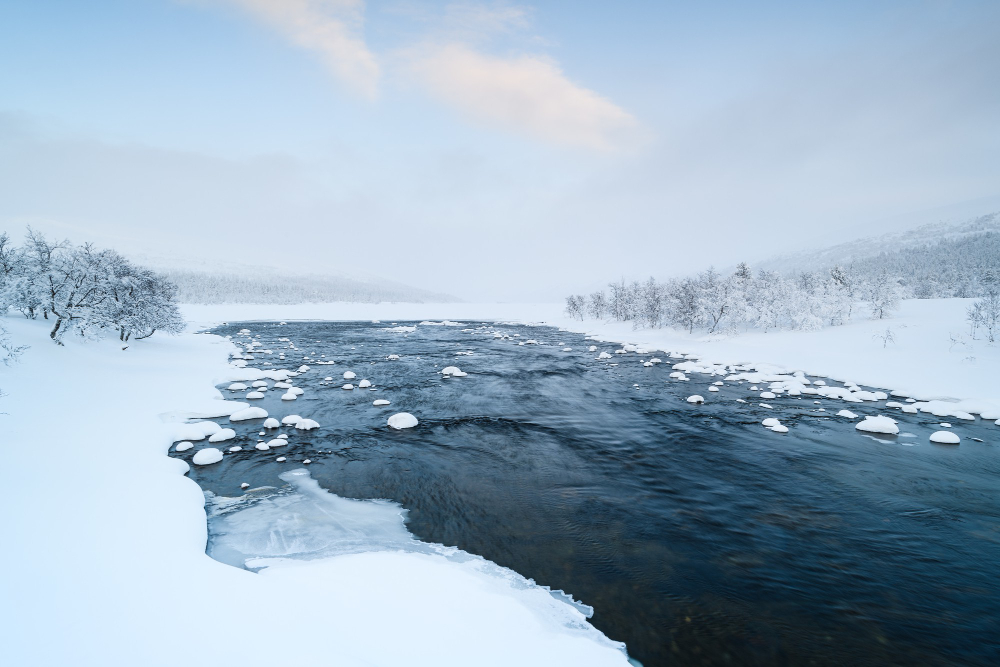
Ponds were dug specifically to freeze, shallow and broad so that ice formed quickly and could be cut with the least effort, and those survive as features whose purpose is rarely apparent.
And the vocabulary survives — streets, buildings and places carrying names that referred to the trade and now refer to nothing in particular, which is the most common way a vanished industry remains present.
Why It Vanished So Completely
The ending was rapid once it began, and the reasons are worth separating.
Mechanical refrigeration produced ice anywhere, at any time of year, in any quantity, without transport — which removes every advantage the natural product had.
The natural supply was also unreliable. A warm winter produced a poor harvest, and the business was exposed to weather in a way a factory is not.
And quality became a concern, since ice cut from lakes carried whatever was in the water, which mattered increasingly as understanding of contamination developed.
The industry disappeared within a few decades, leaving ice houses converted to other uses, ponds that were dug for the purpose and a vocabulary that survives in the names of things.
Which is the usual fate of an industry made obsolete rather than outcompeted. Nothing about it was inefficient for what it was; it was simply answering a question that stopped being asked, by people who had worked out how to ship a frozen lake across the equator and lose only the outside of it.
Which is the part that repays attention. Nothing about the trade involved a clever material or a new machine – it worked because somebody understood that a big enough block of ice is mostly protected by the part of itself that melts first, and then organised an industry around that one fact.
Like our content? Follow us for more.
