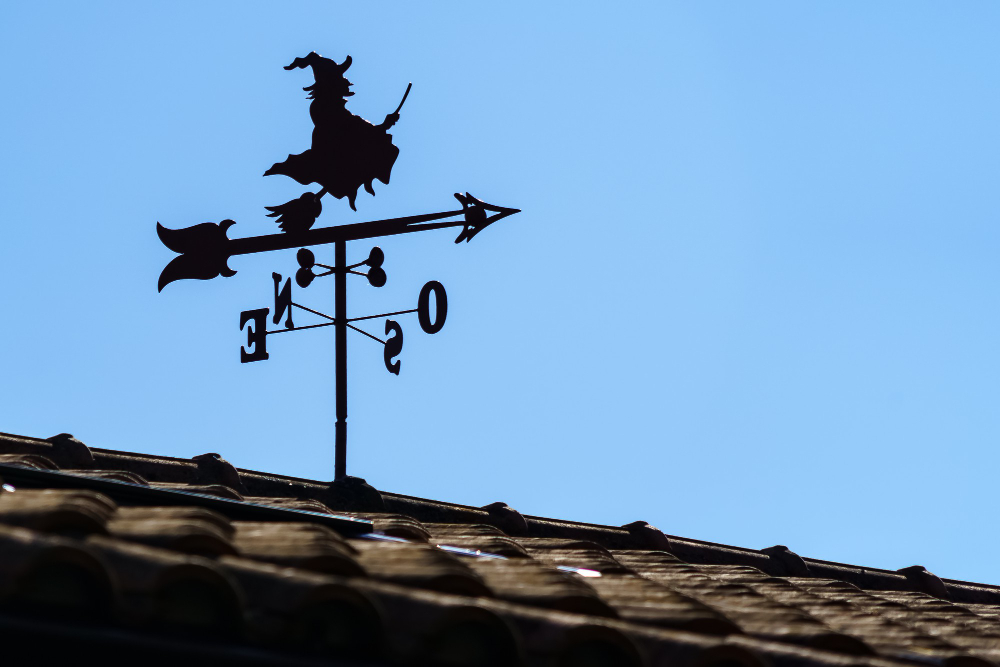
There is a question about weathervanes that catches almost everybody out, and it concerns which way the pointer faces.
The natural assumption is that the arrow shows where the wind is going, like an arrow on a sign. It does the opposite. It points into the wind, toward the direction the wind is coming from.
That is not a design choice so much as a consequence of how the thing balances. And it matches the convention by which winds are named, since a wind is always described by where it comes from.
Understanding why the pointer settles that way explains almost everything about how a weathervane is built, why so many of them are cockerels, and why a poorly made one is worse than useless.
The Imbalance That Makes It Work
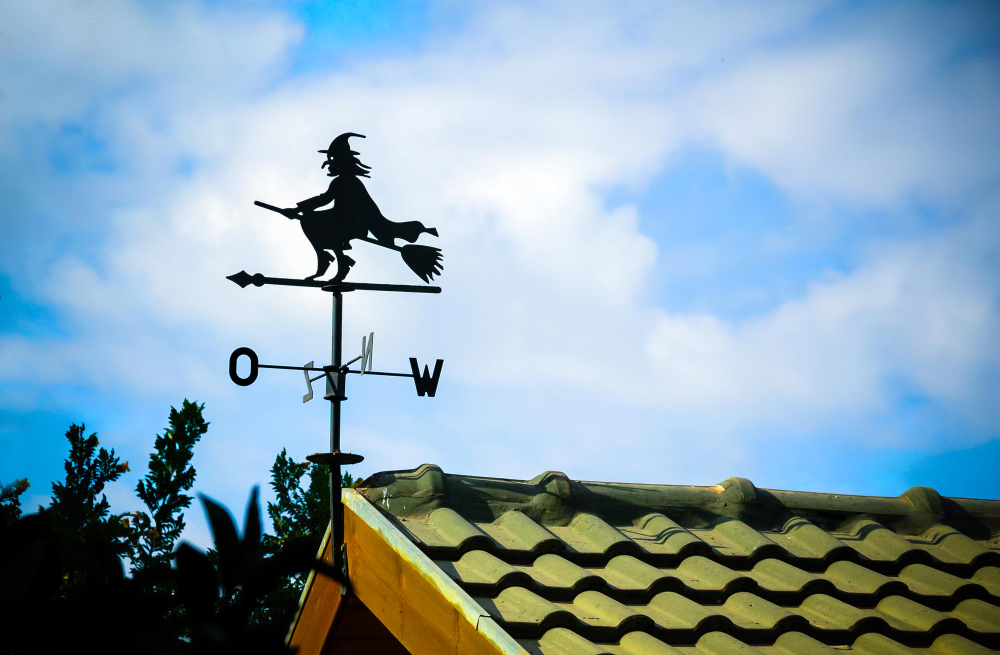
The principle is simple and it has to be built in deliberately.
A weathervane is a rotating piece mounted on a vertical pivot, free to turn in any direction.
One end — the tail — is broad, with a large flat surface. The other end — the pointer — is narrow and presents very little surface to the wind.
Wind pressing on the vane pushes harder on the broad tail than on the narrow pointer. The vane rotates until the tail is downwind and the pointer is upwind, at which point the forces balance and it holds steady.
So the pointer ends up facing into the wind because the tail has been pushed away from it.
That arrangement requires a clear difference in surface area between the two ends. A vane with roughly equal surfaces at both ends has no reason to settle in any particular direction and simply swings about.
There is a size point worth adding. A larger vane responds to lighter winds because its tail presents more surface, but it is also heavier and places more load on the pivot, so size is a trade between sensitivity and wear.
Like our content? Follow us for more.
Why It Must Also Be Balanced by Weight
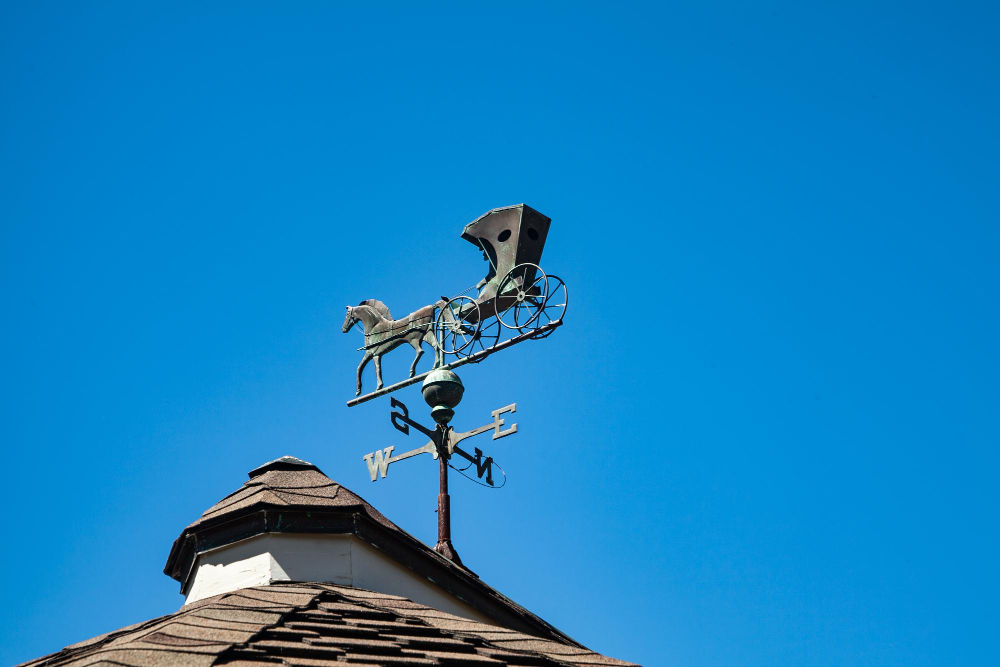
A second requirement is less obvious and just as important.
The broad tail tends to be heavier than the narrow pointer, which would make the vane lean on its pivot and bind, turning stiffly or sticking.
To prevent that, the pointer end is weighted so that the whole assembly balances on the pivot by weight, even though it is deliberately unbalanced by surface area.
That combination — balanced in weight, unbalanced in wind resistance — is the essential engineering of a weathervane.
Get the weight balance wrong and the vane sticks, responds late, or points consistently in a favoured direction regardless of the wind.
The pivot itself must turn freely with very little friction, since a light breeze exerts only a small force, and a stiff bearing will ignore it entirely.
There is a material point worth adding. Vanes were traditionally made of copper, iron or tinned sheet, chosen for durability in weather, and copper vanes develop a green surface over time that protects the metal beneath.
Why It Stands High
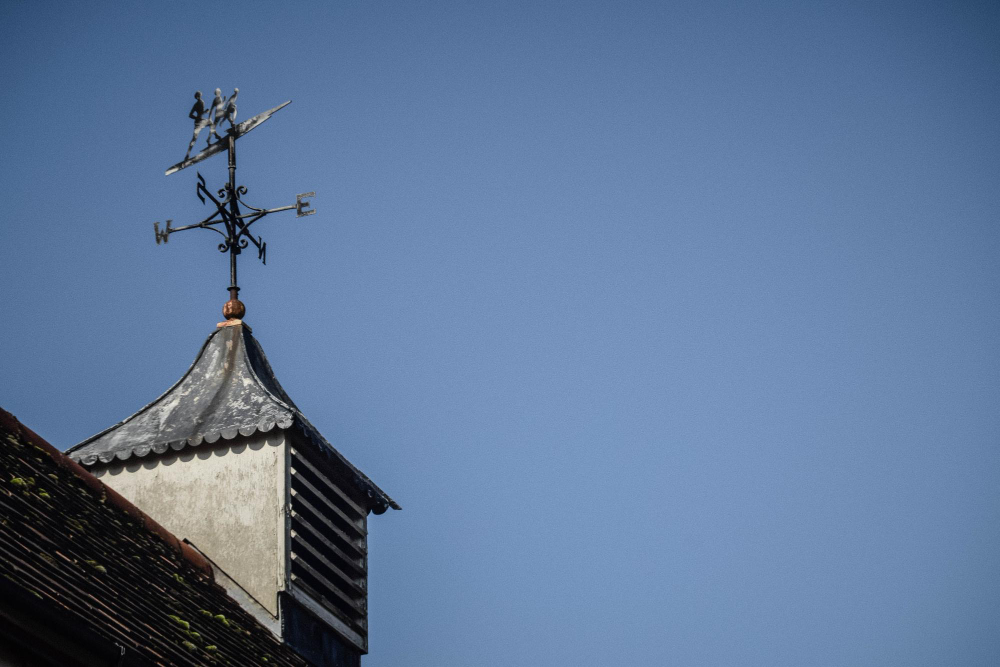
The position of a weathervane is as important as its shape.
Wind near the ground is disturbed by buildings, trees and terrain, swirling around obstacles and changing direction over short distances.
A vane placed low reports that local turbulence rather than the general wind, turning back and forth and giving misleading readings.
Mounted high — on a roof ridge, a spire, a tower or a tall pole — it sits in cleaner air above the disturbance and reports the prevailing direction much more reliably.
That is why weathervanes are so often found on the highest point of a building, and why the tallest building in a settlement was frequently where the most useful one stood.
It is also the reason for the fixed letters marking the compass points beneath many vanes: they allow the direction to be read from the ground at a distance.
There is a gilding point worth adding. Many vanes on prominent buildings were gilded, which both protected the metal and made the vane visible from a great distance as it caught the light.
Why So Many Are Cockerels
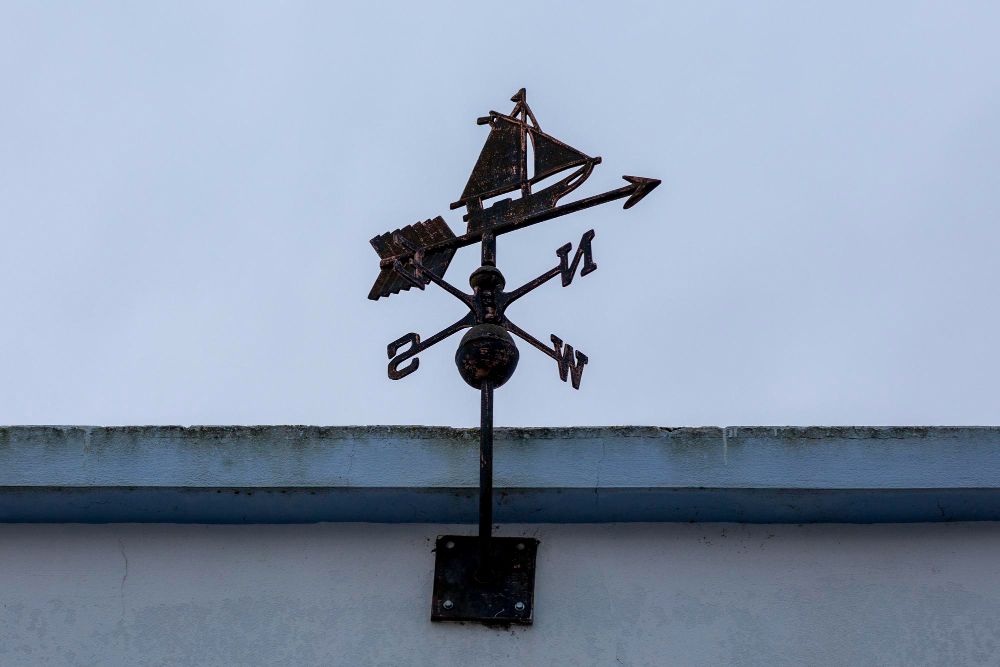
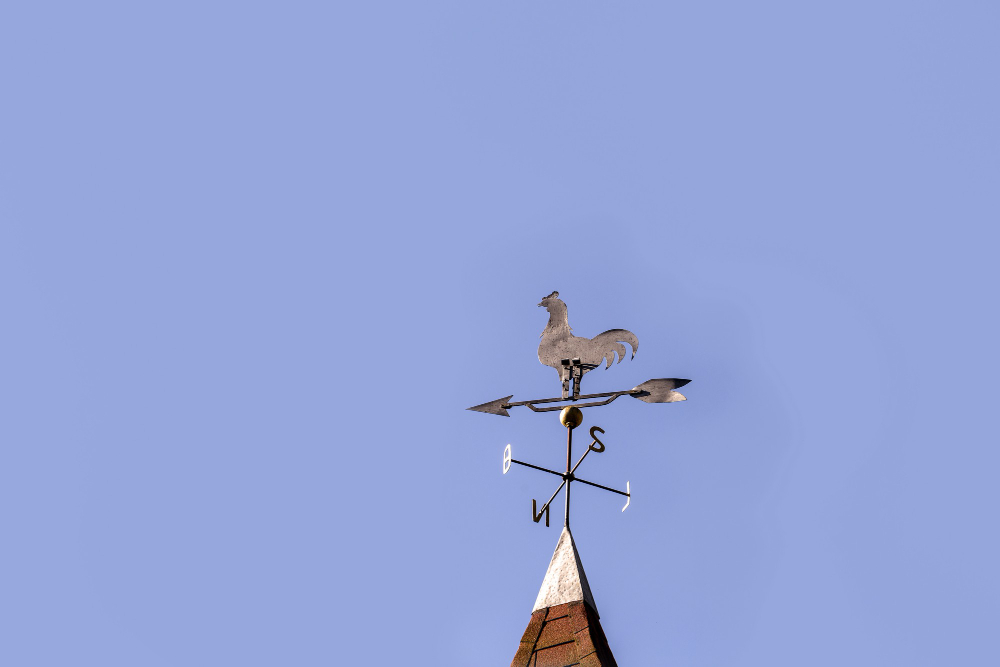
The familiar bird on church towers and barns has a history, and a practical side too.
The cockerel became a widely used form for weathervanes on religious buildings, where it carried a symbolic meaning, and the image spread from there into general use.
Practically, a bird shape suits the principle well: a large tail and a relatively narrow head give exactly the imbalance of surface area the vane requires.
Other forms were chosen to reflect the building or its owner — ships near coasts, animals on farms, figures representing a trade — and the silhouette often says something about the building beneath it.
Whatever the design, the ones that work follow the same rule: a large surface at the tail, a slender pointer at the front, and weight arranged to balance on the pivot.
Decorative vanes that ignore that rule look fine and report the wind badly.
There is a pivot point worth adding. The bearing on which the vane turns is frequently the first part to fail, seizing through corrosion so that the vane stops turning altogether and points the same way regardless of the wind.
A stuck vane looks exactly like a working one on a still day.
A vane that has pointed in the same direction for weeks, through changing weather, has almost certainly seized.
The Compass Letters and Their Problems
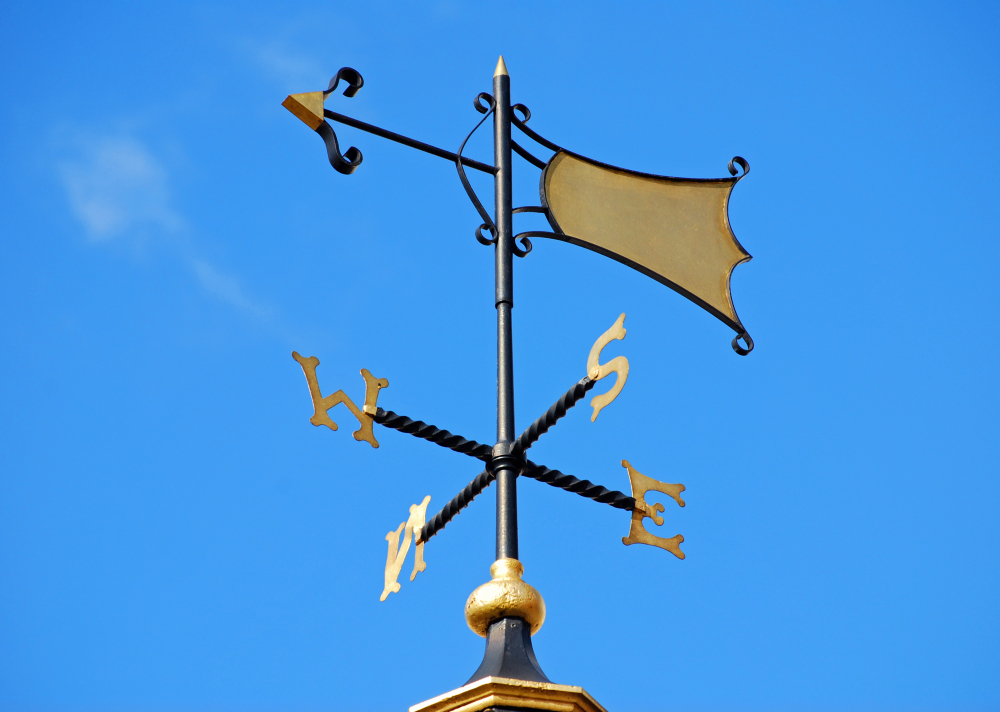
The fixed letters beneath many vanes are useful and can be wrong in an instructive way.
They are set to indicate the four main directions, allowing an observer below to read which way the pointer faces.
Setting them requires knowing true north at the site, and an installer working with a magnetic compass who did not allow for the difference between magnetic and true north could set them measurably off.
Buildings are also not always aligned to the compass, so letters set by eye relative to a building can be skewed.
On an old building the letters may have been disturbed by repairs, storms or repainting, and reinstalled imperfectly.
So a vane can swing correctly into the wind while the letters beneath it misreport the direction — which is a useful reminder that the instrument and its scale are separate things, and either can be at fault.
The pointer is generally the more reliable of the two, since it depends only on physics, while the letters depend on whoever last set them.
Why It Mattered
Before instruments and forecasts, wind direction was among the most useful weather information available.
Farmers used it to judge coming weather, since certain winds in a given place tend to bring rain, cold or settled conditions.
Millers depended on it directly, needing to know the wind before setting their machinery.
Sailors and fishermen used it to judge whether they could leave or return to harbour.
And general experience in any locality built up a working knowledge of what each wind usually brought, much of which was reasonably reliable because it was based on long local observation.
A weathervane made that information visible to a whole community at once, from the highest point in the settlement.
There is a response point worth adding. A well-made vane swings promptly to follow changes in the wind but does not swing wildly in every gust, because its mass and the friction of the pivot damp the movement slightly.
Too little damping and it chatters back and forth; too much and it lags behind real changes.
There is a height point worth adding. The higher a vane is mounted, the steadier its reading becomes, since the air above rooftops is far less disturbed than the air around them.
What Replaced It
The function passed to instruments that do more, and the weathervane stayed.
Modern wind-measuring equipment records direction and speed together, continuously, and feeds forecasts that integrate data from a wide area.
A weathervane reports only direction, at one point, as seen from below — a very limited reading by comparison.
And yet the principle remains exactly the one used in modern wind-direction sensors, which are essentially weathervanes connected to a device that records their position.
So the object survived in two forms: as a decorative feature on buildings, and as the unchanged mechanism inside the instruments that replaced it.
Which is a reasonable thing to consider looking up at one on a church tower or a barn roof. It is pointing, correctly, into a wind nobody below can feel, because somebody long ago made the tail larger than the head and balanced the whole thing on a pin.
And it is a satisfying object for that reason. It needs no power, reports continuously, and has been correct for centuries on the strength of one simple imbalance – which is more than can be said for a great many far more complicated instruments.
Like our content? Follow us for more.