

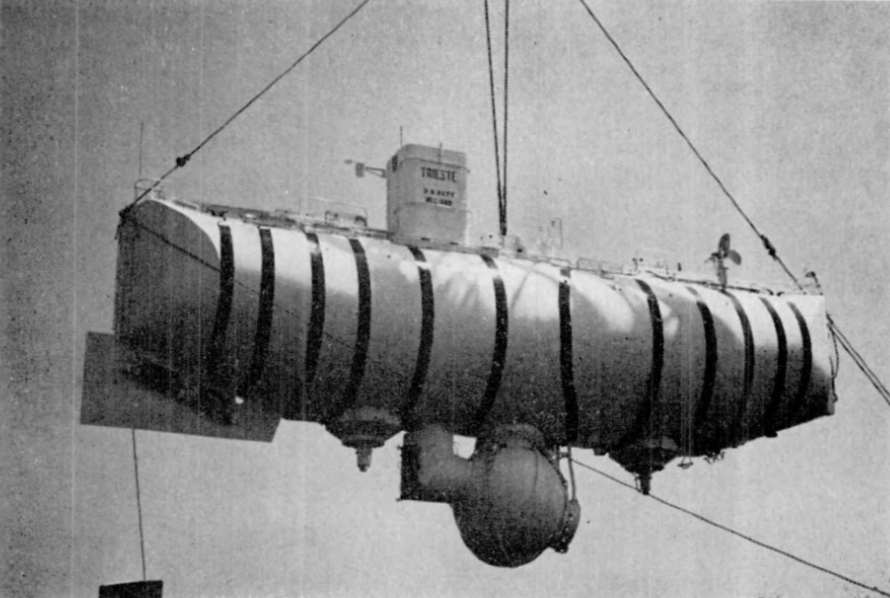
The deepest point in the ocean is at the southern end of the Mariana Trench in the western Pacific, and it is just under eleven kilometres down, which is about seven miles. The surface above it is unremarkable open water. The pressure at the bottom is over a thousand times atmospheric, something in the order of eight tons on every square inch.
Two men went there in January 1960, in a vessel that was already a decade old, using a design principle borrowed from ballooning. They spent about twenty minutes on the bottom, saw very little because they had stirred up the sediment on arrival, and came back up. Then the place was left alone by crewed vehicles for fifty-two years, which is longer than the gap between the first and the most recent crewed landings on the moon.
A balloon, upside down
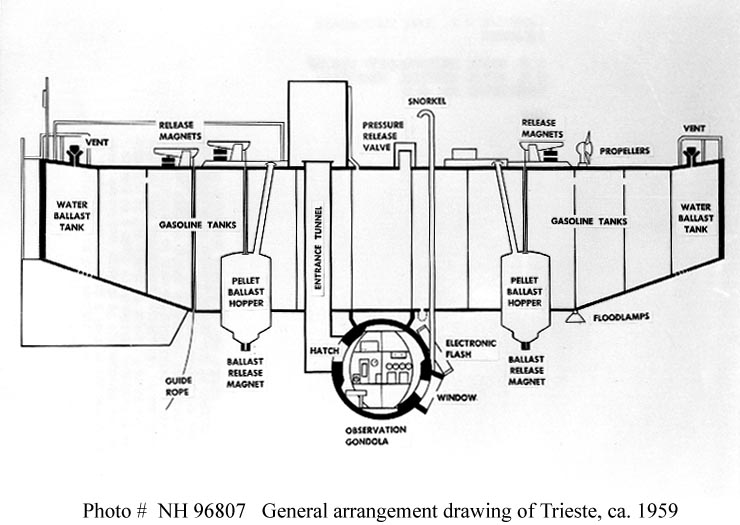
The vehicle was a bathyscaphe, and the concept is simpler than it looks. A submarine controls its depth by taking on and expelling water, which requires a pressure hull large enough to contain people and machinery and strong enough to resist the depth, and that becomes impossible well above seven miles.
The bathyscaphe separates the two functions. A small, very thick steel sphere holds the crew and resists the pressure, and it is slung beneath a large float filled with gasoline, which is buoyant and, more to the point, almost incompressible, so the float does not collapse as it descends. Iron shot ballast held by electromagnets takes the vessel down, and releasing it brings the vessel back up. The whole thing is an underwater balloon: you cannot steer it in any meaningful way, you go down and you come up, and if the electrical system fails the magnets release the shot and the vehicle surfaces on its own. That last property is the only reason it was considered acceptable to put people in it.
Like our content? Follow us for more.
The window cracked on the way down
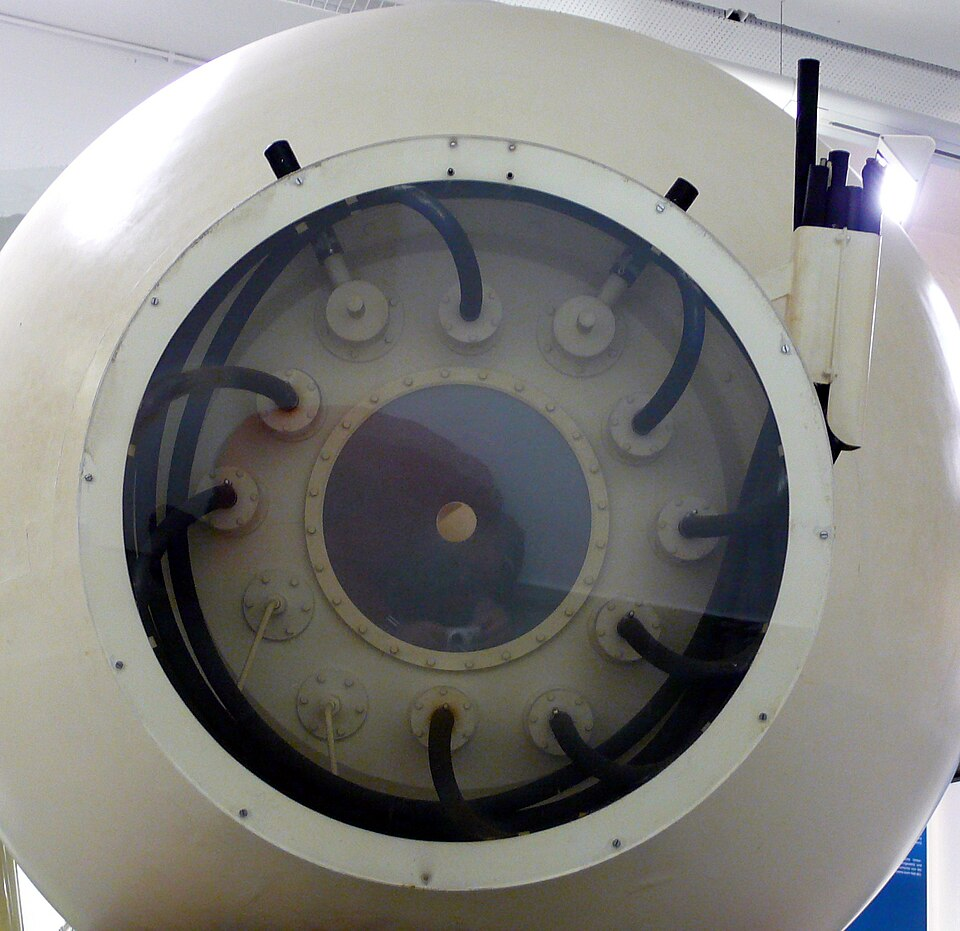
At around nine kilometres, with the descent still in progress, the crew heard a loud report through the hull. An outer pane of the acrylic window in the entrance tube had cracked.
They discussed it and continued. The reasoning was that the cracked element was not the pressure boundary of the crew sphere, and the risk was judged to be to the entrance tube on the way back up rather than to the occupants at depth. That turned out to be correct, and the ascent was managed accordingly. It is worth pausing on the decision, because it is the sort that does not appear in the official account in any detail: two men, five and a half miles down, in a vehicle nobody could reach, hearing their own hull make a noise it had not made before, and electing to keep going for another mile and a half.
Twenty minutes, and a fish that probably was not a fish
They reached the bottom and the sediment came up around them in a cloud, which is the recurring problem with visiting a deep seabed: the floor is a fine ooze and arriving disturbs it comprehensively. Visibility was poor for the whole of the time they were there.
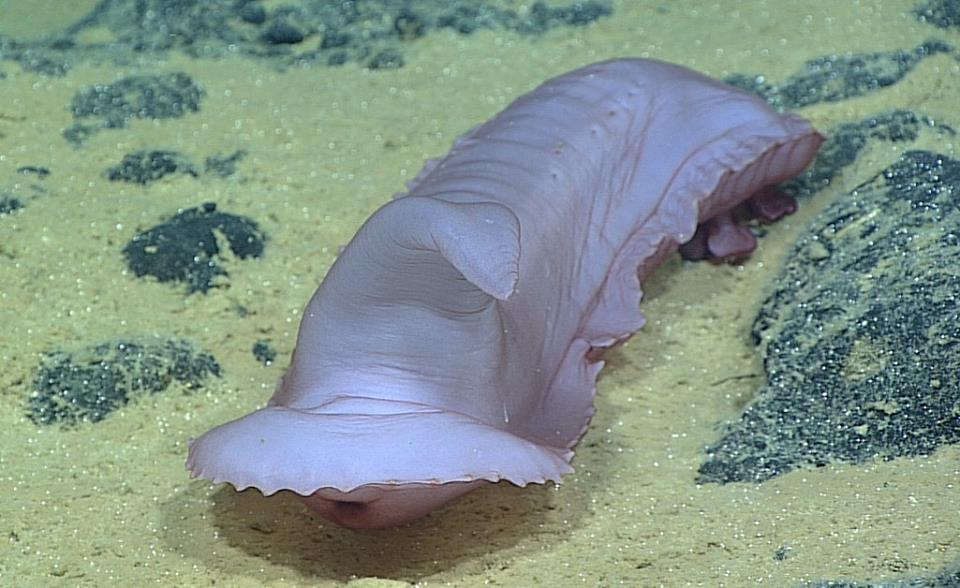
The observation that mattered was a report of a flatfish, seen on the bottom. If correct, it was a vertebrate living at the maximum depth of the ocean, and it was taken at the time as settling a significant question about the limits of complex life. The sighting has been doubted ever since, on the reasonable grounds that no flatfish has been recorded anywhere near that depth in the decades of subsequent observation, and the likeliest explanation offered is a sea cucumber. What has since been confirmed to live there is abundant and strange in its own right: amphipods in large numbers, and giant single-celled organisms that grow to several centimetres. The question of how deep a fish can live has its own answer now, established by camera systems, and it is shallower than the trench floor.
Why nobody went back
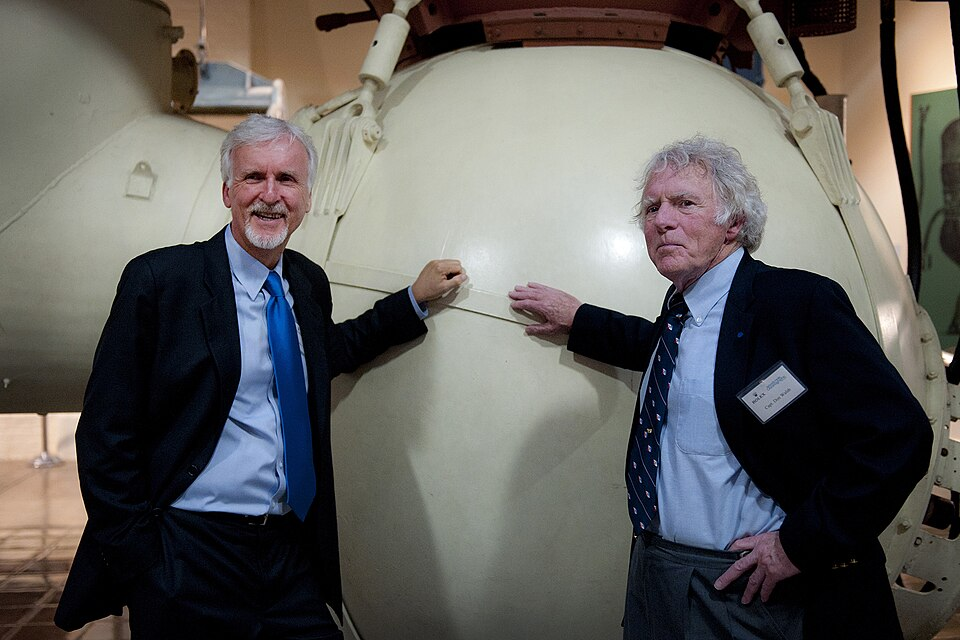
The gap is the most interesting thing about the dive and the explanation is prosaic. The vessel was not capable of doing useful work at that depth: it could not manoeuvre, could not collect a sample, could barely see, and the operation was enormously expensive and logistically heavy. Having proved the point, there was nothing further to do with it.
The scientific effort therefore went to uncrewed vehicles, which is where it has mostly stayed. A Japanese remotely operated vehicle reached the bottom in the mid-1990s and worked there repeatedly, and an American hybrid vehicle did so in 2009. Both of those produced far more data than the 1960 dive, and the second was lost at depth a few years later, which illustrates the economics neatly: losing an uncrewed vehicle is a budget problem. The crewed return came in 2012, in a purpose-built single-seat submersible operated by a film director, and since 2019 a privately developed vessel has made the descent many times, taking paying passengers and mapping the trench floor properly.
What the trench actually is
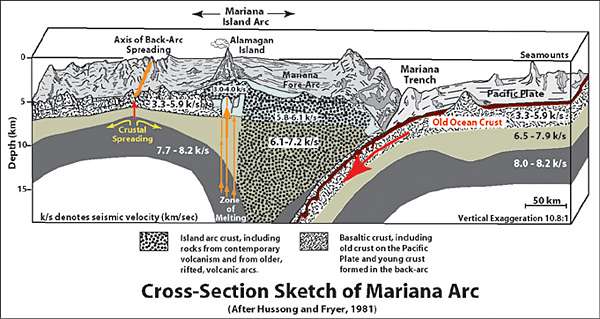
The Mariana Trench exists because one tectonic plate is being forced beneath another. The Pacific plate is subducting under the Mariana plate, and the trench is the surface expression of the bend where it goes down.
That makes it a long narrow feature rather than a hole, and the deepest part of it is a small basin at the southern end. The trench is also, in consequence, geologically active, and the water column above it is a nutrient-poor open ocean, which means almost everything living at the bottom depends on material falling from far above. The food supply at the deepest point is dead matter sinking seven miles, which is why the organisms there are predominantly scavengers and why they are concentrated in the lowest parts of the basin, where the sinking material accumulates.
And what has been found in it since
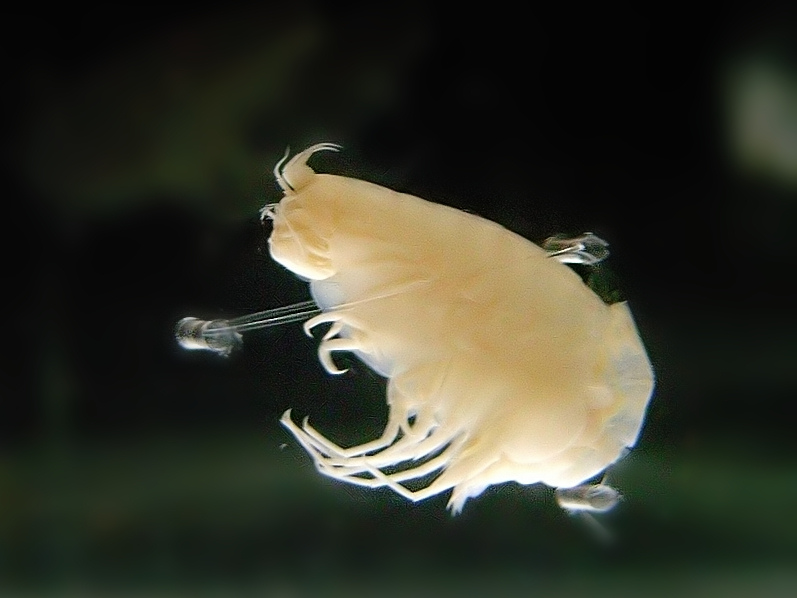
The modern surveys have produced two findings worth reporting. The first is life: a far richer community than the 1960 dive could detect, including microbial communities in the sediment, the amphipod populations, and the giant single-celled forms, together with evidence that the trench functions as a carbon sink because of the material accumulating in it.
The second is less welcome. Plastic debris has been recorded at the bottom of the trench, and persistent industrial pollutants have been measured in the tissue of the amphipods living there at concentrations higher than in animals from heavily industrialised coastal waters. The mechanism is the same one that concentrates the food supply: material sinks, accumulates in the deepest basin, and enters the scavengers that live on it. The deepest, most remote and least visited place on the planet turns out to be a collection point.
The two men
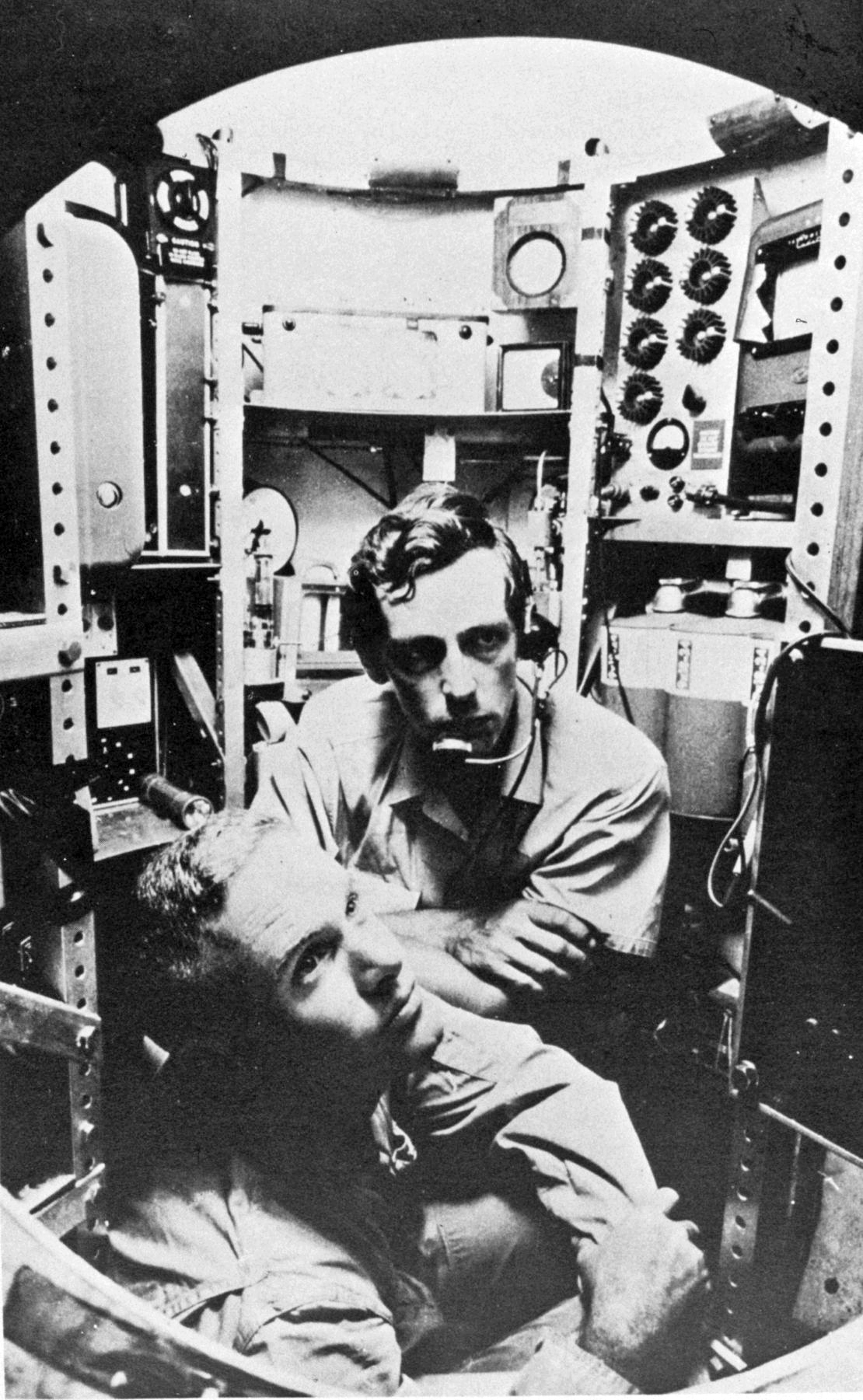
The 1960 crew were a United States Navy lieutenant and the Swiss engineer whose father had designed the vessel. The father had built both record-setting balloons and the bathyscaphe principle, which is why the craft works the way it does, and the son had been diving it for years.
The American officer went on to a long career in deep ocean work and spoke about the dive for the rest of his life, consistently and without embellishment, including about the cracked window and about the doubts over the fish. The pairing is worth noticing: a national navy with the resources and a reason to be there, and a family of engineers who had worked out how to build the vehicle. Almost every deep ocean record since has had the same structure, with a private or philanthropic designer and an institutional operator, and the current era of trench diving is a privately funded vessel doing science with institutional partners.
Why seven miles is harder than it sounds
It is tempting to compare this to spaceflight and conclude that the ocean has been neglected, and the comparison is misleading in one specific respect. Vacuum is a pressure differential of one atmosphere, and a spacecraft hull has to hold that. The bottom of the Mariana Trench is a differential of more than a thousand.
That is why there have been so few crewed descents and why the vehicles that make them are small, thick-walled spheres with tiny windows. It is also why the uncrewed approach has dominated: the engineering penalty for keeping a person alive at that pressure is enormous and the scientific return from doing so is modest. The 1960 dive proved a vehicle could survive it and a human could be there. What the fifty-two-year gap says is that, having established the point, there was very little reason to repeat it until somebody wanted to badly enough to build a better vehicle.
That is probably the fairest way to read the whole episode. The 1960 dive was not a scientific expedition that happened to be crewed; it was a demonstration, conducted by a navy, that the deepest point in the ocean was reachable, and it succeeded completely at being that. The science came later and mostly without people aboard. What the dive left behind was not a dataset but a fact — that the bottom exists, that it can be stood on, and that it has a floor of pale ooze with things moving in it — and facts of that kind are what expeditions are actually for.
Like our content? Follow us for more.
