There is a piece of physics that almost everybody half-knows and that is more interesting stated precisely.
The half-known version is that things fall faster and faster. That is true in a vacuum and is not true in air, where the resistance to movement rises steeply with speed.
At some point that resistance equals the weight, the net force becomes zero, and acceleration stops. The object continues downward at a steady rate and will do so indefinitely.
That steady rate is a property of the object rather than of the fall — it depends on how heavy the thing is and how much drag it generates — and every device that slows a descent works by changing the second of those.
Why Drag Rises So Steeply

The relationship is the reason the effect appears so quickly.
Moving through air means pushing air out of the way, and the force required depends both on how much air is being displaced per second and on how fast each parcel of it is being accelerated.
Both of those scale with speed, which means the resistance rises roughly with the square of the velocity rather than in proportion to it.
Doubling the speed therefore produces around four times the resistance, which is why the balance point is reached far sooner than intuition suggests.
It also means the effect of increasing drag is not linear. Doubling the area of a canopy does not halve the descent rate; it reduces it by a factor closer to the square root of two, which is why canopies are as large as they are.
That square relationship is the single most useful thing to understand about the whole subject, and it explains why very large increases in area produce comparatively modest reductions in speed.
Like our content? Follow us for more.
What the Canopy Is Doing
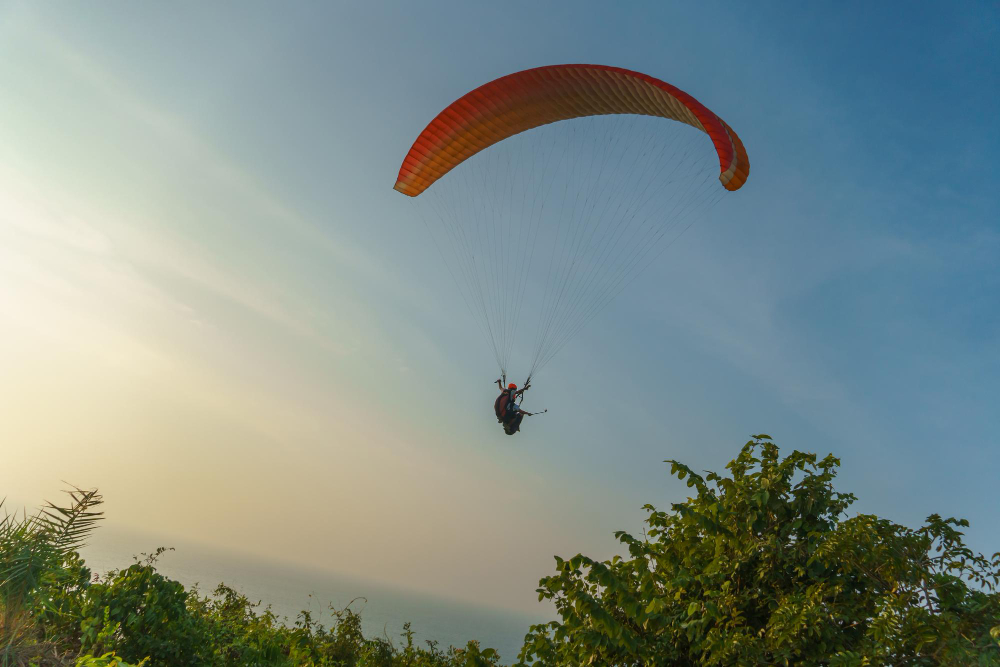
The mechanism is more than surface area, which is the common simplification.
A canopy generates drag by forcing air to change direction, and the pressure difference between the inside and the outside is what supports the load.
Air is compressed beneath and must escape around the edges, which means the flow around the rim is doing a substantial part of the work — and a canopy without a controlled escape route behaves badly.
That is why most designs have an opening at the top. Without one, air escaping only at the rim does so unevenly and alternately, which makes the canopy swing from side to side continuously.
An opening allows a steady controlled flow through the centre, which stabilises the whole thing at a small cost in drag — trading a modest increase in descent rate for a descent that goes roughly straight down.
That is a good illustration of a general principle: stability is frequently bought by deliberately reducing the primary performance.
There is a density point worth adding. Drag depends on the density of the air as well as on speed and area, and air is substantially thinner at height than near the ground.
That means a descent begins faster and slows as it proceeds into denser air, which is the opposite of what most people assume is happening.
The Shape Question
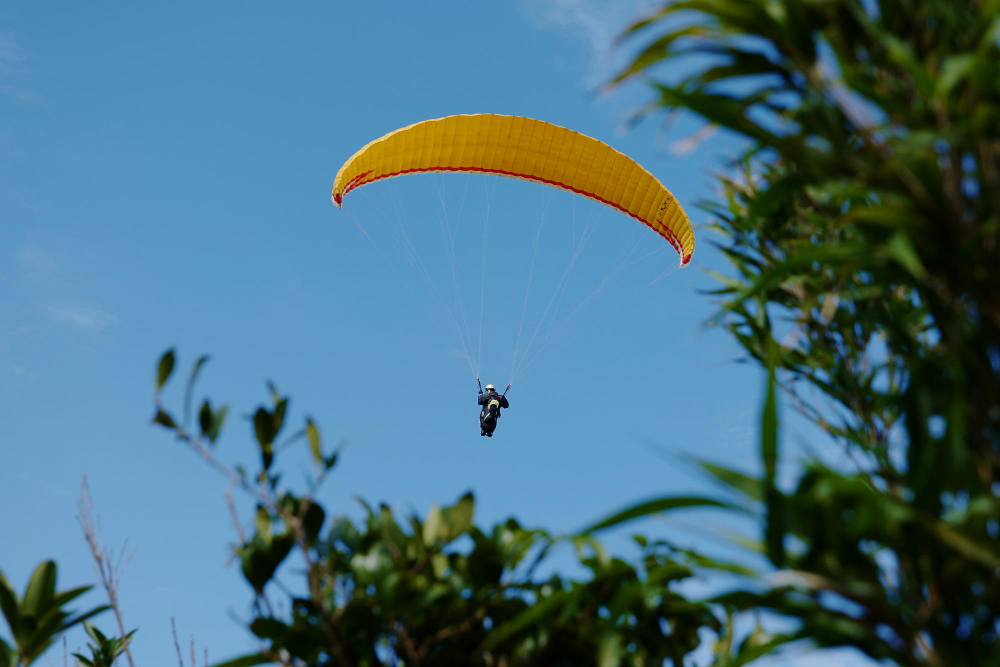
Modern designs differ fundamentally from the round version and the difference is not cosmetic.
A round canopy produces drag and nothing else. It descends, it drifts with the wind, and the occupant has very limited influence over where it goes.
A ram-air design is a wing rather than a brake. Air entering openings at the front inflates a fabric structure into an aerofoil section, which generates lift as well as drag and can be flown.
That changes the problem entirely. A wing has forward speed, can be steered, can be turned into the wind and can trade speed for lift briefly at the end of a descent to reduce the arrival rate substantially.
The trade is complexity. A round canopy either opens or does not; a wing has to inflate correctly into the right shape, can inflate into the wrong shape, and requires skill to operate.
Which is why both exist. Where control matters, the wing wins; where simplicity and reliability under all conditions matter more, the simpler form persists.
There is a load point worth adding. Descent rate depends on the total weight carried, so the same canopy descends faster under a heavier load – which means a canopy is matched to a weight range rather than being general purpose.
Outside that range it either descends too fast or drifts excessively.
Why Deployment Is the Hard Part

The difficult engineering is not the descent, which is the counterintuitive part.
A canopy at speed must go from packed to fully inflated, and the forces during that transition are enormous — far greater than anything experienced during the descent itself.
Opening too fast produces a shock that can damage the canopy, the lines or anything attached, and opening too slowly does not produce enough drag in time.
The solution is to control the rate of inflation deliberately, generally with a device that restricts the canopy to a partial opening for a short period before allowing it to expand fully.
That staged inflation is what makes deployment survivable, and it is a substantial piece of engineering hidden inside something that appears to simply unfold.
Packing matters for the same reason. The order in which everything is stowed determines the sequence in which it emerges, and a packing error produces a deployment failure rather than a slower descent.
Where Else the Principle Appears
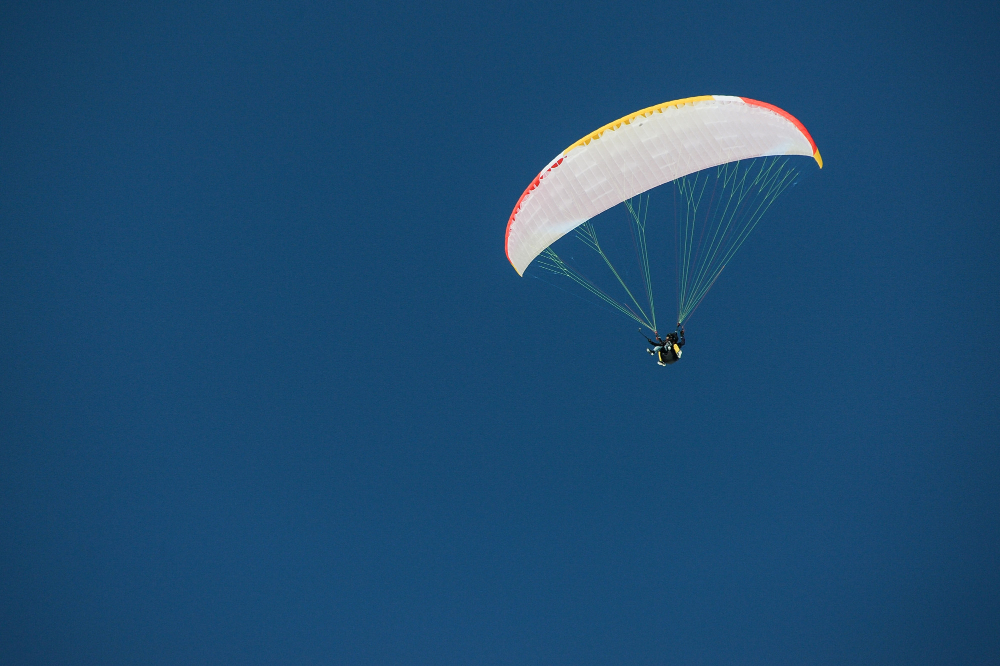
The same physics is used well beyond the obvious application.
Drag devices slow aircraft on landing, reduce the speed of vehicles in testing, and stabilise objects dropped from height so that they arrive the right way up.
Spacecraft entering an atmosphere use it, although in that case the primary braking is done by the atmosphere against a shaped surface long before any canopy is involved, and the canopy handles only the final and slowest part.
Cargo delivery uses arrays of canopies rather than single large ones, because several smaller ones are easier to pack, more tolerant of one failing and easier to match to a specific load.
And the principle appears in nature, in seeds that descend slowly enough to be carried sideways, using exactly the same relationship between surface area, weight and terminal speed.
That last case is the oldest application by an enormous margin, and it works for precisely the reason the manufactured versions do.
Why the Lines Matter as Much as the Canopy
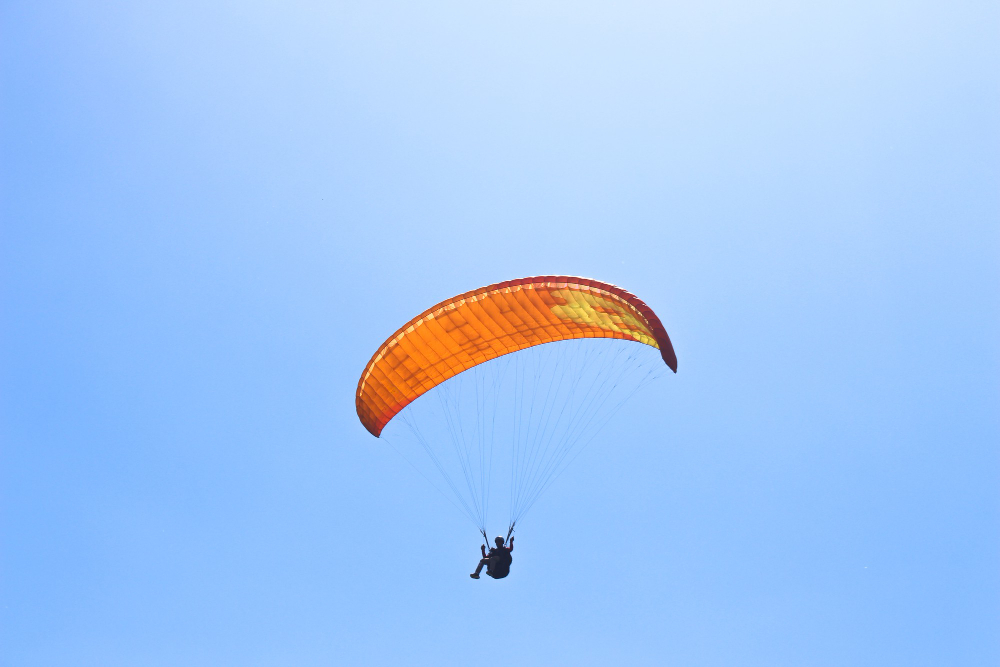
The suspension is a substantial part of the design and receives almost no attention.
The load hangs some distance below the canopy on a large number of lines, and that distance is not arbitrary — it determines how the system responds to disturbance.
A load hung close beneath a canopy swings quickly and is unstable; hung further below, it behaves like a pendulum with a longer period, which damps oscillation rather than amplifying it.
The number of lines matters for distributing load into the fabric. Attaching at a small number of points concentrates stress and distorts the canopy; spreading the attachment around the edge keeps the shape and shares the force.
The lines also have to be of matched length, because a difference of a small amount changes the angle of the canopy and therefore the direction of descent — which is why a line snagged or shortened produces a persistent turn.
And on steerable designs, deliberately shortening lines on one side is the entire control mechanism, deforming the wing to turn it, which means the lines are not merely suspension but the flight controls.
That is why a canopy cannot be assessed on its own. The behaviour of the system is a property of the canopy, the lines and the load together, and changing any of the three changes all of it.
What It Does Not Do
Two clarifications belong at the end because both are widely misunderstood.
A canopy does not slow a descent continuously. It establishes a new steady rate, reached within seconds, and after that the rate does not change unless the air density or the load does.
And it does not provide control over where the descent ends unless it is a design that generates lift. A round canopy goes where the air takes it, and the occupant chooses very little.
Both of those follow directly from the physics at the top of this article, and both are the opposite of how the device is usually imagined — as something that arrests a fall and can be aimed.
What it actually does is reset a single number. The speed at which air resistance balances weight was one value, and now it is a smaller one, and everything the device achieves is contained in that substitution.
That is a remarkably narrow claim for something so dramatic. The canopy does not fight gravity, arrest anything or provide control in the ordinary sense – it moves one number, and the whole apparatus exists to move it reliably.
Like our content? Follow us for more.