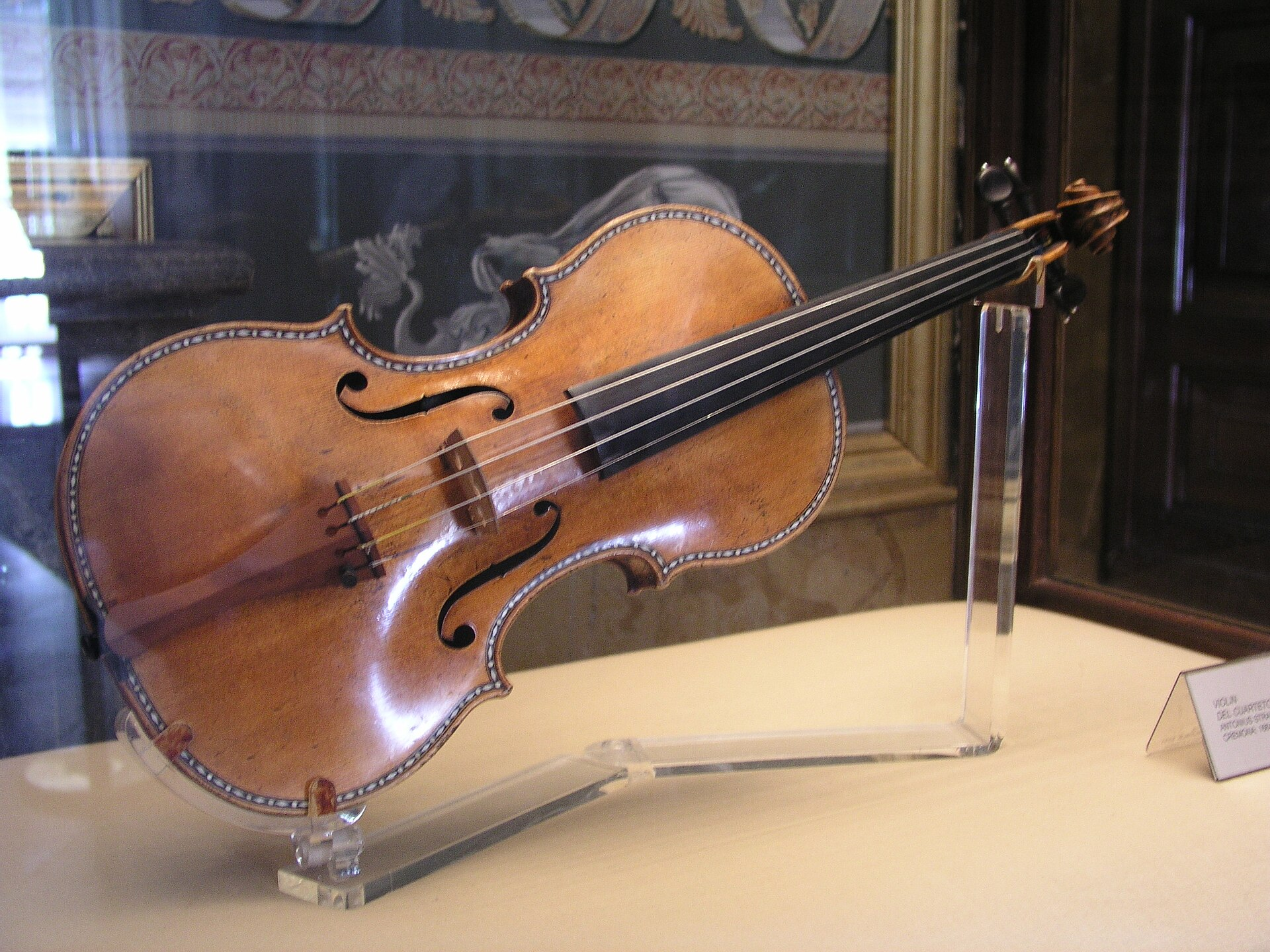
Antonio Stradivari worked in Cremona in the late seventeenth and early eighteenth centuries, and the instruments he made have become the most valuable objects in music. Individual examples sell for millions of dollars; a set used in one research study was valued at around 50 million in total, roughly a hundred times the price of good modern violins.
The justification for that valuation is a claim about sound: that old Italian instruments possess tonal qualities no contemporary maker can achieve. It is one of the most widely repeated beliefs in classical music, held by many players, dealers and listeners.
Enormous effort has gone into explaining why. Researchers have investigated the varnish, the chemical treatment of the wood, the density of timber grown during a cold period in European climate history, the specific geometry of the instruments.
What received far less attention was the prior question: whether the superiority exists at all. When that was finally tested under controlled conditions, the results were not what almost anyone expected. Here is what the experiments found.
The Question Nobody Was Asking
The logical structure of the problem is worth setting out, because it explains why the studies mattered so much.
For a century, researchers pursued the secrets of Stradivari — the physical explanation for a superiority that was assumed rather than demonstrated. As the authors of one of the key papers put it, great efforts had been made to explain why these instruments sound better than high-quality new violins, without anyone providing scientific evidence that this is in fact the case.
Establishing the claim requires two things: that experienced violinists show a general preference for old Italian instruments under double-blind conditions, and that they can reliably tell them apart from new ones.
Neither had been tested properly. Players’ opinions were formed while knowing exactly what they were holding, which is precisely the situation in which expectation shapes perception.
That is not a slight on musicians. It is a well-documented feature of human judgement across every domain where price, prestige and provenance are visible, and it is the reason blind protocols exist.
Like our content? Follow us for more.
Goggles, and a Hotel Room
The first attempt was small and, in retrospect, rough. In 2010 a study conducted in Indianapolis asked violinists to compare instruments in a hotel room, and found a general preference for new violins and an inability to reliably distinguish new from old. It was controversial and easily criticised on grounds of setting and scale.
So the researchers ran it properly. In 2012, a team led by the French acoustics specialist Claudia Fritz, working with the American violin maker Joseph Curtin and strings expert Fan-Chia Tao, assembled a much more controlled experiment.
Ten renowned soloists each blind-tested twelve instruments: six old Italian violins, five of them by Stradivari, and six by contemporary makers. The testing ran across two 75-minute sessions, the first in a rehearsal room and the second in a 300-seat concert hall near Paris.
The blinding was physical. Lights were dimmed and the players wore modified welder’s goggles so they could not identify instruments by sight. They were asked to select the violin they would take on a hypothetical concert tour instead of their own.
The results were published in the Proceedings of the National Academy of Sciences in April 2014.
What They Found
Six of the ten soloists chose a new violin as their favourite. The single most frequently chosen instrument among all twelve was new.
The scoring made it starker. Tallying each player’s top four choices and accounting for instruments rejected outright, one modern instrument came out on top with 26 points — first choice for four players, second for another four, rejected by two. A Stradivari finished last with a score of minus nine. The two most-preferred instruments overall were modern; third place went to a violin from Stradivari’s celebrated golden period.
And on the identification question, the report’s conclusion was unambiguous: soloists readily distinguished instruments they liked from those they did not, but were unable to tell old from new at better than chance levels.
A separate account of related testing found that of seventeen players, seven said they could not tell which were which, seven guessed wrong, and only three got it right.
The authors framed the significance directly. Where most studies open new fields of investigation, this one attempted to close a perennially fruitless one: the search for the secrets of Stradivari.
The Audience Test
A predictable objection followed. Perhaps the difference is not what the player hears under the ear but what reaches an audience — the famous claim that old Italian instruments project better in a hall.
That is a testable claim too, and the same team tested it. Listening experiments were held in 2012 in a small concert hall near Paris and in 2013 in a larger hall in New York, and a further analysis was published in PNAS in 2017.
The findings went the same way, and the paper described them as unambiguous. Listeners found that new violins projected better than those by Stradivari. Listeners generally preferred the new instruments. And listeners were no better than players at telling new from old.
The audiences were not naive, either; they included musicians, violin makers and acousticians, and very similar results were obtained across all backgrounds.
Fritz has also noted the physics side plainly: in terms of measurable physical differences, the researchers have not found any fundamental distinction between new and old Italian violins.
The Caveats That Matter
Responsible reporting requires the limitations, and the researchers stated them themselves.
The instruments used were a specific sample and might not be representative of their kind. Old Italian violins vary enormously in condition, setup and quality, as do modern ones, and a different dozen instruments could produce different results.
The sample of players was small — ten soloists in the main study — because the number of people qualified to evaluate instruments at that level, and willing to participate, is limited.
The tests measure preference and discrimination under specific conditions, over sessions of a couple of hours. They do not measure how an instrument behaves over years of professional use, how it responds to a particular player’s technique over time, or how it ages.
The findings have been contested in the literature, with published letters raising methodological questions and replies from the authors defending the conclusions. This is normal scientific argument rather than a scandal.
What the studies do establish is narrower but still substantial: under blind conditions, the assumed superiority does not show up, and the assumed ability to identify it does not either. That is enough to undermine the confident version of the claim, which was never evidenced in the first place.
What the Secret Was Supposed to Be
It is worth cataloguing what researchers spent a century looking for, because the range of proposed explanations is itself revealing.
The varnish theory held that Stradivari used a formulation, now lost, with acoustic properties. Chemical analysis has examined the varnish in detail without identifying anything that would account for a tonal advantage.
The wood theory pointed to timber grown during an unusually cold period in European climate history, which produced dense, slow-grown spruce with narrow rings. The wood is truly distinctive; whether it produces a better instrument is the unproven step.
A related proposal concerned chemical treatments — minerals or preservatives applied to the wood, possibly to deter insects, which might have altered its acoustic behaviour incidentally.
Others focused on geometry, on the arching of the plates, on how the instruments have aged, or on the effects of centuries of playing.
Each of these is a plausible mechanism. What they share is that they were all attempts to explain an effect whose existence had not been established. If the effect does not survive blind testing, the mechanisms have nothing to account for — which is precisely why the researchers described their work as trying to close a fruitless field rather than open a new one.
Why the Belief Survives Anyway
The results have been public for over a decade and have changed very little. Old Italian instruments still command extraordinary prices and are still described in the language of unmatched tone.
Several things sustain that. Prices are driven by rarity, provenance and investment value as much as by sound; a Stradivari is a historical artefact with a documented lineage, and that would command a premium even if it sounded merely good.
There is also the awkward position of anyone heavily invested in the belief, financially or professionally, which is not an accusation of dishonesty so much as an observation about how difficult it is to hear neutrally when you know what you are holding.
And expectation truly alters perception. A player who believes an instrument is extraordinary will experience it differently, which is real for them and not measurable as a property of the violin.
The most useful consequence is for musicians rather than collectors. Old Italian instruments are priced beyond the reach of the vast majority of players, which is precisely why the researchers considered it important to test the assumption of their tonal superiority. If excellent modern violins are indistinguishable to elite soloists and preferred by audiences, then a good instrument is not the preserve of people with access to millions — which is a substantially more encouraging conclusion than the myth it replaces.
Like our content? Follow us for more.