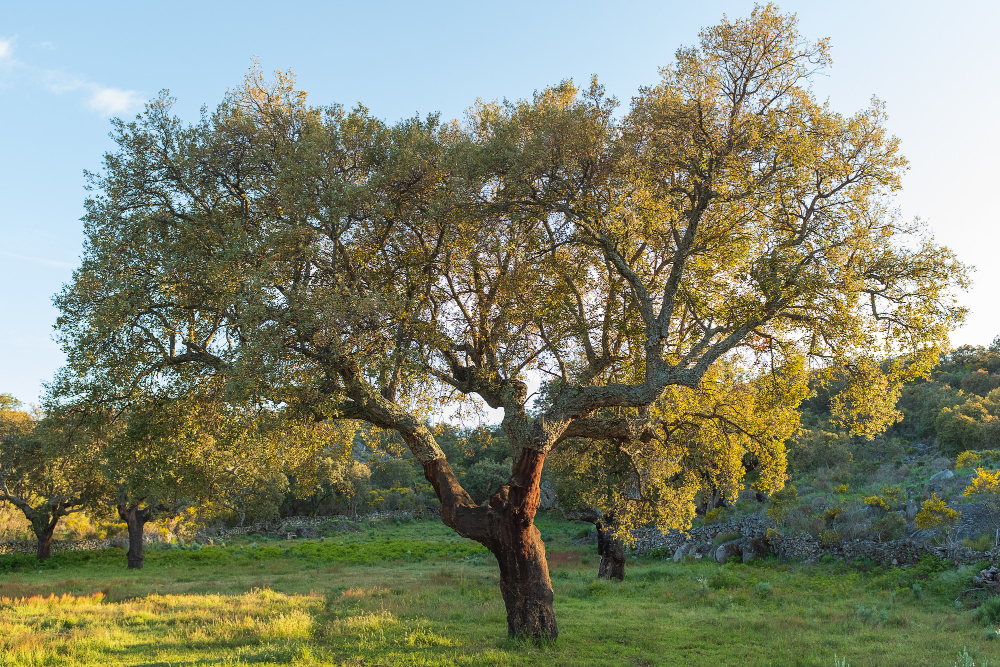
There is a small category of materials obtained from a living organism without killing it, and a smaller category still where the organism replaces what was taken.
Cork belongs to the second. The outer bark of a particular oak is removed in sheets, the tree regenerates it over several years, and the process repeats for as long as the tree lives — which is a very long time.
That arrangement is unusual enough to be worth understanding on its own. What makes it more interesting is that the material produced has a structure found almost nowhere else, and the properties everybody associates with cork are all consequences of that one structure.
What the Material Is
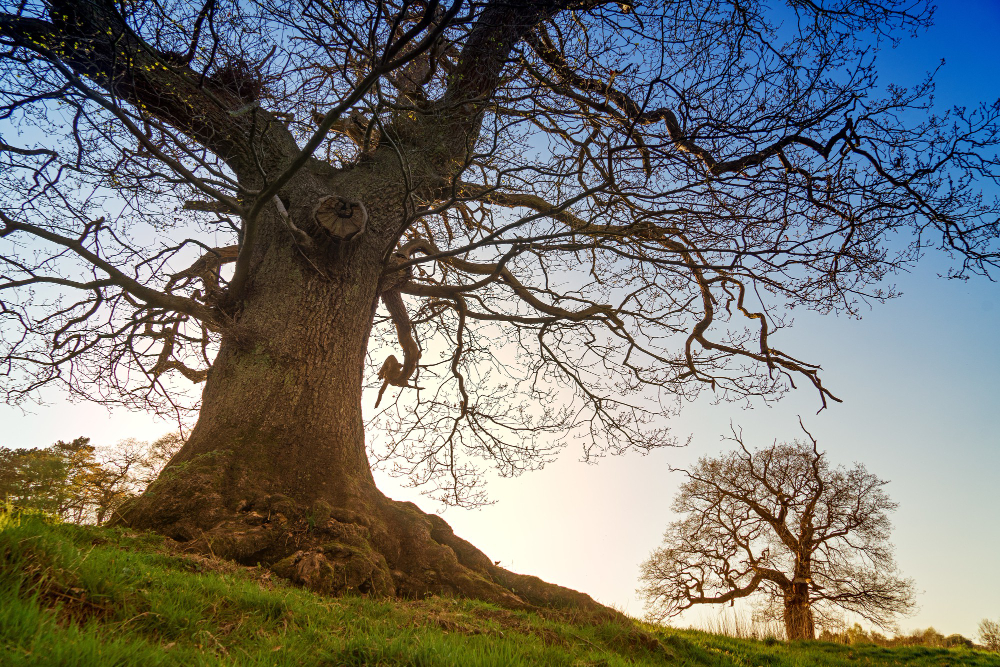
The cellular arrangement explains every property, so it is worth being precise.
Cork consists of very small closed cells, roughly fourteen-sided, packed together with no gaps between them, and each sealed and filled with gas.
The cell walls are thin, flexible and coated with a waxy substance that makes them impermeable to both water and gas.
That means the material is mostly empty space by volume — a very high proportion — enclosed in a structure that does not allow the contents to escape.
Everything follows from those two facts. A material made of sealed gas-filled compartments with flexible walls will be light, will insulate, will compress and recover, will not absorb liquid and will damp vibration — and cork does all of those.
That is an unusual combination to get from one structure, and it is why the material has never been fully replaced despite being more expensive than several alternatives.
Like our content? Follow us for more.
Why It Seals
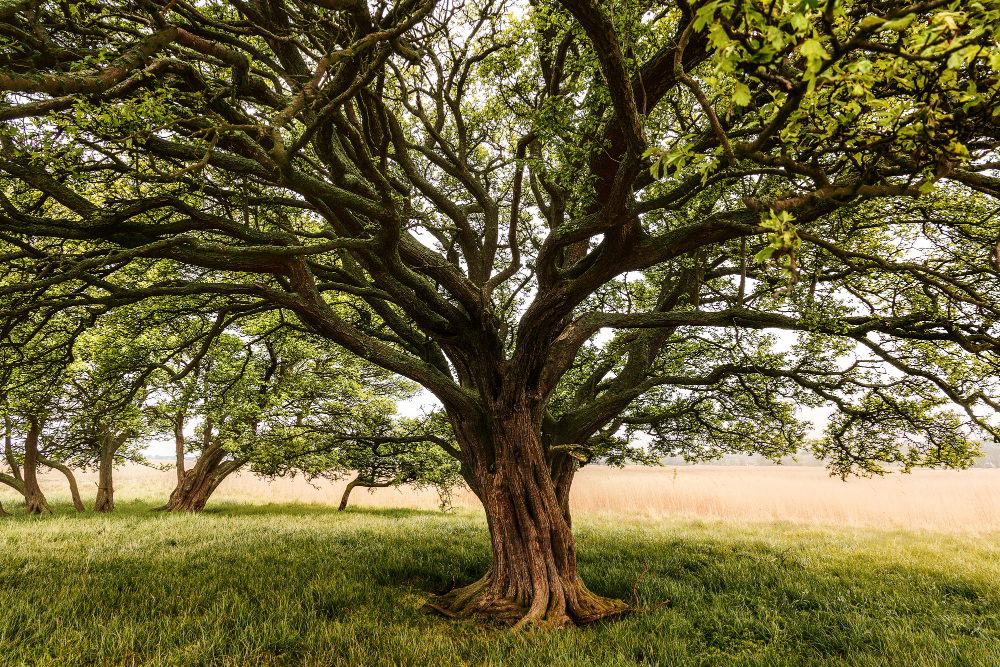
The application everybody knows depends on a property that sounds contradictory.
Most materials, when compressed in one direction, expand in the others. Squeeze a rubber block and it bulges outward.
Cork does not do this to any meaningful degree. Compressed along one axis, it changes very little along the others, because the cells simply fold inward into their own empty space rather than displacing material sideways.
That property is what makes it work as a stopper. A cork compressed to fit into an opening does not resist by needing to go somewhere; it accommodates the compression internally and then pushes outward steadily as the cells attempt to recover.
A material that expanded sideways when squeezed would be impossible to insert. A material that did not push back would not seal. Cork does neither and both, which is a narrow specification that it happens to meet.
It also recovers. Compressed for a long period and then released, it returns most of the way toward its original dimensions, which is why a stopper continues to seal over an extended time.
There is a timing point worth adding. Stripping is done in a specific season, when the tree is actively growing and the layer separates cleanly from the tissue beneath.
Attempting it outside that window damages the tree, which is why the work is compressed into a short period each year and why the labour requirement is so concentrated.
The Harvest
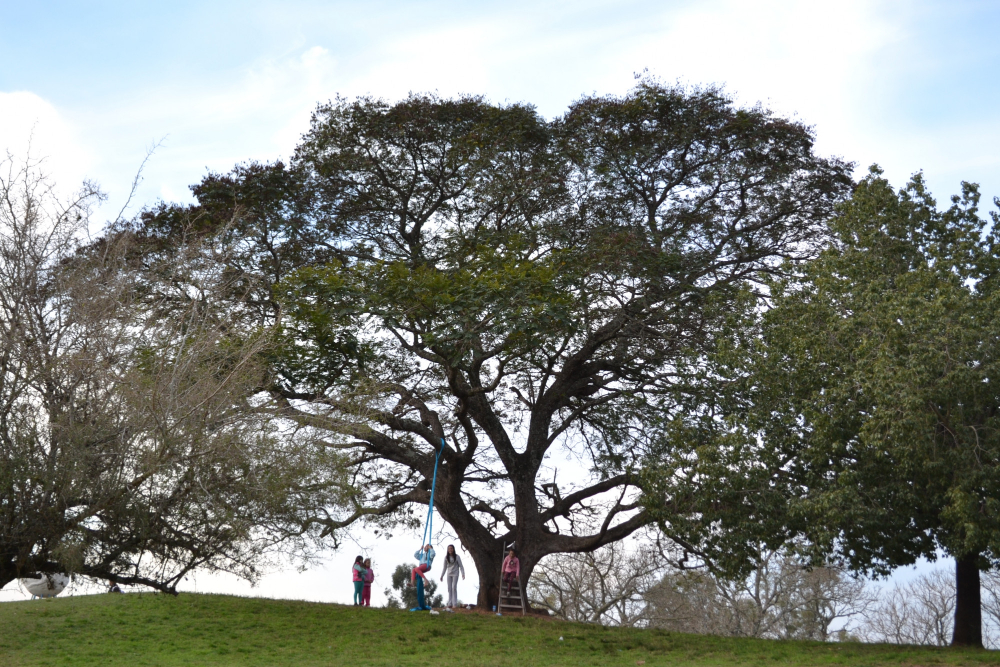
The process is skilled, manual and essentially unmechanised, which is worth explaining.
A tree must reach a substantial age before the first harvest, and that first stripping produces material of poor quality, irregular and unsuitable for most uses.
The second harvest, another cycle later, is better. Only from the third onward is the material consistent enough for the highest-value applications — which means a tree planted now produces its first good crop several decades later.
Stripping is done by hand with an axe, cutting through the outer bark without penetrating the layer beneath, which is living tissue and would kill or damage the tree if cut.
That judgement cannot currently be made by machine reliably, so the work is done by people who have learned it, seasonally, and the skill is a real constraint on production.
The interval between harvests is fixed by regulation in producing regions, on the reasoning that taking bark too frequently exhausts the tree, and the year of harvest is frequently marked on the trunk so that the cycle is visible.
What the Landscape Looks Like
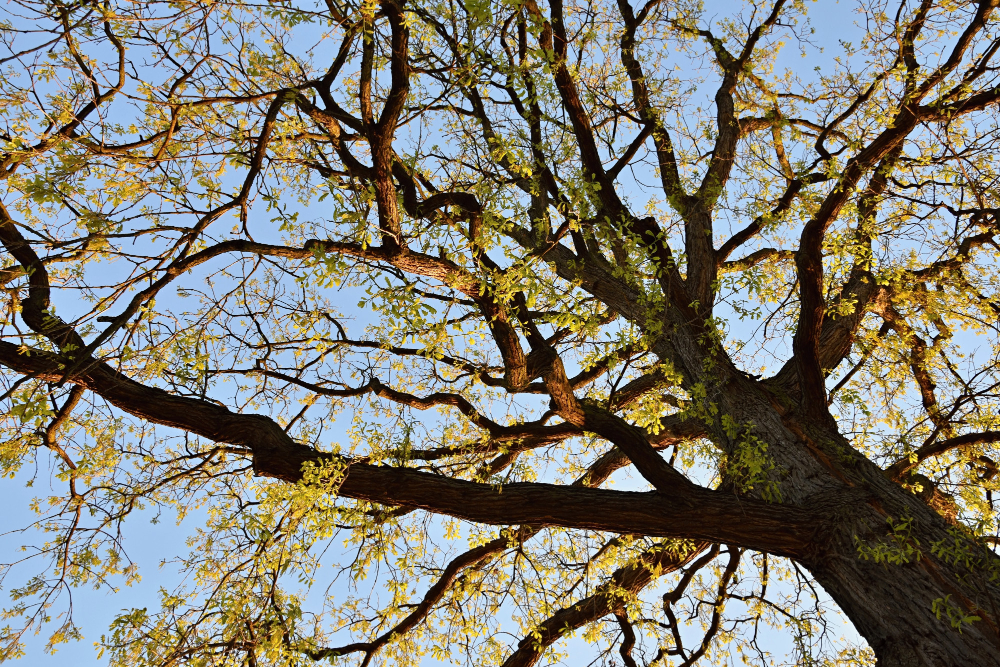
The production system creates a particular kind of countryside, which is a substantial part of why it matters.
Cork oaks are not grown in dense plantations. They are spaced widely, because each needs light and room, which produces an open woodland with substantial gaps between trees.
That spacing allows grazing and cultivation beneath them, so the same land supports trees, livestock and in places crops simultaneously — a mixed system rather than a monoculture.
The resulting habitat is open woodland with permanent trees, which supports a substantially wider range of species than either dense forest or cleared ground, and several of those species are found in few other places.
That is the argument that connects the material to conservation. The habitat exists because the trees are economically worth keeping, and the trees are worth keeping because the bark has a market — which means demand for the material maintains the landscape.
Where the market weakens, the economic reason to maintain the system weakens with it, and the alternative uses for that land are generally less varied.
There is a processing point worth adding. Stripped bark is stacked and left outdoors for a period before anything is made from it, which allows it to stabilise and dry to a consistent condition.
That waiting stage is unmechanised, occupies space and adds months to the cycle, which is part of why the material is expensive relative to alternatives.
The Substitution Question
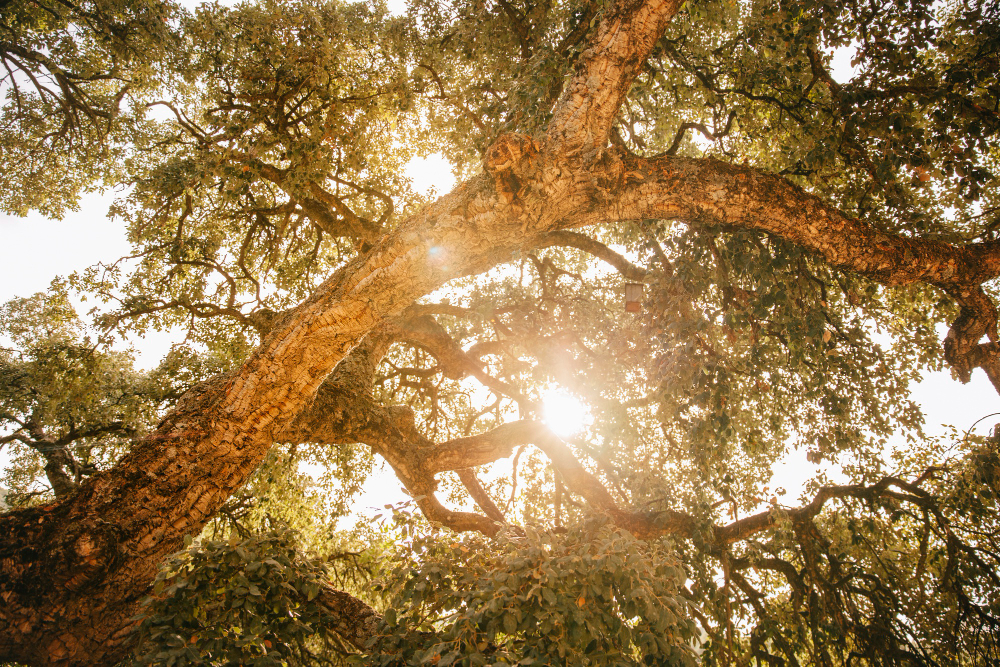
The commercial position is worth stating factually because it is frequently discussed.
Alternatives to cork stoppers exist, using moulded synthetic materials or metal closures, and both perform the sealing function.
They are cheaper, more consistent and do not carry the risk of a particular contamination fault that occasionally affects natural cork and spoils the contents.
Natural cork is defended on the grounds of performance over long periods, on the grounds of the landscape argument above, and on grounds of tradition and expectation.
The market has moved in both directions over recent decades, and the quality problem that drove much of the early substitution has been substantially reduced by changes in processing.
Which of those considerations should dominate is a commercial and environmental judgement rather than a technical one, and this article does not attempt to settle it.
What the Bark Is Doing for the Tree
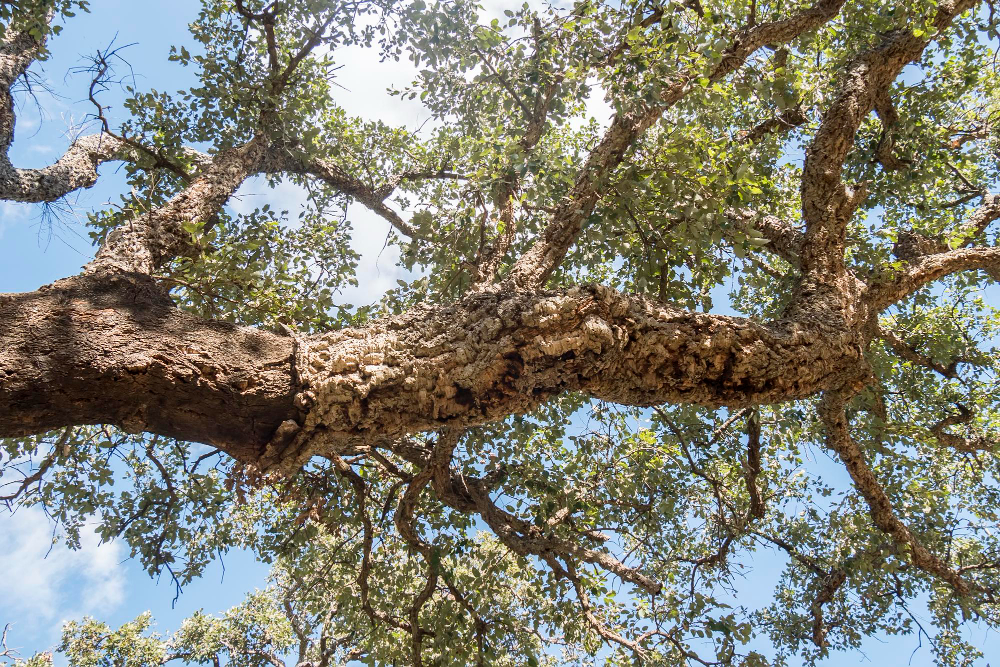
The biology is worth a section, because the material exists for a reason that has nothing to do with anybody using it.
Bark is a tree’s protective layer, and in most species it is comparatively thin and is renewed gradually from beneath as the trunk expands.
Cork oak produces an unusually thick layer of it, built from cells that die once formed and that are sealed and filled with gas — which is the structure described above.
That thickness is generally understood as a response to fire. A thick, dry, low-density insulating layer protects the living tissue beneath from heat, and a tree that survives a fire that removes its competitors is substantially better off.
The same properties that make it fire-protective make it useful. Low density, insulation, impermeability and resistance to decay are all exactly what a stopper or an insulating panel needs.
That is a recurring pattern. A material adapted for one purpose in an organism turns out to suit an entirely unrelated human application, because the underlying requirement — in this case a light impermeable insulator — is the same.
It also explains the regeneration. A tree that has evolved to replace a protective layer after fire damage is well equipped to replace it after somebody has removed it with an axe, which is the property the whole industry depends on.
Everything Else It Is Used For
Stoppers are the visible application and are a minority of the material by volume, which surprises people.
Cork is used in flooring, where the compression recovery and the insulation both matter, and where the material is made from granules bonded together rather than from whole pieces.
It appears in gaskets and seals throughout machinery, for the same compression properties.
It is used for vibration isolation and acoustic treatment, since the cellular structure absorbs energy rather than transmitting it.
It appears in insulation, in sports equipment, in footwear, in fishing floats and in a long list of applications where a light, resilient, impermeable material is wanted.
And the offcuts from stopper production feed all of that, since the pieces removed to produce a cylindrical stopper are ground and bonded into everything else — which means the low-value applications are consuming the waste from the high-value one.
That is a reasonably efficient arrangement, and it explains why the material’s economics depend so heavily on one product that accounts for a modest share of the tonnage.
And it explains why the whole system is more fragile than it appears. A landscape, a habitat and a set of rural livelihoods all rest on a market for one small object, and nothing about the trees themselves would survive that market disappearing.
Like our content? Follow us for more.