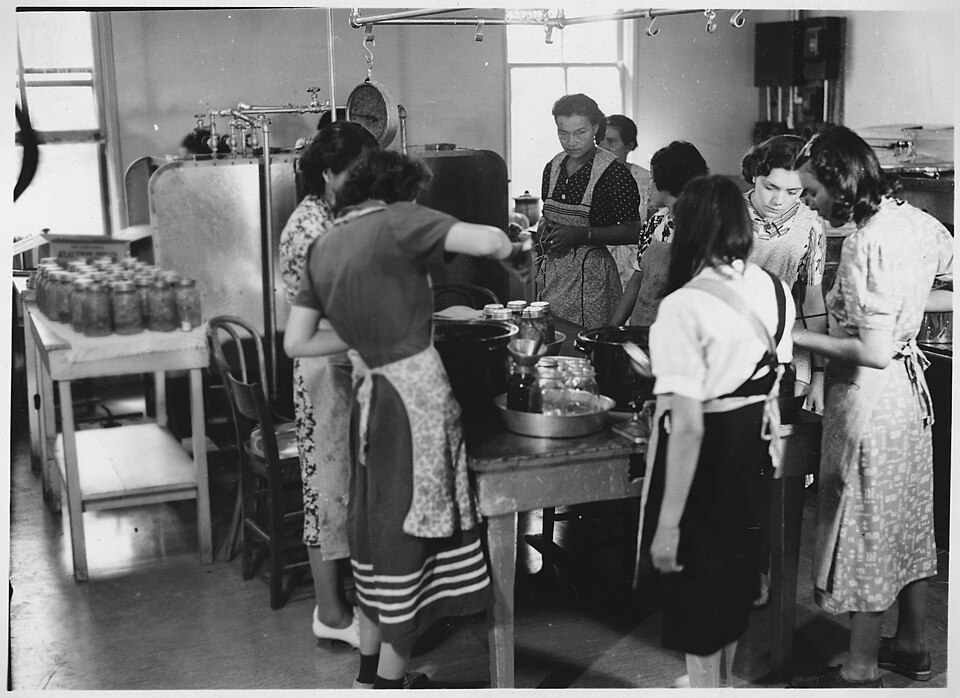
There is a particular confidence to the way an American kitchen handled fruit in August 1960. Nobody read instructions. The method came down a generation at a time, demonstrated rather than written, and it was judged entirely by results: if the jars sealed, and nobody got sick, the method was sound. Thousands of households put up hundreds of quarts a year on exactly that basis.
Most of them were fine. That is the part worth saying first, because the point of looking at the old method is not to suggest that a generation of grandmothers was poisoning its families. The great majority of home-canned fruit was perfectly safe, for reasons that had more to do with the chemistry of peaches and plums than with technique. But almost every individual step in the standard 1960 procedure has since been withdrawn, and some of them have been withdrawn in strong language. The modern guidance did not arrive because tastes changed. It arrived because the failures, when they came, were severe and specific, and because researchers eventually worked out which part of the old routine was doing the actual protecting and which part was doing nothing at all.
The method that held until the numbers came in
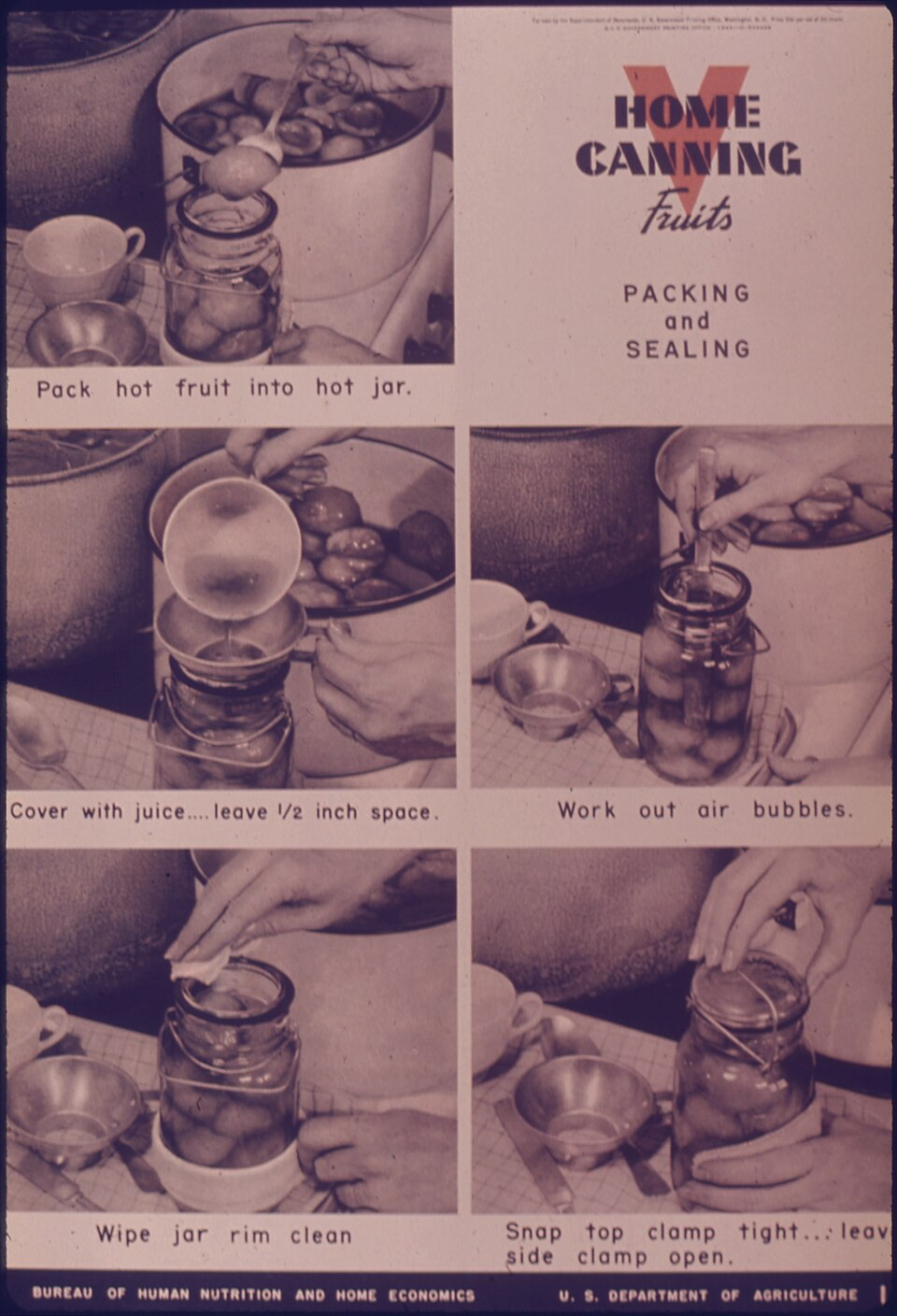
The standard approach was what is now called open-kettle canning. You cooked the fruit in a pot on the stove, ladled it boiling hot into clean jars, wiped the rims, screwed the lids down, and let the cooling contents pull a vacuum. No further processing. The jar was never put into a water bath at all. It was fast, it used one pot, and it saved a kitchen the half-hour of a boiling-water bath on a day that was already too hot.
The Department of Agriculture no longer recommends open-kettle canning for anything. The reasoning is straightforward once stated. Food goes into the jar hot, but the jar, the lid, the ladle and the air inside the headspace are not sterile, and the cooling food is not hot enough for long enough to deal with what they introduce. A seal formed this way is also less reliable, because the vacuum depends on how much steam happened to be trapped rather than on a controlled process. Jars sealed this way can lose their seal weeks later on a pantry shelf, and the failure is not always obvious from looking at them.
Like our content? Follow us for more.
Paraffin wax and the jelly jar
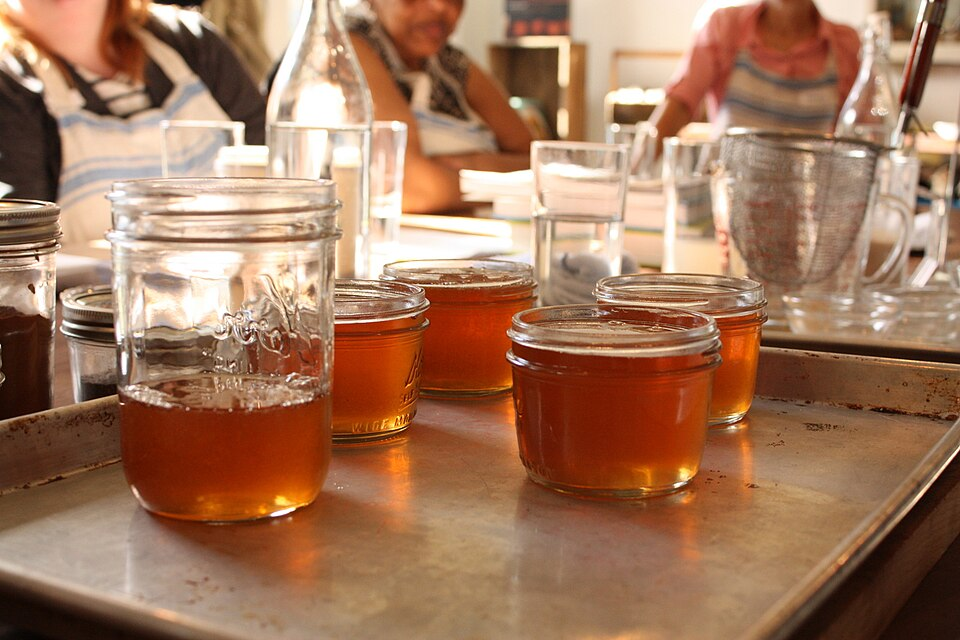
Jelly and jam were a separate ritual. A block of paraffin was melted in an old saucepan kept for the purpose, and a thin layer was poured over the surface of the hot jelly in each glass. When it set, the disc of wax was the seal. The glasses were covered with a circle of cloth or a tin lid that did nothing but keep the dust off. Thousands of jelly glasses sold in that era were designed around the practice.
Paraffin sealing has been off the recommended list for decades. Wax shrinks slightly as it cools and as the jar is moved, and it pulls away from the glass at the edge. The resulting hairline gap is enough to admit mold, and mold growing under a wax seal is growing in a place where nobody can see it. There was also the problem of what happened when the wax cracked and resealed itself over a contaminated surface. Modern guidance is to process jams and jellies in a boiling-water bath with a two-piece lid, which takes ten minutes and removes the question entirely.
The green beans were the real problem
Fruit is acidic. Peaches, plums, apples, berries and properly acidified tomatoes sit low enough on the pH scale that the organism everyone is actually worried about cannot grow in them. That is why the old fruit method mostly worked, and why it is worth being careful about the lesson people draw from it.
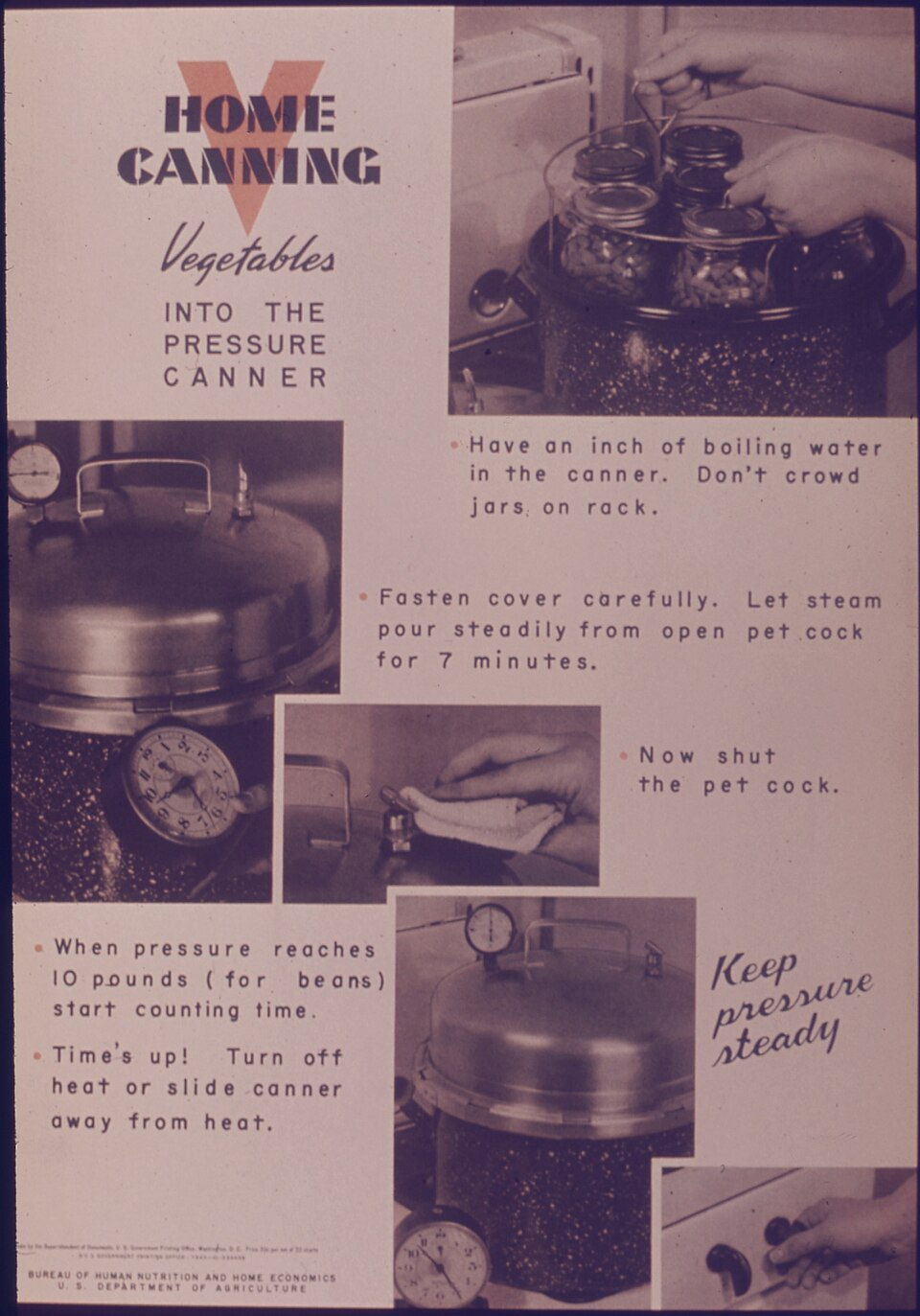
Vegetables are a different proposition. Green beans, corn, peas, carrots, beets, squash and anything else low in acid are a hospitable environment for Clostridium botulinum, and the spores of that organism survive boiling. A boiling-water bath holds the contents at 212 degrees Fahrenheit, which is not enough. A pressure canner reaches roughly 240 degrees, which is. In 1960 a great many households processed green beans in a water bath because that was the pot they owned, and because the jars sealed and looked right. The Centers for Disease Control has for many years identified improperly home-canned vegetables as the leading vehicle for foodborne botulism in the United States. That single fact is the reason the guidance was rewritten rather than merely tidied.
Oven canning, sun canning and the aspirin
Three shortcuts circulated widely enough to be worth naming. Oven canning meant standing filled jars in a hot oven in place of a water bath. It is specifically warned against now on two grounds: dry heat moves into a jar of food far more slowly and less predictably than steam does, so the center of the jar may never reach temperature, and jars not made for dry heat can fail suddenly while the oven is closed.
Sun canning was the practice of standing sealed jars of tomatoes on a south-facing porch to finish. It achieves nothing useful at all. And then there was aspirin. Dropping a tablet into a jar of tomatoes was a genuine and reasonably widespread kitchen trick, on the theory that the acid would do the preserving. It does not. Salicylic acid at that dose does not control bacterial growth, and the practice gave a cook false confidence to skip the step that would have worked. Every modern extension bulletin that mentions it mentions it in order to tell people to stop.
Why the tomato rule had to change
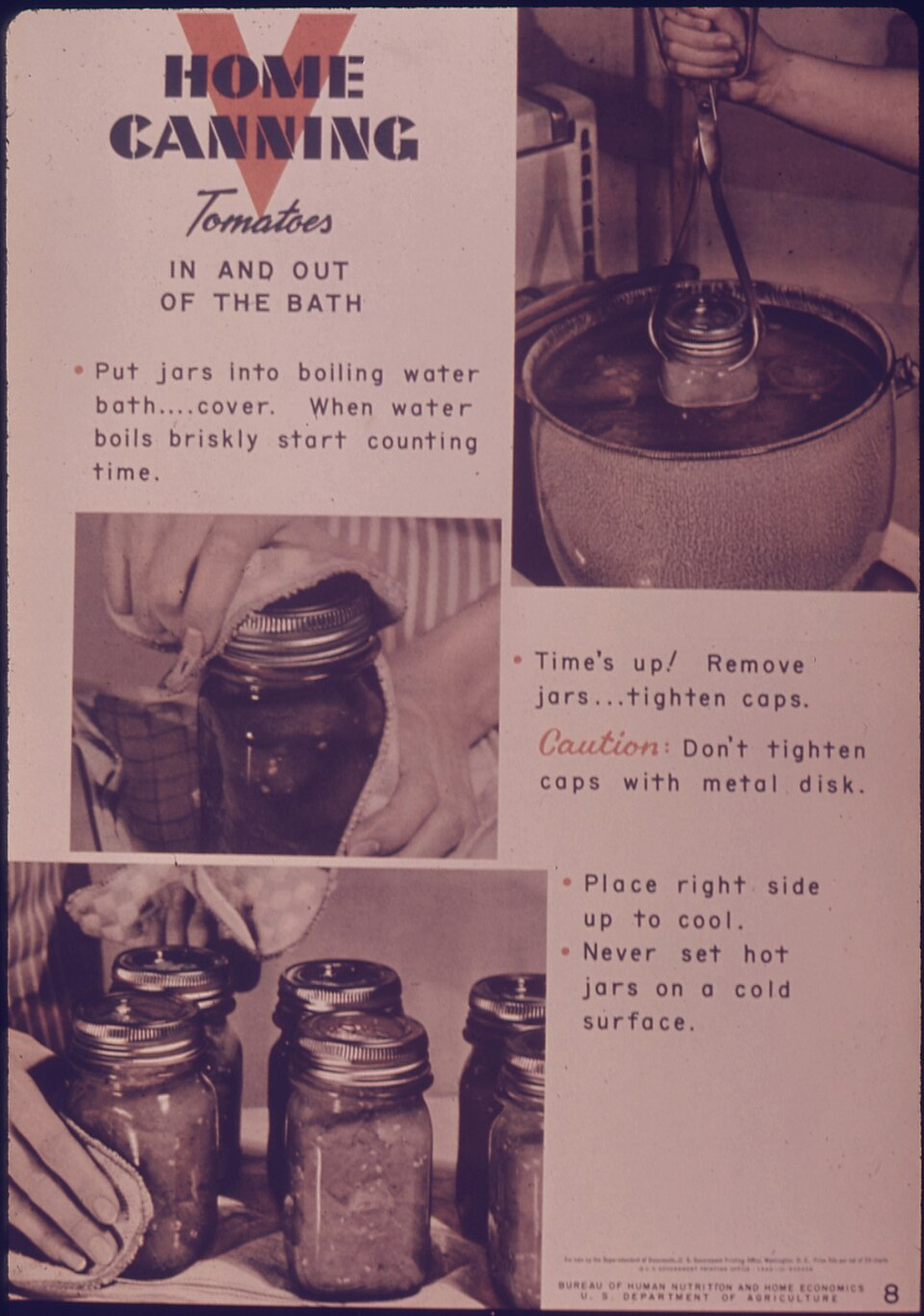
Tomatoes are the awkward case, and the rule around them changed for a reason that has nothing to do with technique. Tomatoes sit close to the dividing line between acid and low-acid foods. Varieties bred through the second half of the century trended toward lower acidity and higher sugar, because that is what shoppers said they wanted, and some of the newer varieties fell on the wrong side of the line.
Current guidance is therefore to acidify every batch of canned tomatoes deliberately, with bottled lemon juice or citric acid in a measured amount per jar, rather than relying on the fruit to be acidic on its own. Bottled juice rather than fresh, because the acidity of bottled juice is standardized and the acidity of the lemon in the fruit bowl is not. A 1960 cook who canned tomatoes with nothing added was working with a different tomato, and the instruction she passed down stopped matching the ingredient somewhere along the way without anybody announcing it.
Lids, rings and the question of reuse
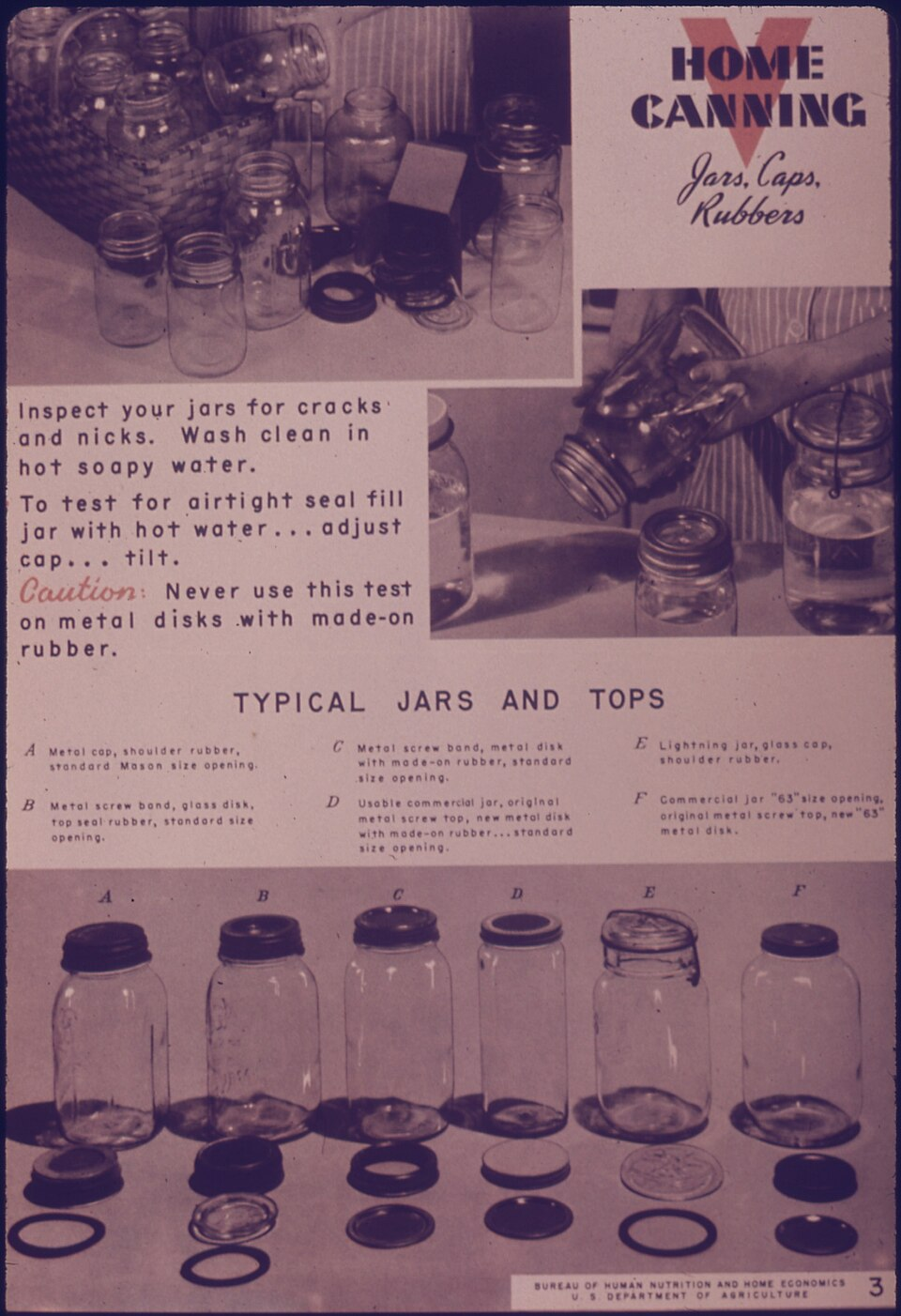
The hardware changed too. Zinc caps with rubber sealing rings, and glass lids held down with wire bails, were still in use in 1960 and are no longer recommended for new canning, because the rubber rings perish unpredictably and the seal cannot be checked the way a flat metal lid can.
The two-piece lid that replaced them is designed around a sealing compound on the underside of the flat disc, and that compound is formulated to be compressed once. Reusing flat lids was universal in 1960, on the sensible-sounding grounds that they looked undamaged. Manufacturers and the Department of Agriculture both advise single use of the flat lid, while the screw band is reusable indefinitely. The band is also supposed to come off once the jar has cooled, which almost nobody did then, because leaving it on hides a failed seal and can hold a lid in place that is no longer actually sealing.
What the old kitchens got right
It would be a poor reading of all this to conclude that the 1960 kitchen was careless. It was rigorous about the things it knew to be rigorous about. Jars were inspected by hand, run finger-round the rim, and rejected for the smallest chip. Produce was processed the day it was picked, which is better practice than most modern home canners manage. Everything was labeled and dated. Pantries were rotated, oldest to the front. A jar with a bulging lid or a suspicious smell went out unopened, and the instruction children were given about that was absolute.
What the old method lacked was not care. It lacked the information that arrived later: the measured penetration rates, the spore survival curves, the pH of the particular tomato in your hand. Grandmothers were applying excellent judgement to an incomplete picture. The current guidance exists because somebody did the arithmetic that the kitchen could not do for itself, and the honest conclusion is that the method deserves respect and should not be copied.
Like our content? Follow us for more.