

Transparency is so familiar that it stops registering as strange. You look through a window and see the street, and it does not seem to require an explanation.
But consider what is actually happening. There is a solid object between you and the street, several millimetres thick, made of the same element as the beach. Light enters one side and emerges from the other having been almost entirely unaffected. That does not happen with wood, metal, stone, plastic, paper or nearly anything else.
The usual folk explanations are wrong in instructive ways. Glass does not have gaps for light to travel through — it is a dense solid. Light is not too small to be blocked. And the fact that glass is amorphous rather than crystalline, while true and important elsewhere, is not the reason you can see through it.
The actual answer sits in quantum mechanics and it is unexpectedly tidy. Here it is.
Light Is Not a Small Object
The first thing to abandon is the picture of light as tiny particles finding their way through gaps.
Light behaves as a wave and as a packet of energy, and the relevant property here is that a packet of light carries a specific amount of energy determined by its colour. Blue light carries more than red. Ultraviolet carries more than either.
When light meets a material, the question is not whether it can fit through. It is whether the material can absorb it.
A material absorbs light when an electron in it can take up the energy of an incoming photon and move to a higher energy level. That is the transaction. If it happens, the light is gone — converted into electron energy and usually into heat — and the material is opaque at that colour.
If no electron can accept that particular quantity of energy, nothing happens. The photon carries on.
Like our content? Follow us for more.
The Energy Gap
Here is where glass becomes interesting.
In a solid, electrons cannot hold arbitrary amounts of energy. They occupy defined bands, with forbidden gaps between them. An electron can sit in the lower band or the upper band, but not in between — so to be excited it must receive at least enough energy to cross the gap entirely.
That gap size determines what a material does with light.
In metals, electrons are free to move and can absorb across a very wide range, so metals absorb visible light readily and are opaque. Some of that energy is re-emitted, which is why polished metal is reflective.
In glass, the gap between the filled band and the empty one above it is large — larger than the energy carried by any photon of visible light. So a photon of visible light arrives, and there is simply no available transition it can pay for. No electron can accept it. Nothing absorbs it, and it continues through.
That is transparency: not a passage through gaps, but a failure to interact for lack of sufficient energy.
The neatest confirmation is what happens with ultraviolet. UV photons carry more energy, and ordinary glass does absorb a substantial portion of them, which is why you do not get a suntan through a closed window. Glass is transparent to visible light and substantially less so to UV, precisely because UV can pay the price and visible light cannot.
What Melting Actually Does
That still leaves the original puzzle. If the atoms are much the same, why is sand opaque and glass clear?
The answer is structure rather than composition, and it operates at a scale much larger than individual atoms.
Sand is a collection of separate crystalline grains with countless surfaces and boundaries between them. Every one of those boundaries is an interface where light changes direction, because the material on either side bends light slightly differently.
Light entering a heap of sand is not absorbed so much as scattered — bounced repeatedly at grain boundaries until it emerges in every direction rather than continuing in a straight line. The result looks white and opaque, in the same way that snow, salt, crushed ice and foam do.
Melting removes the boundaries. The material fuses into one continuous solid with no internal interfaces, and light passes through in a straight line.
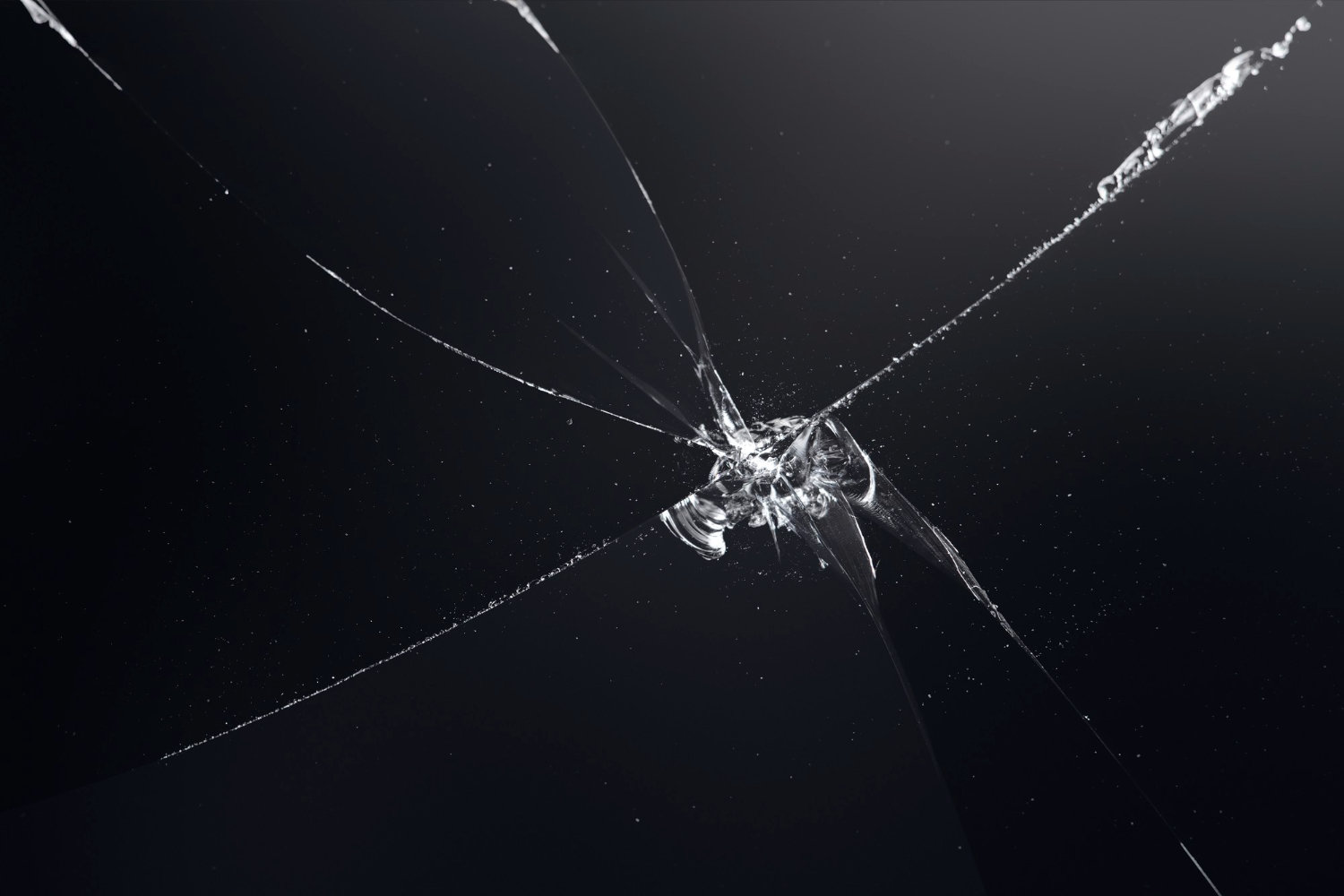
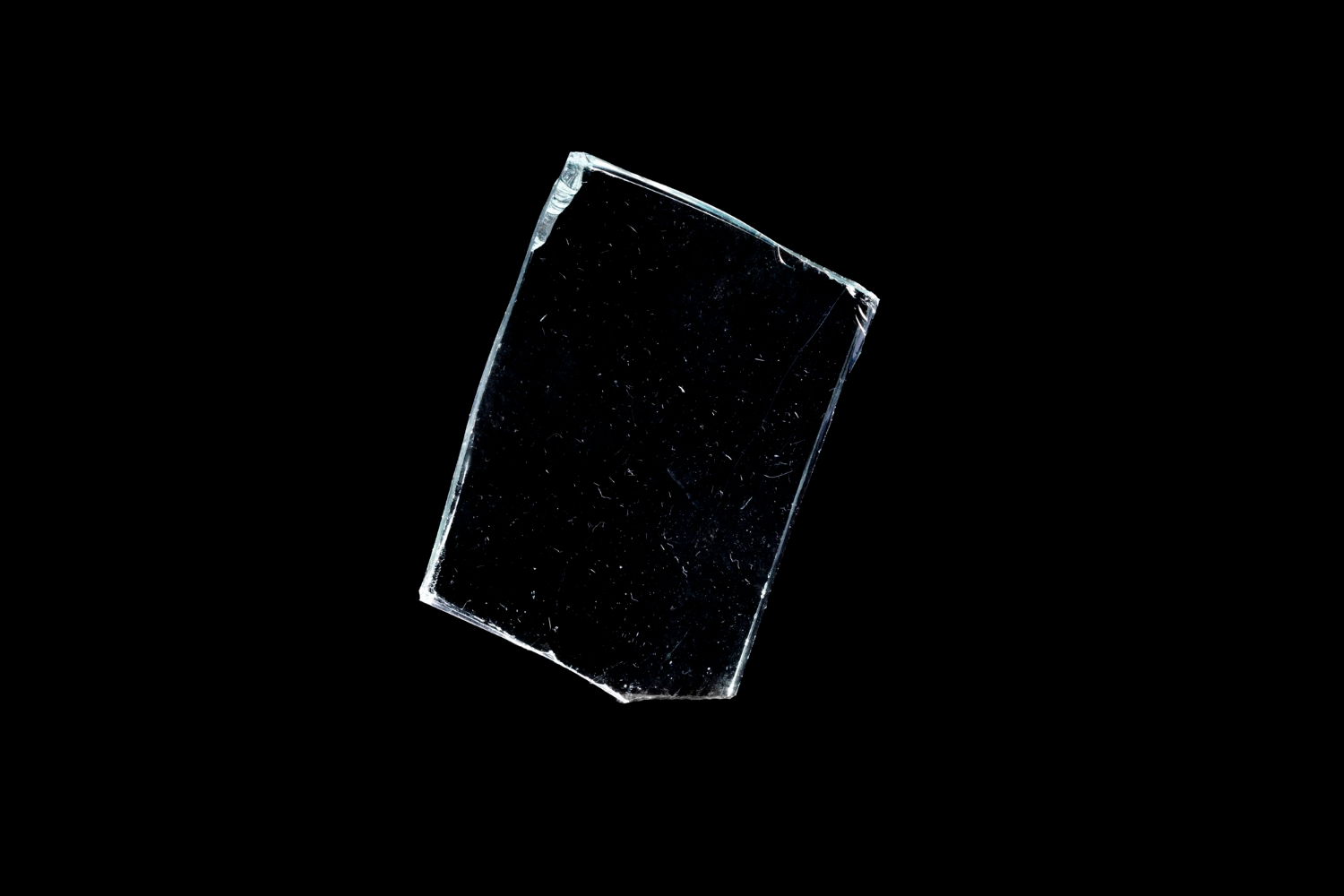
You can watch this in reverse. Crush a sheet of glass and the fragments are white and opaque, despite being chemically identical to the pane they came from. Nothing changed except the number of surfaces.
The same principle explains a great many everyday materials. Paper is white because it is a tangle of transparent fibres scattering light at every boundary. Clouds are white for the same reason, being made of transparent water droplets. Wet paper turns translucent because the water fills the air gaps and reduces the mismatch at each surface.
Why Glass Is Not Quite a Liquid Either
A related idea circulates and is worth addressing, because it attaches itself to this subject.
Glass is amorphous. Its atoms are arranged without the long-range repeating order of a crystal, which is unusual for a solid and is why glass has no sharp melting point, softening gradually over a temperature range instead.
That is a real and important property. It affects how glass is made, worked and cooled, and it is why glassblowing is possible at all.
What it does not do is make glass a liquid, and it is not the reason glass is transparent. Plenty of amorphous materials are opaque, and plenty of crystalline materials — quartz, diamond, ice, salt as a single crystal — are transparent. Structure at the atomic scale determines mechanical behaviour; the electronic band gap determines optical behaviour, and the two are separate questions.
Why It Is Never Perfectly Clear
Real glass is not quite as transparent as the theory suggests, for reasons that show up dramatically at scale.
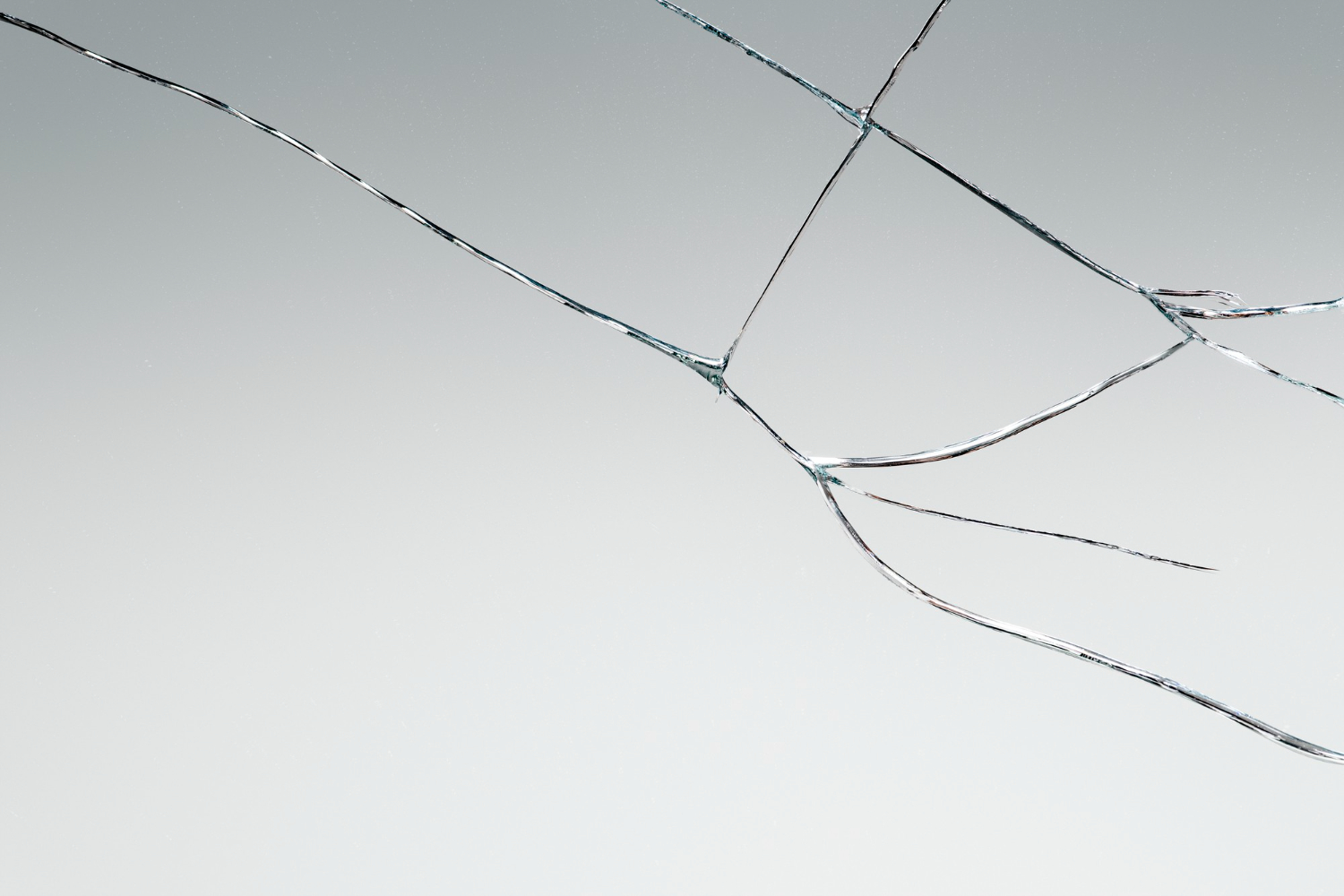
Look at the edge of a pane and it is green. That colour comes from small quantities of iron in the raw materials, which does absorb some visible light. Through the thickness of a window it is imperceptible; through the length of a pane it accumulates and becomes obvious.
Manufacturers producing low-iron glass for shopfronts and display cases go to some trouble to remove it, which tells you how small a contaminant needs to be to matter.
Impurities are also how coloured glass is made deliberately. Adding specific metal compounds introduces electrons with available transitions in the visible range, so particular colours are absorbed and the rest transmitted.
Optical fibres represent the opposite extreme: glass purified to the point that light travels kilometres through it with modest loss. That entire technology exists because the transparency of glass is a property that can be pushed further with sufficiently clean material.
Why Some Solids Are Opaque and Others Are Not
The band-gap explanation generalises neatly, and applying it to other materials makes the logic clearer.
Diamond is transparent for exactly the same reason as glass: it has a very large band gap, well above the energy of visible photons, so nothing absorbs them. That is why a substance made entirely of carbon — the same element as soot and graphite, both black — is clear.
Silicon has a smaller gap, small enough that visible light can be absorbed, which is why a silicon wafer is opaque and dark. But silicon is transparent to infrared, whose photons carry too little energy to cross even that smaller gap, which is why infrared lenses are made from it.
Water and most simple gases have large gaps and are transparent. Coloured minerals typically contain transition metals with electrons that have available transitions in the visible range, absorbing some colours and reflecting others.
Semiconductors sit in the interesting middle, with gaps small enough to be crossed by visible or near-visible light, which is precisely what makes solar cells and light-emitting diodes possible.
So transparency, colour, opacity and the entire electronics industry are all consequences of the same variable: how large the energy gap is between the electron states a material offers.
An Ordinary Miracle
There is something worth appreciating in the ordinariness of it.
Every window is a demonstration that visible light and silicate glass are mismatched in a very specific way — that the energy carried by the light your eyes evolved to use happens to fall below the threshold at which glass can absorb anything.
That is not a designed coincidence, but it is a fortunate one. A material transparent to visible light, made from the most abundant material on any beach, workable when hot and rigid when cool, turns out to be the basis of windows, lenses, spectacles, microscopes, telescopes, laboratory equipment and the fibres carrying this sentence to you.
Almost none of it would work if the band gap in silica happened to be slightly smaller. The glass would be coloured, or dark, and a great deal of what humans have been able to see and do would have been substantially harder.
Like our content? Follow us for more.

