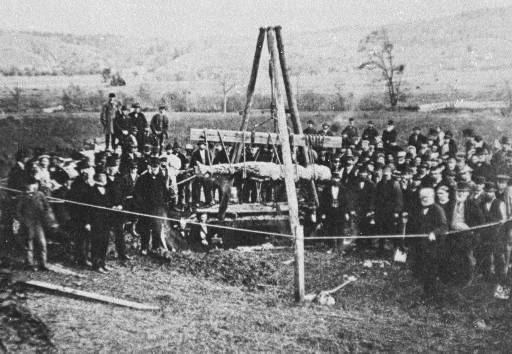
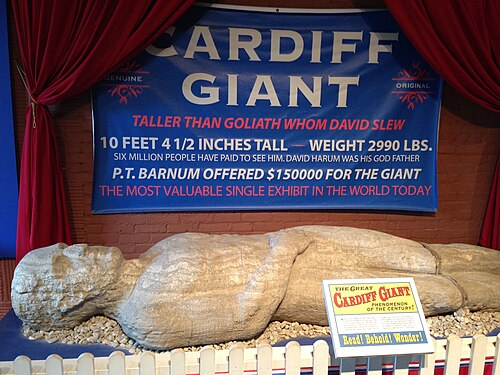
In October 1869, two workers digging a well behind a barn on a farm in Cardiff, in upstate New York, struck something hard. As they cleared away the earth, they uncovered the enormous figure of a man — ten feet long, carved from stone, lying as if buried where he had died. Word spread like wildfire. Was this the petrified body of a giant from a lost age, one of the biblical giants said to have once walked the earth? Was it an ancient statue left by some forgotten civilization? Within days, the “Cardiff Giant” was the most talked-about object in America, and people were traveling from far and wide, paying good money for a glimpse of the stone colossus.
It was, of course, a hoax — one of the most successful and audacious in American history. The giant was not ancient and not a petrified man; it was a statue, carved in secret, aged with acid and stains, and buried on the farm the year before by a man with a very specific and rather peculiar motive. The story of the Cardiff Giant is a tale of cynicism, gullibility, showmanship, and profit, featuring a cast that includes an atheist cigar-maker, a scheming farmer, credulous crowds, learned scholars who should have known better, and the greatest showman of the age. And it left behind a phrase that Americans still use today, attached to the wrong man.
The Argument That Started It All
The mastermind was a man named George Hull, a cigar manufacturer from New York and, notably, a committed atheist and skeptic. The idea for the hoax reportedly came to him after a heated theological argument during a visit to Iowa, where he clashed with a revivalist preacher over a passage in the Book of Genesis stating that there were once “giants in the earth.” Hull, disbelieving, was struck by how literally the faithful took such passages, and he conceived a plan that was equal parts moneymaking scheme and elaborate practical joke aimed at religious gullibility.
His idea: create a fake petrified giant, “discover” it, and see how many people — including devout literalists — would believe it was real. It was a cynical experiment in credulity with a profit motive attached, and Hull committed to it thoroughly. He arranged to have a large block of gypsum quarried, and then had it secretly carved into the figure of a giant man by stonecutters sworn to secrecy. In a final touch of dark humor, he reportedly had the giant’s face modeled to resemble his own. The finished figure was then artificially aged — beaten with tools to simulate pores, and stained with acids to give it the appearance of great antiquity. The whole thing cost Hull a substantial sum, an investment he was betting he could recoup many times over.
Like our content? Follow us for more.
Burying the Giant
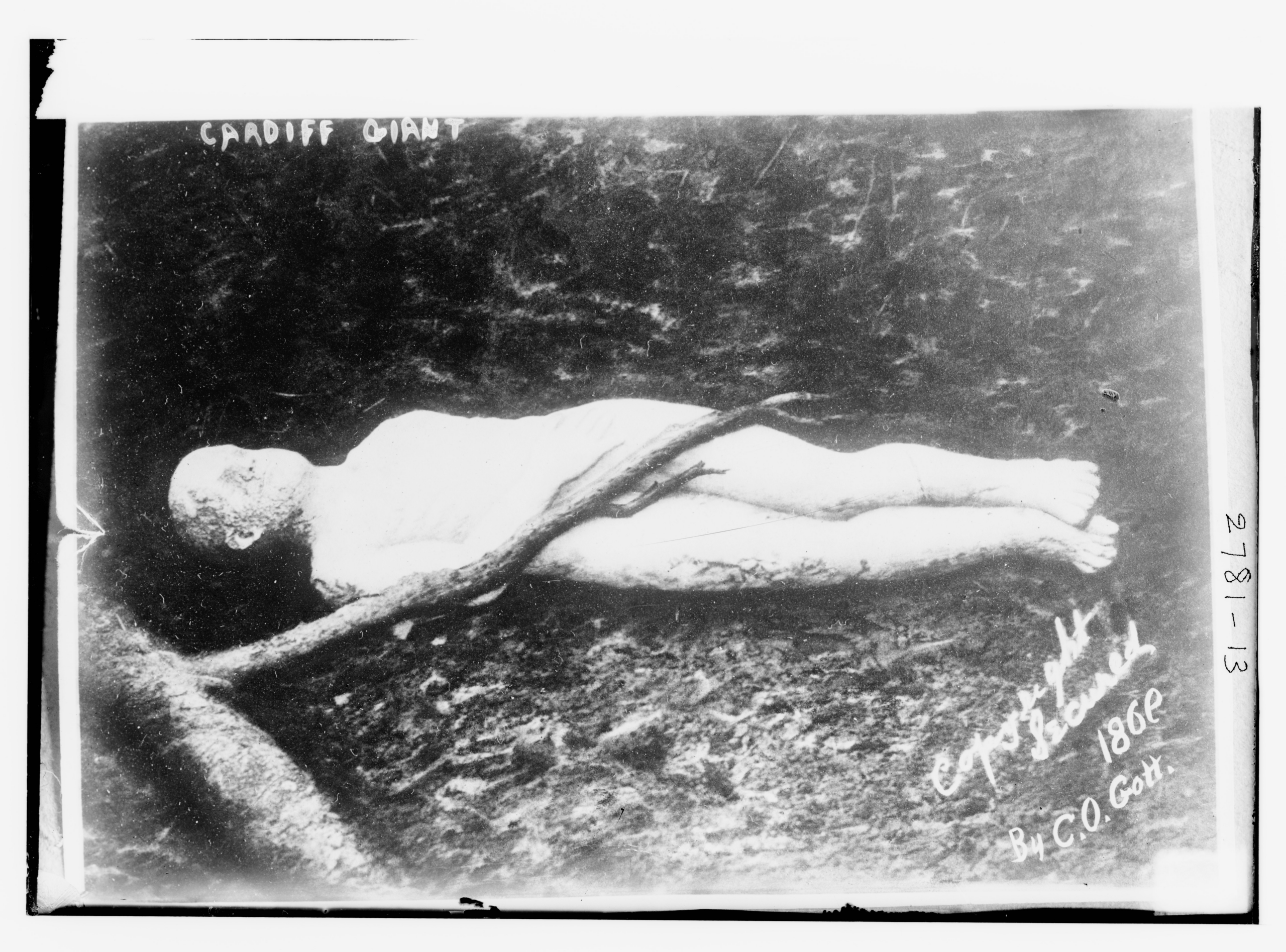
With his ten-foot fraud complete, Hull shipped the heavy statue across the country to the farm of his cousin, William Newell, in Cardiff, New York. There, in secret, they buried the giant in the ground behind Newell’s barn. And then they waited. Hull understood that the con required patience: the ground had to settle, memories of any suspicious activity or mysterious heavy shipments had to fade, and the “discovery” had to appear entirely accidental and genuine.
They waited about a year. Then, in October 1869, Newell hired two men to dig a well on his property — at a spot he had chosen precisely because the giant lay beneath it. The workers, entirely unaware of the setup, dug down and struck the buried figure, and the “discovery” of the Cardiff Giant was underway exactly as Hull had planned. The unwitting well-diggers had played their part perfectly, lending the find an air of total authenticity. Newell wasted no time capitalizing on it.
A National Sensation
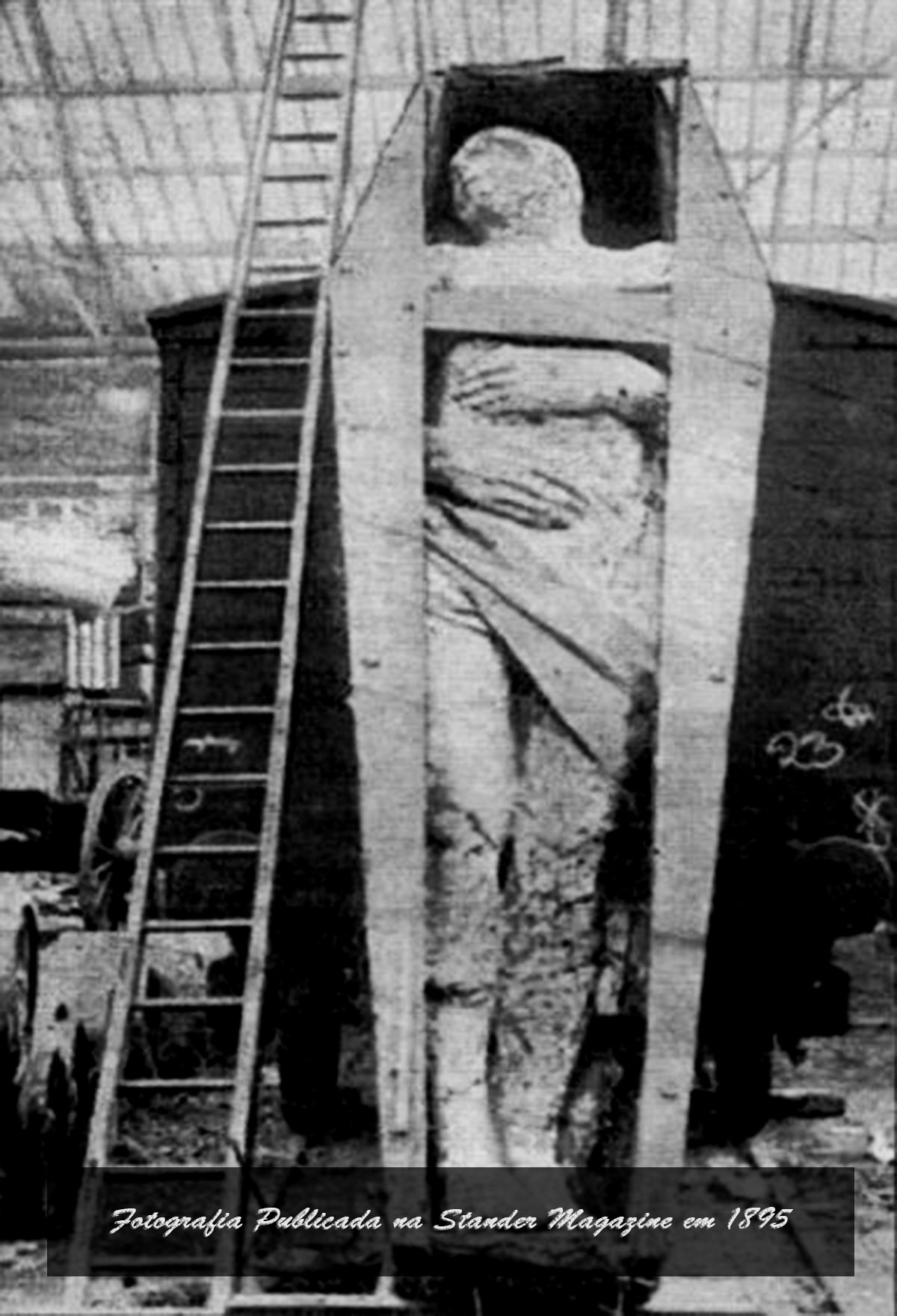
The reaction was immediate and enormous. Newell erected a tent over the giant and began charging admission — initially a modest sum, quickly raised as the crowds swelled. And swell they did. People came from all over to see the stone giant, and a fierce public debate erupted over what it actually was. Some were convinced it was a real petrified man, proof of the biblical giants. Others argued it was an ancient statue carved by some vanished people. Remarkably, a number of scholars and educated men lent credence to the ancient-statue theory, examining the figure and pronouncing it a real antiquity, which only fueled the frenzy.
There were skeptics from the start, to be sure — including scientists who correctly identified it as recently carved gypsum, and the head of a prominent university who pointed out the obvious problem that no one digs a well in that particular spot without a reason. But skepticism did little to slow the phenomenon; if anything, the controversy drew more paying visitors. The giant became so lucrative that Hull sold his interest in it to a syndicate of businessmen, led by a man named David Hannum, for a very large sum — a fortune in the money of the day. Hannum moved the giant to the city of Syracuse for exhibition, where the crowds and the profits continued to pour in. A carved block of gypsum, buried and dug up as a prank on the pious, had become one of the most profitable attractions in the country.
Enter P.T. Barnum
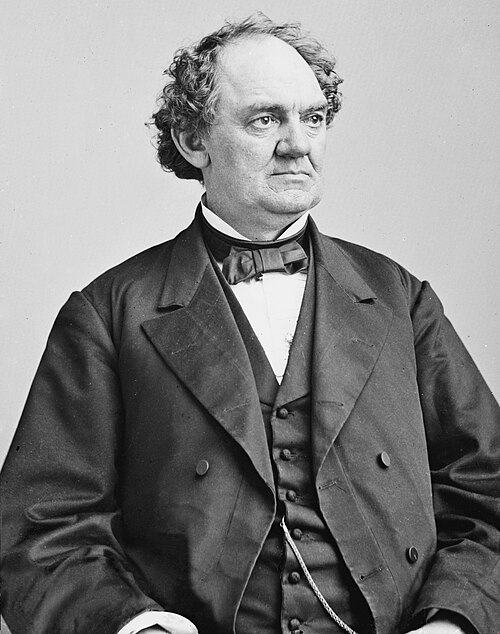
No story of American humbug in the nineteenth century would be complete without P.T. Barnum, the legendary showman, and he did not miss this one. Recognizing a sensation when he saw one, Barnum offered a large sum to buy the Cardiff Giant from Hannum’s syndicate. The owners, doing very well with their prize, refused to sell.
Barnum’s response was pure Barnum: if he couldn’t buy the famous fake, he would make his own. He commissioned a copy of the Cardiff Giant — a fake of a fake — put it on display, and brazenly advertised that his was the real article and that the one in Syracuse was the counterfeit. Now there were two Cardiff Giants drawing crowds, each claiming to be the real one, both of them frauds. Barnum’s copy, promoted with his unmatched flair, reportedly drew even larger crowds than the original. It was a perfect piece of nineteenth-century showmanship: an imitation of a hoax, marketed as the authentic version of something that was never authentic to begin with.
The Phrase Everyone Gets Wrong
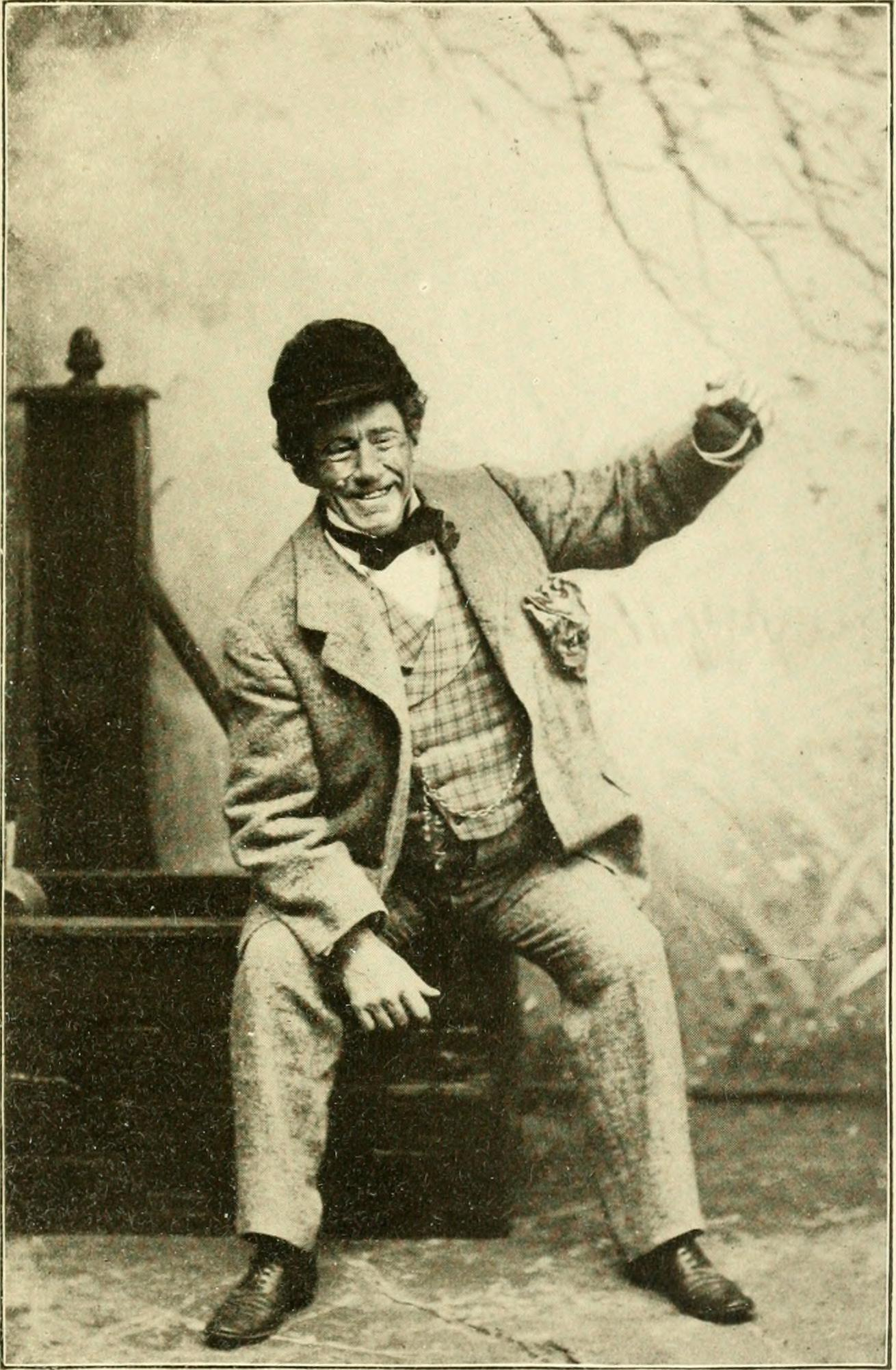
This is where the Cardiff Giant gave the world one of its most enduring sayings — and where history took a wrong turn that persists to this day. As the newspapers reported on Barnum’s audacious copy and his claim that his was the real giant, the response attributed to David Hannum, the owner of the original fake, was a comment on all the people flocking to pay and see Barnum’s imitation: “There’s a sucker born every minute.”
The line has echoed through American culture ever since, a byword for the endless supply of gullible people. But here is the twist that few know: the phrase is almost universally attributed to P.T. Barnum himself, who has become synonymous with it. In fact, by the most cited account, it wasn’t Barnum who said it at all — it was Hannum, and he was saying it about the suckers paying to see Barnum’s fake, not celebrating his own showmanship. There is, in truth, no solid evidence that Barnum ever uttered the famous words, and the attribution to him appears to be a historical error that stuck. So one of the most Barnum-associated quotations in existence may well be something Barnum never said, born instead from a dispute over two fraudulent stone giants. It’s a fittingly deceptive legacy for a hoax.
The Unraveling and the Legacy
The Cardiff Giant’s reign as a real mystery couldn’t last. Under mounting scrutiny, the stonecutters who had carved it came forward, and George Hull, perhaps satisfied with his profits and his point proven, confessed to the whole scheme in late 1869. The following year, the matter reached a court — Hannum had sued Barnum over the copy — and a judge dryly ruled that Barnum couldn’t be sued for calling a fake giant a fake, since that’s exactly what it was. Both giants stood exposed as frauds, and the sensation deflated.
But the Cardiff Giant didn’t disappear. The original continued to be exhibited as a curiosity for decades, a famous fraud rather than a real wonder, and it survives to this day in a museum in Cooperstown, New York, where visitors can still see the ten-foot gypsum man who fooled a nation. Its true legacy, though, is as a perfect parable of human credulity and the appetite for a good story. Hull set out to prove that people would believe almost anything if it was dressed up convincingly, and he succeeded beyond his expectations — fooling not just the devout he’d set out to mock, but scholars, journalists, and thousands of ordinary people, and even inspiring a copycat fraud from the era’s greatest showman. More than 150 years later, in an age of viral misinformation, the Cardiff Giant feels less like a quaint historical oddity than an oddly modern cautionary tale. There really is, it seems, a sucker born every minute — whoever it was that said it.
Like our content? Follow us for more.