

There is a difference between a piece of engineering and a commitment, and reclaimed land is the largest example of the second.
A bridge, once built, stands. A tunnel, once dug, remains a tunnel. Most infrastructure requires maintenance and would survive neglect for a considerable period.
Reclaimed land is different in kind. It exists only while the pumping continues, and it would revert within months if it stopped. The engineering is not the wall or the pump but the decision to keep operating them indefinitely, across generations, without any prospect of completion.
That makes it an unusual thing to have built, and the mechanics of how it works are worth understanding.
The Basic Operation
The method has been essentially unchanged for a very long time, whatever the power source.
An area is enclosed by an embankment, which separates it from the surrounding water.
Water inside the enclosure is then removed and discharged over the embankment into the water outside, which is at a higher level.
The land is drained, and pumping continues indefinitely because water keeps arriving.
That last point is the one people miss. The reclamation is not a single act of emptying — rain falls on the enclosed area continuously, groundwater seeps under and through the embankment, and the enclosed land sinks over time, which makes the height difference greater.
So the pumping requirement never reduces and generally increases.
Like our content? Follow us for more.
Why It Sinks
The subsidence is the complication that makes the whole thing progressively harder.
Waterlogged ground contains a great deal of water within the soil structure, and much reclaimed land is peat or soft sediment that was previously saturated.
Removing the water allows the material to compress under its own weight, and in the case of organic soils it also allows decomposition, which was previously prevented by the waterlogging and which removes material entirely.
Both processes lower the surface.
That creates a loop. Drainage lowers the land, which increases the height water must be lifted, which requires more pumping, which drains it further.
Land that was at or near the surrounding water level when reclaimed may sit several metres below it after a few centuries, and the pumping requirement has grown accordingly.
Lifting Water Before Engines
The pre-industrial version is the part that is most often depicted and least often explained.
Wind-powered machinery drove a mechanism that lifted water — either a large paddle wheel pushing water up a short rise, or a helical screw carrying it upward in pockets.
The limitation is height. Such devices lift water a modest distance in a single stage, which is inadequate where a substantial rise is required.
The solution was to arrange them in sequence, with each machine lifting water to a level where the next could take it, in a series of stages up to the final discharge.
That required several machines working in coordination, each dependent on the ones below and above it, and a failure anywhere in the chain interrupted the whole sequence.
Wind is also intermittent, which meant the system had to be sized for average conditions with storage capacity to cover calm periods — and a prolonged calm during heavy rain was a real problem.
Steam and then electrical pumping removed both limitations, permitting greater lift in one stage and operation independent of weather.
The Water Has to Go Somewhere
A detail that is easy to overlook concerns the receiving water, and it constrains everything.
Water pumped out of a reclaimed area must be discharged into something — a river, a canal, the sea — and that receiving body has its own level, which varies.
Where discharge is to a tidal water body, it can be done by gravity at low tide through gates that open when the outside level falls below the inside one, and close when it rises.
That is far cheaper than pumping and is used wherever possible, which means the operation of a drainage system is tied to the tide.
Where the outside level is permanently higher, or where the tide does not fall far enough, pumping is required continuously.
And the whole system is vulnerable at the point of discharge, since a high outside level combined with heavy rainfall inside is the condition where water cannot be got rid of.
The Water Level Is a Decision
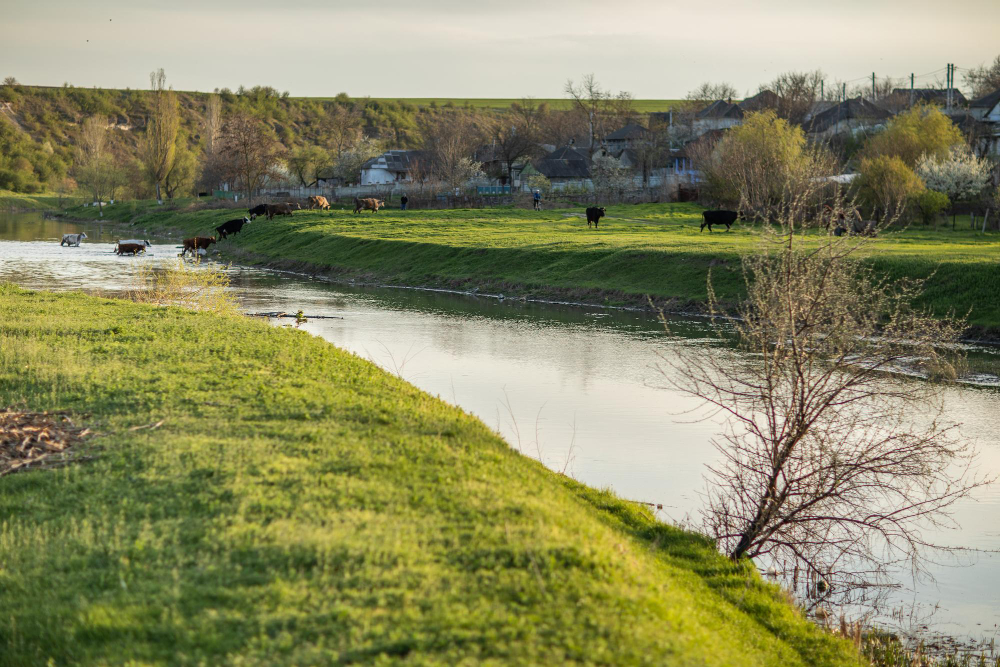
One aspect of these landscapes is truly unusual and worth stating directly.
In ordinary country, the water table is whatever it is — a consequence of rainfall, geology and drainage that nobody sets.
In reclaimed land it is chosen. The level maintained in the ditches determines the level in the soil, and that level is decided by whoever operates the pumps according to what the land is being used for.
Arable ground wants a lower level than pasture. Building land wants lower still. Ground held for nature conservation may want it higher.
So different areas within a drained landscape are maintained at different levels, separated by their own embankments and pumps, and the whole area is a mosaic of managed water tables rather than a single surface.
That produces boundaries visible on the ground, where the level changes across a ditch, and it means that a decision about land use is simultaneously a decision about pumping.
It also creates conflicts that have no equivalent elsewhere. Neighbouring users wanting different levels are in direct competition, because water moves, and resolving that is precisely what the water-management institutions exist to do.
Which is the administrative side of the same point. The land requires continuous operation, the operation requires continuous decisions, and the decisions require a body with the authority to make them and impose them on people who disagree.
What It Produces
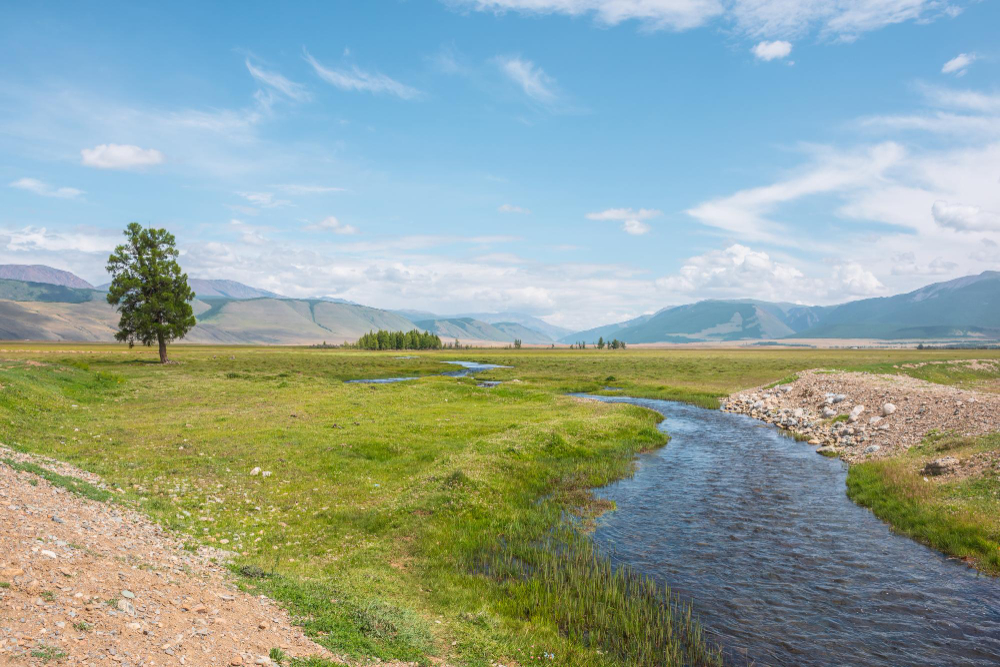
The landscape created is distinctive and legible.
Fields are rectangular and regular, because the land was laid out deliberately rather than accumulating through use.
Ditches run in a grid, at regular intervals, because drainage requires water to have a route to a collection channel from anywhere in the field.
Roads and settlements sit slightly higher, frequently on embankments or on the spoil from digging the channels.
Trees are scarce and windbreaks are planted rather than natural, since the land was under water and has no woodland history.
And the whole area is flat to a degree that is unusual in natural landscapes, because it was a water surface and water is level.
Reclaiming Without Pumping
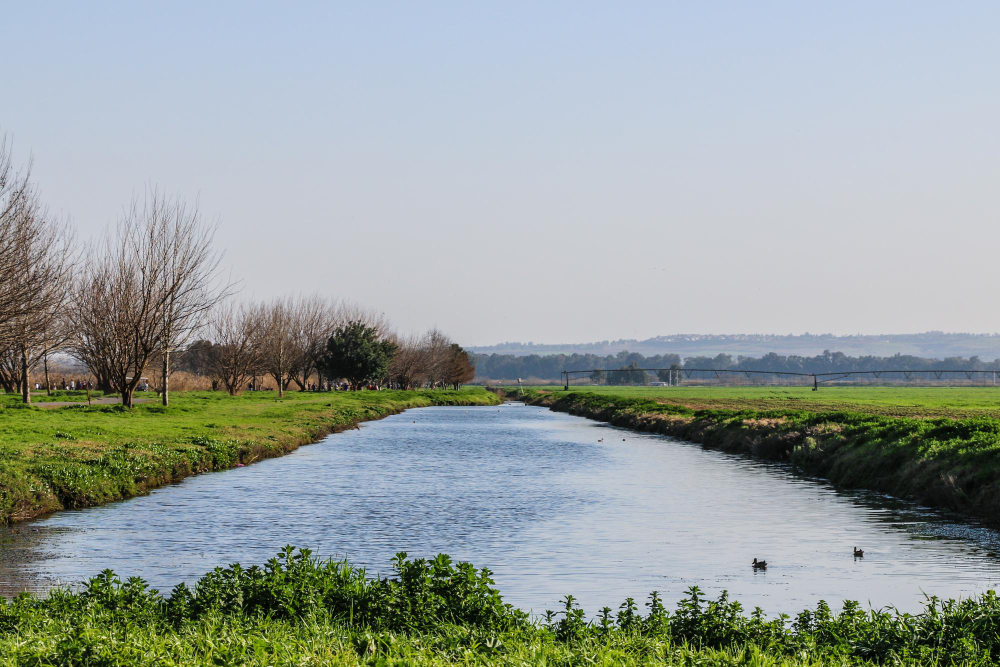
There is an older approach worth describing, because it worked without any machinery at all and shaped large areas.
Where a coast has a substantial tidal range and sediment-laden water, land can be gained by allowing the sediment to settle rather than by removing water.
Low banks and channels are arranged so that tidal water enters slowly, spreads across an area, drops its load as it slows, and drains away — repeating twice a day for years.
The surface builds up gradually, and once it is high enough to be above most tides, vegetation establishes and accelerates the process by slowing the water further and trapping more material.
At that point a bank can be built to exclude the sea entirely, and the land is already at a workable level rather than below it.
That method is slow, requires the right conditions, and produces land that sits above rather than below the surrounding water — which means it does not carry the permanent pumping obligation.
It also explains why some reclaimed areas require constant pumping and others do not. Land gained by accretion sits high; land gained by draining a lake or an inlet sits low, and the difference determines whether the commitment is permanent.
Which is a useful distinction when looking at flat coastal country. Whether the ground is above or below the water outside the bank tells you which method created it, and therefore whether anybody is still pumping.
The Permanent Commitment
What makes reclaimed land worth thinking about is the obligation it creates.
Every such area represents a decision by people long dead that their successors would continue pumping, and that decision cannot be revisited cheaply — the land is now occupied, farmed, built on and lived in, and stopping is not an option that can be exercised.
Maintenance is therefore not a choice about whether to keep something in good condition. It is a requirement to keep a process running that the alternative to is the land ceasing to exist.
That is a fairly unusual relationship between people and infrastructure, and it has produced institutions specifically for the purpose — bodies responsible for water levels, with powers and revenues, some of which are among the oldest continuously operating administrative organisations anywhere.
Which is the part worth carrying. The visible engineering is embankments and pumps, and the actual engineering is an administrative arrangement designed to outlive everybody involved in creating it, doing one thing continuously, forever, with no completion date at all.
That is an unusual thing to inherit. Most infrastructure is a gift from the past that can be neglected; this is an obligation, handed down, that cannot be declined by anybody living on it.
Like our content? Follow us for more.

