

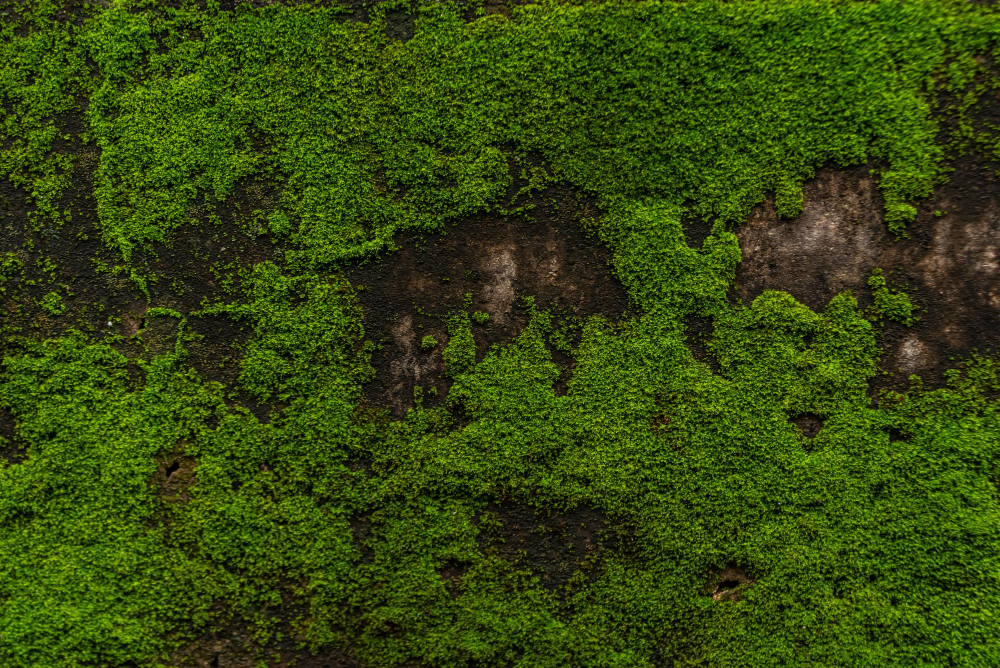
There is moss on the wall outside, on the north face of a gravestone, in the gaps between paving slabs, along the damp side of a tree. It looks like a very small, very simple plant, and that reading is half right. It is small. It is not simple. It is running a completely different operating system from the grass growing a few inches away, and the difference explains almost everything odd about where moss turns up and how it behaves.
There Are No Roots, and That Is Not a Deficiency
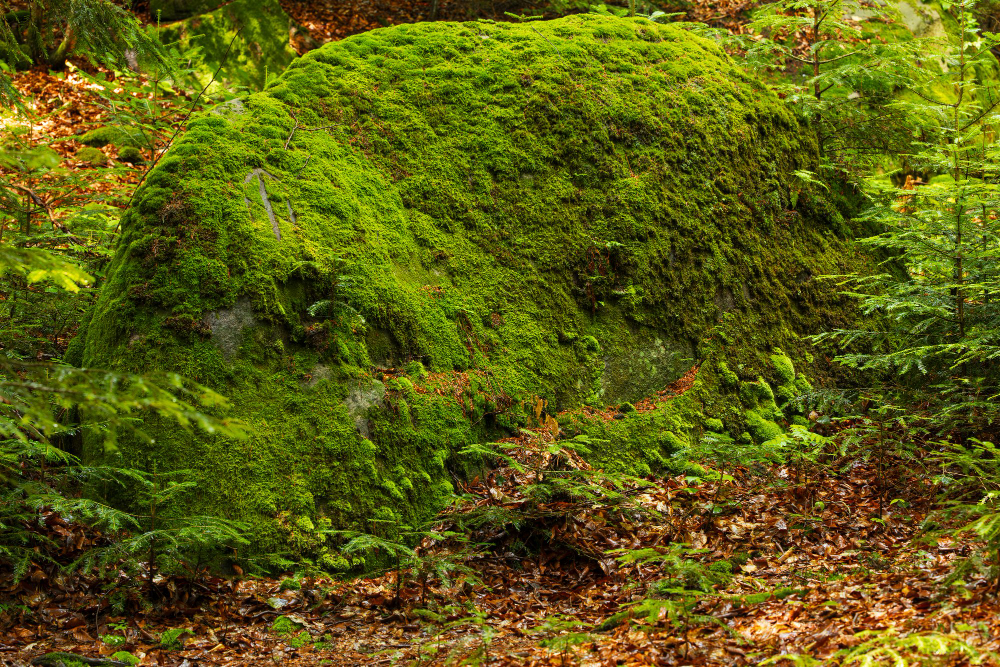
A moss cushion is anchored by rhizoids: fine, often brownish threads that grip whatever the moss is sitting on. They look like roots and they are frequently described as roots, but they are not doing a root’s job. A root absorbs water and dissolved minerals and pushes them into the plant. A rhizoid grips. That is essentially the whole function.
This is why moss can live on surfaces that will not support anything else. A gravestone has no soil. A roof tile has no soil. A tree trunk has bark, not earth. None of these can supply a root system, and so none of them can host a grass or a wildflower or a seedling that lives past its first few weeks. Moss does not need them to. It is not drawing anything up from below, so what it is sitting on barely matters, as long as it can hold on.
The consequence is that moss colonises the bare, hard, thin places first. It is doing something no rooted plant can do, and it has the field to itself.
Like our content? Follow us for more.
Water Goes In Through the Whole Surface
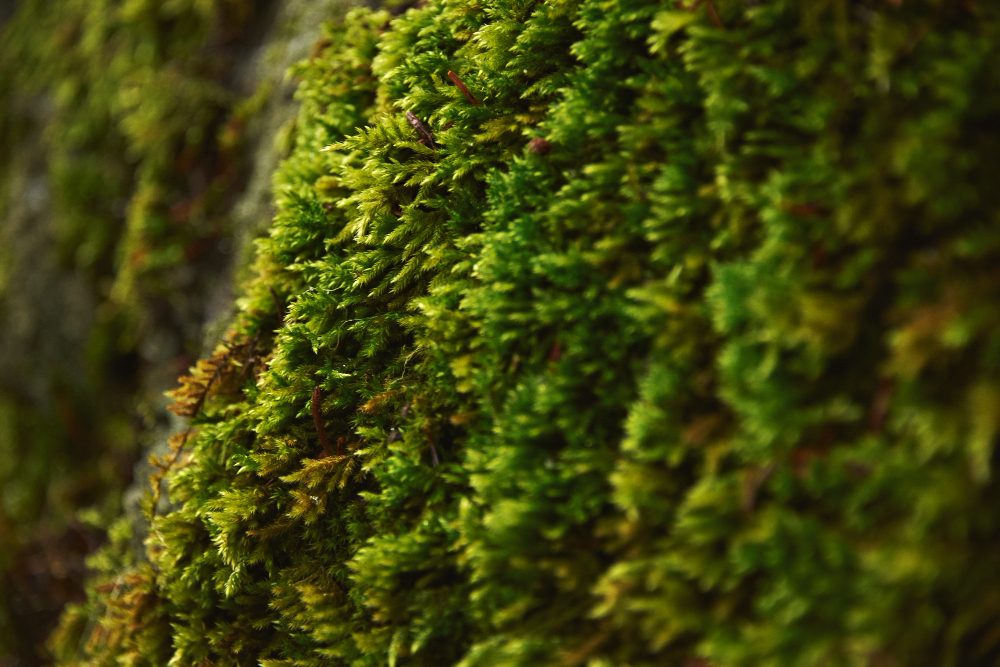
If a moss is not taking water up through roots, it has to get it another way, and the way is direct absorption across the entire plant. Every leaf, every stem, the whole cushion, takes water straight out of whatever it touches: rain, dew, mist, runoff down a wall, the damp film on a shaded stone.
This has an immediate design consequence. Moss leaves are usually a single cell thick. There is no need for the thick, waxy, multi-layered leaf that other plants build, because that construction exists to keep water in and to route it through internal veins. Moss has no internal veins worth the name and is not trying to keep water in. A one-cell-thick leaf is the correct answer when the whole point is to let water cross the surface as fast as possible in both directions.
It also explains the shape of a moss cushion. Packed tightly together, the individual shoots create a dense mat that holds water between them by capillary action, the same effect that draws liquid up into a sponge or a paper towel. The cushion is a water store, and a great deal of what looks like plant is actually the spaces between plant. A saturated moss cushion can hold many times its own dry weight in water, and it releases that water slowly, which is why the ground under a mossy bank stays damp long after the surrounding soil has dried.
The Height Limit Is Set by Physics
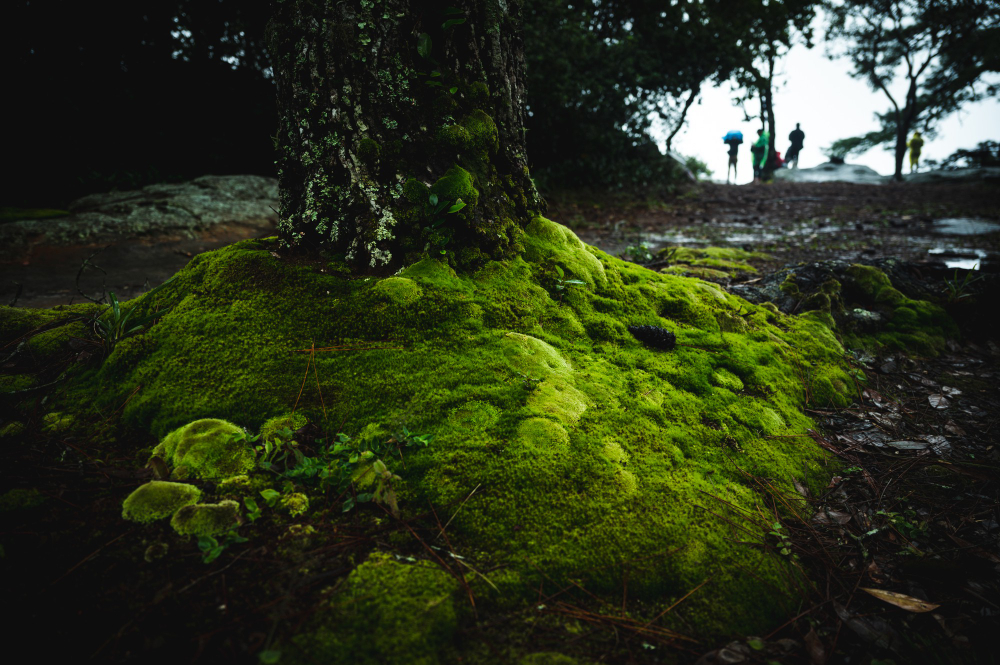
Ask why moss is always small and the answer is not that it has not got round to being bigger. It is that a plant with no internal plumbing cannot be.
Every other land plant you can think of has xylem: a system of reinforced tubes that carry water from root to leaf, with the pull generated by evaporation at the top. That system is what lets a tree stand a hundred feet tall and still get water to the topmost leaf. Moss has, at most, a rudimentary central strand in some species, and nothing like the reinforced conducting tissue of a vascular plant.
Without tubes, water can only move by soaking across from cell to cell and by creeping between shoots. Both processes work over millimetres and centimetres. Neither works over metres. So the maximum height of a moss is set by how far water will travel through a damp mat without help, which is a few inches for most species and a foot or so for the tallest. This is not a limitation moss is straining against. It is simply the size at which the strategy works.
The Trick Is Giving Up Rather Than Holding On
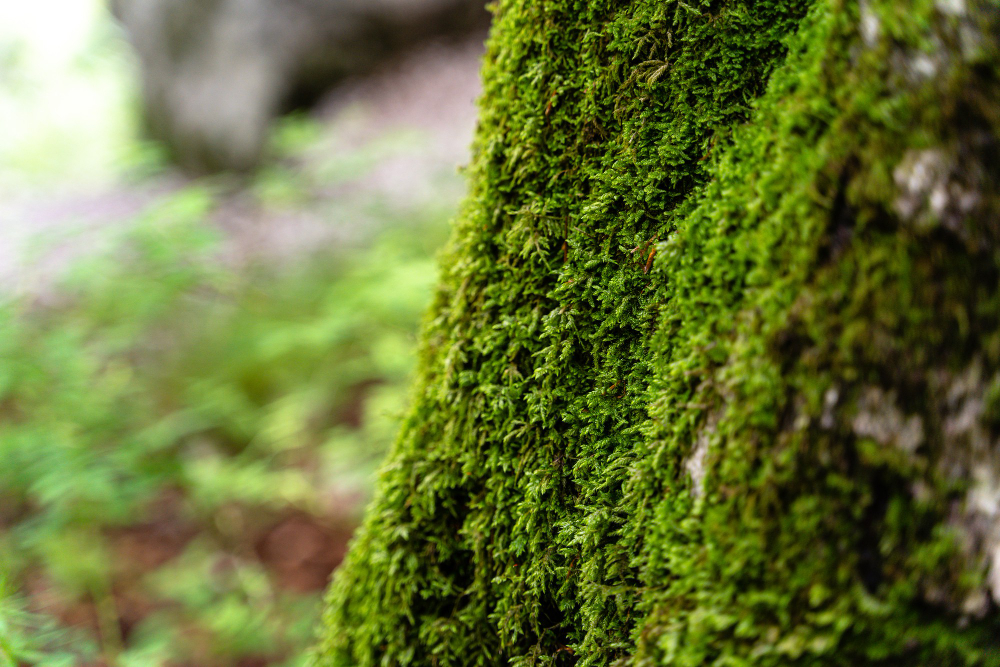
Here is the part that separates moss from almost everything else growing outdoors. When conditions dry out, a typical plant defends itself. It closes the pores on its leaves, it holds onto the water it has, it wilts, and if the drought continues past a certain point, its cells collapse and it dies. The whole strategy is to maintain a working internal water content no matter what the outside is doing.
Moss does the opposite. It lets go. As the air dries, the moss dries with it, until its water content is close to that of the surrounding air. The cushion shrinks, curls, changes colour, and looks, to any reasonable observer, dead. It has shut down: photosynthesis stops, growth stops, metabolism drops to almost nothing.
Then it rains, and within minutes, sometimes within seconds, the moss rehydrates and starts working again. Not recovers slowly over days. Starts again. You can watch a brown, crisp cushion turn green while you are looking at it.
The technical description for this is poikilohydry: letting your internal water content track the environment rather than defending it. It is a rare strategy among land plants and a very common one among mosses, lichens and some algae. It works because the cells are built to survive desiccation rather than to avoid it. The membranes are stabilised by particular sugars and proteins as water leaves, so that the cell’s structures do not tear themselves apart as they collapse, and can be reassembled when water returns.
What Drying Out Actually Buys
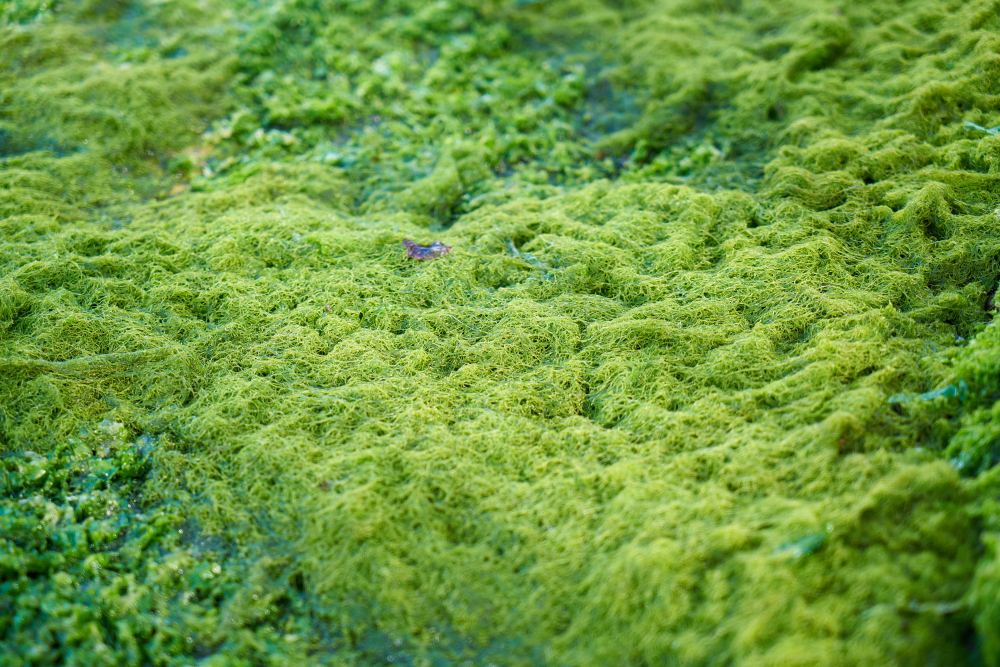
Being able to dry out completely is not just a way of surviving a bad week. It changes what counts as habitable.
A rooted plant on a south-facing stone wall would need water to be available more or less continuously through the growing season. It is not, so the plant cannot live there. A moss on the same wall needs water to be available in occasional bursts. Between those bursts it simply is not doing anything, and not doing anything costs almost nothing. It can spend the great majority of the year shut down and still accumulate a year’s worth of growth in the scattered hours when it is wet.
This is why moss appears in places that look, to us, impossibly hostile: the top of a dry stone wall, a roof, a paving crack, the bark of a tree in a dry summer, the polar and high-alpine ground where the growing season is measured in weeks. It is not that moss tolerates the conditions better. It is that it opts out of them and waits.
Two Generations, One Plant
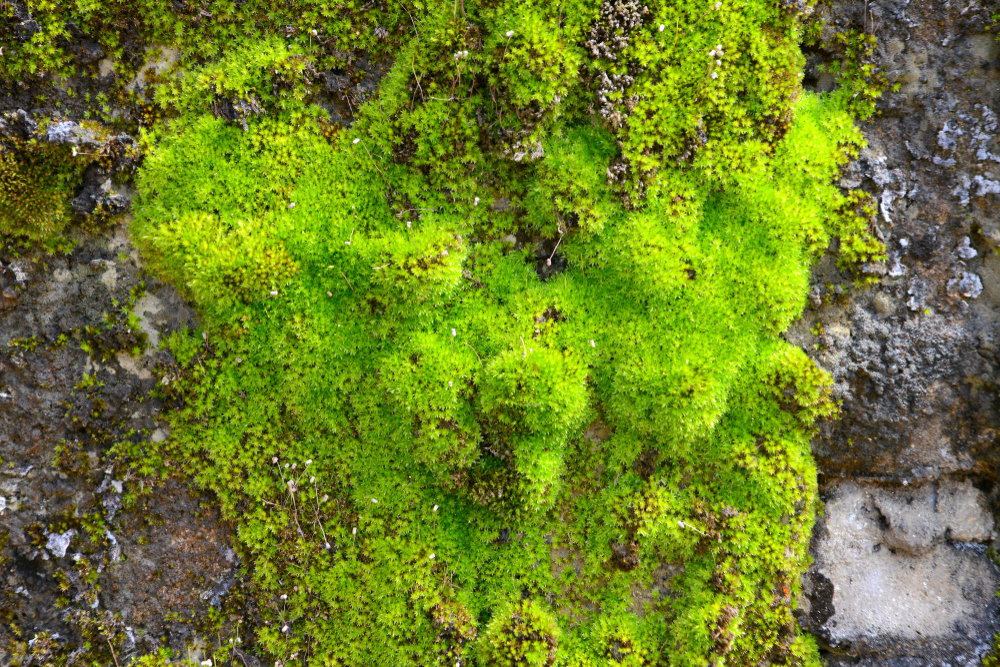
Moss reproduction is strange even by plant standards, and it is the other half of what separates it from the plants around it.
The green cushion you are looking at is only one of two stages, and it is the stage with a single set of chromosomes. When it is wet, sperm cells swim, physically, through the film of water on the cushion, to reach egg cells on the same or a nearby plant. The requirement for liquid water is absolute. Moss fertilisation cannot happen in dry conditions, which is another reason moss is committed to damp places, at least occasionally.
Fertilisation produces the second stage, and this is the part people see without recognising it. Those fine stalks with a capsule on the end, rising out of a moss cushion like a field of tiny lampposts, are not flowers and are not part of the green plant in the ordinary sense. They are a separate generation, with a doubled set of chromosomes, growing out of and nourished by the green cushion underneath. The capsule at the top is full of spores.
When the capsule is ripe, it opens, usually in dry weather, and releases spores that are light enough to travel on air currents over very long distances. This is why moss turns up on a new roof, a new wall, a freshly exposed rock face, with no plausible parent nearby. The spores were already in the air.
Why It Grows on the North Side, and Why That Is Only Half True
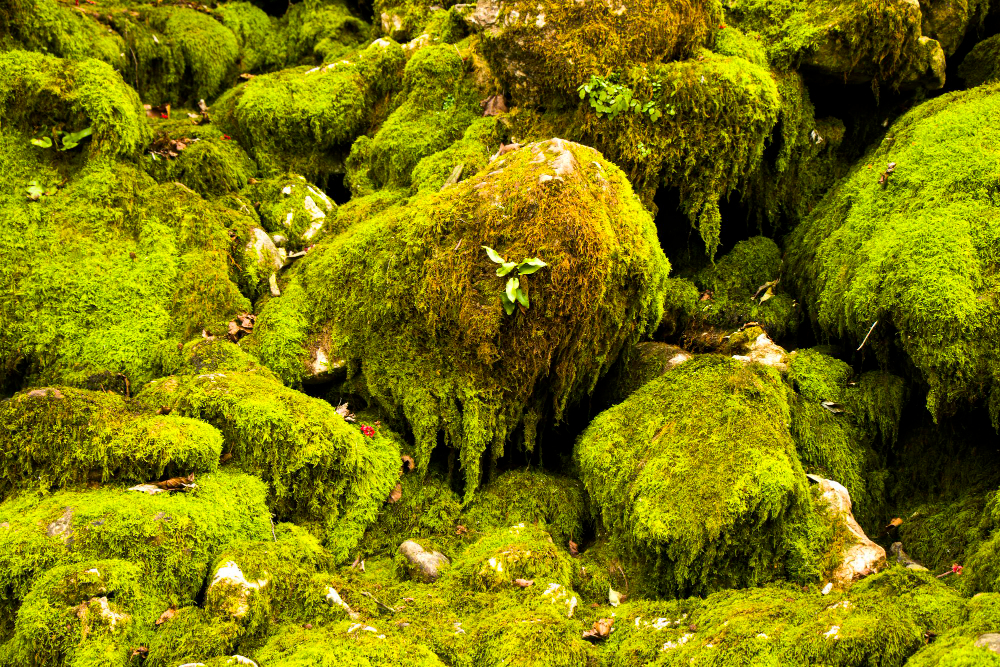
The old wayfinding tip is that moss grows on the north side of a tree, and in the northern hemisphere there is something to it, but the mechanism is worth stating properly, because the rule fails often enough to be dangerous.
Moss needs moisture and it needs it to persist. In the northern hemisphere, the north face of a trunk, a wall or a stone gets the least direct sun, so it stays damp longest after rain and dew, and it dries most slowly. More hours wet means more hours of growth. That is the whole of the effect.
But anything else that keeps a surface damp will produce the same result. A prevailing wet wind will put moss on the windward side regardless of compass direction. A tree shaded by a building will be mossy on the shaded side. A leaning trunk will be mossy on the upper face where water sits. In dense woodland, where everything is shaded, moss grows on all sides equally. The rule is not really about north. It is about which surface stays wet, and north is only a decent proxy for that in open ground in the right hemisphere.
What the Cushion Is Doing to the Surface Under It
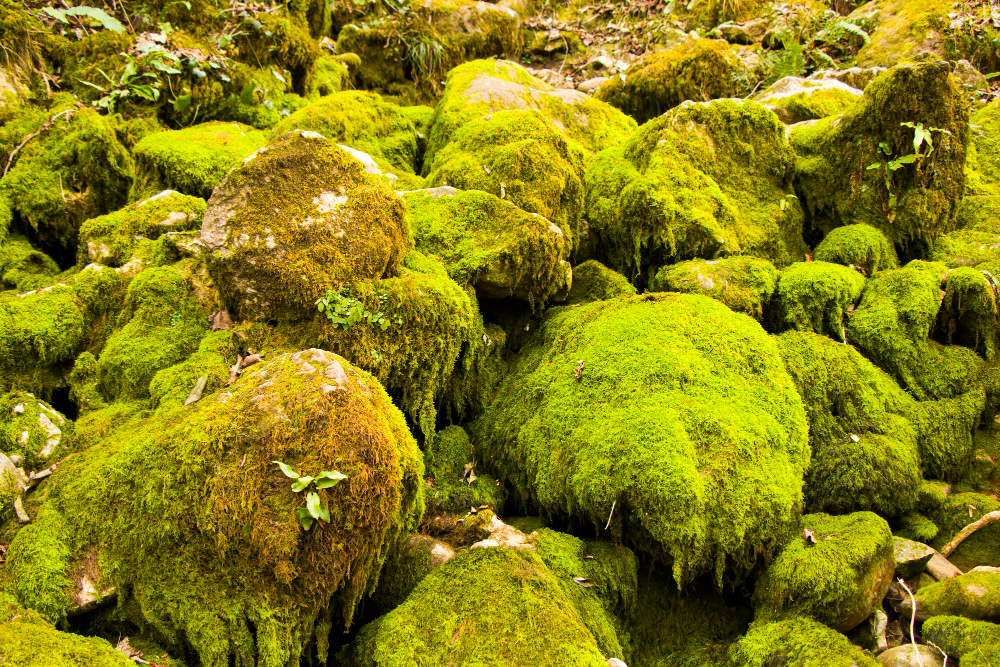
A moss cushion is not passively sitting on a wall. It holds water against the surface for far longer than the surface would otherwise stay wet, and prolonged wetness is what drives most weathering of stone, brick and mortar. The acids produced by the moss itself play a small part, but the main effect is simply keeping things damp.
On a natural rock face this is the start of soil. Moss traps windblown dust and grit in the cushion, adds its own dead material as older shoots die back beneath the growing surface, and gradually builds a thin organic layer where there was bare stone. That layer eventually holds enough water and enough nutrients for something with roots to establish. Moss is frequently the first thing onto new ground after a landslip, a lava flow or a retreating glacier, and what follows it is arriving in soil that moss made.
On a roof or a wall the same process is a maintenance problem rather than a triumph, which is the usual relationship between geology and property.
A Different Answer to the Same Problem
Every land plant is solving one problem: how to live out of water while being made mostly of it. The familiar answer is to build infrastructure. Grow roots to find water, grow tubes to move it, grow a waterproof skin to keep it, grow supporting tissue so the whole apparatus can stand up, and defend a constant internal state against whatever the weather does.
Moss answers the same question by refusing to build any of that. No roots, no tubes, no waterproofing, no support, no defended internal state. It stays small, absorbs water wherever it touches it, works only when wet, and shuts down the rest of the time.
It is easy to read this as the primitive version, an early draft that the real plants improved on. It is not. Both strategies are hundreds of millions of years old, both are still running, and moss occupies an enormous amount of ground that the sophisticated approach cannot touch. The next time you see a green cushion on a wall with nothing underneath it but stone, that is the point: nothing else could be there, and it got there by giving up everything a plant is supposed to have.
Like our content? Follow us for more.
