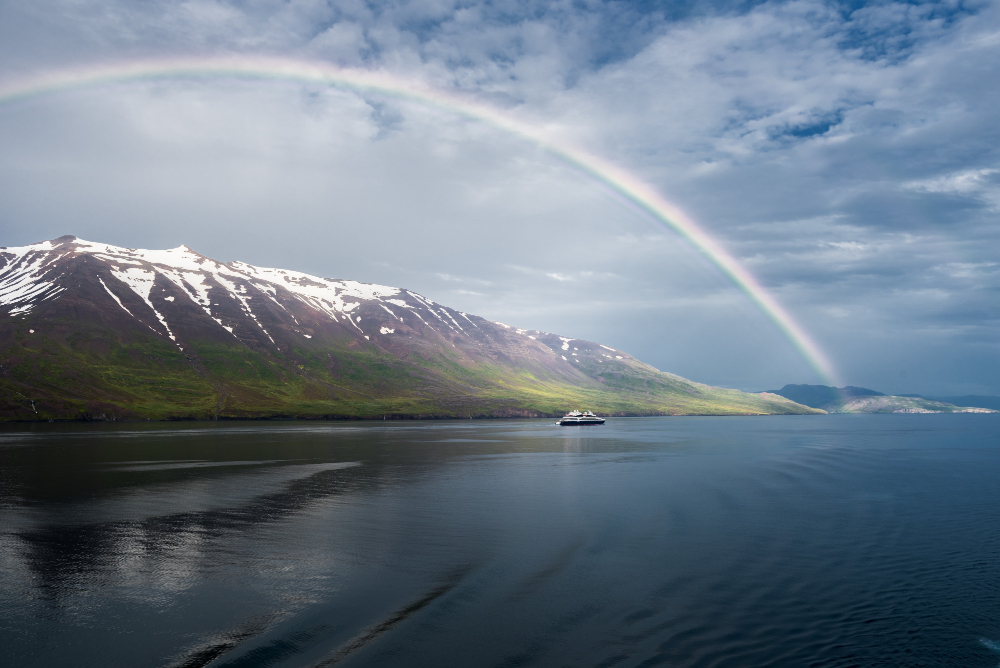
Nearly everyone learns that a rainbow is sunlight split into colours by raindrops, which is true and which explains almost none of the things that are actually strange about rainbows. It does not explain why a rainbow is a circle. It does not explain why the circle is always the same size. It does not explain why the second bow has its colours the wrong way round, why the sky between the two bows is darker than the sky outside them, or why you have never in your life seen a rainbow at midday in summer. All of those come out of the geometry, and the geometry is where the interesting part lives.
What Happens Inside a Single Drop
Take one spherical raindrop with sunlight falling on it. A ray enters the front surface and bends, because light changes speed when it crosses from air into water, and a ray crossing the boundary at an angle gets deflected. That bending is refraction.
The ray then crosses the drop, hits the back surface from the inside, and a portion of it reflects back the way it came instead of passing out. It crosses the drop again, reaches the front surface, and exits, bending a second time as it goes. So the path is: bend in, bounce off the back, bend out. The light leaves the drop travelling back towards the general direction it came from.
The colour separation happens because the amount of bending depends on wavelength. Red light is bent least, violet most, and the difference, although small at each surface, is enough that by the time the light exits the drop the colours are fanned out into a narrow spread instead of recombined into white.
Every drop in a shower is doing this. That alone would just produce a general brightening. The reason you see a sharp, structured bow is the next part.
Like our content? Follow us for more.
Why the Light Piles Up at Forty-Two Degrees
Sunlight strikes a spherical drop across its whole face. A ray hitting dead centre goes straight through and comes straight back. A ray hitting near the edge is deflected sharply. Between those extremes, every ray comes out at some angle, and the angles are not spread evenly.
As you move your entry point from the centre of the drop outwards, the exit angle increases, then reaches a maximum, then decreases again. Near that maximum, a whole band of incoming rays all leave at very nearly the same angle, because at a turning point the output stops changing much even though the input keeps changing. The light bunches up there. Physicists call it the rainbow angle, and for red light in water it is about forty-two degrees from the direction pointing straight away from the sun; for violet it is about forty degrees.
That is the entire explanation for why there is a bow at all rather than a wash of colour. Light of a given colour comes back from a drop concentrated at one specific angle, and nowhere near as strongly at any other.
The number is fixed by the refractive index of water, which does not change. This is why every rainbow you have ever seen has been the same size. A rainbow is not bigger in a heavy shower or smaller in a light one. It is always a circle of the same angular radius, because it is a property of water rather than a property of the weather.
So It Is a Circle, Centred on Your Own Shadow
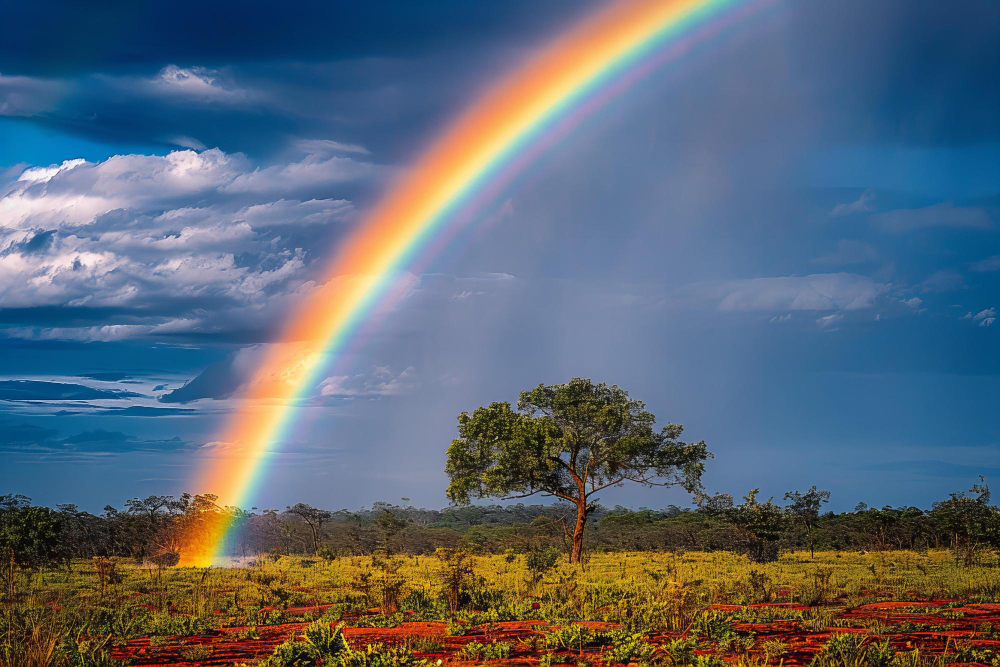
Here is the step that makes everything else fall into place. The forty-two degrees is measured from the antisolar point: the direction exactly opposite the sun from where you are standing, which is the same as the direction of your own head’s shadow.
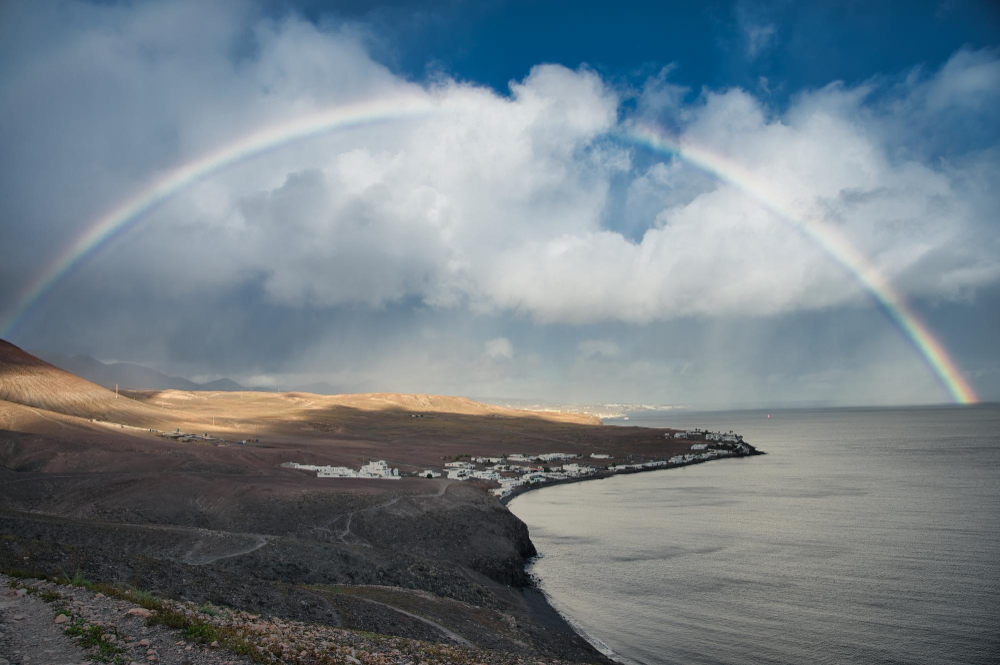
All the drops that can send red light to your eye are the ones sitting forty-two degrees away from that point. Rotate that around and you do not get an arc, you get a full circle. The rainbow is a circle centred on the shadow of your head, and you only see part of it because the ground gets in the way.
That is why rainbows are arcs rather than rings, and why the rainbow you see from an aircraft or from the top of a waterfall can be a complete circle: with nothing below you blocking the lower half, the whole ring is there.
It is also why the rainbow moves when you move. The circle is centred on your head’s shadow, which travels with you, so the bow travels with you. There is no fixed pot of ground for it to end on. Walk towards it and it retreats, not out of mischief but because its centre is attached to you.
Two People Do Not See the Same Rainbow
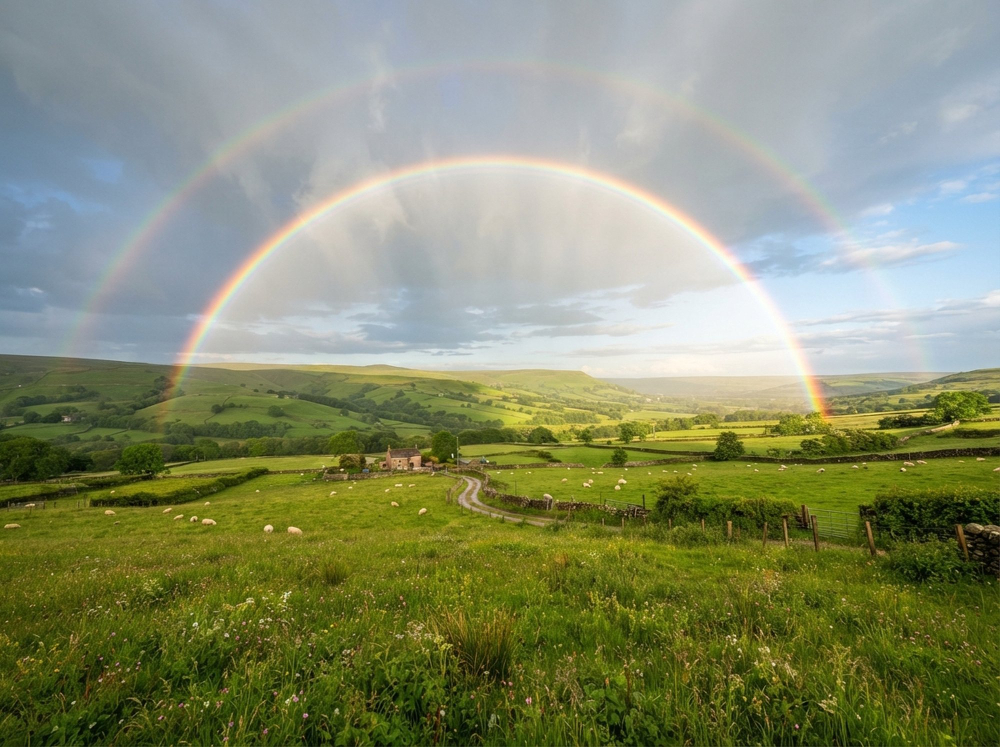
Follow the geometry one more step. The bow you see is made of light from the particular drops sitting at forty-two degrees from your antisolar point. Someone standing a few metres away has a different antisolar point, so the drops that qualify are different drops.
They are seeing a rainbow made of different water. It looks like the same bow because it occupies the same apparent position relative to the landscape, but it is assembled from a separate set of drops, and it is, in every meaningful sense, a separate rainbow. Each pair of eyes gets its own.
This is also why a rainbow has no distance. Asking how far away it is has no answer, because the drops contributing to it may be fifty metres off or two kilometres off, and the bow appears at the same angular size either way. A photograph cannot focus on a rainbow as an object; it focuses on the rain, and the bow comes along at whatever depth the water happens to be.
The Second Bow, and Why Its Colours Are Reversed
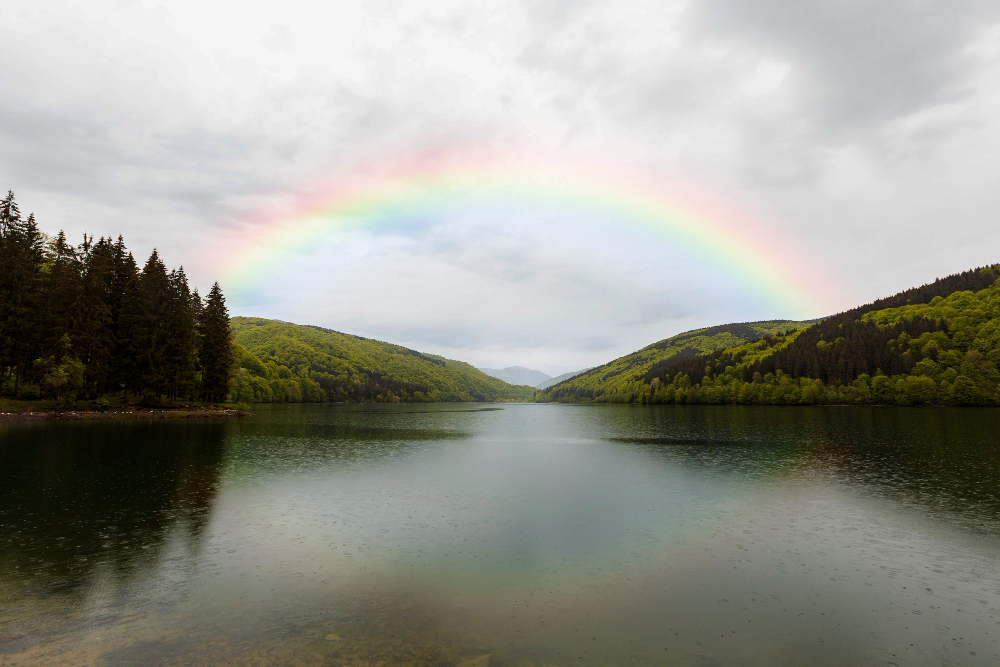
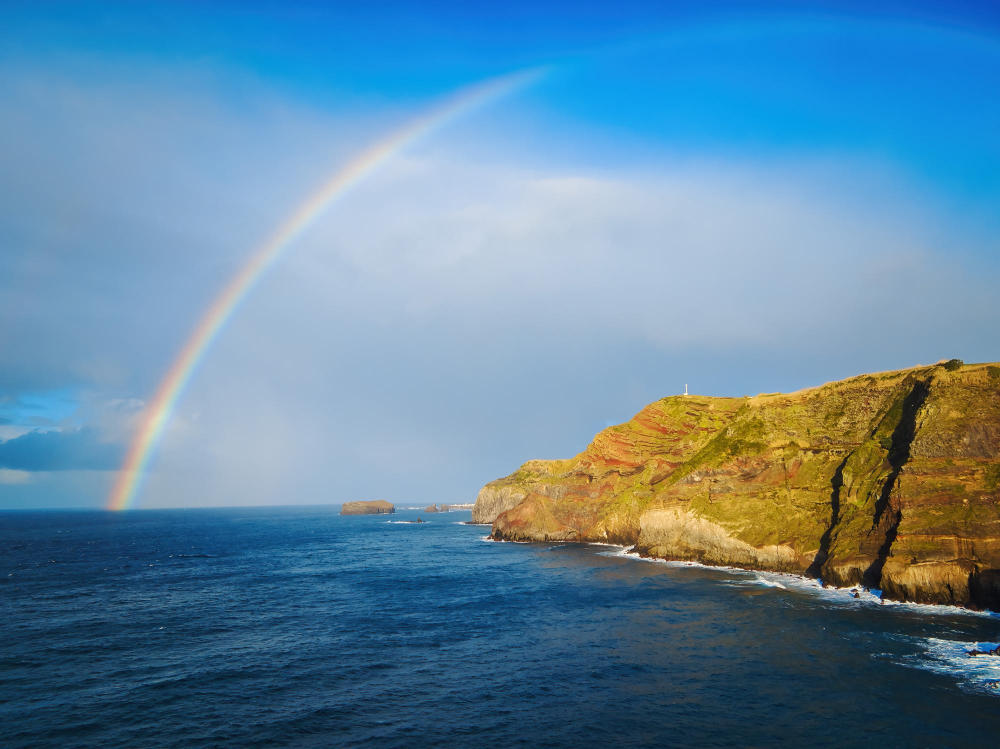
A fainter bow often appears outside the main one, at about fifty-one degrees, with red on the inside and violet on the outside: the opposite order.
It comes from light that reflected twice inside the drop instead of once. Two internal bounces change the geometry, pushing the exit angle out to around fifty-one degrees, and the extra reflection flips the order in which the colours emerge. Each internal reflection also loses light out of the back of the drop, which is why the secondary bow is noticeably dimmer than the primary. Third and fourth bows exist mathematically and are so faint, and so awkwardly positioned near the sun, that seeing one is a rare event.
If both bows are visible, look at the sky between them. It is darker than the sky above the secondary or below the primary. This is Alexander’s band, named after the Greek commentator who described it around 200 AD, and it is a direct consequence of the angles. Single-reflection light comes back at forty-two degrees or less, and double-reflection light at fifty-one degrees or more. The gap between them receives almost no returned light at all, so it is measurably darker. The dark band is not an illusion or a contrast effect. There is nothing being sent to your eye from that part of the sky.
Why You Never See One in the Middle of the Day
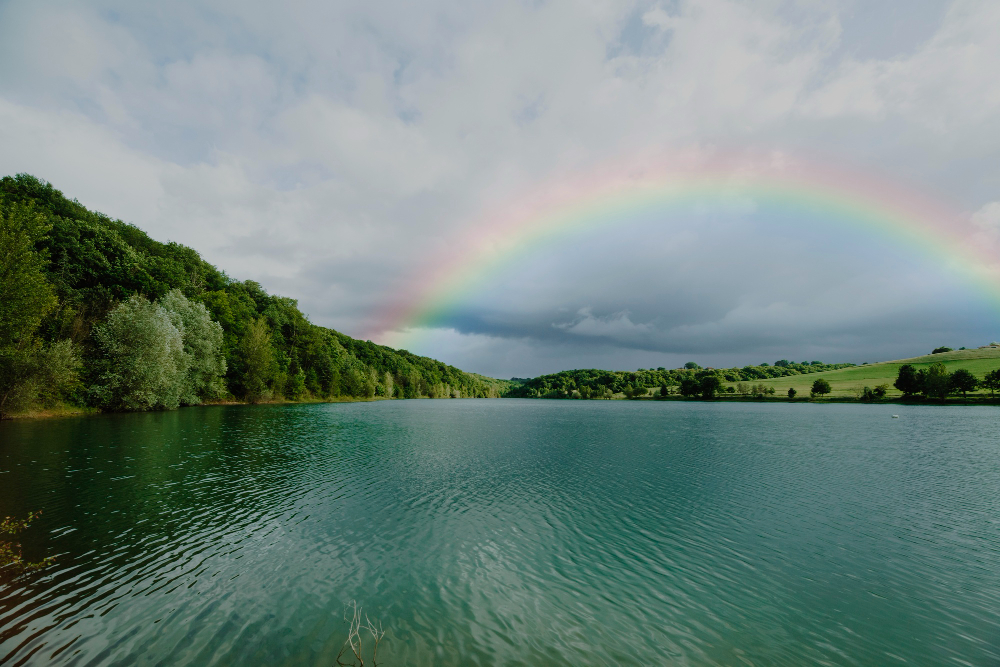
Because the bow sits forty-two degrees from the antisolar point, and the antisolar point sits exactly as far below the horizon as the sun sits above it, the height of a rainbow depends entirely on the sun’s height.
When the sun is low, just after dawn or before sunset, the antisolar point is just below the horizon and the bow stands tall, sometimes a full semicircle. As the sun climbs, the antisolar point sinks and the bow drops with it. Once the sun is more than forty-two degrees above the horizon, the entire bow is below the horizon and cannot be seen from the ground at all.
In summer at mid-latitudes the midday sun is well above that limit, which is why rainbows are morning and evening events. Near the equator, where the sun passes close to overhead, the usable window is narrower still. And a rainbow seen at sunset is at its maximum possible height, which is why the biggest bows come at the ends of the day.
Everything Else That Uses the Same Trick
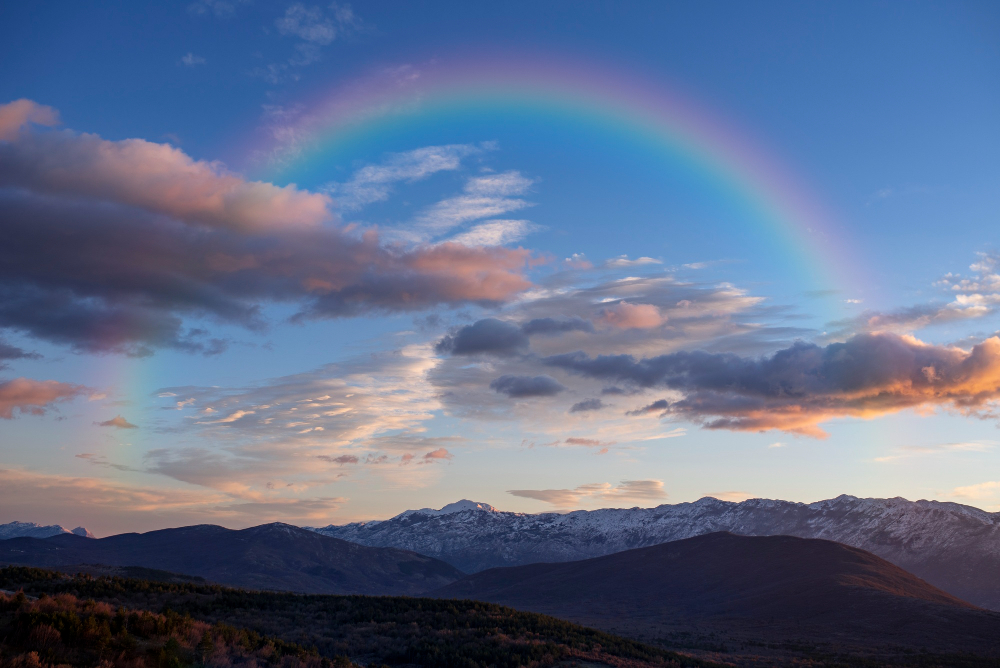
Once you know a rainbow is a spherical drop returning light at a fixed angle, you start recognising the same effect elsewhere.
A garden hose on a fine spray produces a rainbow if you stand with the sun behind you, and because the drops are close, you can walk sideways and watch the bow move with you in a way that is much easier to notice than with real rain. Waterfalls and fountains do the same. Sea spray does it.
Fog produces a fogbow, and it is white. The droplets in fog are so small that the physics shifts from simple refraction to diffraction, the colours smear across each other and overlap, and what comes back is a broad pale arc with the colour washed out.
Dew on grass produces a dewbow, lying across the ground rather than standing in the sky, because the drops are on a horizontal surface instead of suspended in the air.
And the moon produces moonbows, by exactly the same mechanism with a light source around four hundred thousand times fainter. They are real and they are fully coloured, but at that brightness the colour-sensitive cells in the human eye are barely operating, so a moonbow usually looks white to the naked eye and shows its colours only in a long-exposure photograph.
The ring around the sun or moon on a hazy day is not the same thing at all. That is a halo at twenty-two degrees, made by ice crystals rather than water drops, and it forms around the light source rather than opposite it.
Not a Thing, a Direction
The stubborn misconception is that a rainbow is somewhere. It is not. It is the answer to a question about angles, and the question has a different answer for every observer.
The drops are real and they are in a particular place. The sunlight is real. What is not real, in the way a cloud or a mountain is real, is the bow itself. It is a pattern in the direction that light happens to leave water, assembled fresh for each pair of eyes, positioned relative to the shadow of the head doing the looking.
Which makes the folklore about a pot of gold at the end more accurate than it was ever intended to be. There is no end. There is no place. If you walk to where the bow appeared to touch the ground, you will find wet grass, and the rainbow will be forty-two degrees away from your shadow, exactly where it always was.
Like our content? Follow us for more.