

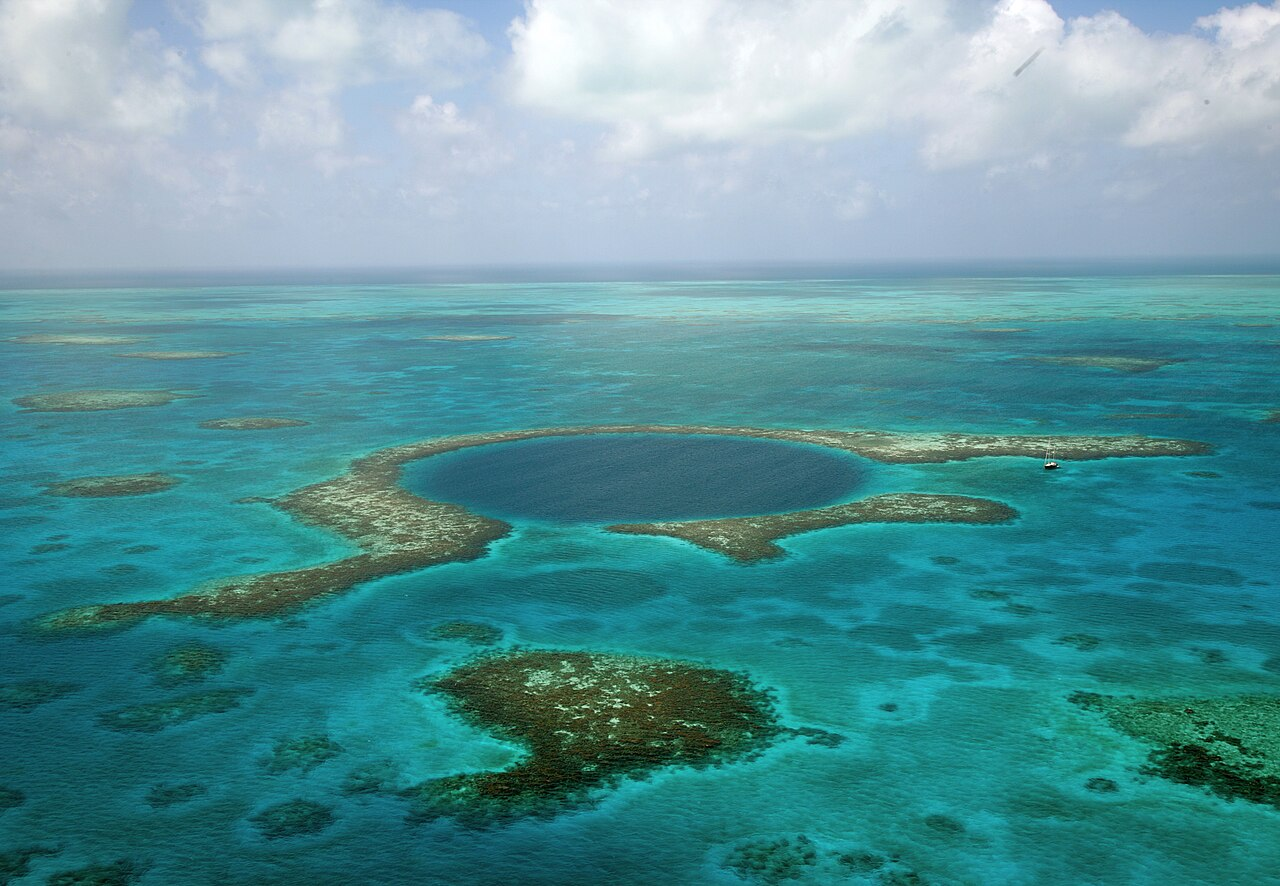
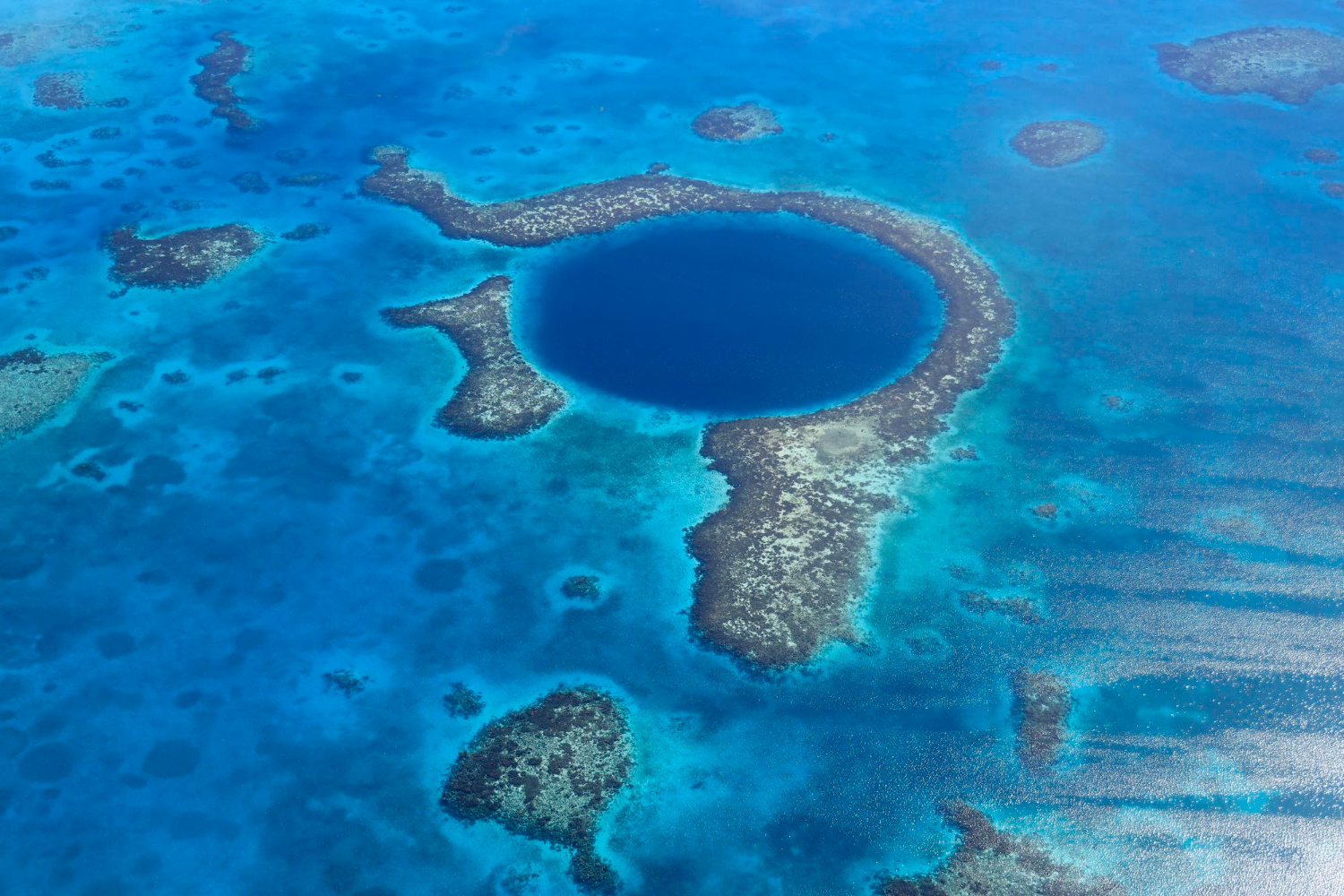
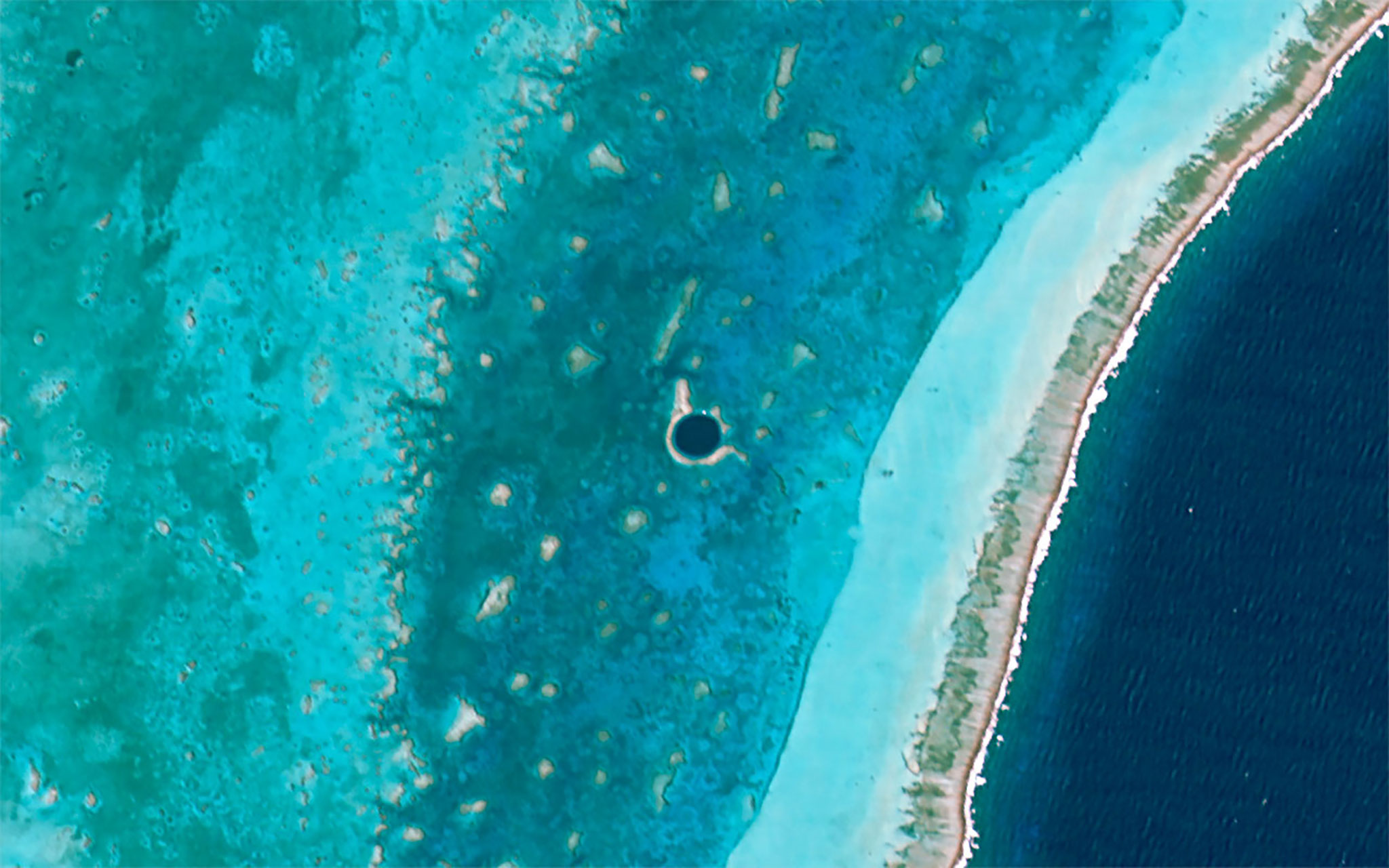
There are a handful of places on Earth so visually striking that a single photograph of them is instantly recognizable, and the Great Blue Hole is one of them. Seen from above, it appears as an almost perfect circle of deep navy water, roughly a thousand feet across, set into the pale turquoise shallows of a Caribbean reef like a dark eye staring up at the sky. It has been photographed from planes, from helicopters, and from orbit, and it draws divers and sightseers from all over the world to the coast of Belize.
But the most interesting thing about the Great Blue Hole is not how it looks from the air. It is what it used to be. This is not a hole in the seafloor in any ordinary sense, not a crater or a trench or a spot where the bottom simply drops away. It is the remains of a cave, a limestone cavern that formed on dry land during the ice ages, when so much of the planet’s water was locked up in glaciers that the sea in this region sat hundreds of feet lower than it does today. The cave filled with water when the ice melted, its roof gave way, and the ocean claimed it. And the proof of that history is still hanging in the dark a hundred and thirty feet down. Here is the story of how one of the world’s most famous dive sites was built in open air.
A Circle in the Reef
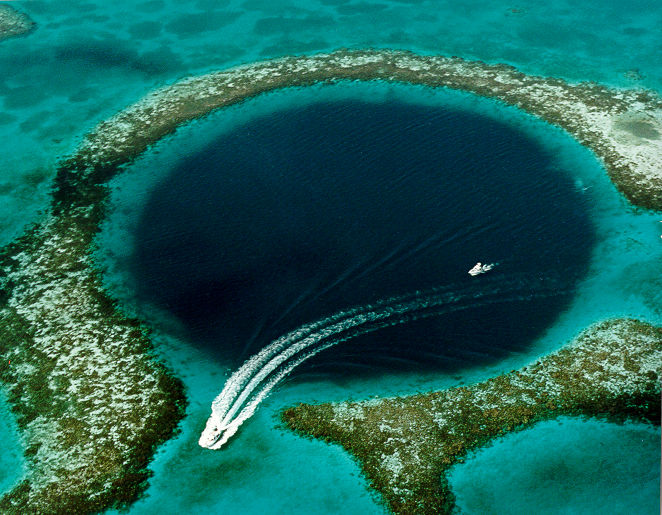
The Great Blue Hole sits near the center of Lighthouse Reef, an atoll lying off the coast of Belize in the western Caribbean. Its dimensions are impressive and unusually regular: roughly 300 meters, or about a thousand feet, across, and around 124 meters, roughly 400 feet, deep. The near-perfect circularity is part of what makes it so arresting from above, and the sharp contrast between the bright, shallow reef water surrounding it and the deep blue of the shaft itself is what gives the feature its name.
The site sits within the Belize Barrier Reef Reserve System, which was inscribed as a UNESCO World Heritage Site in 1996, and it forms part of one of the most significant marine environments in the Western Hemisphere. Its international fame owes a good deal to the French oceanographer Jacques Cousteau, who brought his research vessel to the site in 1971 to chart its depths and later featured it in his television work, declaring it one of the world’s premier diving destinations. That expedition did more than generate publicity; the investigations carried out then helped confirm what the hole actually is, establishing it as a karst limestone formation that had taken shape before the sea rose to cover it. Cousteau’s visit put the Great Blue Hole on the map for millions of viewers and helped establish Belize as a world-class diving destination, but the scientific finding was arguably the more remarkable outcome.
Like our content? Follow us for more.
Built When the Sea Was Somewhere Else
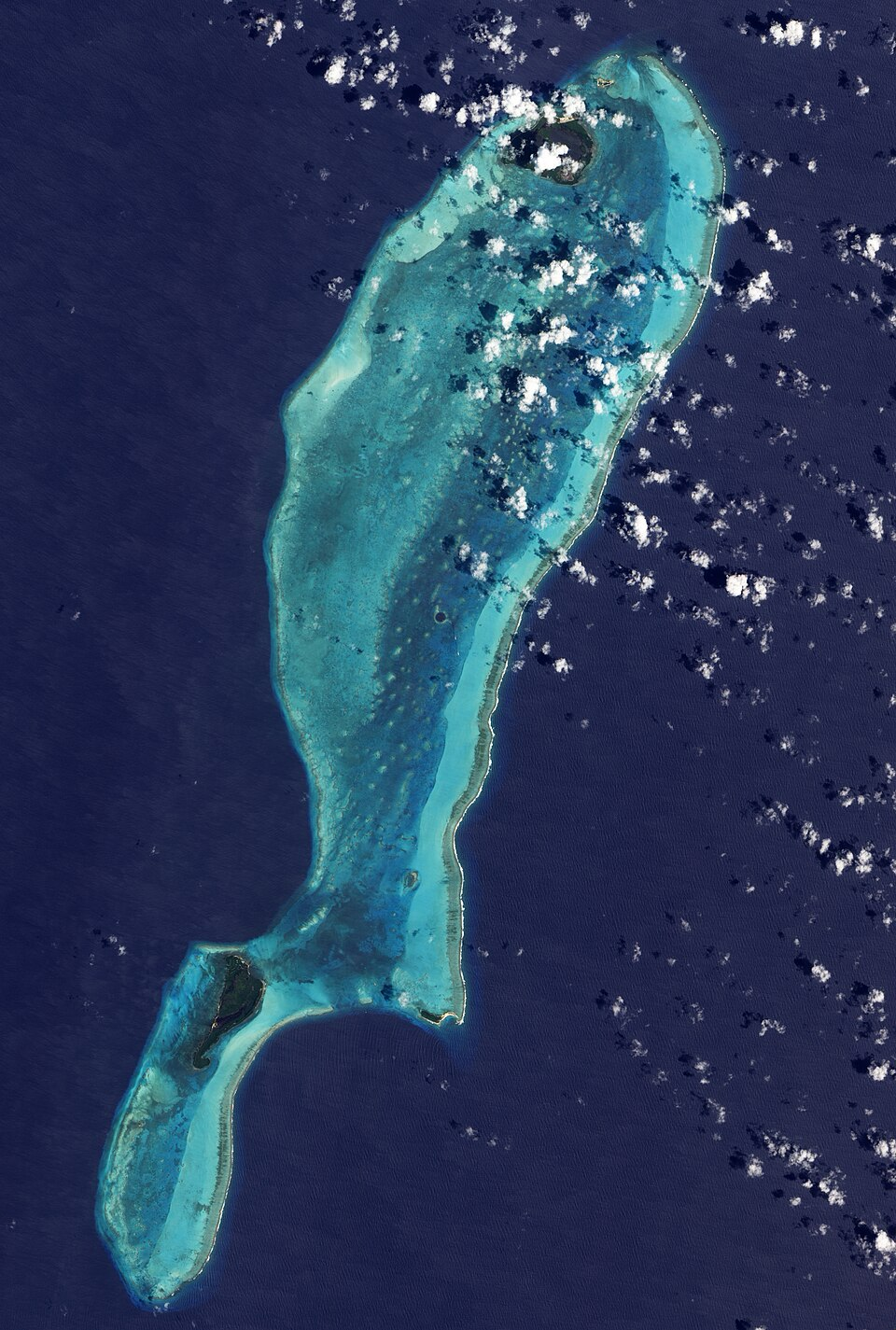
To understand how a cave ends up four hundred feet under the Caribbean, you have to picture the region during the ice ages. When enormous volumes of the world’s water were bound up in continental ice sheets, global sea levels were dramatically lower than they are now, and large areas that are underwater today stood exposed as dry land. What is now Lighthouse Reef was, in those periods, above the waterline.
Limestone is soluble. Rainwater, mildly acidic, seeps into it, dissolves it, and over long stretches of time hollows out cave systems, the same process that produces caverns and sinkholes in limestone country all over the world. That is exactly what happened here. Rain worked its way into the exposed limestone platform, dissolving out chambers and passages, and a cave system developed in open air. Analysis of the formations inside indicates that this happened not in one episode but in several distinct phases, with formation dated to roughly 153,000, 66,000, 60,000, and 15,000 years ago, corresponding to different periods when sea levels were low and the rock stood dry. Investigations have also identified ledges at several depths inside the shaft, at roughly 21, 49, and 91 meters, marking stages in that long history. The Great Blue Hole, in other words, was not made all at once. It was assembled over more than a hundred thousand years of intermittent dry spells.
The Stone Icicles That Give It Away
The single most compelling piece of evidence sits well below the surface, and it is the reason this story can be told with confidence rather than as speculation. Divers descending into the shaft encounter, at depths of roughly forty meters and beyond, enormous stalactites: the tapering mineral formations that hang from cave ceilings, built up drop by drop over millennia.
The crucial point about stalactites is that they cannot form underwater. They are made by water dripping through the air inside a cave, each drop leaving behind a minute deposit of dissolved mineral, slowly growing a stone icicle downward from the ceiling. That process requires an air-filled chamber. A stalactite hanging a hundred and thirty feet beneath the Caribbean is therefore a direct, physical record of a time when that spot was a dry cave with air in it and water dripping from its roof. Chemical analysis of these formations has reinforced the point, with isotopic signatures matching ice-age conditions. Samples collected by researchers over the years have been dated to the Pleistocene periods noted above, confirming the site’s origin as a limestone cave system that flooded as the post-glacial sea rose. There is a real pleasure in this kind of evidence: not an inference from a model, but a tangible object you can swim up to and touch, which by its very existence tells you the ocean used to be somewhere else.
The Tilt Nobody Expected
There is a further detail in the stalactites that adds an unexpected wrinkle. When researchers examined the formations carefully, they noticed that some of them are not hanging straight down. They are off-vertical by about five degrees, and, importantly, they are tilted in a consistent direction rather than randomly.
This matters because a stalactite, while it is forming, is a plumb line. Gravity dictates that it grows straight down. If a stalactite is now leaning at an angle, and its neighbors are leaning the same way, the most reasonable explanation is that the entire block of rock it is attached to has shifted since the formation grew. In other words, the ground itself tilted. Researchers have interpreted this consistent five-degree lean as evidence of past geological movement, a tilting of the underlying limestone plateau, followed by a long period of stability in its current position. It is a subtle observation with a large implication: it indicates that the story of this place involves not only rising seas but also the slow deformation of the Earth’s crust beneath it. The Great Blue Hole records both.
What the Collapse Left Behind
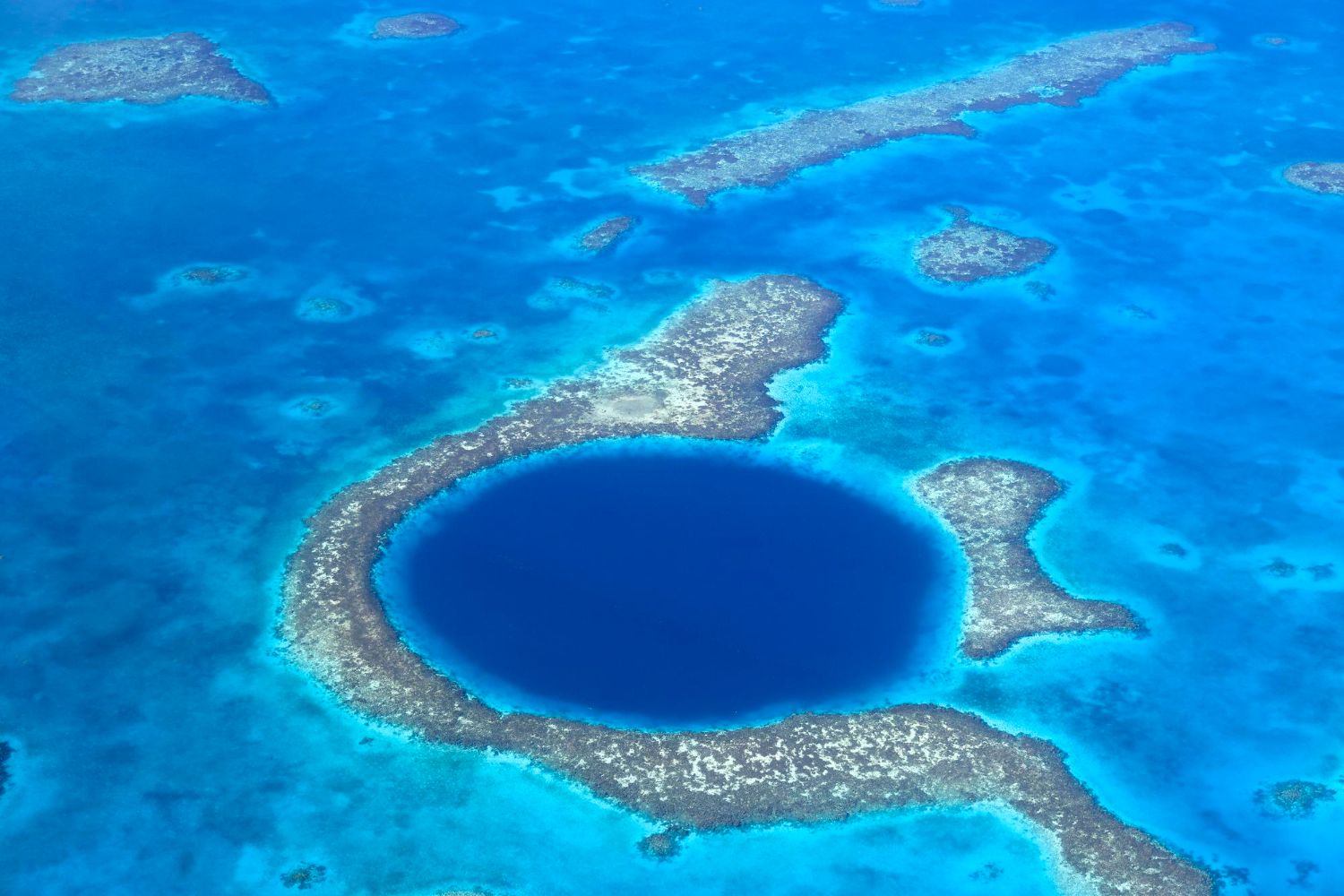
The final act in the hole’s formation came when the ice ages ended. As the great ice sheets melted and sea levels climbed, the water advanced across the exposed limestone platform and flooded the cave system that had been carved into it. At some stage, the roof of the main chamber could no longer support itself and gave way, collapsing inward and leaving behind the open vertical shaft that is visible today.
That collapse is what turned a hidden cave into a striking circular opening in the reef. The near-perfect roundness that makes the site so photogenic from the air is essentially the outline of a collapsed cave ceiling. Below the rim, the shaft descends through water that becomes progressively stranger the deeper you go. A 2018 expedition that mapped the interior using submersibles and sonar identified a layer of hydrogen sulfide at roughly ninety meters down; below that boundary the water is anoxic, containing effectively no oxygen, and consequently supports essentially no life. The same expedition produced detailed three-dimensional scans of the interior and recovered undisturbed sediment layers thousands of years old, valuable records of the region’s environmental past. Less happily, it also found modern plastic debris resting near the bottom, a sobering illustration of how thoroughly human material has spread even into the most remote and celebrated corners of the ocean.
A Window Into a Different World
For divers, the Great Blue Hole is a distinctive experience, and it is worth being clear that it is not a casual one. Recreational dives typically descend to about forty meters, roughly a third of the way down, and operators generally expect advanced certification and recent deep-diving experience, because depth, overhangs, and nitrogen narcosis all come into play. Visitors who do not dive can take in the site from scenic flights, which arguably offer the more spectacular perspective anyway, or snorkel the vibrant reef around the rim, which is where most of the colorful coral and fish life actually is. The interior of the hole itself is comparatively sparse, which surprises many first-time visitors expecting an underwater garden.
But the real appeal of the place is not the marine life; it is the time travel. Swimming down past those tilted stone icicles means moving through a landscape that was assembled in open air, in a world with different coastlines, when the sea was hundreds of feet lower and this patch of the Caribbean was solid ground. Very few places let you visit the ice age so directly. The Great Blue Hole endures as one of the best-preserved natural records of the sea-level rise that ended the last glacial period, a place scientists study to understand how coastlines have shifted across the ages. It is a natural wonder, a photographer’s dream, and a geological archive all at once, and the next time you see that famous dark circle in a photograph, you will know that you are looking at the ceiling of a cave that fell in.
Like our content? Follow us for more.
