

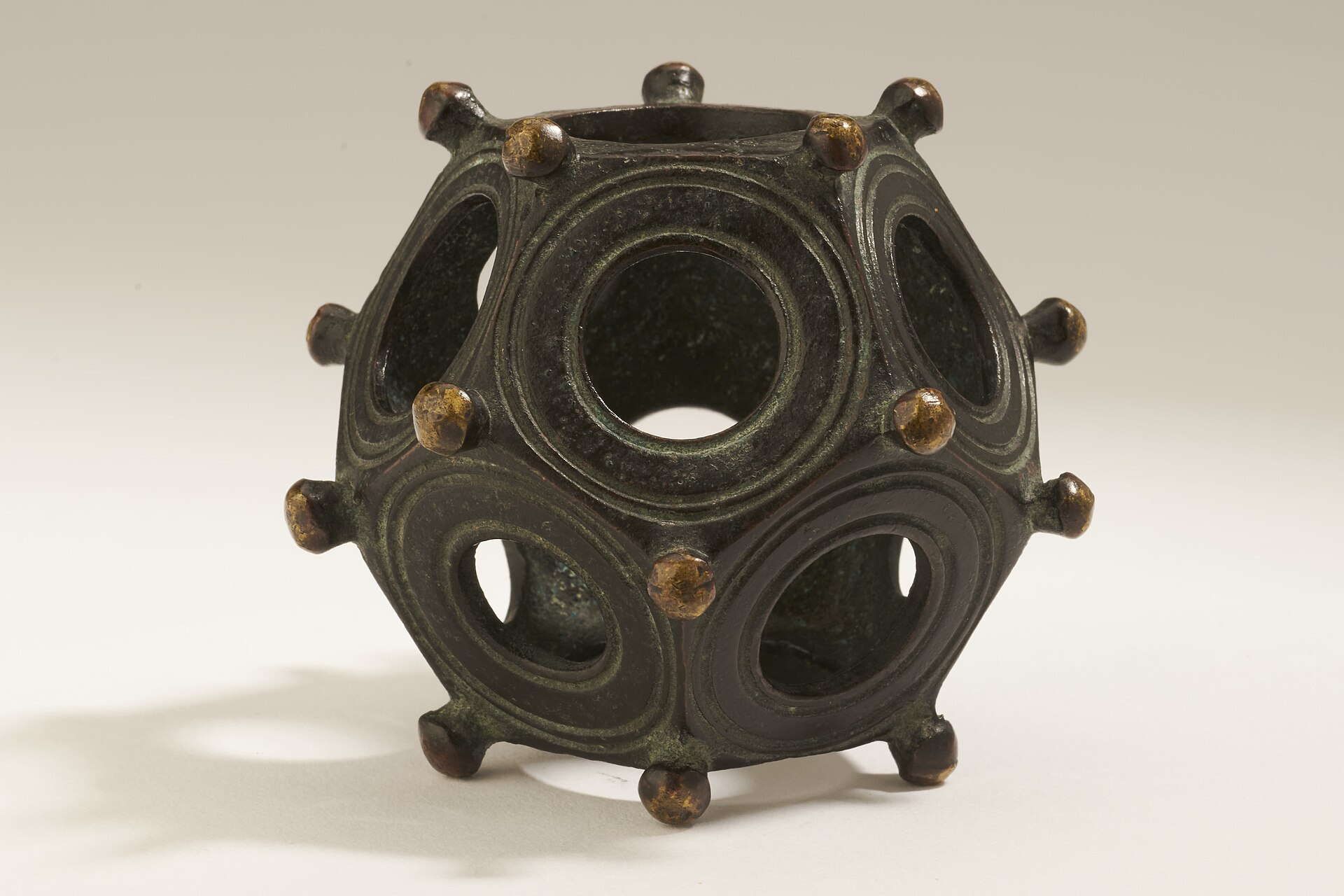
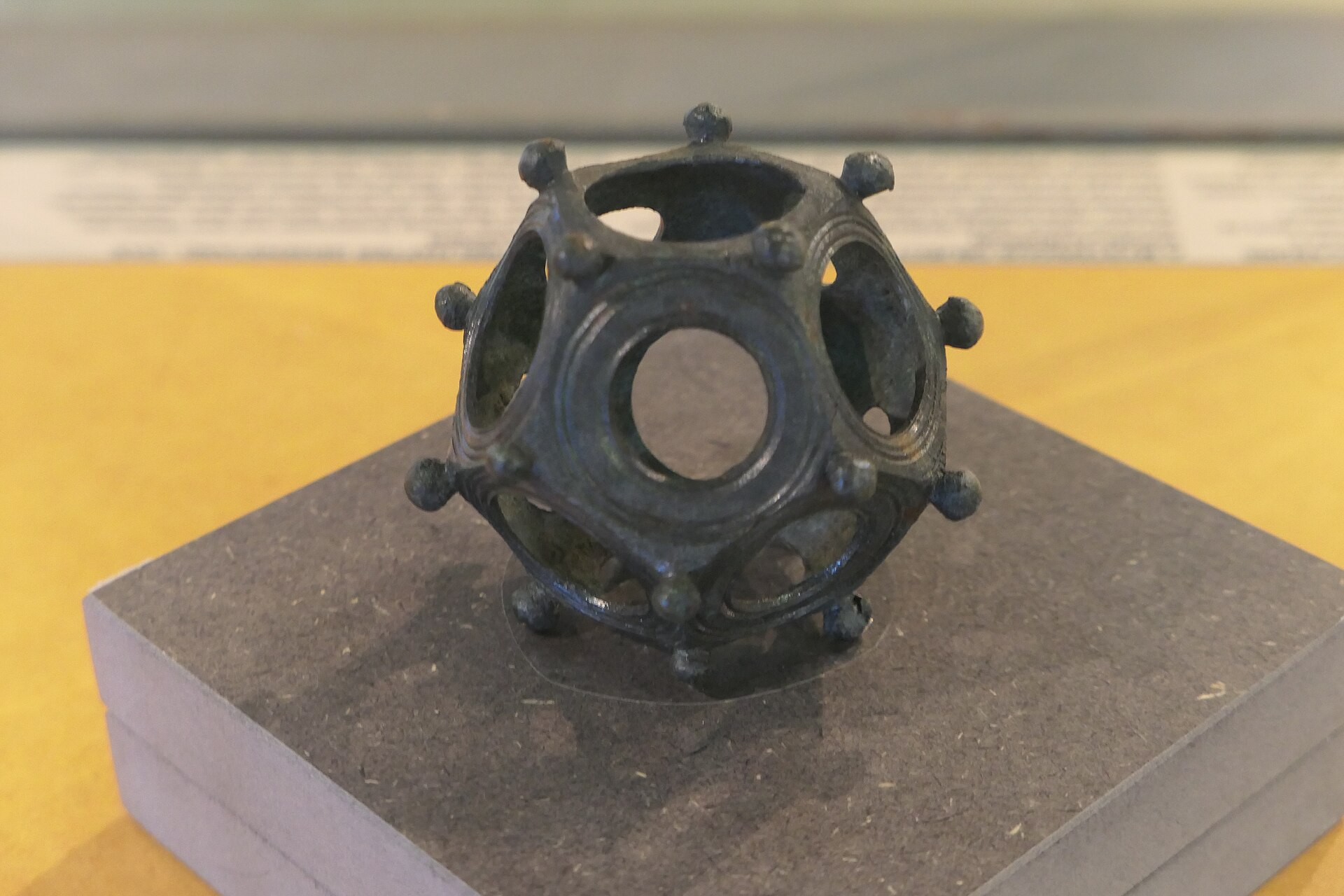
In 1739, a local historian digging in a field in the English countryside turned up an odd piece of ancient metalwork alongside some Roman coins. It was hollow, roughly the size of an egg, cast in bronze, and formed of twelve equal flat faces, each one a pentagon. Every face had a circular hole cut into its center, and each of the twenty corners carried a small rounded knob. It was clearly deliberate, clearly skilled work, and clearly Roman. Presented to the Society of Antiquaries in London, it was described simply as a piece of ancient brass consisting of twelve equal sides.
Nobody could say what it was.
Nearly three hundred years later, nobody still can. Since that first find, more than a hundred and twenty similar objects have been recovered across a broad swath of what was once the Roman Empire, and they remain one of archaeology’s most stubbornly unsolved puzzles. Dozens upon dozens of explanations have been proposed, and not one has been confirmed. These are not obscure fragments requiring expert interpretation; they are handsome, distinctive, carefully manufactured objects that plainly mattered to the people who owned them. And we have absolutely no idea why. Here is the enduring enigma of the Roman dodecahedron.
What They Actually Are
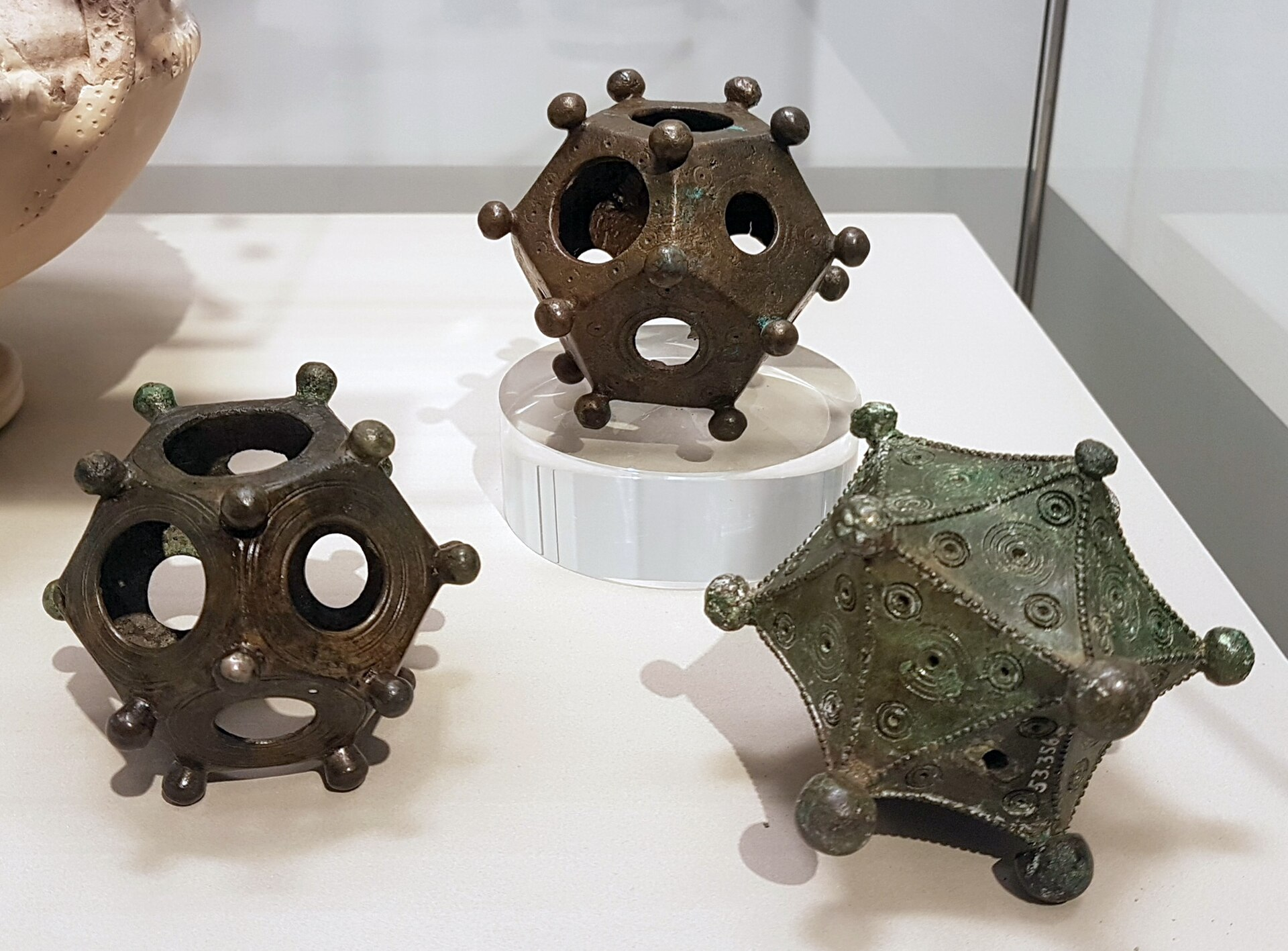
The basic description is consistent enough to be worth setting out precisely. A Roman dodecahedron is a small, hollow object with twelve pentagonal faces, arranged in the geometric shape that gives it its name, from the Greek for “twelve faces.” Most are cast in bronze, though a small number are made of stone. They range in size from roughly four to twelve centimeters across, so from about the size of a golf ball up to something you would need a full hand to hold.
Each of the twelve faces has a circular opening cut into it, and this is where things get interesting: the holes are not uniform. They vary in diameter from face to face, and they are often not perfectly centered. At each of the object’s corners sits a small spherical knob or projection. Beyond these shared features, the objects differ substantially. Some are plain, others decorated with rings or patterns. Sizes vary. Hole arrangements vary. Crucially, no two are exactly alike, and none appear to have been mass-produced. That last point turns out to matter a great deal for the theories, because a set of objects with inconsistent dimensions is very hard to explain as any kind of standardized instrument. A related object, a twenty-sided icosahedron of similar bronze construction with the same distinctive corner knobs, has also been found, deepening the puzzle rather than clarifying it.
Like our content? Follow us for more.
Where They Turn Up, and Where They Don’t
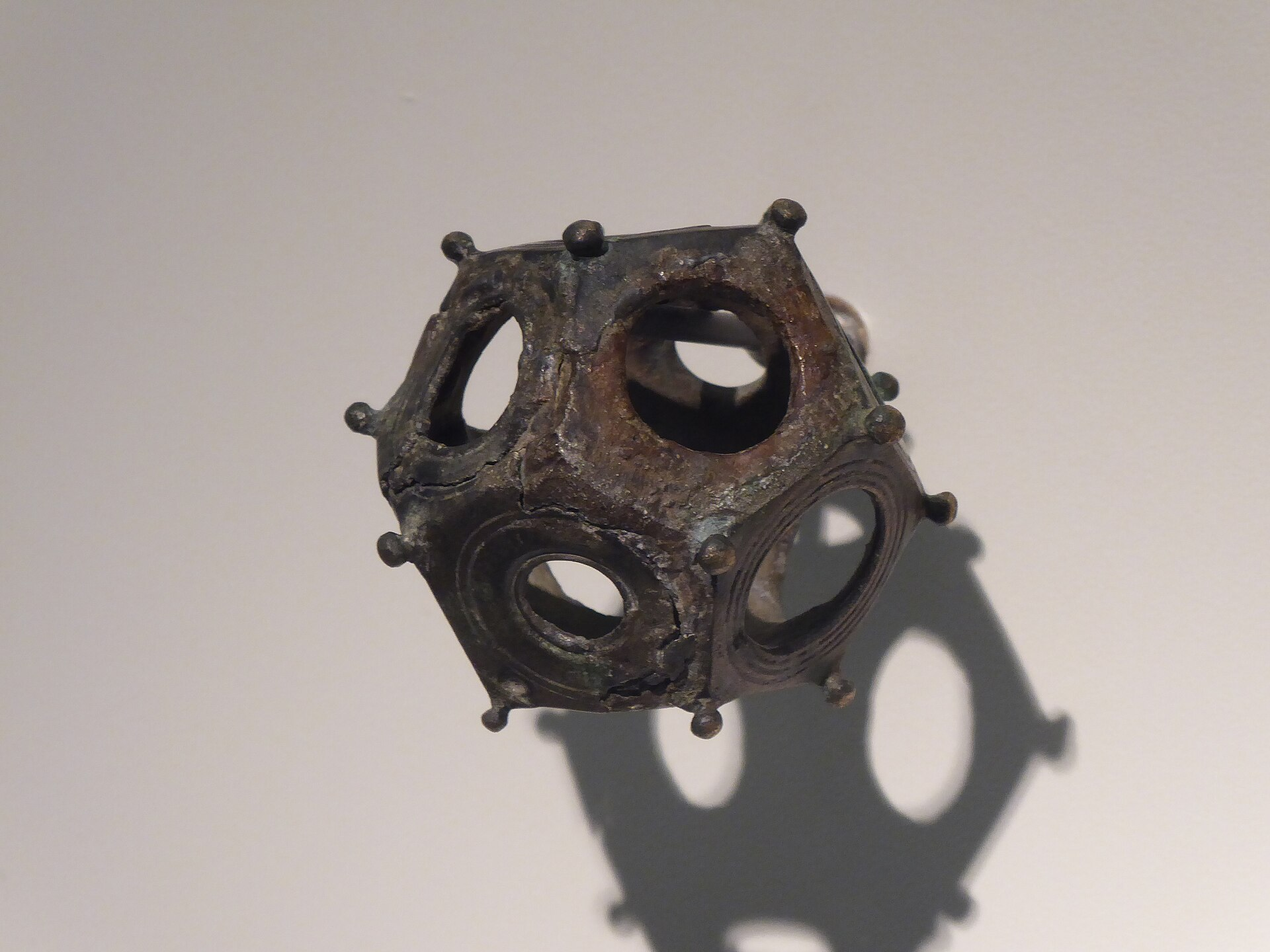
The geographic distribution of these objects is one of the most suggestive things about them, and one of the least explained. Roman dodecahedrons have been discovered across the northwestern provinces of the Roman Empire: in what is now Britain, France, Germany, Belgium, Switzerland, and the Netherlands. More than 120 examples are known, and new ones still occasionally surface, including a well-preserved example unearthed by a volunteer with a local archaeology group in Lincolnshire, England, in 2023, described by the group’s secretary as the find of a lifetime.
And here is the strange part: essentially none have been found in Italy or the Mediterranean heart of the empire. Whatever these objects were, they appear to have been a phenomenon of the northern provinces, of the Gallo-Roman world rather than Rome itself. That is a truly odd pattern for an artifact of the Roman world, and it hints that the objects may be connected to local traditions, perhaps Celtic or Gallic ones, rather than to Roman practice broadly. The findspots themselves are also revealing, or at least tantalizing. Dodecahedrons have been recovered from graves, from the remains of villas, from temple sites, and from military camps. And they are almost always found singly, one at a time, rather than in groups or caches, as though each one belonged to a particular person or had been deliberately placed. They date, broadly, to roughly the second through fourth centuries of the common era, with some examples possibly earlier.
The Silence in the Record
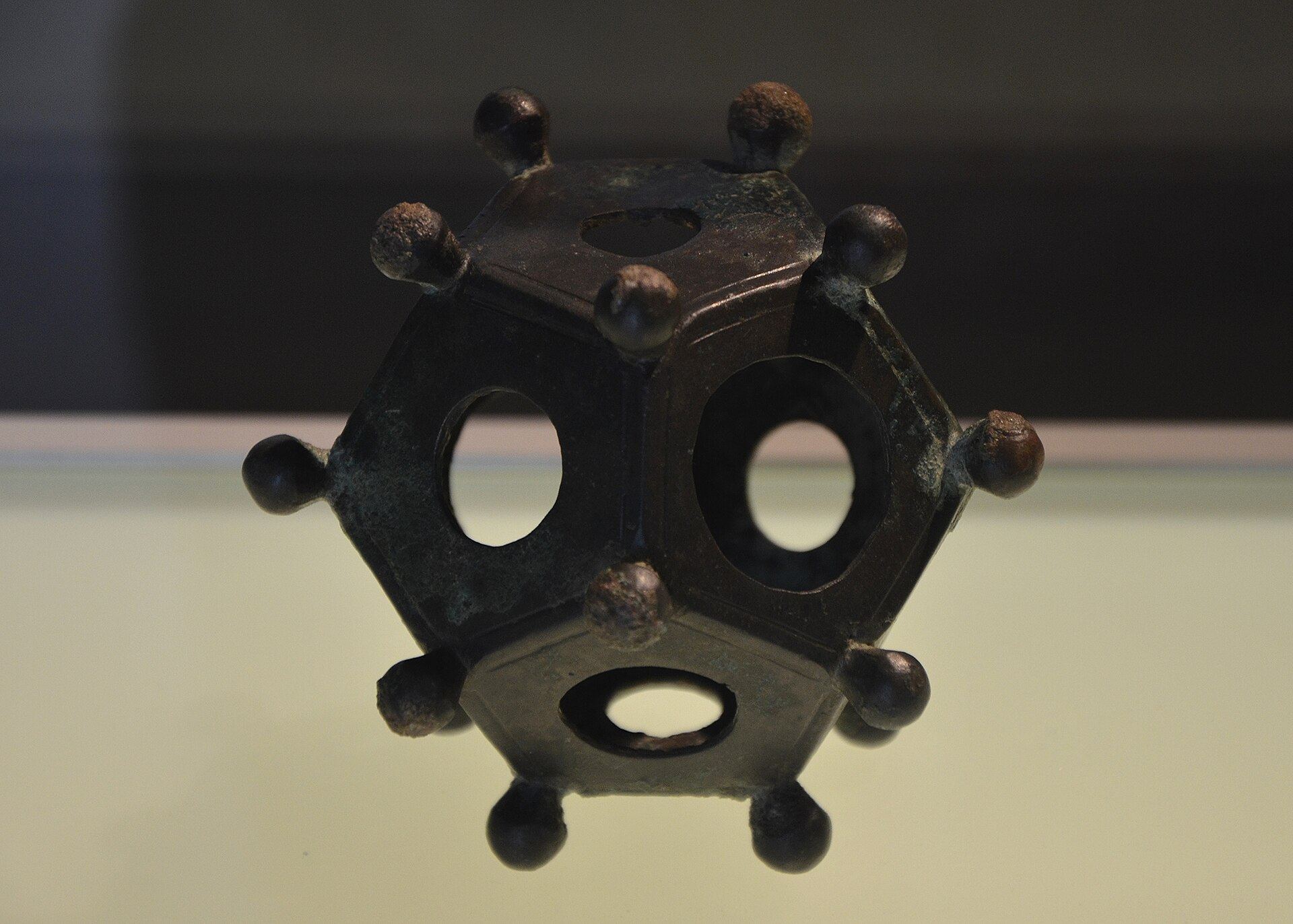
The reason this puzzle has proven so stubborn comes down to a single, remarkable absence. The Romans were prolific writers. They left behind histories, letters, poetry, technical manuals, military handbooks, legal texts, inventories, graffiti, and personal correspondence in enormous quantity. They also left a rich visual record: mosaics, frescoes, carvings, and reliefs depicting daily life in considerable detail.
In all of that material, there is no mention of these objects. Not a description, not an instruction, not a passing reference, not a picture. As one curator at a German Roman fort and archaeological park put it, we have no sources from antiquity that give any explanation of the function or meaning of these objects, which means any theory about them can be neither proved nor disproved. That silence is the crux of the whole problem. Archaeologists working on almost any other Roman artifact can consult the written and visual record for context. Here there is nothing to consult. The objects arrive in the present entirely without instructions, and every interpretation has to be built from the physical evidence alone, which is precisely why the field has produced dozens of competing ideas and no consensus.
Fifty Theories and Counting
The explanations that have been proposed over nearly three centuries range from the sober to the delightfully speculative, and by some counts there are more than fifty of them. A sampling gives the flavor.
Many suggestions are practical. They have been proposed as measuring instruments of some kind, perhaps for gauging distances, or as surveying tools, or as devices for calculating optimal sowing dates, functioning as a sort of agricultural calendar. They have been suggested as candle holders, the hollow interior and flat faces being at least plausible for supporting a taper, and one find is sometimes cited as having wax residue. They have been proposed as knitting aids for producing the fingers of gloves, a theory that enjoys enthusiastic popular support and has been demonstrated to work in practice, though critics note this proves only that it can be done, not that the Romans did it. Others have suggested rangefinders for artillery, water-flow gauges, or ornamental tops for scepters or standards.
Other theories head in a different direction entirely. Some hold that the objects were religious or ritual items, perhaps used by priests or druids in the northern provinces, though there is no textual or archaeological evidence to support this. Some propose they were gaming pieces or toys, possibly used in a bowling-type game where players tossed stones at the holes, or simply objects of amusement for soldiers on campaign. Others suggest they were astronomical devices for measuring the angle of sunlight. There is even a theory that they were props used in magic or divination.
The Craftsman’s Masterpiece
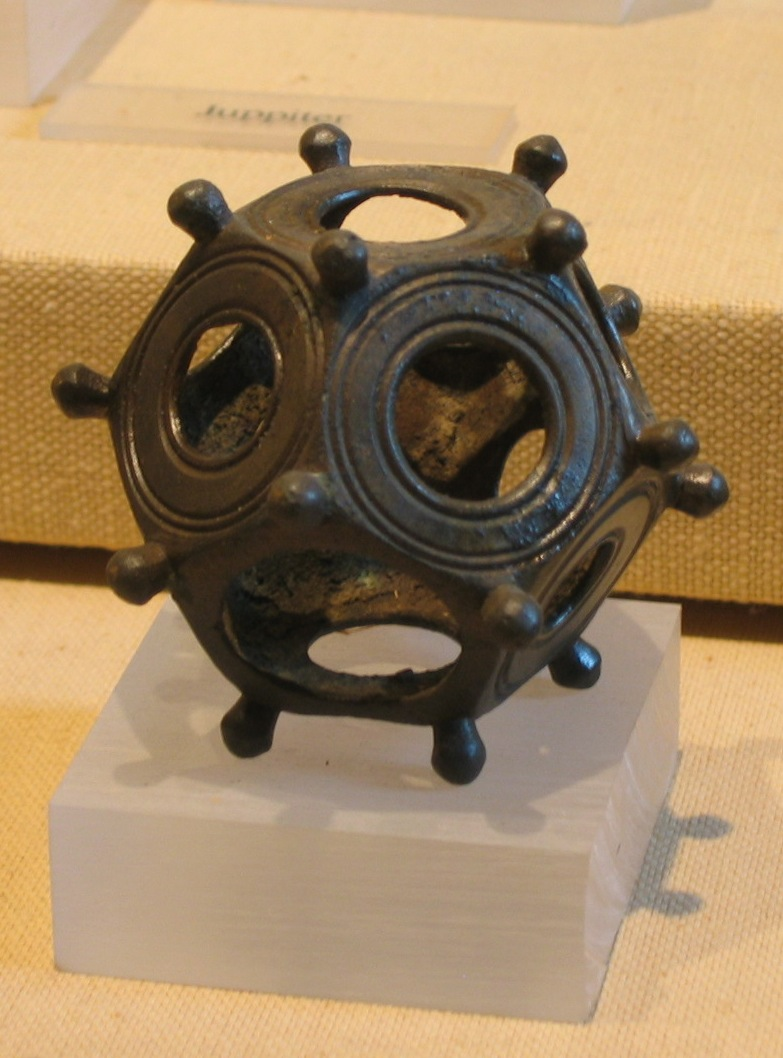
Among the more compelling recent suggestions is one that sidesteps the question of practical function entirely. Some researchers have argued that the dodecahedrons may have been a kind of masterpiece: a demonstration piece by which a bronze caster proved his technical ability and earned status within his craft.
The argument is grounded in the objects themselves. Making one of these is difficult work. The geometry is unforgiving, requiring twelve identical pentagonal faces to meet precisely, with a hollow interior, varied apertures, and twenty applied knobs. One recently studied example was cast in a leaden, sticky alloy that was awkward to mold and fragile in texture, meaning the maker was working against his material rather than with it. As the archaeology group that recovered it observed, an enormous amount of time, energy, and skill went into producing the object, which argues strongly against a mundane everyday purpose. Supporting this reading is a curious detail: many dodecahedrons show little or no sign of wear. Objects that are used regularly get scratched, worn, dented, and repaired. These often look as though they were made, admired, and put away. On this view, the technical function is beside the point; the object exists to show what its maker could do. It is an elegant theory, and, like all the others, entirely unproven.
Why We May Never Know
It is worth sitting with the possibility that this puzzle has no solution waiting to be found. Some researchers think the objects may have served multiple purposes, or that their meaning shifted over time and place, or simply that whatever they were for was so ordinary and well understood by contemporaries that nobody ever thought to write it down. That last possibility is perhaps the most poignant: things that everyone knows are exactly the things that go unrecorded.
What is certain is that these objects continue to fascinate specialists and amateurs alike, and continue to turn up. They sit in dozens of museums across Europe, often accompanied by explanatory labels that are conspicuously vague, because there is nothing definite to say. New finds reignite the debate every few years, generating fresh rounds of theorizing without moving much closer to an answer.
There is something appealing about a mystery this pure. It requires no lost civilization, no conspiracy, no exotic technology, just a well-made object from a well-documented empire, sitting in a display case, steadily refusing to explain itself. Nearly three centuries after that first find in an English field, the Roman dodecahedron remains exactly what it was then: a beautifully crafted question mark from the ancient world, holding onto a secret that everyone who knew it took with them.
Like our content? Follow us for more.
