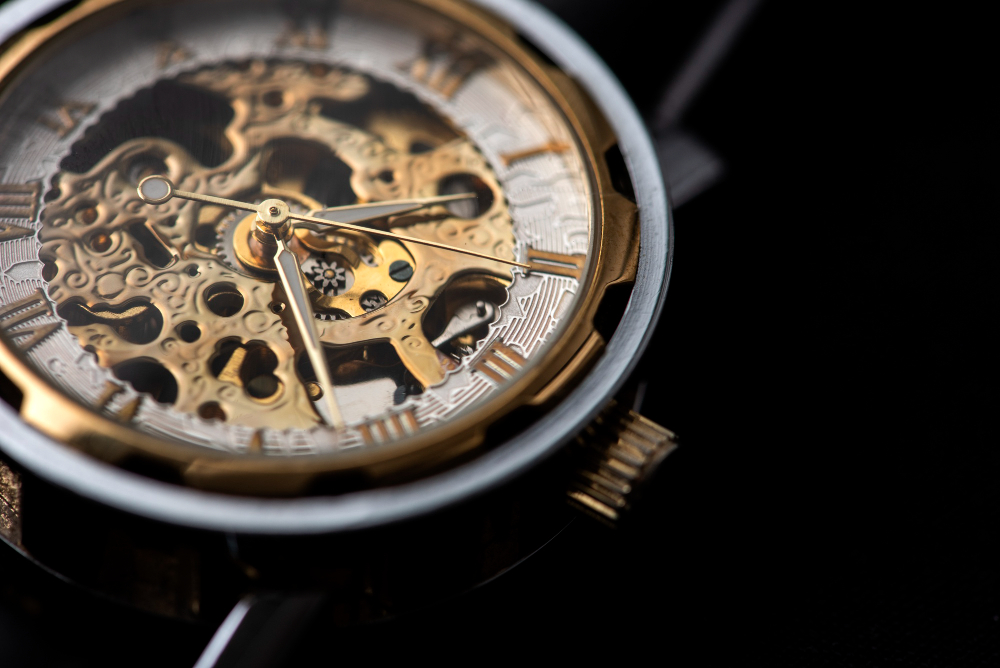
On almost every wristwatch the winding crown sits on the right-hand side of the case, at roughly the three o’clock position.
The usual assumption is that this is about the hand wearing the watch. It is the opposite: the crown is positioned for the other hand, the one that has to operate it, and everything about the convention follows from which wrist most people use.
The Chain of Reasoning Is Short and Entirely Practical
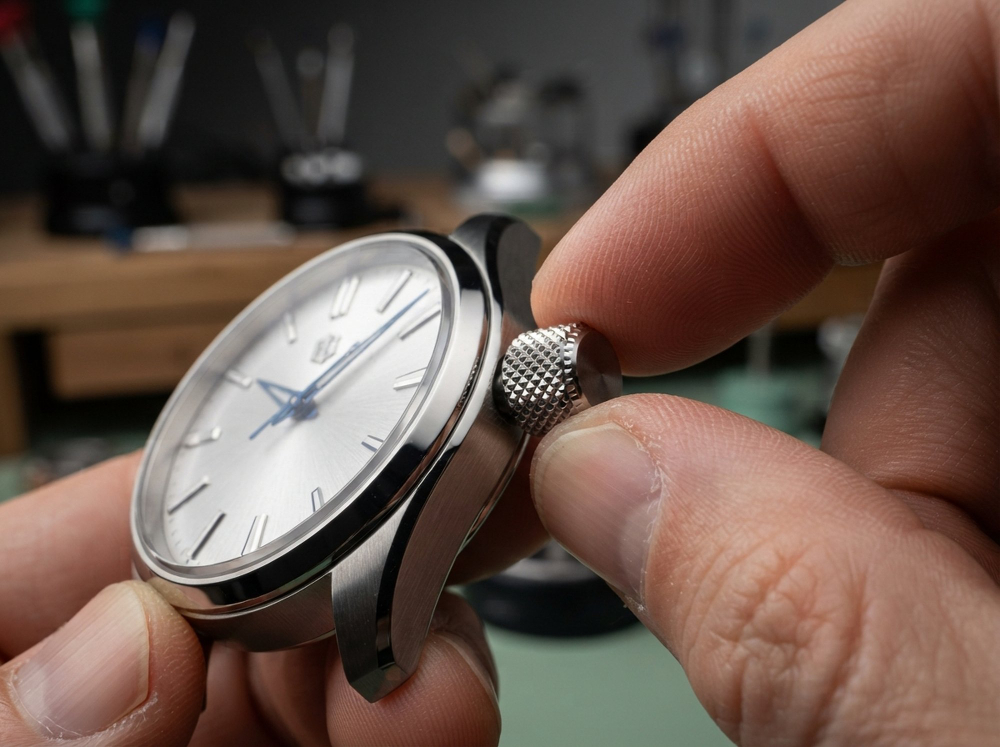
Most people are right-handed. A right-handed person wears a watch on the left wrist, because the dominant hand is the one doing things and a watch on it is in the way, gets knocked, and is harder to read while the hand is occupied.
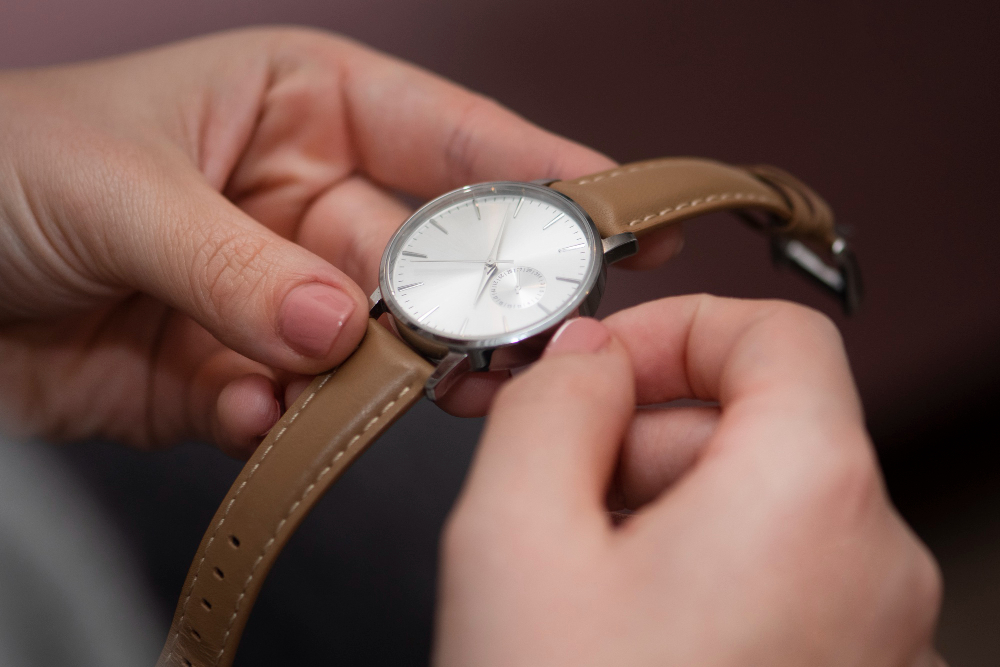
With the watch on the left wrist, the hand available to operate it is the right. The crown therefore has to be where the right hand can reach it comfortably, which is the side of the case nearest the hand – the right side as you look at the dial.
That is the whole explanation. It is not about the dominant hand wearing anything. It is about which free hand is going to perform a small fiddly operation on a small object, and the geometry of reaching across.
The test confirms it. Watches made for left-wrist wear by people who want the crown out of the way have it on the left instead, and watches made for right-wrist wear – which left-handed people frequently prefer – are produced with the crown on the left for exactly the same reason reversed.
Like our content? Follow us for more.
The Crown Was Not Always There
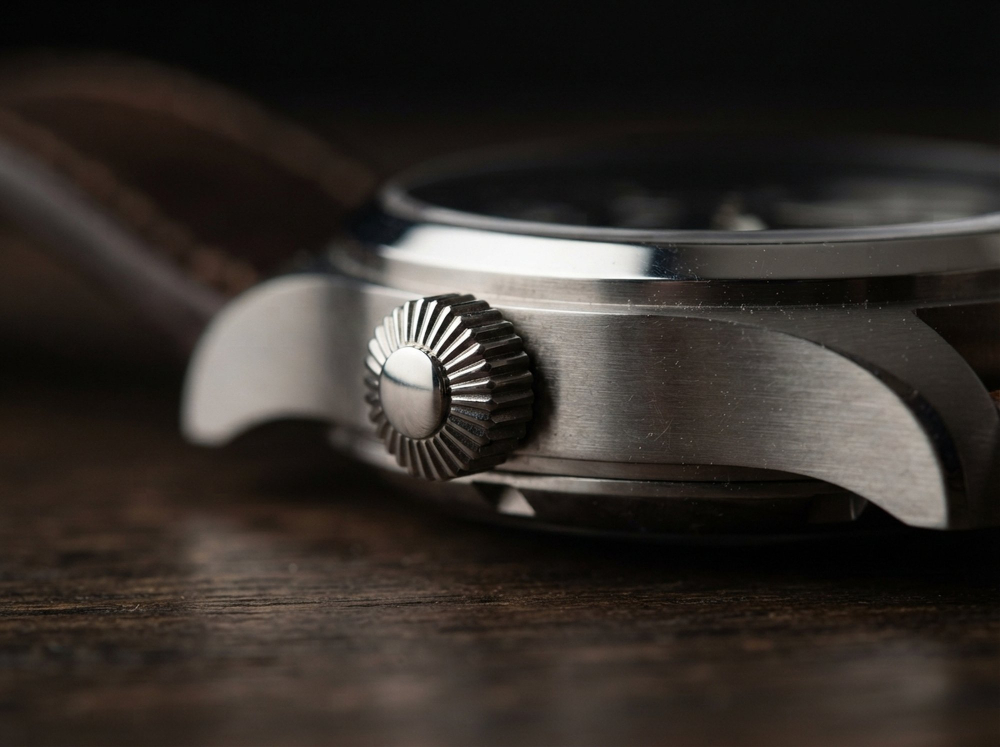
The position is a consequence of a bigger change, which is that the crown exists at all.
Earlier watches were wound with a separate key, inserted into a hole in the case or the dial and turned. The key was a separate object that had to be carried, that got lost, and whose hole was a route for dust into the movement.
Keyless winding, operated by a crown built into the case, removed the separate object and sealed the opening considerably better. It is one of those improvements that looks minor and changes the practical experience of owning the thing completely – a watch you can wind without needing anything else is a different object from one you cannot.
Once the crown existed as a permanent fixture on the case, its position became a question, and the answer was decided by wrist and handedness rather than by anything mechanical. The movement does not care which side the stem enters from.
Why It Pulls Out in Stages
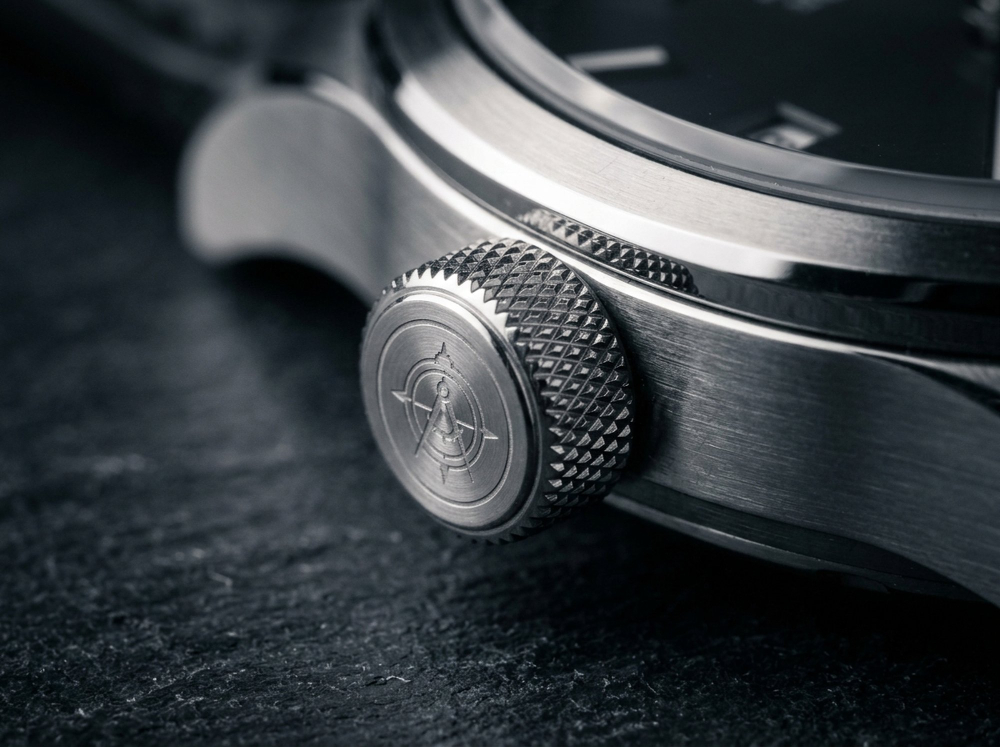
The crown usually does more than one job, and the staged positions are a neat piece of mechanical design.
Pushed fully in, turning it winds the mainspring. Pulled out one click, turning it usually sets the date or performs a secondary function. Pulled out fully, turning it moves the hands.
Inside, a single stem engages different parts of the train depending on how far out it is, operated by a sliding pinion and a lever arrangement that shifts the engagement. One control, one axis of movement, three functions, selected by position and all operated by the same turning action.
On many mechanical watches pulling the crown fully out also stops the movement, so the watch can be set precisely against a time signal and started at a chosen moment. That feature exists because somebody wanted watches to be synchronised to the second, and it survives in watches that will never be used for anything of the kind.
It is also the quickest way to tell something about a movement without opening it. Pull the crown fully out and watch the second hand. If it stops dead, the movement has a hacking mechanism, which was originally specified for military and technical use and is now simply expected. If it carries on sweeping, it does not – which is not a fault, and is how an enormous number of perfectly good watches have always worked.
The Position Has Real Costs and Some Watches Moved It
Three o’clock is the conventional answer and it is not a perfect one, which is why alternatives exist.
A crown at three o’clock sits exactly where the back of the hand meets the wrist when the wrist is bent backwards. Anybody who has worn a watch with a large crown while doing press-ups, carrying something heavy against the body, or simply typing with the wrist flexed has felt it dig in. On a thick watch with a prominent screw-down crown the effect is genuinely uncomfortable.
The responses are varied. Some watches move the crown to four o’clock, lower down the case, which keeps it reachable and clear of the wrist bone. Some tuck it between protective shoulders cast into the case, which is where the familiar guarded look on sports watches comes from – those are not styling, they are there to stop the crown being knocked and to keep it off the hand.
A smaller number move it to nine o’clock, on the left of the case, which is either a watch intended for the right wrist or a deliberate choice to keep the right side of the case completely clear.
And a few put it on the back of the case entirely, operated through the caseback, which solves the comfort problem and creates a worse one, because the watch has to come off to be set.
Each of those is a different answer to the same tension: the crown has to be reachable by a hand and out of the way of a wrist, and those two requirements point in slightly different directions.
The Dive Watch Did Something Different
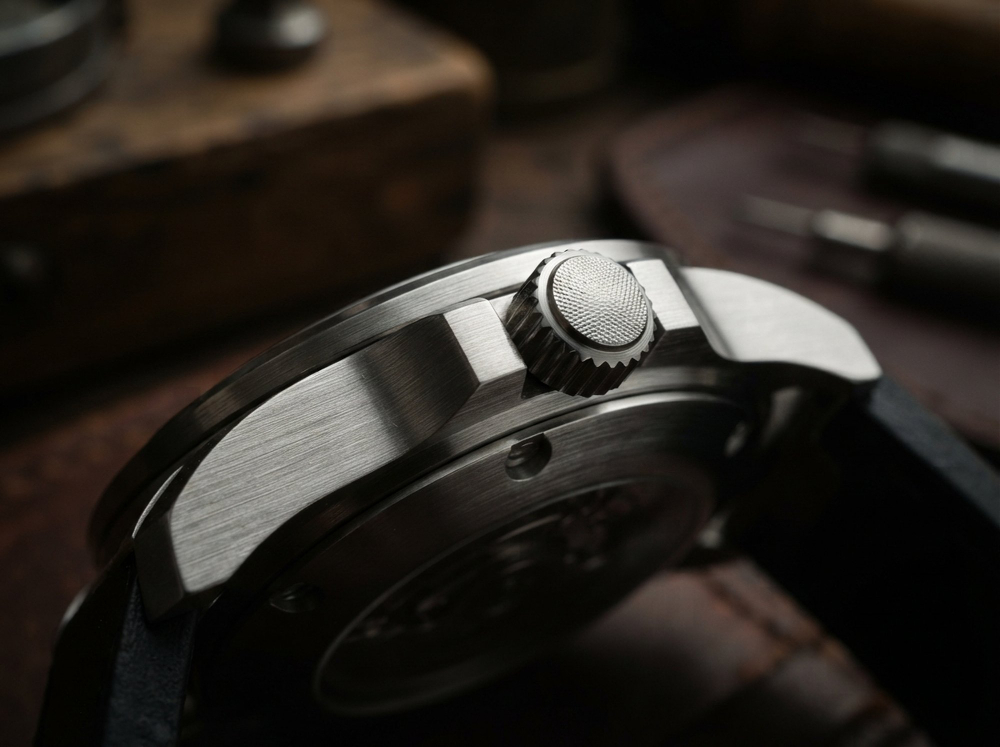
The one widespread exception to the simple crown is the screw-down version, and it exists because a crown is a hole in a watertight case.
The stem has to pass through the case wall, and that passage is sealed with gaskets. Those gaskets work, and they work better when the crown is also screwed down against a threaded collar, compressing the seal and holding the crown firmly closed rather than relying on the gaskets alone against pressure.
The consequence is a watch where the crown must be unscrewed before it can be wound or set, and screwed back afterwards – and where forgetting to screw it back is the single commonest way a water-resistant watch is ruined.
That is worth knowing on its own. Most water damage to such watches is not a failure of the watch. It is an unscrewed crown, which means the one part the owner operates is also the one part that defeats the sealing when left wrong.
The gaskets are also the component with a finite life. Rubber hardens and loses compliance over years whether the watch is worn or not, so a water-resistant rating is a statement about the watch when it was made rather than a permanent property of it. That is why the rating is routinely described as requiring periodic checking, and why it is the single most commonly misunderstood number printed on a watch.
Why Any of This Survived the Battery
A quartz watch does not need winding. A watch with no mechanical movement to wind could, in principle, dispense with the crown entirely and be set by buttons, or by nothing at all if it sets itself.
Several designs have done exactly that. The crown survived anyway, on the overwhelming majority of watches, for reasons that are partly functional and largely conventional.
Functionally it is a good control. It is operable with cold or wet fingers, it needs no power, it provides tactile feedback, it is sealed more easily than a button, and it allows precise continuous adjustment rather than stepping.
Conventionally it is simply what a watch looks like. A round case with a small knurled knob at three o’clock reads as a watch, immediately, to everybody, and removing it makes an object that is recognisably something else.
So a feature introduced to replace a winding key, positioned for the free hand of a right-handed wearer, is now present on enormous numbers of watches that need no winding, operated rarely, and retained principally because its absence would be noticed. Which is roughly the life cycle of every successful design detail: solve a problem, become standard, outlive the problem, and stay because you have become part of what the thing is.
Look at your own, if you wear one. Crown on the right, at three o’clock, where your other hand falls.
If it is somewhere else, somebody made a deliberate decision about which wrist you were going to use.
And if you are left-handed and have spent your life operating a crown awkwardly with your weaker hand because every watch in the shop was built for somebody else, that is not your imagination. The convention is not a law of nature, it is a majority preference frozen into an industry, and watches built the other way round exist and are not difficult to find once you know the term for them.
Like our content? Follow us for more.