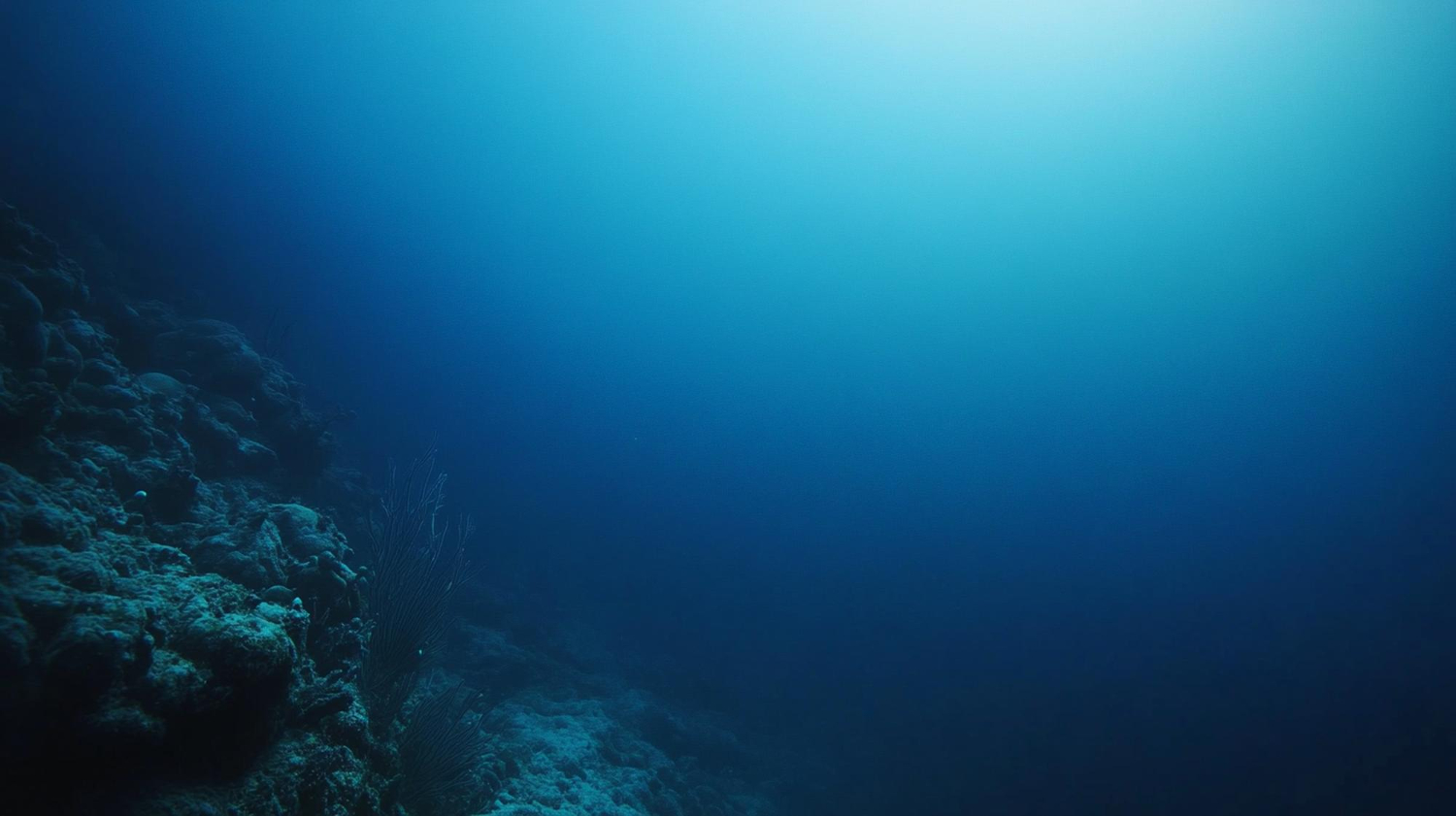
Sound behaves very differently in water than in air, and most of the differences are counterintuitive.
It travels roughly four to five times faster. It carries very much further. And, unlike light, it is not stopped by the darkness of the deep ocean, which is why sound rather than vision is the sense that matters most for animals living below the sunlit layer, and why every human technology for finding things underwater is acoustic.
The most remarkable consequence is a structure with no visible existence at all: a horizontal layer, at a depth of roughly a kilometre in temperate oceans, that functions as a waveguide. Sound entering it is prevented from leaving, and travels along it for distances that seem implausible.
Here is how a layer of water traps sound.
What Sets the Speed of Sound in Water

The channel exists because the speed of sound in seawater is not constant. It depends on three things, and they vary with depth in opposite directions.
Temperature is the strongest influence. Warmer water carries sound faster.
Pressure is the second. Higher pressure carries sound faster, and pressure increases steadily and predictably with depth.
Salinity is the third and generally the weakest in the open ocean, since it varies comparatively little.
Now consider what happens as you descend. Near the surface the water is warm, so sound is fast. Descend and the temperature falls sharply through the thermocline, so the sound speed drops. Keep descending and eventually the temperature stops falling much, because the deep ocean is uniformly cold — but the pressure keeps rising.
So there is a depth at which the temperature has finished decreasing and the pressure has not yet compensated: the point at which the speed of sound reaches its minimum. Above it, sound is faster because the water is warmer. Below it, sound is faster because the pressure is greater.
That minimum is the axis of the channel.
Like our content? Follow us for more.
Why the Minimum Traps Sound
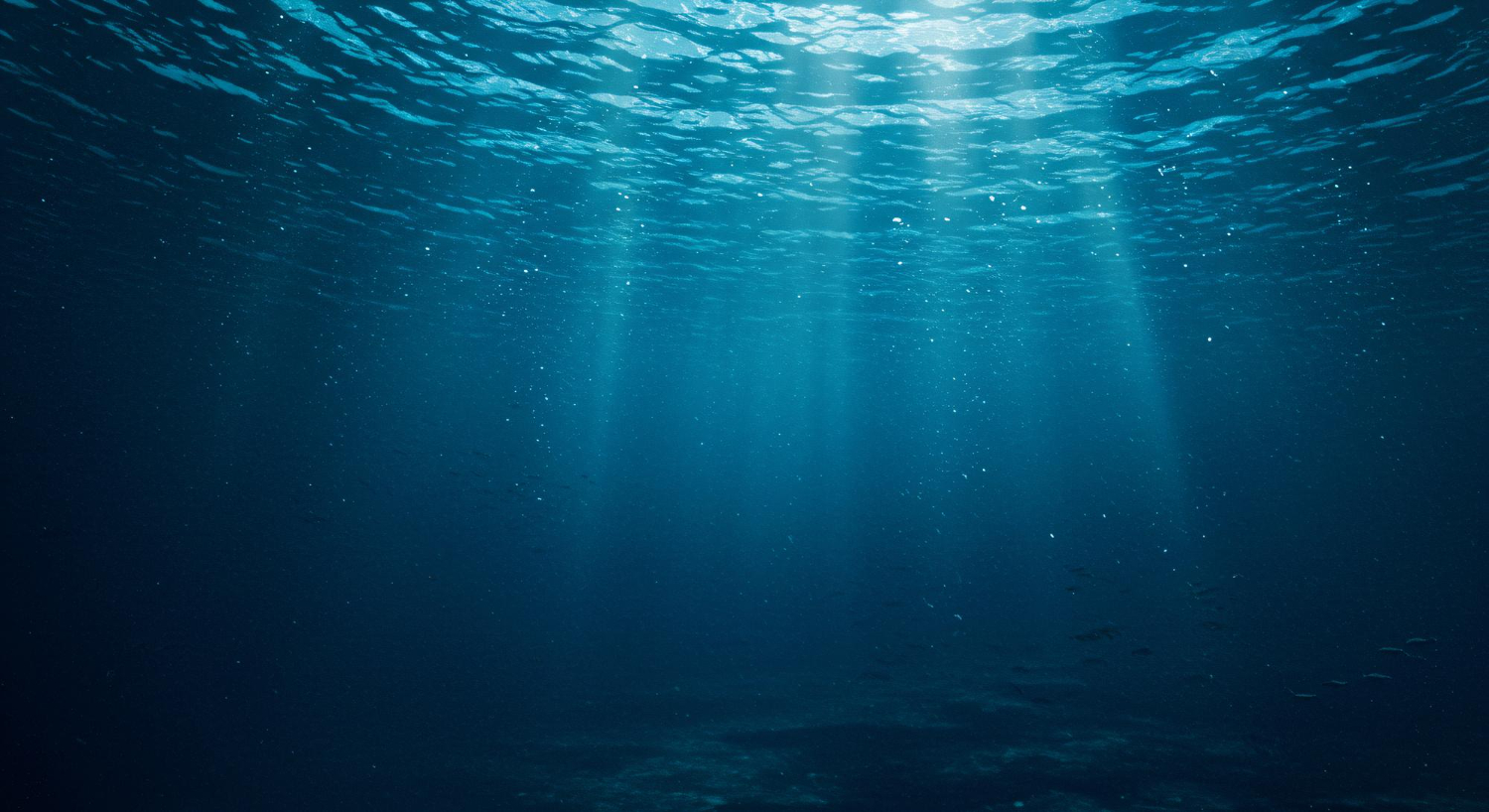
The trapping follows from a general rule about waves: sound bends toward regions where it travels more slowly.
A sound wave travelling upward from the axis enters faster water, and refraction bends it back downward. A wave travelling downward enters faster water for the opposite reason, and refraction bends it back upward.
The result is that a sound ray leaving the axis at a shallow angle oscillates about it, curving down, then up, then down again, and never leaves the layer at all.
Because it does not spread out in three dimensions and does not reach the surface or the seabed, it avoids two of the main mechanisms by which sound in the ocean is lost. Reflection off the surface scatters energy; reflection off the seabed absorbs a great deal of it. Sound in the channel encounters neither.
The consequence is that transmission loss is dramatically lower than it would be otherwise, and low-frequency sound in particular — which is absorbed least by seawater — can travel across an entire ocean basin.
The layer sits at roughly a kilometre depth in temperate waters. It rises toward the surface at high latitudes, where the surface water is already cold and the temperature gradient largely disappears, and lies deeper in the tropics where the warm surface layer is thicker.
How It Was Discovered and Used

The effect was identified during the middle of the twentieth century, and the practical applications followed immediately.
The first was a distress system. A small explosive charge detonated at the correct depth by someone in the water could be detected at listening stations very far away, and the arrival times at multiple stations allowed the position to be calculated by triangulation. That application gave the channel its acronym.
Listening arrays were subsequently established to monitor the channel over very long ranges, and the same physics underlies a great deal of underwater acoustic detection.
There is a scientific application that is elegantly simple. Because sound travels at a speed that depends on temperature, timing how long a signal takes to cross an ocean basin gives an extremely sensitive measurement of the average temperature along that path — a single number integrating an entire crossing, which is difficult to obtain any other way.
The channel is also used to detect and locate distant seismic events and other underwater sounds, since anything sufficiently loud within or near the layer becomes audible over an enormous area.
There is a related structure worth mentioning, because it explains a phenomenon divers and sailors notice.
Under some conditions a second, shallower sound channel forms near the surface, where a layer of well-mixed water sits above cooler water below. Sound entering that surface layer can be trapped in it in the same way, travelling further along the surface than expected.
The opposite also occurs. Where the temperature structure bends sound downward away from a listener, regions form in which a source is effectively inaudible despite being close – acoustic shadow zones, which are precisely what anyone trying to avoid detection would like to occupy.
So the ocean is not acoustically uniform in any direction. It is layered, and the layering changes with season, latitude, weather and depth, which means the same sound source can be detectable at enormous range on one day and inaudible a few miles away on another.
What Uses It Naturally

The obvious question is whether animals exploit this, and the honest answer requires care.
Large baleen whales produce extremely low-frequency calls, at frequencies well suited to long-distance propagation, and they spend time at depths where the channel exists. The suggestion that these calls travel across ocean basins through the channel has been made for a long time and appears widely in popular accounts.
The evidence is more qualified than the popular version implies. The physics is not in doubt — low-frequency sound in the channel does travel very long distances. What is harder to establish is how far individual whale calls are actually detected in practice, whether the animals are deliberately using the channel, and whether long-range communication is the function of the calls at all.
Estimates of detection range vary substantially, and researchers have been appropriately cautious about the strongest claims. It is fair to say that whale calls are well matched to long-distance propagation and that the channel can carry them a very long way; it is not established that whales are conducting basin-scale conversations.
The distinction matters because the confident version circulates far more widely than the evidence supports.
Why Sound Beats Light Underwater
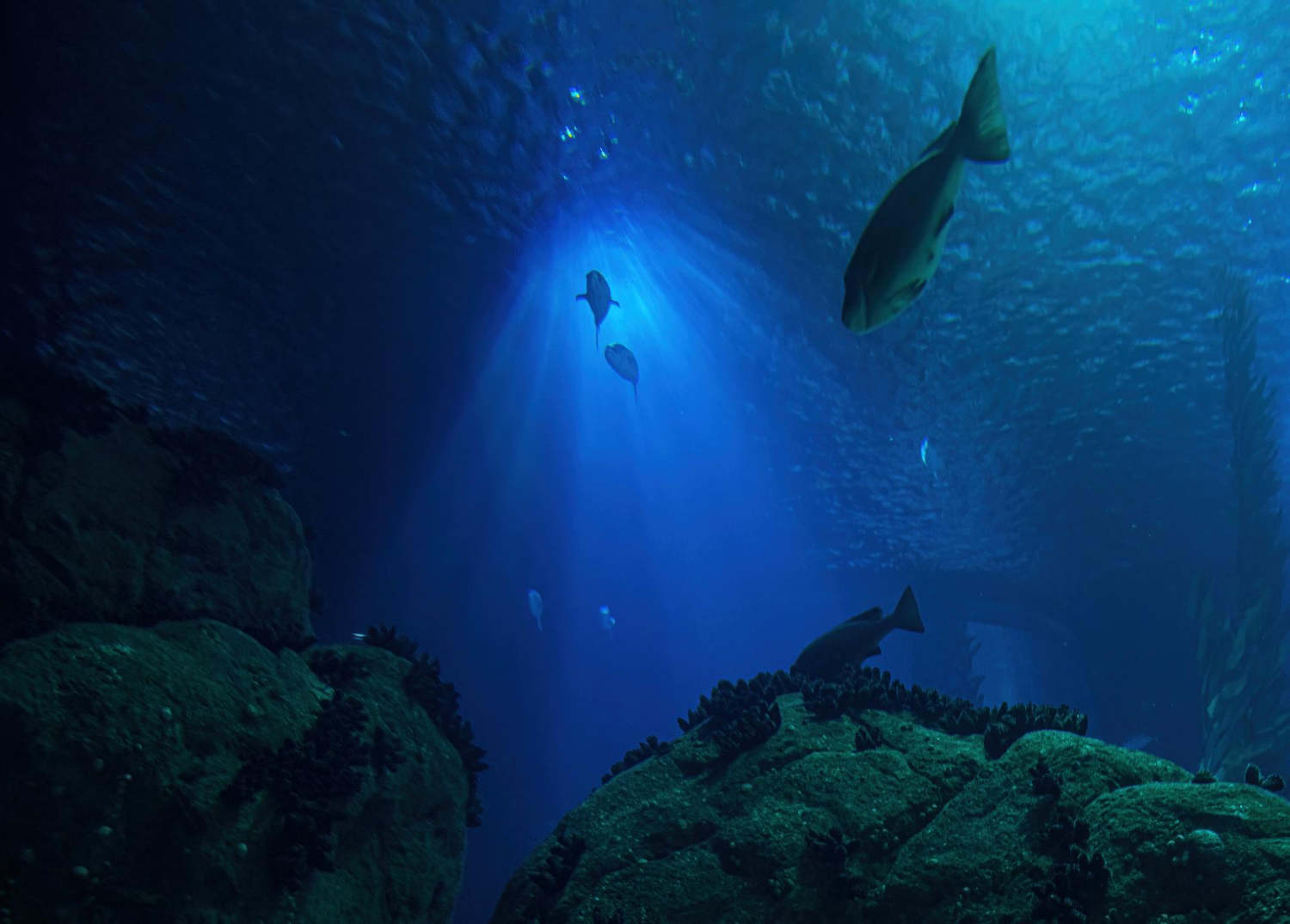
The comparison with light is worth making explicitly, because the difference in scale is what makes the ocean acoustically strange.
Seawater absorbs light strongly and unevenly. Red wavelengths are gone within a few metres, and even the blue-green light that penetrates furthest is essentially exhausted within a couple of hundred metres in clear water. Below that there is nothing but whatever organisms produce themselves.
Sound behaves entirely differently. Absorption in seawater is low, and crucially it depends heavily on frequency — high frequencies are absorbed over relatively short distances while very low frequencies are barely attenuated at all.
That frequency dependence has a practical consequence that shapes every acoustic system in the ocean. High frequencies give fine detail and short range; low frequencies give poor detail and enormous range. You can see a small object nearby or detect a large event very far away, and not both with the same signal.
Every animal and every technology in the ocean sits somewhere on that trade-off. Echolocating animals hunting small prey use high frequencies and accept short range. Large whales producing very low calls sit at the other end. Systems designed to detect distant events use low frequencies for the same reason.
The channel amplifies the advantage at the low-frequency end, because sound that is barely absorbed and also prevented from spreading or reflecting is losing energy by almost no mechanism at all.
Sound as the Ocean’s Light
The broader point is about what perception is like in an environment where vision fails.
Below the sunlit layer, light is essentially absent, and seawater absorbs it strongly in any case. Sound has the opposite properties: it travels far, it travels fast, and it is barely attenuated at low frequencies.
So the sensory world of the deep ocean is acoustic in a way that is difficult to imagine from land. Distance, direction, size and material can all be inferred from sound, and animals that hunt in darkness do so by listening or by producing their own sound and interpreting the returns.
Human technology followed exactly the same logic. Every method of finding things underwater — locating the seabed, mapping structures, detecting vessels, surveying geology beneath the seafloor — is acoustic, because nothing else propagates usefully.
The channel is the extreme case of that principle. A layer of water with no boundary, no surface and no visible existence, which nonetheless behaves like a pipe, carrying sound halfway around a basin because the speed of sound happens to have a minimum at a particular depth.
Nothing built it and nothing maintains it. It is a consequence of temperature falling faster than pressure rises, in the top kilometre of an ocean — and the result is that the sea has a channel running through it that only sound can use.
Like our content? Follow us for more.