

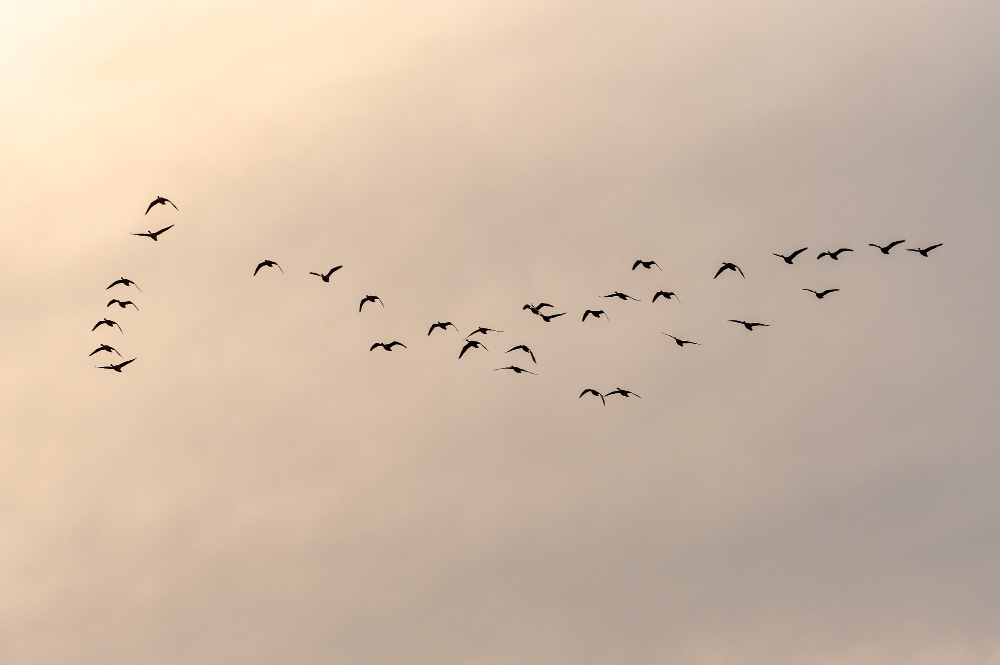
There is a strong intuition that coordinated group movement requires coordination — something issuing instructions, or at minimum some shared signal that everybody is responding to.
That intuition is wrong, and the demonstration that it is wrong is one of the more satisfying results in the study of collective behaviour.
A flock turning together looks like an organised response. Analysis of high-speed footage, tracking individual birds within a flock, shows something different: each bird is adjusting to a handful of neighbours, continuously, according to rules that involve no information about the flock as a whole.
The group-level pattern is a consequence of the individual-level rules rather than a thing anybody is producing.
The Three Rules
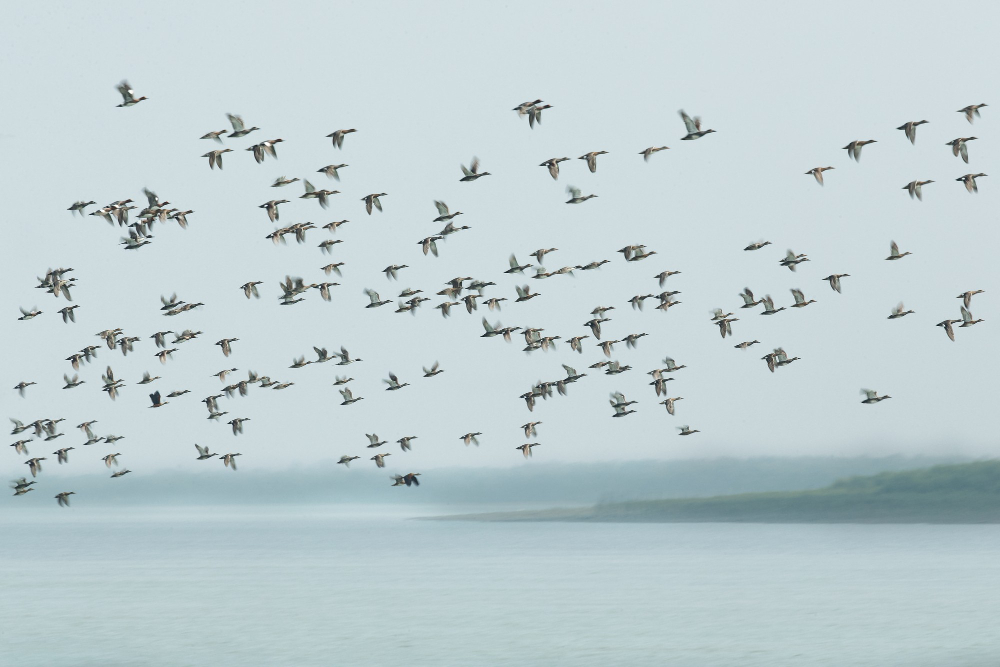
The model that reproduces this behaviour is remarkably simple, and simulations using it generate movement that looks convincingly like the real thing.
The first rule is separation: do not collide, move away from anything too close.
The second is alignment: match the direction and speed of your immediate neighbours.
The third is cohesion: move toward the average position of your neighbours, so the group does not disperse.
That is the whole model. No leader, no plan, no information about where the flock is going or what shape it has.
Applying those rules to a few hundred simulated individuals produces flocking, turning, splitting around obstacles and recombining — behaviour that was not programmed and emerges from the interaction.
The correspondence between the model and real flocks is close enough that the general account is widely accepted, with the details of how real animals implement it remaining under investigation.
Like our content? Follow us for more.
How Many Neighbours
One finding refines the model in an important way.
The obvious assumption is that each bird responds to everything within a certain distance. Analysis of real flocks indicates something different: birds respond to a fixed number of nearest neighbours, roughly six or seven, regardless of how far away they are.
That distinction matters enormously. A distance-based rule breaks down when the flock changes density, because a bird in a sparse region would have no neighbours to follow and a bird in a dense region would be overwhelmed.
A count-based rule is robust to density changes. Whether the flock is packed or spread out, each individual is tracking the same number of others, and the coordination holds.
That is a substantially more sophisticated arrangement than it appears, and it explains why flocks can compress and expand dramatically without falling apart.
Why the Turn Travels So Fast
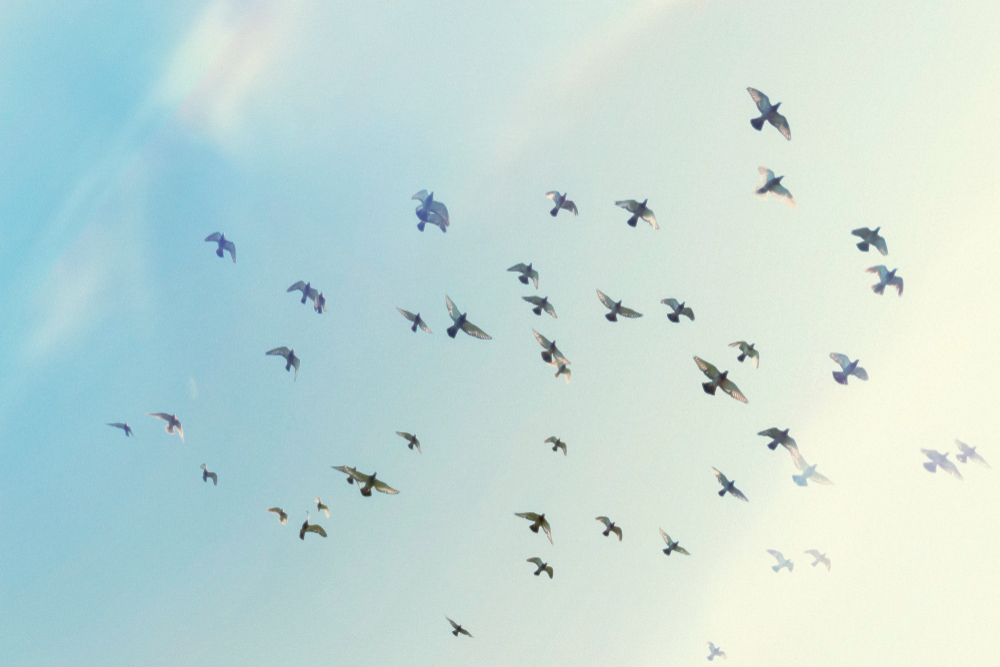
The speed of a direction change across a large flock is the most striking feature and has a specific explanation.
A change initiated by a few birds at one edge propagates across the flock faster than it could if each bird simply reacted to its neighbour reacting to its neighbour, with a delay at each step.
Analysis indicates that the turn propagates as a wave, with very little loss and very little delay, and the speed is roughly constant regardless of flock size.
The proposed explanation involves the system being in a state where it is highly sensitive to disturbance — poised near a transition, so that a small change anywhere is transmitted efficiently throughout rather than being damped out.
That property is described in physics terms rather than biological ones, and it is one of the reasons this subject attracts physicists as much as ornithologists.
The practical consequence is that a flock behaves less like a collection of individuals and more like a material with particular properties, which is a truly useful way of modelling it.
There is a cost worth stating alongside the benefits. Flocking concentrates a large number of individuals in one place, which makes them conspicuous, increases competition for food and facilitates the transmission of anything contagious.
A behaviour that persists despite those costs is presumably delivering something substantial, which is the same reasoning applied to any expensive trait.
What It Is For
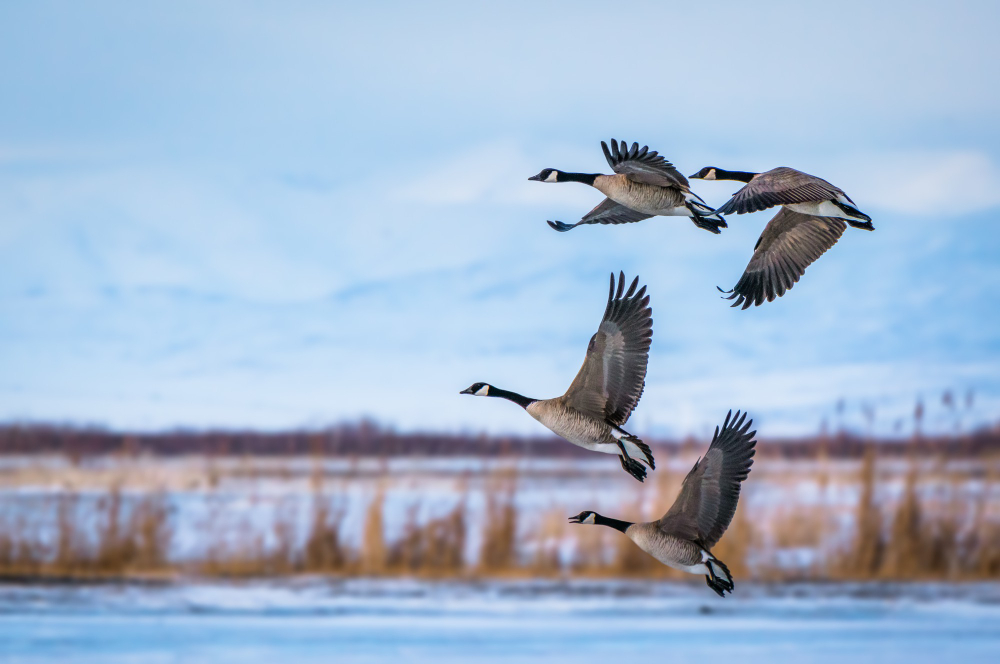
The functional question has several answers, none of which is complete.
Predator avoidance is the leading account. A large coordinated group makes it difficult to single out an individual, and the constant movement and shape change disrupts targeting — which is why the behaviour is most dramatic when a predator is present.
There is also a dilution effect, which is simply that being one of many reduces individual risk, and a detection effect, since many eyes notice a threat sooner than one.
Information sharing is a second account. Individuals that have found food, or that know a route, influence their neighbours without any explicit communication, and the group can consequently move toward resources that most members have no knowledge of.
Thermal and energetic benefits apply in some cases, particularly in formations where individuals exploit the air movement generated by others.
And roosting aggregation has social functions that are separate from the flight behaviour itself.
The honest position is that different species flock for different reasons and that the same mechanism serves several purposes.
There is a limit worth noting on how far the analogy extends. These rules describe individuals responding to immediate neighbours with no goal and no information about the whole.
Groups where individuals have intentions, memory of one another or knowledge of a destination behave differently, and applying flocking models to them produces plausible-looking results that may be describing nothing real.
The Same Rules Elsewhere
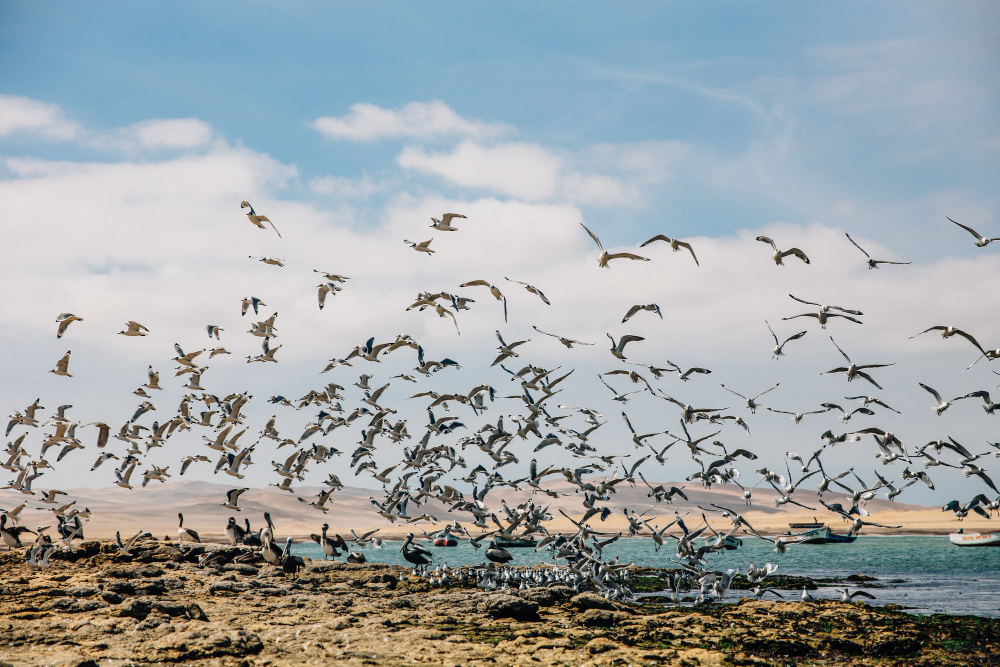
The generality is what makes this more than an ornithological curiosity.
Fish schools show comparable behaviour with comparable rules, and the shape changes and coordinated turns are structurally similar despite the medium being entirely different.
Insect swarms, herds of grazing animals and some microbial populations show related patterns.
Pedestrian crowds follow rules of the same family, and the models developed for animal groups are used in designing spaces where crowds move — which is a direct practical application of the research.
And the mathematics has been applied well beyond biology, to any system where many units interact locally and produce a global pattern.
That transferability is the substantive finding. The behaviour is not a property of birds; it is a property of systems with local interaction rules of a particular kind.
Why the Shapes Look the Way They Do
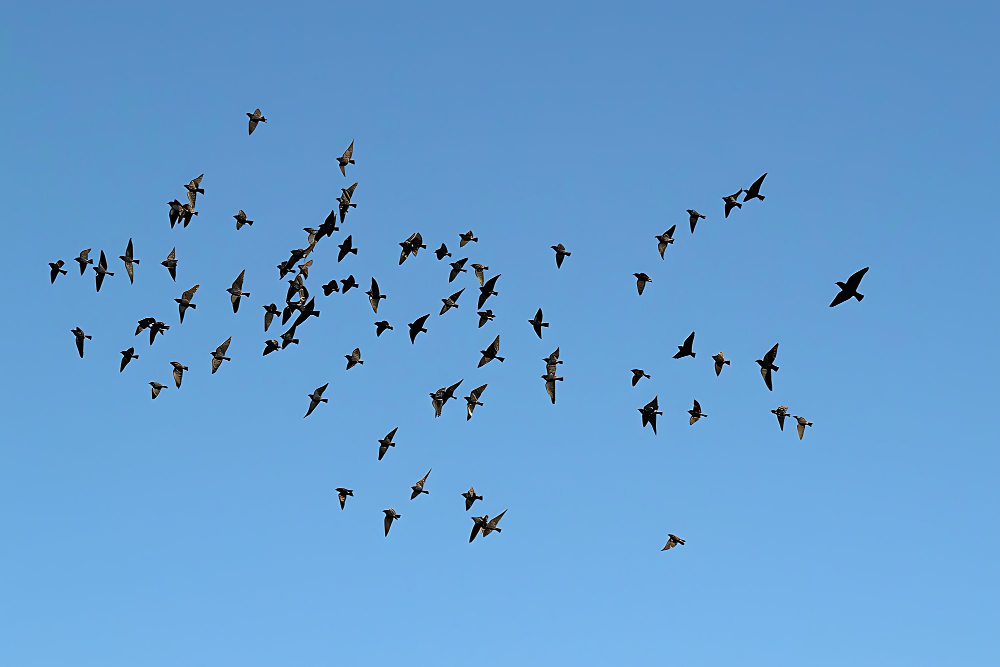
The visible patterns have specific explanations, and identifying them makes watching a flock more interesting.
The dark dense regions that appear and move through a flock are areas where birds have bunched, which happens where the flock is turning or where a threat has caused local compression.
Because the flock is a three-dimensional object viewed from one side, apparent density also changes with orientation — the same spacing looks dense when you are looking along a layer and sparse when looking across it, which produces dramatic apparent changes from nothing but rotation.
Splitting around a predator and closing behind it is a direct consequence of the separation rule operating on a fast-moving object, requiring no coordinated evasive decision.
Waves travelling across a flock as a visible band of darkness are the propagating turn, with birds banking in sequence and presenting a different profile as they do.
And the overall shape tends toward a ball when threatened and a sheet when travelling, because cohesion dominates under threat and alignment dominates in transit.
None of that requires anybody to have decided anything. The shapes are consequences of a small number of local rules being applied by a large number of individuals in a three-dimensional space, and the apparent choreography is an artefact of watching it from outside.
What This Changes
The conceptual point is worth stating because it recurs across several fields.
An impressive coordinated outcome does not require a coordinator. A pattern at the level of a group can arise entirely from rules operating at the level of individuals who have no information about the pattern and no intention of producing it.
That is counterintuitive, because the human tendency when observing organised behaviour is to look for the organising agency.
It also has a limitation worth stating. Demonstrating that simple rules can produce a pattern does not establish that those are the rules the animals are using, and the match between model and observation is evidence rather than proof.
What is established is that no leader is required, that individuals track a small fixed number of neighbours, and that the resulting system transmits information across itself with remarkable efficiency.
Which means a flock of thousands turning as one — among the more impressive things visible in an ordinary sky — is thousands of birds each watching about six others and doing nothing more complicated than that.
And the coordination everybody attributes to the group is not located anywhere inside it. No individual bird has access to any version of the flock, which means the thing you are watching exists only from outside it.
That is an unusual property for something so obviously real. The flock has a shape, a size and a direction, and none of those exist anywhere except in the eye of somebody standing on the ground.
Like our content? Follow us for more.
