Almost everything alive on the surface of this planet runs, ultimately, on sunlight. Plants capture light and turn it into sugar. Animals eat the plants. Other animals eat those animals. Pull the sun out of that equation and nearly every food chain we know collapses within a season. For most of scientific history, this was treated as a basic rule of biology: life needs the sun, if not directly then a few steps removed.
Then, in 1986, workers in southeastern Romania were drilling exploratory boreholes near the Black Sea coast, scouting ground for a proposed power plant. What they found instead was a hole leading down into a cave system that had been sealed off from the outside world for something on the order of five and a half million years, since long before our species existed. The air inside was toxic. There was no light, and there never had been. By every expectation, it should have been an empty stone tomb. Instead, researchers who descended into it found a thriving, complex, interconnected community of living creatures, dozens of species that exist nowhere else on Earth, surviving in permanent darkness on an energy source that has nothing to do with the sun. Here is the story of Movile Cave, the sealed world beneath Romania.
An Accidental Doorway
The discovery was pure chance. In the mid-1980s, crews working near the port city of Mangalia, on Romania’s Black Sea coast, were drilling test holes to evaluate the ground for construction. The landscape above gives away nothing: scrubby, dusty farmland, flat and unremarkable, with no dramatic sinkhole or cave mouth to suggest that anything unusual lies beneath. Nobody had any reason to think there was a hidden world under their feet.
But the drilling broke through into a void, and that void turned out to be the entrance to a maze-like network of flooded limestone passages roughly eighteen meters, or about sixty feet, below the surface. Sealed above by thick layers of clay and limestone, the cave had no meaningful connection to the surface world. Rainwater did not seep in. Surface air did not circulate down. The system had been effectively closed since the late Miocene epoch, when the geology of the region shifted and shut the door. When scientists began exploring and studying it, they realized very quickly that this was not an ordinary cave. It was something far rarer: a sealed environment that had been running its own biological experiment, undisturbed, for millions of years, and had been opened by accident.
Like our content? Follow us for more.
Proving It Was Really Sealed
An obvious question hangs over any claim like this. How can anyone be confident that a cave was truly cut off, that nothing had been trickling in from the surface across all that time? Caves leak. Water finds its way through rock. The assertion that this system had been isolated for millions of years is an extraordinary one, and it needed extraordinary support.
Researchers found an elegant way to test it, and the timing was almost too convenient. The Chernobyl reactor accident occurred in 1986, the same year the cave was discovered, and it spread detectable radioactive isotopes across large areas of Europe, including Romanian soil. Those isotopes became a kind of chemical timestamp on surface water. So scientists tested the water inside the cave for the telltale radioactive signatures of that fallout, and found none of it. Not a trace. Whatever water was down in the cave had not come from the surface, not recently and apparently not for a very long time. It was a striking confirmation that the seal was real: one of the most widely dispersed contamination events in modern history had not penetrated a single drop into this underground world. Combined with the geology and the peculiar chemistry of the cave’s water and air, the evidence pointed to a system that had been closed off since roughly five and a half million years ago.
The Air That Would Not Sustain Us
Movile Cave is not a place a person can casually visit, and not only because access is tightly restricted and permitted only for approved researchers. The environment inside is deeply hostile to human physiology. The atmosphere in the deeper parts of the system bears very little resemblance to the air at the surface.
Oxygen levels run at roughly half of what our lungs expect. Carbon dioxide is present at concentrations enormously higher than in the outside atmosphere. The air is laced with hydrogen sulfide, the compound responsible for the smell of rotten eggs, and with methane and ammonia. The water in the cave’s pools is warm, murky, low in oxygen, and thick with dissolved chemicals. Researchers who have worked there describe an atmosphere that is acrid and pungent, an environment humans can tolerate only briefly and only with careful precautions. Everything about it reads as inhospitable, the sort of chemistry that appears on a list of reasons a place should be lifeless. And yet those same chemicals turn out to be precisely the reason the cave is not lifeless at all. What makes the air unbreathable for us is the fuel that keeps everything down there alive.
A Food Chain Built on Chemistry
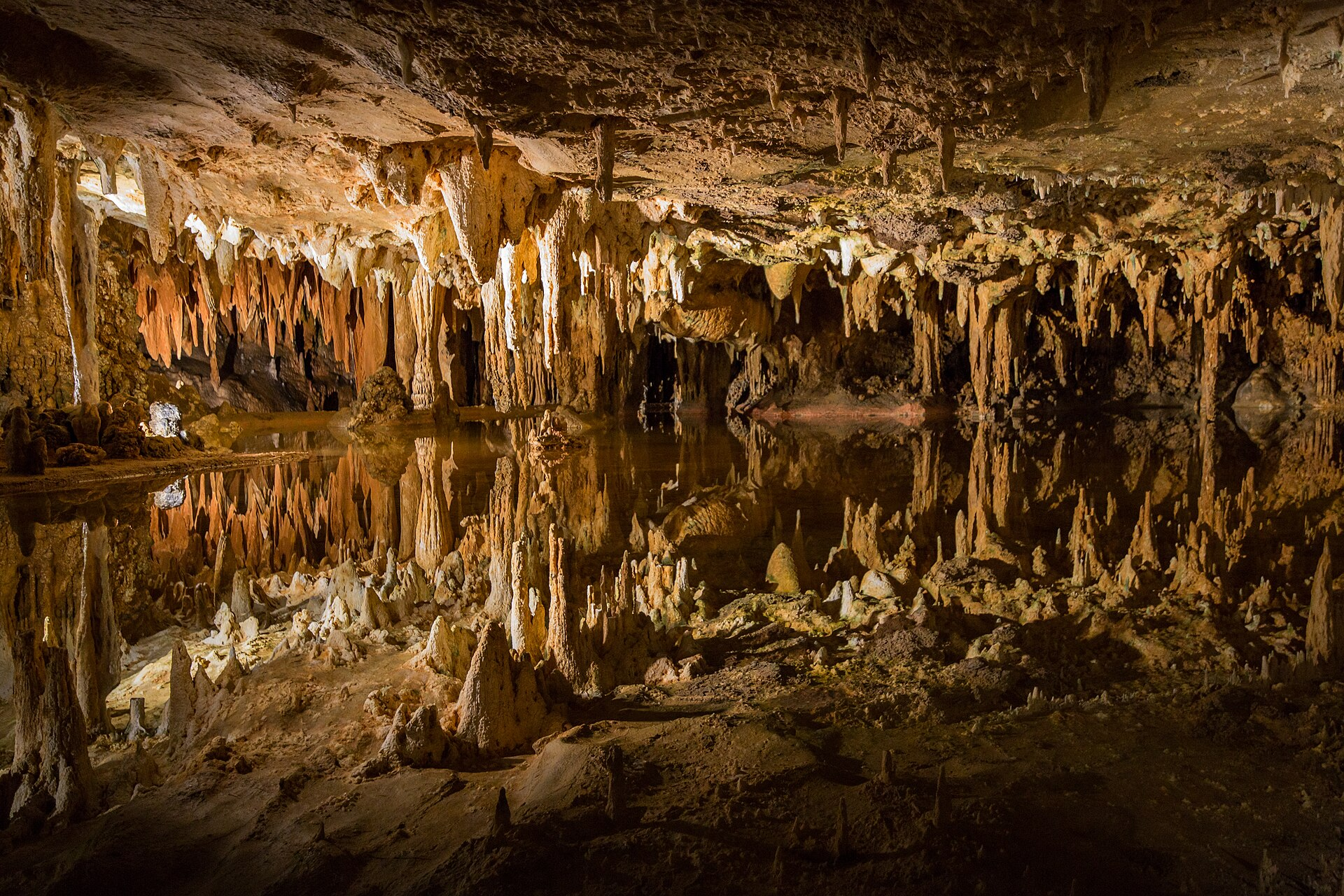
The key to Movile Cave is a process called chemosynthesis. Instead of bacteria and plants harvesting energy from light, the microbes at the base of this ecosystem pull energy from chemical reactions, oxidizing compounds like sulfide, methane, and ammonium to build the organic material that everything else depends on. These bacteria form pale, slimy microbial mats that float on the surface of the water and coat the cave walls near the pools. Those mats are the pasture of this underground world.
From there, the food web assembles itself much as it would anywhere else, just without a single photon involved. Small creatures graze the microbial mats. Larger creatures eat the grazers. Predators sit at the top. The whole structure, from the bottom up, is powered by chemistry drawn out of rock and water rather than by sunlight falling on leaves. What made this so significant scientifically is that when Movile was studied, ecosystems running independently of the sun were known essentially from one place: the deep-sea hydrothermal vents discovered on mid-ocean ridges in the late 1970s. Movile added a second, radically different example, a freshwater, land-based version sealed inside continental limestone rather than perched on the ocean floor. It was, as researchers have described it, the first such subterranean ecosystem ever found, and it forced textbook diagrams of how life on Earth is powered to be redrawn.
The Creatures in the Dark
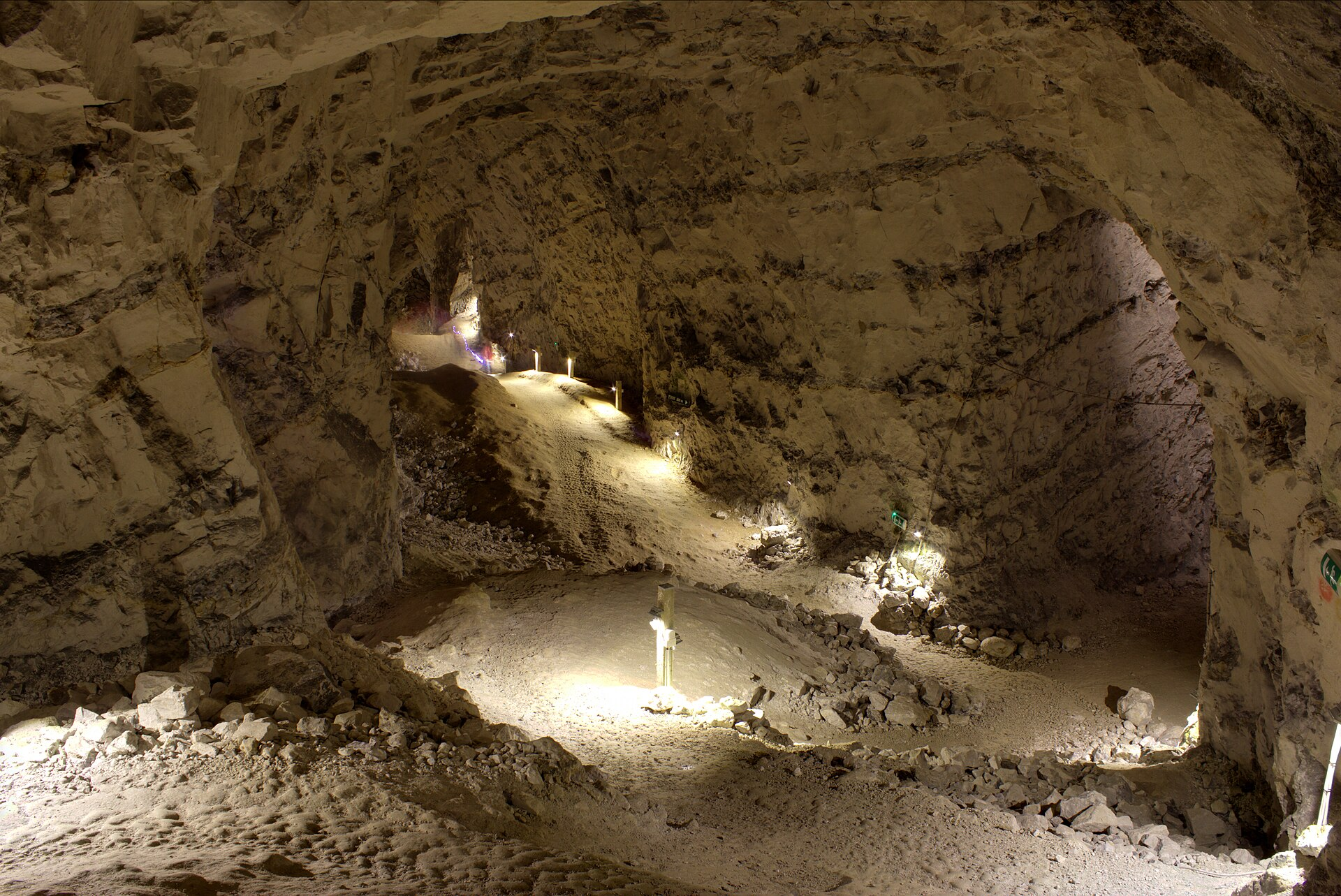
The inhabitants of Movile Cave read like the cast of a science fiction story. Surveys have identified somewhere around fifty invertebrate species living in the system, and the striking figure is how many of them exist nowhere else: depending on the survey and the year, roughly thirty-three to thirty-seven of them are endemic, found only in this one cave. They have been evolving in isolation, in the dark, for millions of years, and it shows.
The roster includes spiders, pseudoscorpions, woodlice, centipedes, leeches, snails, water scorpions, and a range of smaller organisms whose classification researchers are still working out. Certain features recur again and again across otherwise unrelated creatures. Most of them are blind, many having lost functional eyes entirely, because eyes are an expensive organ to maintain and useless in a place that has never had light. Most of them are also unpigmented, pale or translucent, since coloration serves little purpose where nothing can be seen. A water scorpion has abandoned eyes altogether. A blind leech swims in water no sunbeam has ever touched. A centipede with serrated hind legs was nicknamed the king of the cave by the scientists who described it. Each of these species is a small demonstration of what evolution does when you remove light from the equation and leave the process running for a few million years.
Why This Cave Matters
Beyond the sheer strangeness of it, Movile Cave has become important to science in its own right, and its significance reaches well past Romania. The cave functions as a natural laboratory for studying how life copes with extreme conditions, and researchers have used it to explore questions ranging from evolutionary biology to microbiology to the chemistry of how organisms process toxic compounds.
Its most intriguing role may be in the search for life elsewhere. An ecosystem that thrives in permanent darkness, in a chemically harsh environment, powered entirely by reactions in rock and water, is a reasonable model for what life might look like beneath the ice of certain moons in our own solar system, or below the surface of Mars. If life exists in such places, it will not be sunbathing; it will be doing something much closer to what the microbes of Movile do. That makes this cave one of the better analogs available for thinking about biology beyond Earth, and it has attracted research interest on exactly those grounds. Access to the cave remains strictly limited, which is entirely appropriate: this is a fragile system that survived untouched for millions of years and could be disrupted easily by careless visitation.
There is something humbling in the whole affair. A crew drilling a routine borehole in an unremarkable field opened a door onto a world that had been sealed since before our species existed, and inside was a complete, functioning community of life that broke one of biology’s assumed rules. It is a reminder that the planet is not finished revealing itself, that discoveries of real consequence can still turn up under a dusty patch of farmland, and that life is substantially more inventive about where and how it survives than we tend to assume. Somewhere beneath the Romanian countryside, in absolute darkness, that ancient experiment is still running.
Like our content? Follow us for more.