

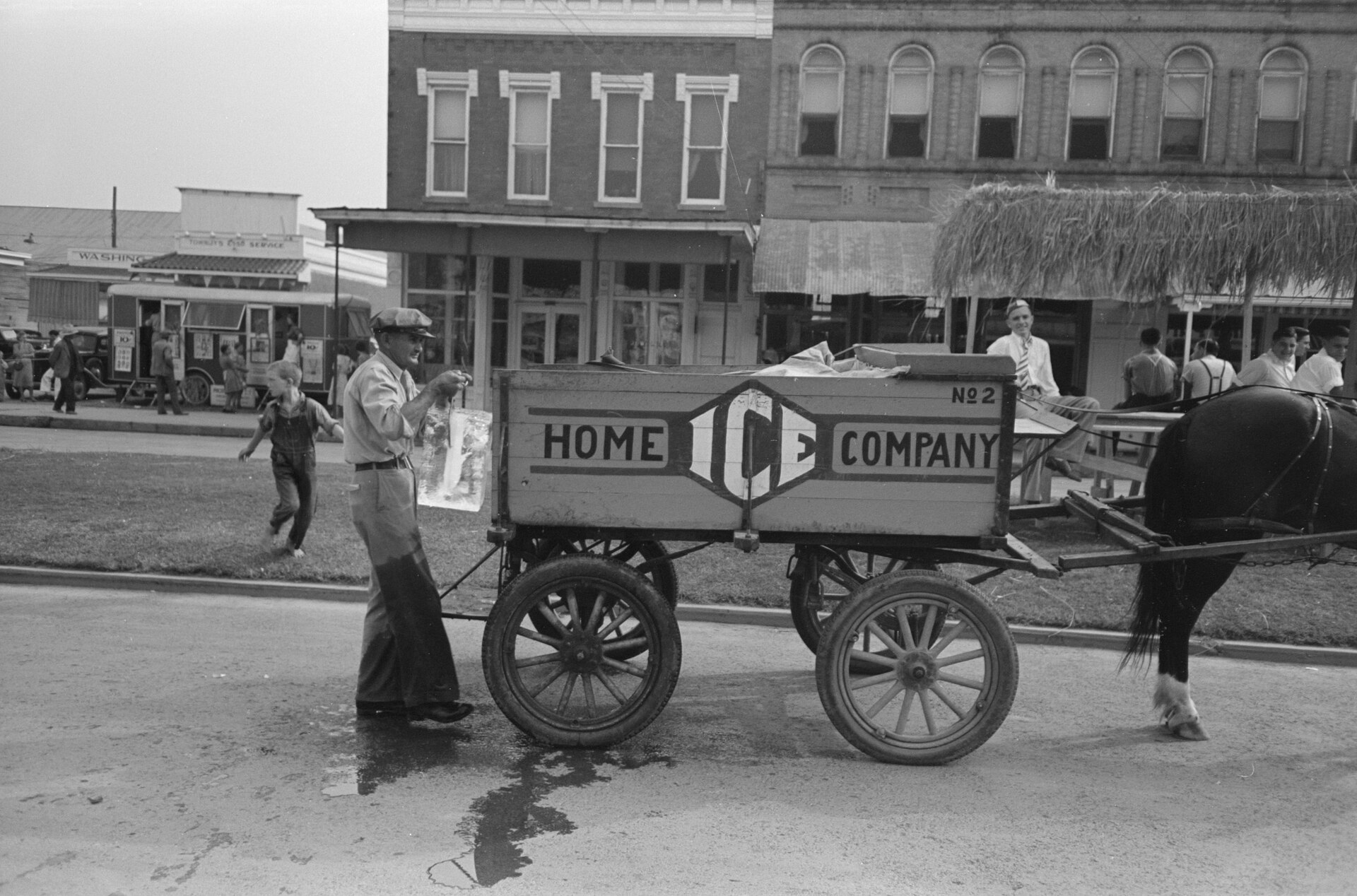
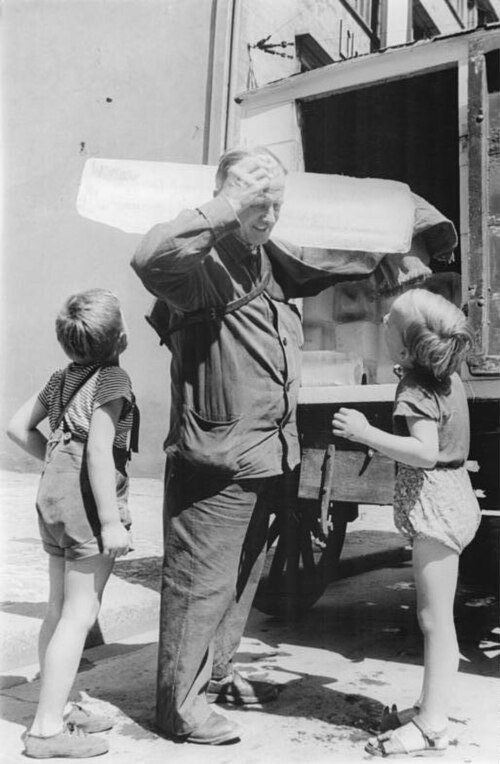
Every American kitchen once contained a box that told the truth about summer: keeping anything cold required somebody, somewhere, to have harvested winter itself — sawed it from a frozen lake in January, buried it in sawdust, and delivered it to the back door in July, one dripping hundred-pound block at a time. The man who carried it was the iceman, and for roughly three generations he was as fixed a feature of American life as the mail carrier: a leather-shouldered figure with iron tongs, a horse who knew the route better than he did, and a following of children who materialized behind the wagon every hot afternoon, waiting for the silver chips that flew when he scored a block — free, cold, and better than candy by every surviving account.
The whole system — the winter harvests, the sawdust-packed icehouses, the window cards, the drip pans — added up to one of the largest industries in nineteenth-century America, and one of the strangest: a nationwide supply chain for frozen water. It collapsed within a couple of decades of the electric refrigerator’s arrival, taking its vocabulary, its trade, and its daily rituals with it. Here’s how America kept summer at bay before the plug — and why the iceman’s world is worth a moment of July gratitude.
The Man Who Sold Winter to the Tropics
The American ice trade begins with one of business history’s great long-shot bets. In 1806, a young Boston merchant named Frederic Tudor loaded a ship with ice cut from Massachusetts ponds and sailed it to the Caribbean island of Martinique, on the theory that people in hot places would pay for cold. The first voyages lost money spectacularly — much of the cargo melted, and Boston’s merchants treated the scheme as a running joke — but Tudor kept refining the operation: better insulation (sawdust, it turned out, was nearly perfect), purpose-built icehouses at the destinations, and a patient campaign to teach the tropics to want ice at all, sometimes giving it away to create the habit.
It worked on a scale nobody had imagined. By mid-century, Tudor — by then inevitably “the Ice King” — was shipping New England ice to the American South, the Caribbean, and famously as far as Calcutta, a four-month voyage that still delivered sellable ice and returned fortunes. The trade he proved out became an industry: by the late 1800s, ice harvesting employed tens of thousands of men each winter, cutting on the Hudson, the lakes of Maine, and frozen waters across the northern states, with Maine’s Kennebec River alone shipping ice by the hundreds of thousands of tons in banner years. Walden Pond — yes, that one — was harvested commercially while Thoreau watched and wrote, bemused, that the sweltering inhabitants of Bombay would drink at his well.
Like our content? Follow us for more.
The Winter Harvest: Farming a Frozen Lake
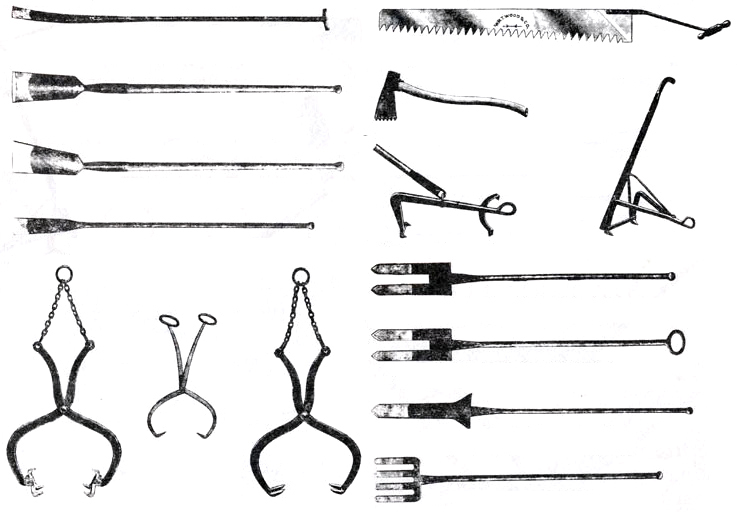
The supply side of the trade ran like agriculture in reverse — a harvest that required the coldest weeks of the year and moved with real urgency, since the crop could soften with one thaw. When the ice reached a foot or more thick, crews took to the lakes: horses drawing steel scoring plows marked the surface into a grid; sawyers cut along the lines with long ice saws; and the resulting blocks — often two-hundred-pound cakes — were poled like barges through open channels to the shore, hauled up ramps by horse or steam power, and stacked twenty, thirty, forty feet high inside vast wooden icehouses, each layer insulated with sawdust and hay. Packed right, the winter’s harvest kept through the following autumn with surprisingly modest losses.
It was hard, cold, dangerous work — men and horses both went through the ice often enough that crews kept ropes and rehearsed rescues — and it built a seasonal culture across the northern countryside: farm families earned winter cash on the harvest, lakeside towns threw ice-cutting into their calendars alongside haying, and the icehouse by the shore was as standard a piece of infrastructure as the grain elevator would become on the prairie. American winters, in a sense, were a cash crop for a hundred years.
The Wagon, the Card, and the Fifty-Pound Stairs
Delivery is where the trade entered daily life, and where the memories live. Households owned an icebox — an insulated wooden cabinet, often handsome oak, with a metal-lined compartment up top for the block and shelves below for the food — and the melting block’s drip ran to a pan underneath that somebody (in every family’s telling, always them) had to empty before it overflowed, the era’s most democratic chore.
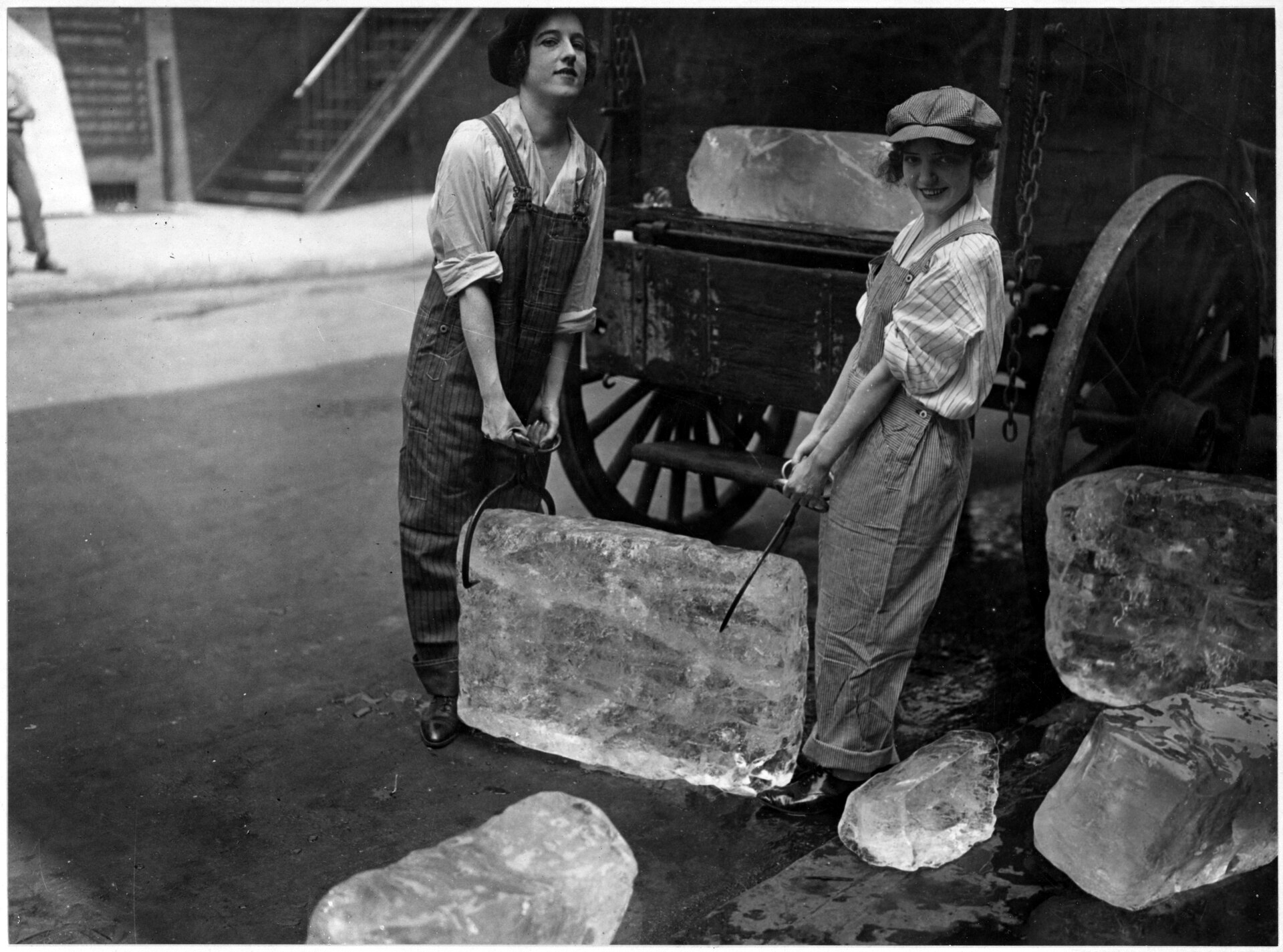
The iceman came through the neighborhood on a schedule, and communication ran on a famous piece of pre-electronic technology: the ice card, a square placard printed with numbers on its four edges — commonly 25, 50, 75, 100 — placed in the front window and rotated so the number showing at the top told the passing driver how many pounds the house wanted that day. No card, no stop. The driver read the windows down the block, scored and split blocks to size on the wagon’s tailgate with pick and chisel — producing the chips the trailing children collected as a right — then swung the block onto his leather-caped shoulder with tongs and carried it in, up two or four flights if the customer lived there, several dozen times a day. Icemen were, by necessity, among the strongest men in any neighborhood, and the trade’s place in the era’s popular songs, comedies, and gossip — the iceman being one of the few outsiders with standing access to the kitchen — made him a folk figure outright, immortalized on the American stage by the time O’Neill borrowed him for a title.
The trade also carried an entire summer economy on its back. Ice cream — hand-cranked in the backyard freezer with ice and rock salt from the iceman’s block — was a direct dependent, as were the corner drugstore’s soda fountain, the butcher’s case, the saloon’s cold beer, and the railroad refrigerator cars that moved California produce east across the desert in bunkers of harvested ice, re-packed at icing stations along the line. When Americans of the era tasted anything cold, an iceman stood somewhere in the supply chain, tongs in hand.
The Plug That Ended a World
The trade’s end came in two waves. First, around the turn of the century, mechanical ice plants began manufacturing ice year-round in the cities — cleaner and more reliable than lake ice, which was already facing pollution worries — ending the great winter harvests while keeping the wagons and the window cards. Then, in the 1920s and 30s, the electric household refrigerator arrived, and the numbers tell the story with brutal speed: an expensive novelty in 1925, the refrigerator was in roughly half of American homes by the eve of the Second World War, and standard equipment shortly after it. Ice routes thinned street by street; delivery companies pivoted to fuel oil or faded out; the icehouses on the northern lakes burned, collapsed, or found second lives as barns; and by the 1950s the iceman survived mainly in family stories, the occasional rural route, and the national vocabulary.
The vocabulary, at least, proved durable. Millions of Americans went on calling the refrigerator “the icebox” to the end of their lives — plenty of their grandchildren caught the habit — and the phrase remains the trade’s live monument, along with a scatter of others: “put it on ice” and the rest all descend from the days when cold was cargo.
Where the Ice Age Survives
For the curious, the iceman’s world is easier to visit than most vanished trades. New England and upper-Midwest historical societies keep the tools and the wagons — Maine’s ice-industry museums and lakeside historical villages stage winter ice-harvest demonstrations, cutting and hauling with the old saws and tongs for crowds who come away permanently respectful — and antique iceboxes, ice cards, and tongs turn up at flea markets as some of Americana’s most charming collectibles. An original ice card in the classic window sizes makes a conversation piece no smart speaker will ever match.
And the trade earns one last summer thought. Every cube that tumbles from the door of a refrigerator represents, on the other side of a century, a frozen January lake, a horse on the ice, a sawdust mountain in a wooden barn, and a strong man on a hot staircase with winter on his shoulder. The luxury hasn’t changed — cold in July is still a small miracle, delivered now by compressor instead of shoulder. It’s just that somebody used to carry it, four flights up, before lunch, and wave to the kids on the way back down.
Like our content? Follow us for more.
