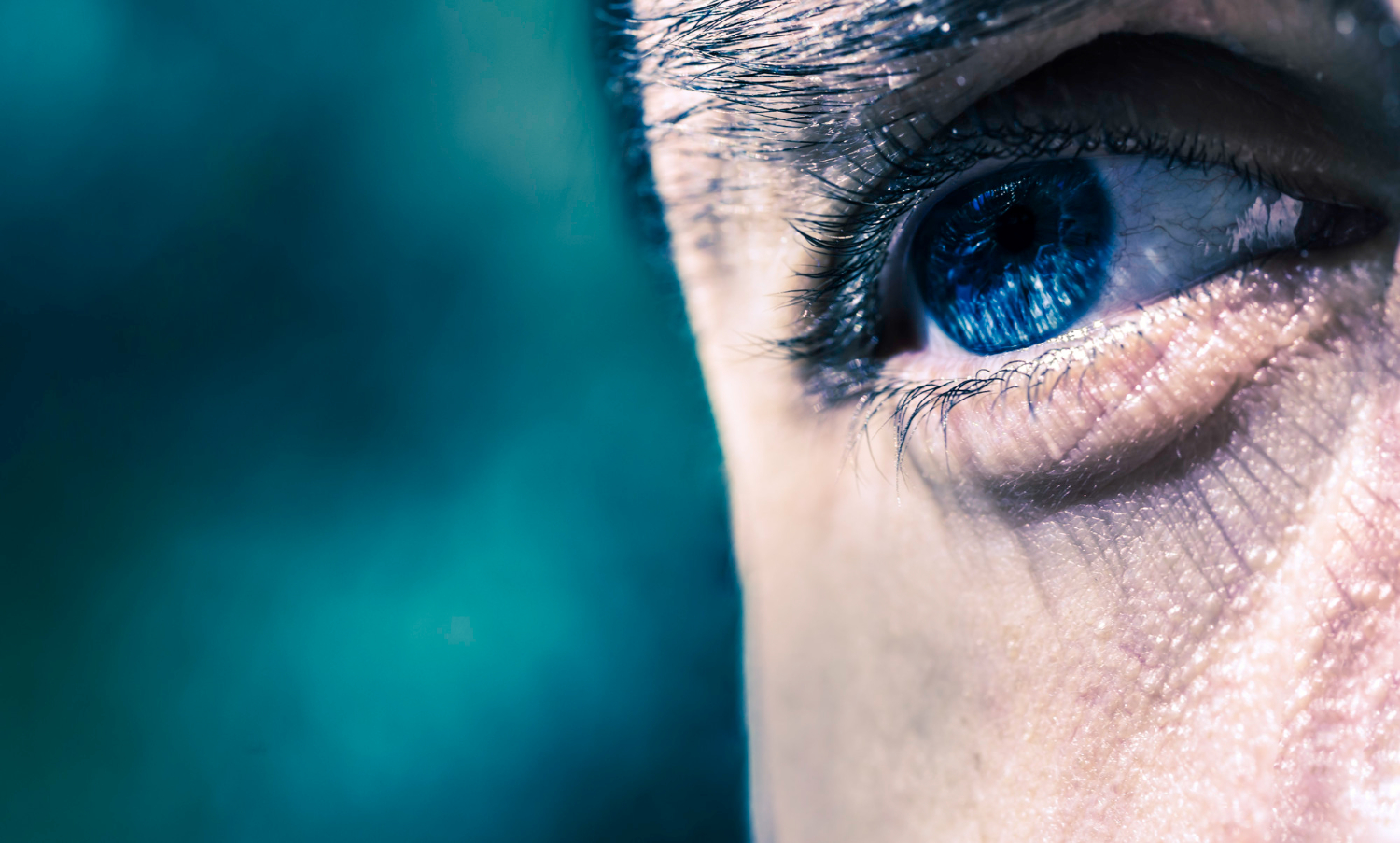
Most inherited traits are messy. Height involves hundreds of genetic contributions. Most physical characteristics are the product of many genes interacting with environment and chance, which is why family resemblance is a matter of tendency rather than rule.
Eye colour is unusually tidy by comparison. Roughly 74 percent of the variation in human eye colour traces to a single stretch of chromosome 15, and within that region one change accounts for nearly all of the difference between blue and brown.
That change appears to have happened once. A 2008 study led by Hans Eiberg at the University of Copenhagen found that blue-eyed people carry an identical stretch of DNA around the relevant switch, and that this holds across populations separated by thousands of miles. The pattern is the signature of a founder mutation: a single variant that arose in one individual and has been inherited ever since.
Which means, if the finding holds, that everyone with ordinary inherited blue eyes shares a common ancestor. Here is how that conclusion was reached.
There Is No Blue Pigment
Start with the physics, because it makes the genetics comprehensible.
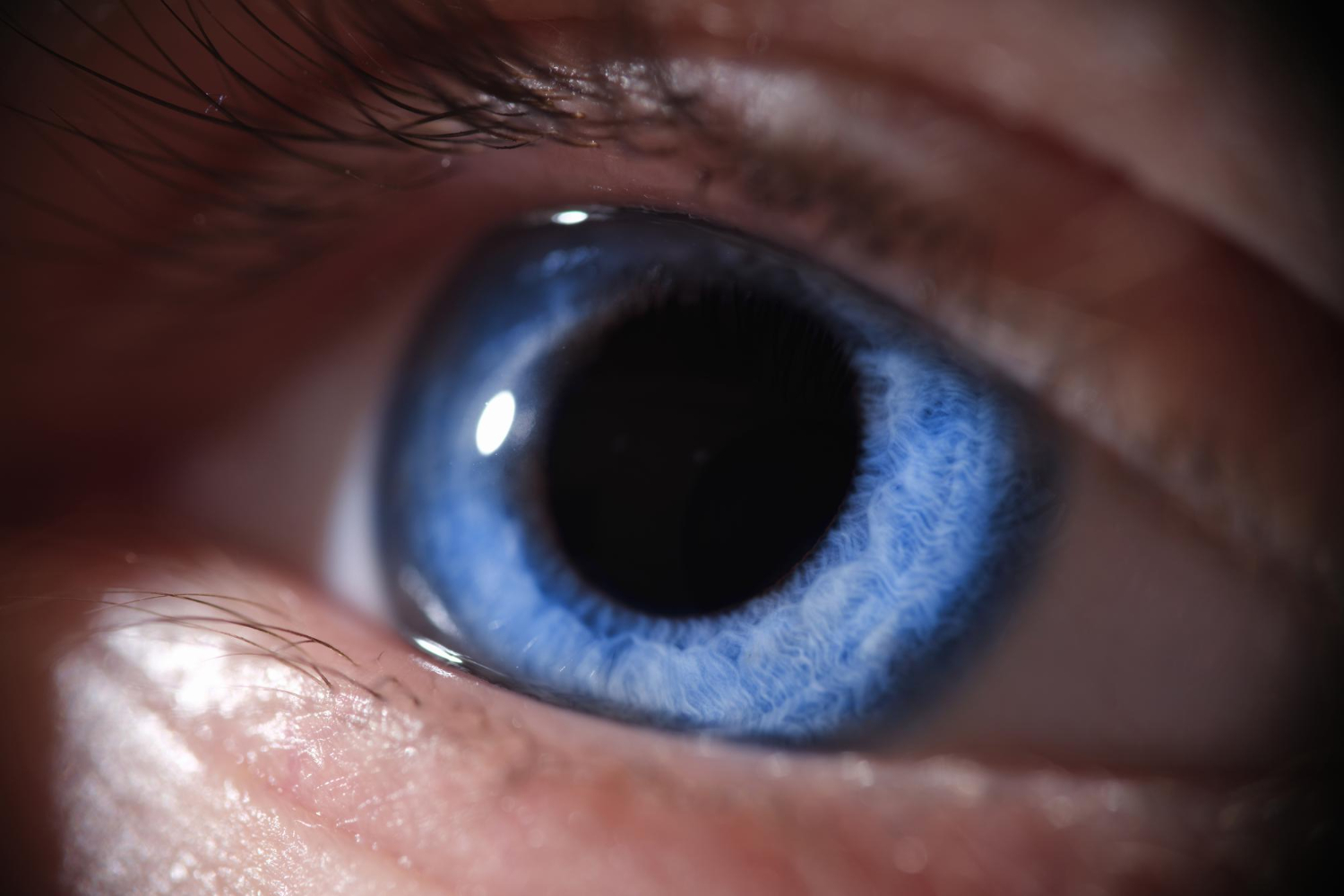
Human eye colour comes down to melanin — the same pigment that colours hair and skin — and specifically to how much of it sits in the front layer of the iris.
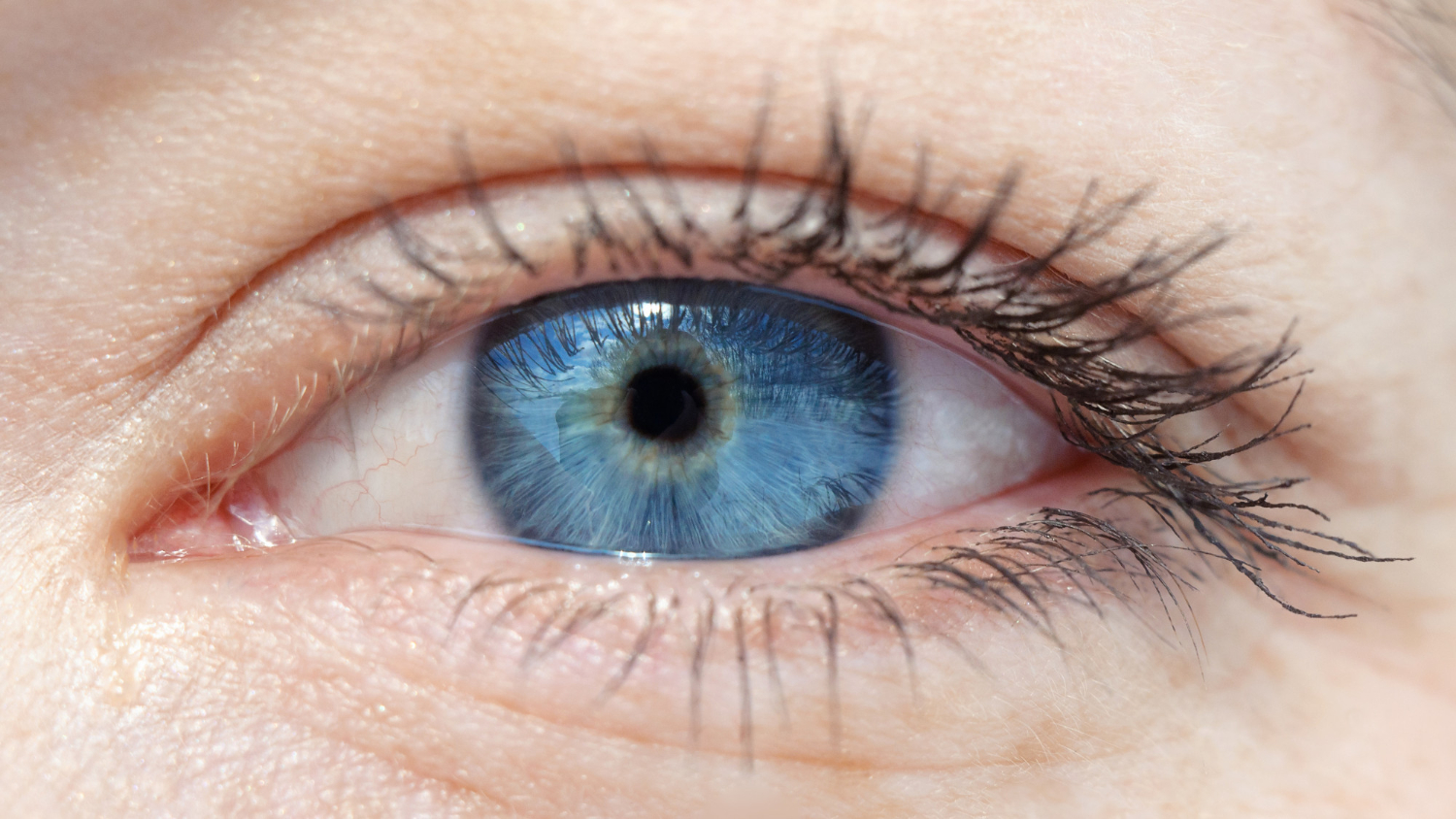
Melanin is brown. There is no blue pigment in a human eye and never has been. An iris with a lot of melanin absorbs most of the light entering it and appears brown. An iris with very little melanin absorbs less, and the light that scatters within the tissue returns predominantly short wavelengths, which the eye reads as blue.
This is the same scattering effect that makes the sky blue, and it explains why blue eyes can appear to change shade with lighting: the colour depends on how light is behaving, not on a fixed pigment.
Green and hazel eyes sit between the extremes, with intermediate melanin levels and additional genetic contributions fine-tuning the result. But the fundamental axis is quantity of brown pigment, and blue sits at the low end.
So “blue eyes” is not really a trait that was added. It is a trait produced by something being reduced.
Like our content? Follow us for more.
The Switch, Not the Gene
For years researchers looked for the responsible mutation in the wrong place.
The obvious candidate was OCA2, a gene involved in producing melanin. It codes for the P protein, part of the melanin production pathway, and had already been implicated in several eye colours. But despite extensive searching, no mutation in OCA2 itself explained blue eyes.
The reason is that the change is not in the gene. It is in the controls.
The variant sits within a neighbouring gene, HERC2, in a stretch of DNA that functions as a regulatory element — effectively a dial governing how active OCA2 is. The mutation turns that dial down. OCA2 still works; it simply produces far less melanin in the iris.
Eiberg described it as a switch that turned off the ability to produce brown eyes, though the mechanism is better understood as dimming than switching off. That distinction matters biologically: if OCA2 were disabled entirely, the result would be a general absence of pigment in hair, skin and eyes, which is a different condition altogether. The blue-eye variant is highly specific, affecting melanin in the iris while leaving the rest of the system intact.
One base-pair change — a single letter in roughly three billion — accounts for most of the difference between brown eyes and blue.
Why One Ancestor
The founder-mutation conclusion rests on a specific and rather elegant piece of reasoning.
Eiberg’s team worked with genetic material from the Copenhagen Family Bank, covering three generations of Danish families. They used 100 families, selected so that some contained both blue- and brown-eyed members, excluding families whose irises showed blue and green spotting. They then examined blue-eyed people from Turkey and Jordan — populations geographically and historically distant from Denmark.
All of them carried the same version of a cluster of genetic markers spanning part of HERC2. Not merely the same functional variant, but the same surrounding block of DNA, inherited together as a unit.
That is the key. If blue eyes had arisen independently in different populations, the underlying DNA would differ even where the resulting eye colour looked identical — different mutations producing the same visible outcome. Identical marker blocks across distant groups indicate a single origin, spreading by inheritance rather than arising repeatedly.
From the degree of uniformity, the team estimated the mutation arose roughly 6,000 to 10,000 years ago. The research had been building since 1996, and the paper appeared in the journal Human Genetics in 2008.
Eiberg’s summary was blunt: originally, we all had brown eyes.
What the Finding Does Not Mean
Several caveats are worth stating clearly, because this result is frequently over-interpreted.
It does not identify a person. There is no name, no location beyond a broad region, no burial. The conclusion is statistical: the pattern in the DNA is consistent with a single founder. Who that individual was is unknowable.
It does not mean blue-eyed people are closely related in any meaningful sense. Six to ten thousand years is a long time, and everyone alive shares vast numbers of ancestors from that period. Sharing one specific ancestral variant is not the same as being family.
It does not imply anything about ability, character, or worth, and the genetics involved concern a single pigment-regulating switch and nothing else. Melanin levels in the iris carry no other biological freight.
And it is one line of research rather than a closed question. Eye colour genetics has continued to develop, with additional genes identified that fine-tune shades of green, hazel and grey. Eiberg himself framed the mutation as an ordinary example of the genome constantly shuffling and trying out variations — one change among an enormous number, most of which do nothing noticeable.
The core finding — one region, one dominant variant, strong evidence of a single origin — has held up well. The popular version of it tends to lose the hedging.
What Babies’ Eyes Have to Do With It
There is a familiar observation that fits neatly into this account and is often misunderstood.
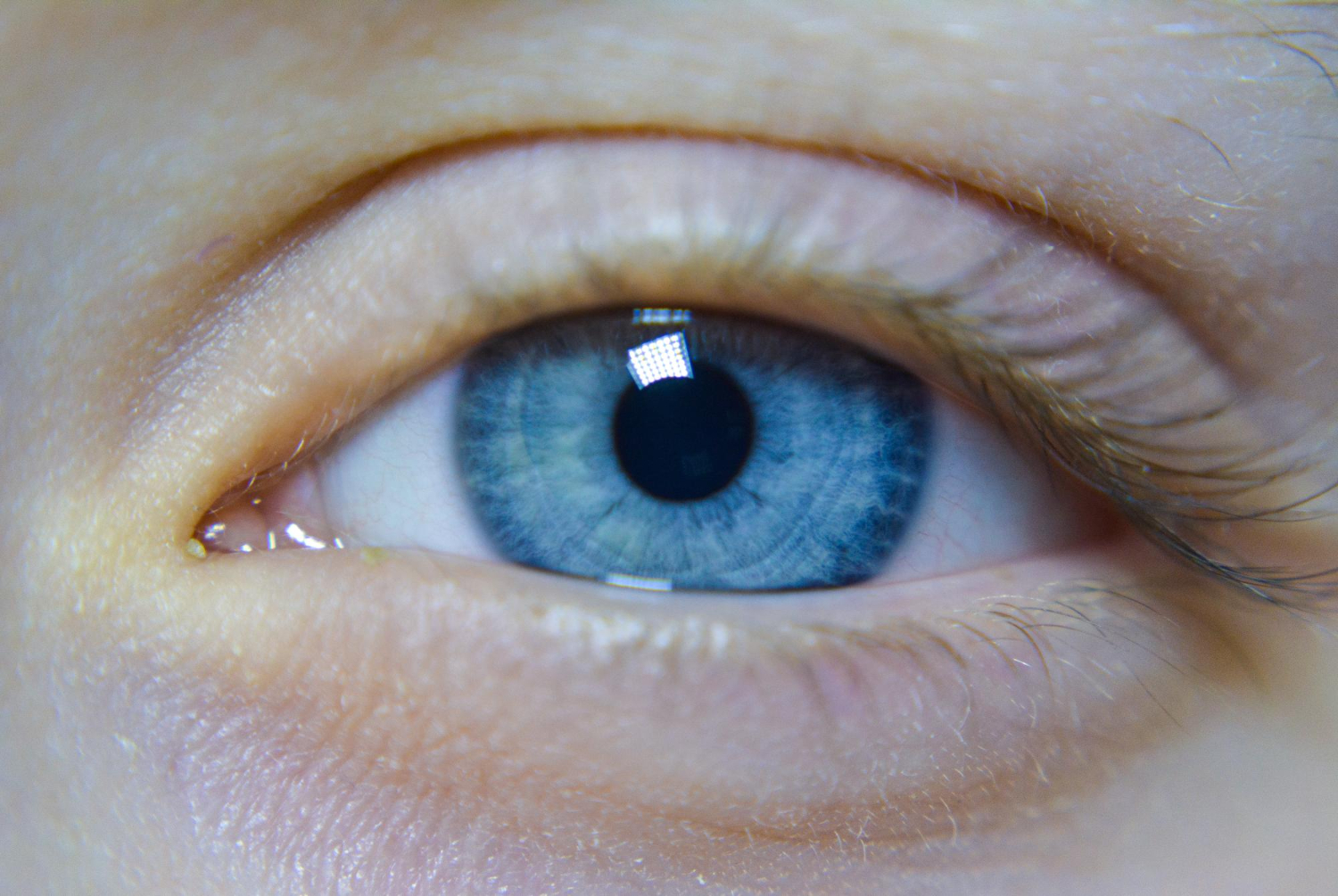
Many babies of European descent are born with blue or grey eyes that darken over the following months or years. This is frequently taken to mean eye colour is unstable or that blue is somehow a default.
The explanation follows directly from the pigment mechanism. Melanin production in the iris is not complete at birth; it develops over the first months of life as the pigment cells become active. A newborn iris with little melanin scatters light and appears blue for exactly the same physical reason an adult blue iris does.
If the child’s genetics call for substantial melanin, it accumulates and the eyes darken, often settling by somewhere between six months and three years. If the genetics call for very little, the eyes stay blue.
So infant blue eyes are not evidence of a blue-eyed ancestor in any given case. They are evidence that pigment deposition takes time. The colour a child ends up with is determined by the genetics; the delay simply means it is not visible immediately.
This also explains why the trait is not observed uniformly at birth across populations: where melanin levels are high, pigmentation is typically further along at birth and the blue phase is brief or absent.
Why a Tiny Change Spread So Far
An obvious question follows: if the variant does nothing except reduce pigment in the iris, why did it become common?
The honest answer is that nobody is certain. Several possibilities have been discussed. It may have offered some advantage in low-light northern latitudes, though evidence for that is limited. It may have spread through sexual selection, novelty being attractive. Or it may have spread largely by chance, carried along with neighbouring genetic material under selection for other reasons, or amplified through founder effects in expanding populations.
Genetic drift alone can carry a neutral variant to high frequency, particularly in small populations that later expand. Not every common trait is common because it was useful.
What can be said is that the timing places the mutation in the Neolithic, during the spread of agriculture and substantial population movement across Europe and western Asia — conditions under which a variant present in a founding group can become widespread in descendant populations.
There is something worth sitting with in the scale of it. One person, somewhere, some thousands of years ago, was born with a single altered letter in a regulatory sequence, which slightly reduced the pigment in their irises. Everyone who has looked into blue eyes since has been looking at the consequence of that one change, still propagating, in a face that individual could not have imagined.
Like our content? Follow us for more.