There is a common misunderstanding about coloured windows that makes the craft seem simpler than it was.
The assumption is that the glass is a canvas — clear material with colour applied to the surface, like paint on a panel.
That is not how it works. The colour is dissolved through the thickness of the glass, introduced while it was molten, and the glass was made in that colour from the beginning.
Which means a window is not painted. It is assembled, from separate pieces of separately coloured glass, each cut to shape and joined to its neighbours — and almost every constraint on the design follows from that.
Where the Colour Comes From
The chemistry is straightforward in principle and was extremely difficult in practice.
Metal compounds added to molten glass dissolve and produce colour, and different metals produce different colours: cobalt gives blue, copper can give blue or green or red depending on conditions, iron gives green and brown, manganese gives purple.
The complication is that the result depends on more than the metal added. The temperature, the duration, and crucially whether the furnace atmosphere contains excess oxygen or is starved of it all change the outcome — so the same metal produces entirely different colours under different conditions.
That is why the recipes were difficult. A workshop was not following a list of ingredients but controlling a process, and the knowledge was held by people rather than written down.
Red was the hardest. The deep red used in medieval windows requires copper under precisely controlled conditions and produces colour so intense that glass made throughout in that colour is nearly opaque.
The solution was to make it as a very thin layer on clear glass — which is a manufacturing achievement in itself, requiring the two to be worked together while molten.
There is a supply point worth noting first. Coloured glass was frequently not made where it was used – it was produced in specialist centres and traded as sheet, then cut, painted and assembled elsewhere.
That separation of making from assembling is why a workshop could produce windows without being able to make the colours in them, and why the loss of a glasshouse affected work over a wide area.
Like our content? Follow us for more.
The Gold One
One colour deserves its own account because the mechanism was not understood for centuries.
Adding gold to glass under the right conditions produces a rich red, and the amount required is very small.
The colour is not produced by gold in the way that cobalt produces blue. It comes from extremely small particles of gold suspended in the glass, which interact with light in a way that depends on their size.
That is why the process was so difficult to control. The colour depends on how the particles form during cooling, which depends on the temperature history, and a batch could be ruined by cooling at the wrong rate.
It also explains why the colour is so difficult to reproduce from a recipe alone. The ingredients are the easy part and the thermal treatment is the process.
Why the Pieces Are Small
The physical constraints of the material determined the appearance of every window.
Glass could only be made in limited sizes by the available methods, which were either blowing a cylinder and flattening it or spinning a disc — both producing a modest sheet with variable thickness.
That sheet was then cut into shapes, and cutting was done by scoring and breaking, which limits what shapes are achievable — gentle curves are possible and sharp internal angles are not.
Pieces were joined with strips of lead, which are flexible enough to follow a curve and strong enough to hold, and the assembled panel was supported by an iron framework.
So the leading is structural rather than decorative, the piece size is set by the glass manufacture, and the shapes are set by what can be cut — which means the visual character of a window is dictated almost entirely by the material.
The design is therefore drawn around the constraints, with the lead lines forming part of the composition because they cannot be avoided.
What Is Actually Painted
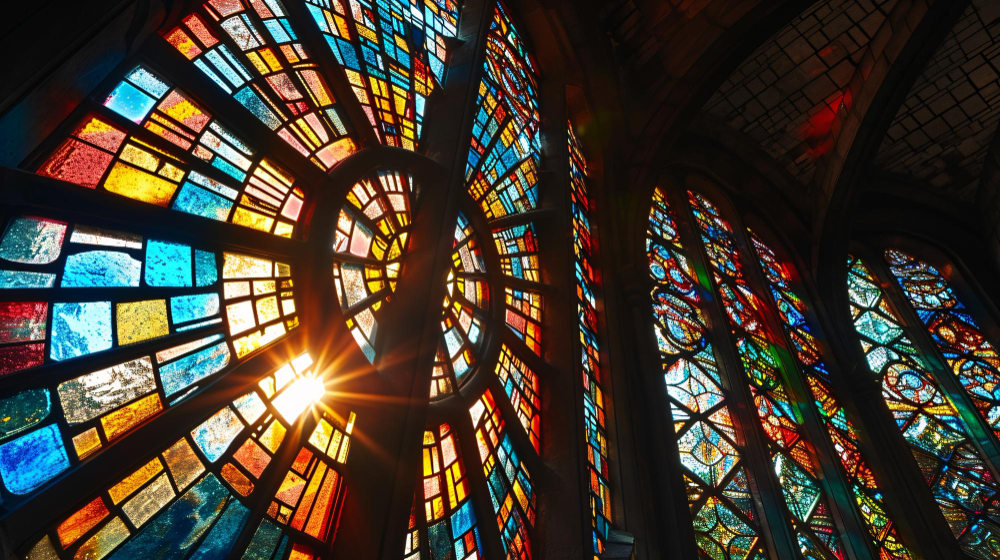
Some painting does occur and understanding what it does clarifies the rest.
Detail — faces, hands, folds, lettering, texture — cannot be produced by assembling coloured pieces, because the pieces would be impossibly small.
Those details are painted onto the coloured glass using a dark pigment containing finely ground glass, and then fired, which fuses the pigment into the surface permanently.
That painting is subtractive rather than additive. It blocks light rather than adding colour, which is why medieval glass detail reads as shadow and line rather than as coloured painting.
A second technique applied to the back of clear or coloured glass and fired produces yellow, which is a stain rather than a pigment and was a substantial development because it allowed two colours on one piece without a lead line between them.
There is a scale point worth making. A large window may contain several thousand separate pieces of glass, each cut individually and joined to its neighbours, assembled in panels small enough to handle and then fitted together in the opening.
The labour involved is enormous and is distributed across cutting, painting, firing, leading and glazing, which in a working shop were separate trades.
Why It Looks Like That
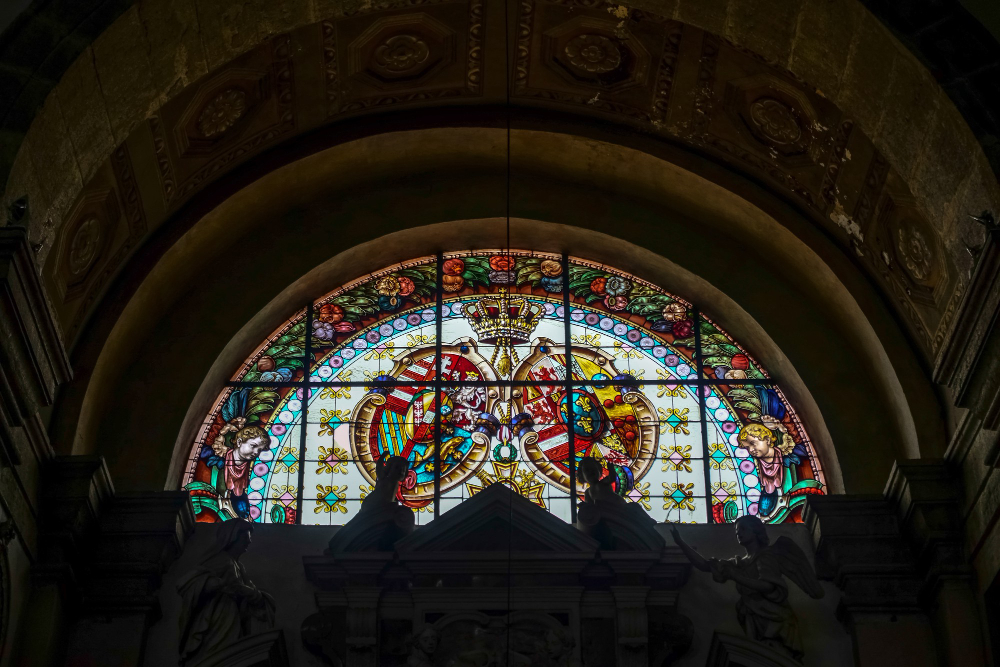
The optical behaviour is what distinguishes the material and it is worth being specific.
Glass in a window is lit from behind rather than in front, which means the viewer sees light transmitted through the material rather than reflected from it.
Transmitted colour is far more saturated than reflected colour, because all the light reaching the eye has passed through the colouring material rather than bouncing off a surface.
Old glass also contains irregularities — bubbles, variation in thickness, streaks from imperfect mixing — which scatter light and make the surface appear to vary as you move.
Modern glass made to a consistent standard lacks that variation, which is why replacement panels in old windows are frequently identifiable even when the colour matches.
That unevenness was a manufacturing limitation and is now regarded as a desirable characteristic, which is a fairly common trajectory for the defects of obsolete processes.
Why the Windows Move
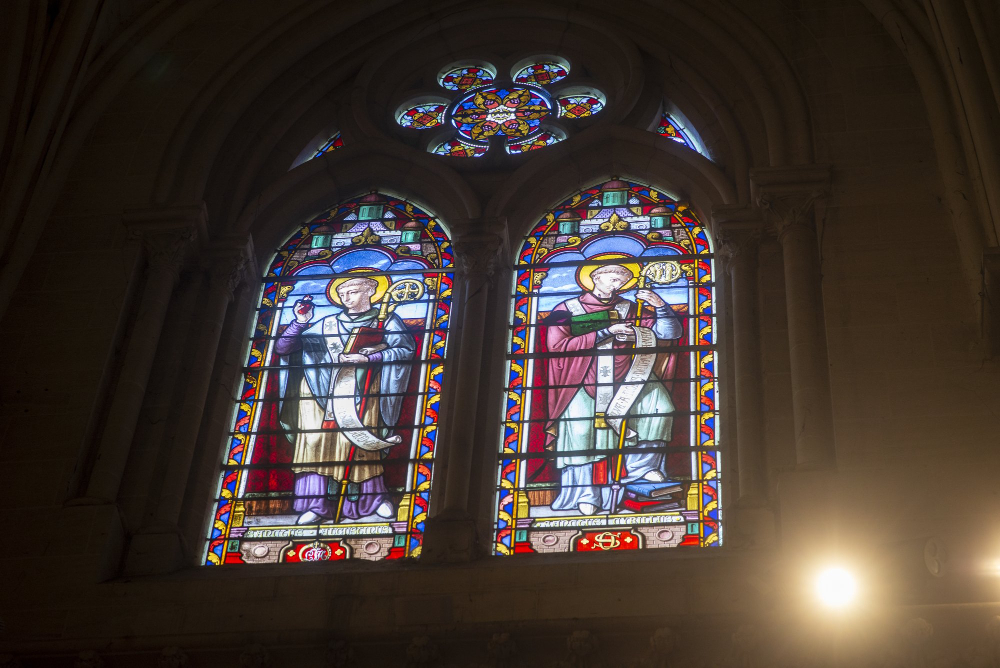
A practical matter belongs here because it determines what survives.
A panel of glass held in lead is not rigid. The lead is soft, the panel is large, and gravity acts on it continuously — so an unsupported panel sags over time, bowing outward and eventually failing.
That is why panels are tied to iron bars set into the stonework, at intervals, which carry the weight and hold the shape.
The bars are visible as horizontal lines across any large window, are structural rather than decorative, and their spacing is determined by how much unsupported panel the lead can carry.
Lead also fatigues. It is soft enough to accommodate movement, which is why it works, and that same softness means it deforms permanently over centuries and eventually loses the ability to hold the glass.
Releading is therefore a periodic necessity rather than a repair — panels are taken out, dismantled, cleaned and reassembled with new lead, and a window several centuries old may have been through the process several times.
Which produces an interesting question about what is original. The glass may be medieval and the lead holding it may be recent, and the composition, the cutting and the painting are original while the structure is not.
That is the same question that arises with any maintained historic object, and in stained glass it has a clear answer in practice: the glass is the artefact and the lead is the mounting, replaced as required without anybody regarding the window as less authentic for it.
What Was Lost and Found
The knowledge did not survive continuously, and the reasons are worth stating.
Workshop recipes were transmitted by apprenticeship rather than documentation, which means they survive only as long as the chain of practitioners does.
Periods of disruption broke those chains in various places, and where a workshop closed without passing its methods on, the specific results it produced went with it.
Later revivals therefore involved reconstruction rather than continuation — working backwards from surviving glass, analysing composition, and experimenting to reproduce results whose method was unknown.
That reconstruction has been substantially successful, aided by analytical techniques that can determine what is in a sample without destroying it.
Which produces a slightly odd situation. The composition of medieval glass is now better documented than it ever was while it was being made — and the people who made it could produce colours from knowledge they could not have written down, in a process they understood as practice rather than chemistry.
Which is the usual relationship between craft and science. The knowledge came first, held in the hands of people who could produce a result without being able to say why it worked – and the explanation arrived centuries later, after the practice that generated it had already stopped.
Like our content? Follow us for more.