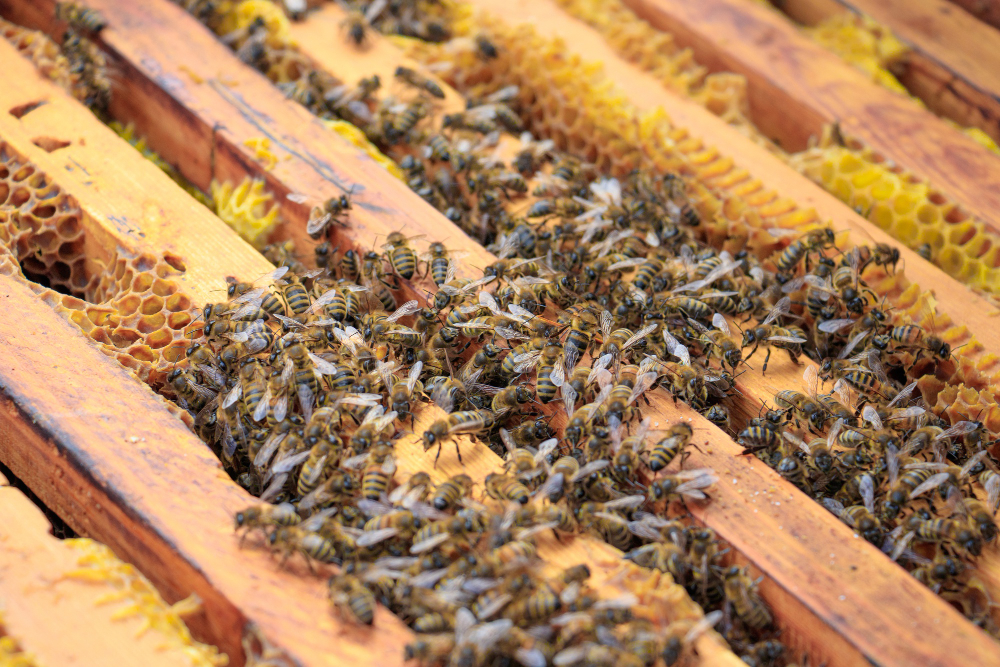
For most of the history of keeping bees, getting honey meant damaging the colony that produced it.
Bees build comb attached to whatever surfaces are available, fused to the walls and ceiling of the space they occupy and to each other. There is no way to remove a piece without cutting it free, and cutting it free destroys the structure the bees built and frequently the brood inside it.
So the traditional arrangement involved either harvesting in a way that killed or severely set back the colony, or collecting only what could be reached without doing so.
What changed that was not a new material or a new tool but a measurement — the observation that bees respect one particular gap, and that designing around it makes the whole interior of a hive movable.
The Gap Bees Leave Alone
The behaviour behind the design is precise and consistent.
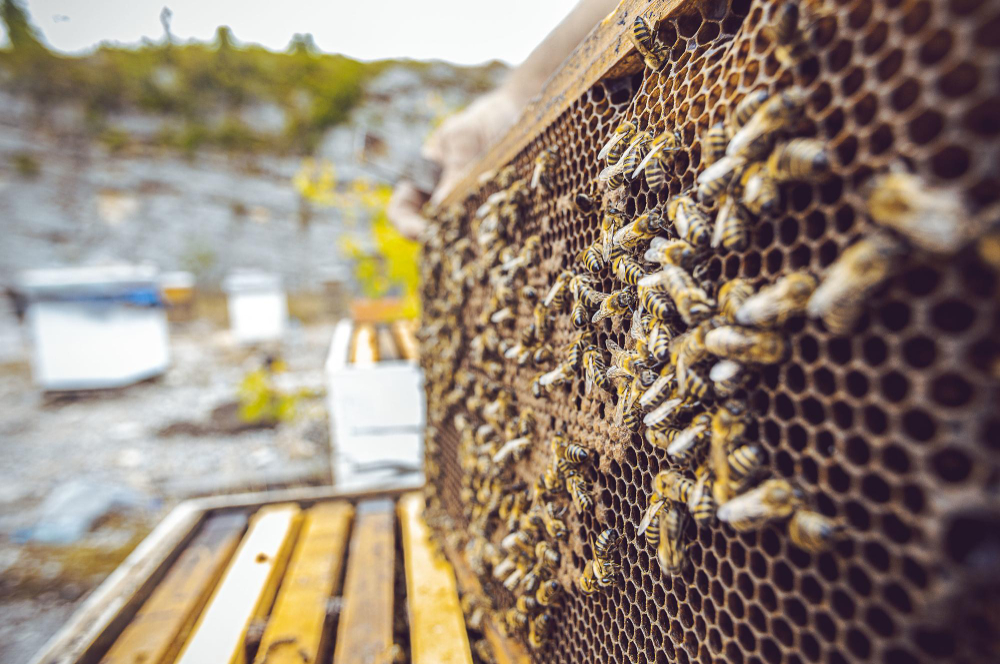
Bees need to move around inside their nest, and they maintain passages between comb surfaces wide enough for two bees working back to back.
Gaps smaller than that are useless as passages and are sealed shut with resin collected from plants, which the colony uses to close cracks and exclude draughts.
Gaps larger than that are wasted space and are filled with additional comb, which bees build readily wherever room allows.
Between those two responses is a narrow range of width that bees neither seal nor build in — they simply leave it open as a walkway.
That range is small, measured in millimetres, and its consistency across colonies is what makes it usable as a design principle.
Like our content? Follow us for more.
Why That Changed Everything
The insight was to apply the measurement to every internal surface.
If each frame hangs inside the box with exactly that gap between it and the walls, and exactly that gap between it and its neighbours, the bees will build comb within the frame and leave the surrounding space clear.
The result is a set of combs each held in its own removable frame, none attached to anything else, which can be lifted out, inspected and replaced.
That makes it possible to look at every part of the colony — to check the queen is laying, to see the state of the brood, to assess stores and to spot disease — without cutting anything.
It also makes it possible to remove honey from some frames while leaving the rest untouched, and to return the empty comb for the bees to refill, which saves them the enormous cost of building it again.
So a single dimensional observation turned beekeeping from something done to a colony into something done alongside one.
What the Comb Costs
The value of reusing comb is substantial, and it follows from how wax is made.
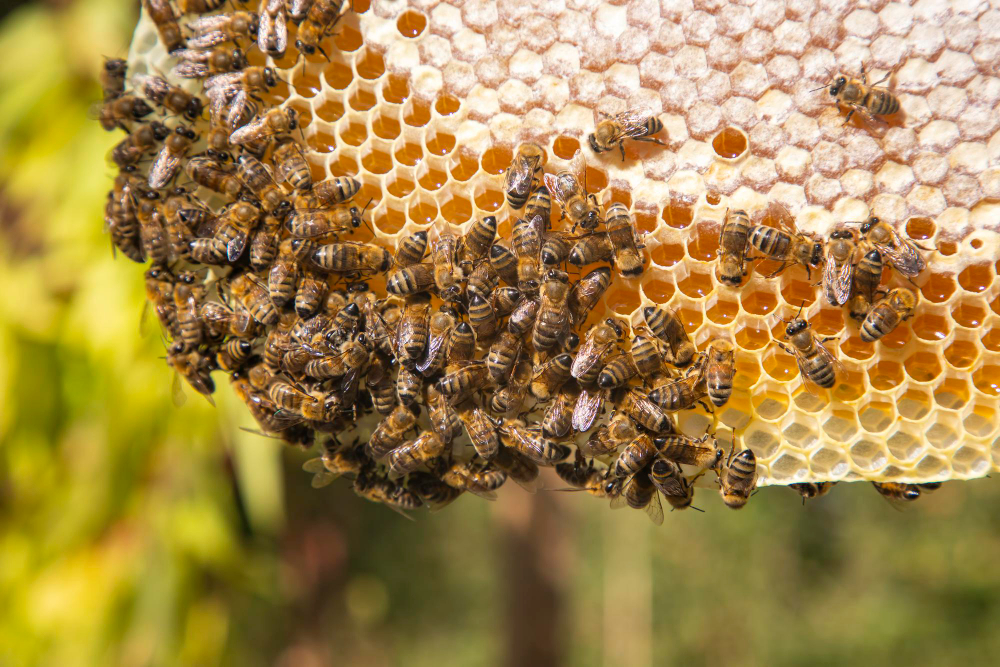
Bees produce wax from glands on their abdomen, and producing it consumes a large quantity of honey — so every piece of comb represents a substantial energy investment by the colony.
Traditional harvesting destroyed that investment each time, and the colony had to rebuild before it could store again.
Returning intact comb after extraction lets the bees go straight to filling it, which is why harvests from movable-frame hives are larger than from fixed-comb arrangements.
Extraction itself became possible for the same reason. A frame of comb can be spun so that honey is thrown out of the cells by the rotation while the wax structure remains intact, which is not possible with comb that has been cut free.
There is a timing point worth adding. Opening a hive disrupts the colony’s temperature and routine, so inspections are brief and are done in suitable weather, which limits how often the frames can actually be examined.
The design makes inspection possible without making it free.
The Hexagon Is the Bees’ Decision
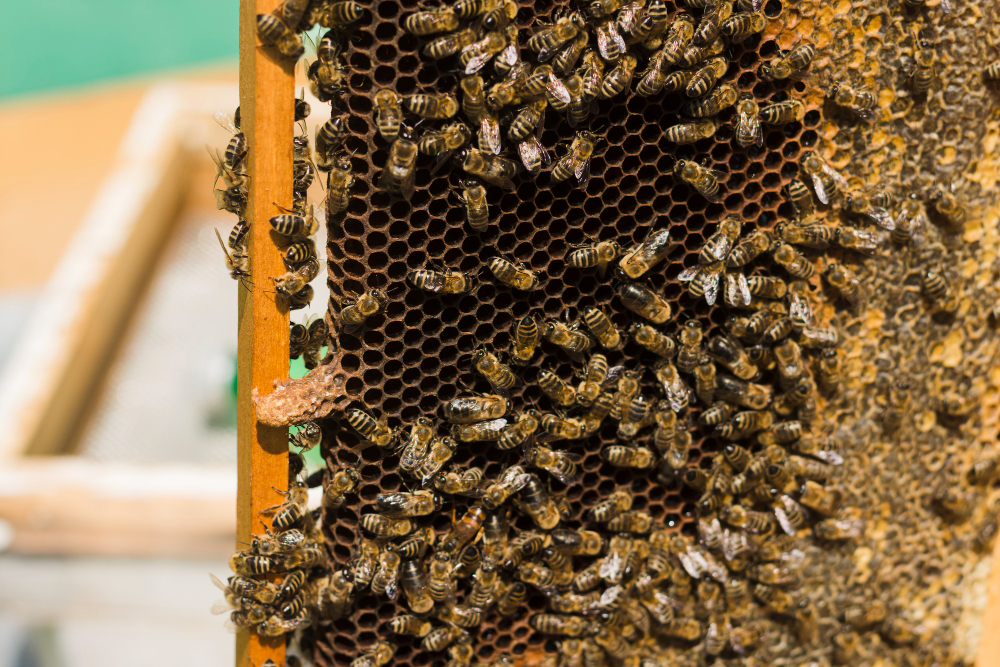
The shape of the cells is frequently credited to the beekeeper’s frame, and it is not.
A frame provides a place to build and nothing more; the cells within it are constructed entirely by the bees, in the same form they build anywhere.
Many hives use a thin sheet of wax pressed with a hexagonal pattern as a starting guide, which encourages straight and regular comb and reduces the proportion of larger cells the colony would otherwise build.
That guide influences the result and does not create it — bees building without it still produce hexagonal cells.
The regularity of the frame is what the beekeeper contributes. The geometry of the comb is what the bees contribute, and the two are easily confused.
What a Colony Actually Is
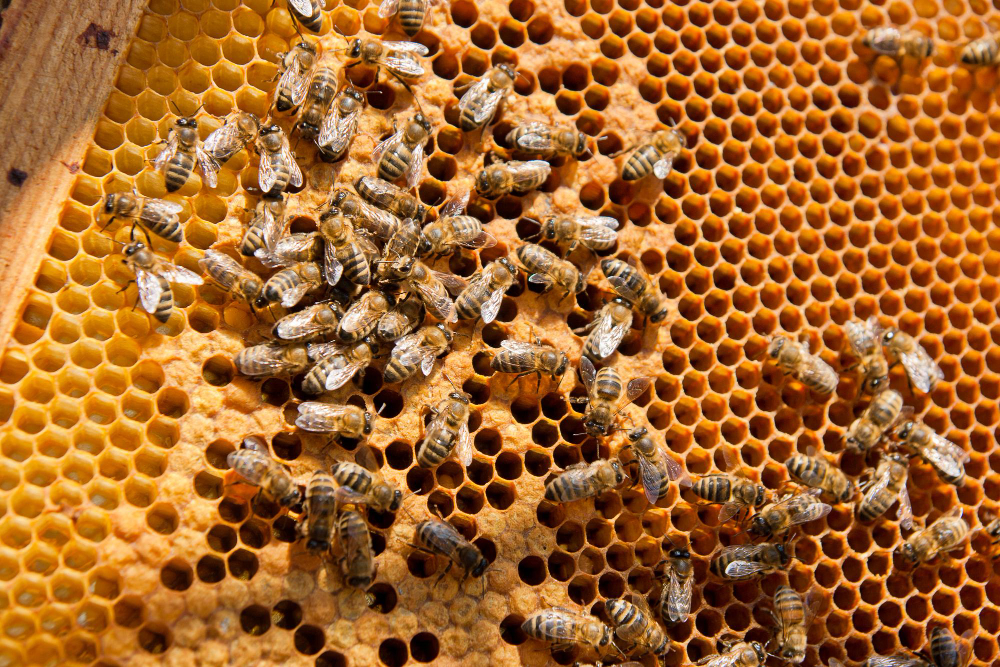
Understanding the design requires understanding the unit being housed.
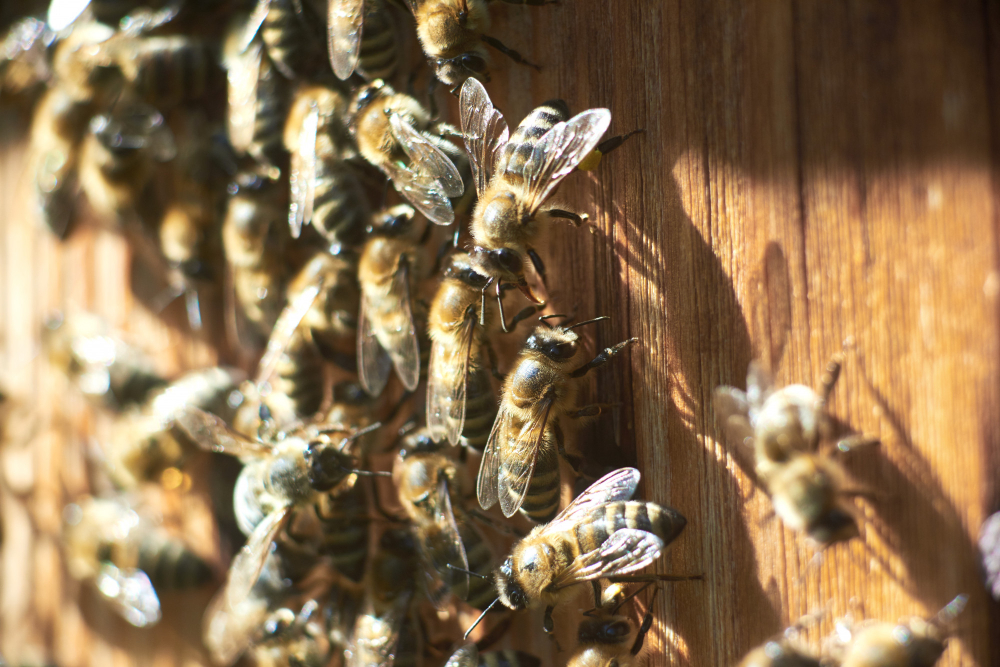
A colony is a single reproductive female, a large number of non-reproductive female workers, and a seasonal population of males, living as a unit that behaves more like a single organism than like a group of individuals.
The workers change jobs as they age, moving from tasks inside the nest to guarding and finally to foraging, which means the colony’s labour force is organised by age rather than by type.
The colony regulates its own temperature, clustering together in cold weather and fanning to cool in hot weather, keeping the brood area within a narrow range.
And it reproduces by dividing: part of the colony leaves with the old queen to establish a new nest, leaving the remainder to raise a replacement — which is the event beekeepers spend a considerable part of their effort anticipating.
A hive, then, is housing for a superorganism, and its design has to accommodate that organism’s own management of space, temperature and growth.
The Older Designs

The alternatives are worth describing because several persist.
Woven or coiled containers made from plant material provided a dry cavity and were entirely fixed-comb, harvested by removing the colony or cutting out comb.
Hollowed logs and clay cylinders served the same purpose in different regions, with the same limitation.
Top-bar arrangements are an intermediate form: individual bars laid across the top of a cavity, each of which the bees use as a starting line for a single comb, which can then be lifted out on its bar.
They lack the side and bottom spacing of a full frame, so comb is frequently attached to the walls and must be cut free, but they allow inspection far more readily than a fixed cavity.
Each of those arrangements reflects a different compromise between simplicity, cost, the bees’ behaviour and what the keeper wanted from them — and several remain in use for exactly those reasons.
Why the Box Stacks
The external form of a modern hive follows from the frame, and it explains why hives look the way they do.
A colony expands through the season and contracts in winter, and the space it needs changes accordingly.
Boxes of identical footprint that stack vertically allow the keeper to add space as the colony grows and remove it as the colony shrinks, without disturbing the frames already occupied.
A lower section typically holds the brood and the colony’s own stores, and upper sections are added for surplus honey above it.
A grid with openings sized for workers but not for the larger queen is sometimes placed between them, which keeps egg-laying confined to the lower boxes so that the upper frames contain only stored food.
Every one of those boxes carries frames spaced by the same gap, which is why frames from one box fit any other of the same pattern — a standardisation that allows equipment to be shared, bought and replaced.
That interchangeability is itself a consequence of the single measurement. Once the internal spacing was fixed, everything around it could be made to a standard, and the hive became a system rather than a container.
What the Design Teaches
The general point is about where good design comes from.
The movable-frame hive did not impose a structure on bees. It observed a behaviour the bees already had and built the container around it, so that the colony’s own tendencies produce the result the keeper wanted.
That is a durable principle: working with the existing behaviour of a system rather than against it produces designs that are cheap to maintain and robust, because they are not constantly fighting what they contain.
And it is worth noting how small the key observation was. Not a new material, not a new mechanism — just the width of a gap, measured carefully and applied everywhere — which turned out to be the entire difference between a hive that had to be destroyed to be used and one that could be opened, examined and closed again every week of the season.
Which is a useful thing to remember about any design that seems to have solved a problem permanently. The solution frequently turns out to be an observation somebody made carefully about the thing being designed for – and everything else follows from taking that observation seriously.
Like our content? Follow us for more.