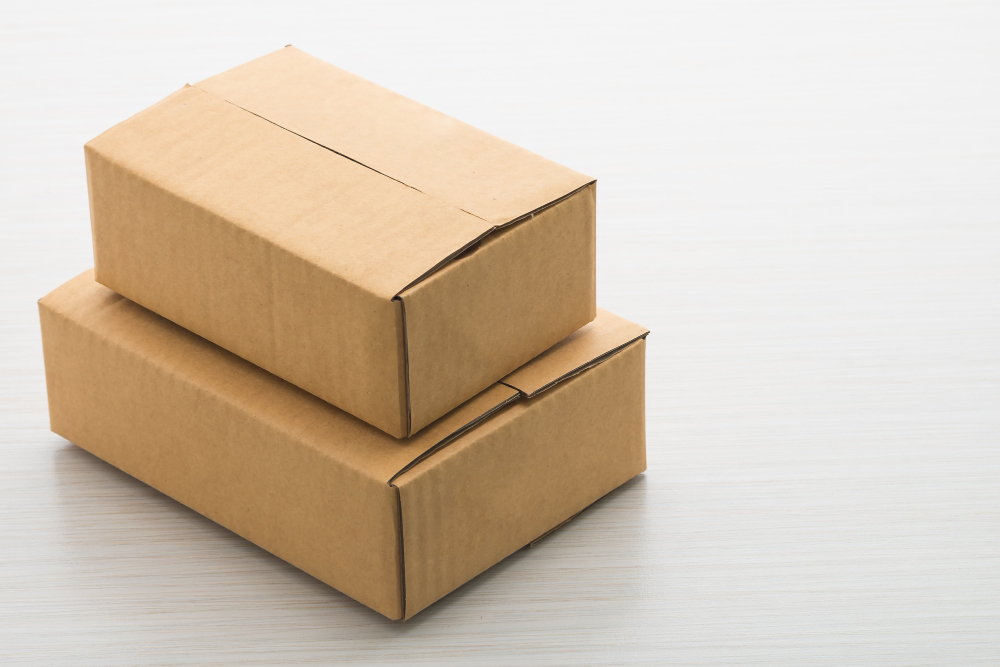
Corrugated board is one of those inventions so completely ordinary that it is hard to see as an invention at all. Something like a hundred billion boxes are made from it every year, it carries a large fraction of everything that moves between places, and it is made from one of the weakest, floppiest materials in industrial use. The interesting question is not why we use cardboard. It is how paper was persuaded to hold anything up.
A Flat Sheet Fails by Bending, Not by Tearing
Take a sheet of paper by one edge and hold it out horizontally. It flops. Now the important observation: it did not tear, and it did not crush. Paper is actually quite strong when you pull it along its length. The failure was not a failure of the material at all. It was a failure of shape.
When a flat sheet bends, the material on the outside of the curve is stretched and the material on the inside is squashed, with a neutral layer in between doing nothing. In a sheet a fraction of a millimetre thick, the stretched and squashed faces are almost in the same place, so there is almost nothing resisting the bend. The sheet gives way long before the paper itself is anywhere near its limit.
The resistance of a beam to bending depends very steeply on its depth, far more than on the amount of material in it. Doubling the depth of a beam does much more for its stiffness than doubling its thickness at constant depth. So the way to make paper stiff is not to use more paper. It is to get the material further apart, and put nothing in the middle.
That is precisely what corrugated board does. The two flat facings are held apart by the fluted layer between them, so when the board is bent one facing goes into tension and the other into compression across a real distance. The board might be four or five millimetres deep where the paper is a fraction of a millimetre. The stiffness gain is out of all proportion to the extra material, because most of the added depth is air.
Like our content? Follow us for more.
Why the Middle Layer Is Wavy Rather Than Anything Else
You could hold two sheets apart with blocks, or a honeycomb, or vertical strips. The wave is chosen because of what it does under a load pressing down on the edge of the board, which is the load a stacked box actually experiences.
Each arc of the flute is a small arch. An arch loaded from above converts that downward push into compression running along the curve and out to where the arch meets its supports, and paper, like stone, handles compression along its length far better than it handles bending across its width. The flute turns a load that would fold a flat sheet into a load that squeezes a curved one.
Because the flutes run continuously along the board, they form a row of parallel arches, each supported at top and bottom by being glued to the facings. The glue lines matter enormously: they stop the flute from simply unrolling flat under pressure, which is what it would otherwise do. The facings hold the arch shape, the arch carries the load, and neither works without the other.
This is also why corrugated board is strongly directional. Stand a box on end so the flutes run vertically and each flute is a small column taking load along its length, which is the orientation it is built for. Lay it so the flutes run horizontally and the same load is now trying to bend and flatten those arches sideways, and the board gives way at a small fraction of the weight. A box printed with an arrow indicating which way up it goes is often making a structural request, not a stylistic one.
The Wave Size Is Chosen, and It Is a Trade

Corrugated board comes in standard flute profiles, identified by letter, and the choice between them is a straightforward exchange between two things you cannot have at once.
Large, tall flutes put the facings further apart. That gives more depth, so more stiffness against bending, and more air, so more cushioning, because a tall arch has further to travel before it collapses and absorbs more energy on the way. Large flutes are what you want around something fragile.
Small, closely spaced flutes put more arches under a given length of facing. That gives better resistance to a crushing load applied straight down, and a flatter, smoother surface that prints well and holds a crisp fold. Small flutes are what you want for a retail box that has to look right and stack high.
So the tall profiles cushion and the fine profiles stack and print, and a great deal of packaging engineering is choosing between them or combining them. Double-wall board glues two different flute sizes together with a third facing between, taking the cushioning of the coarse layer and the crush resistance of the fine one, and it is why a box for something heavy feels so much more substantial at the edge than a box for something light.
Everything Fails at the Corners
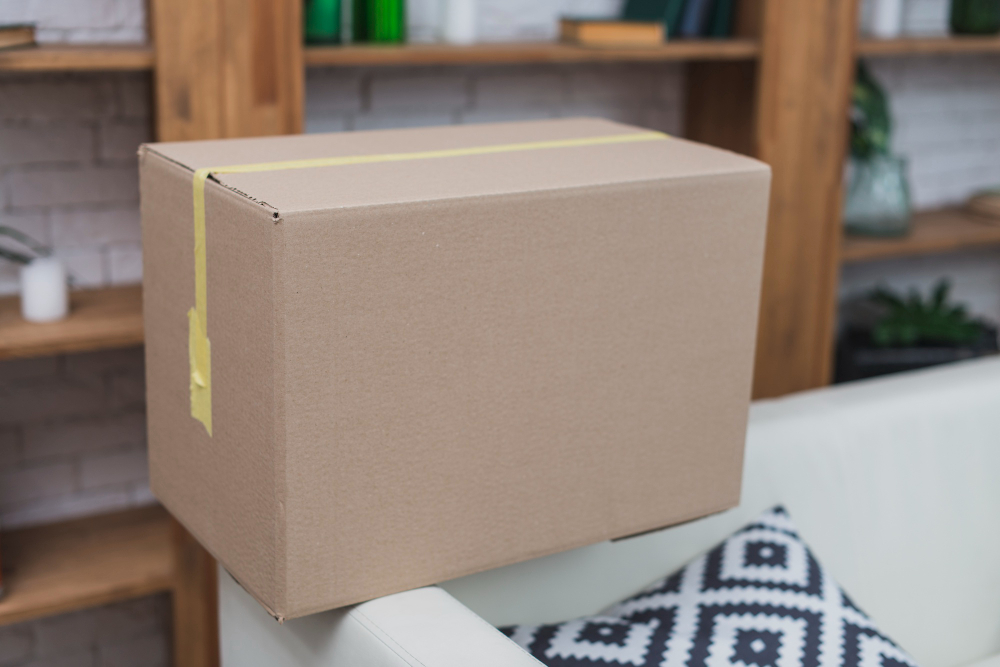
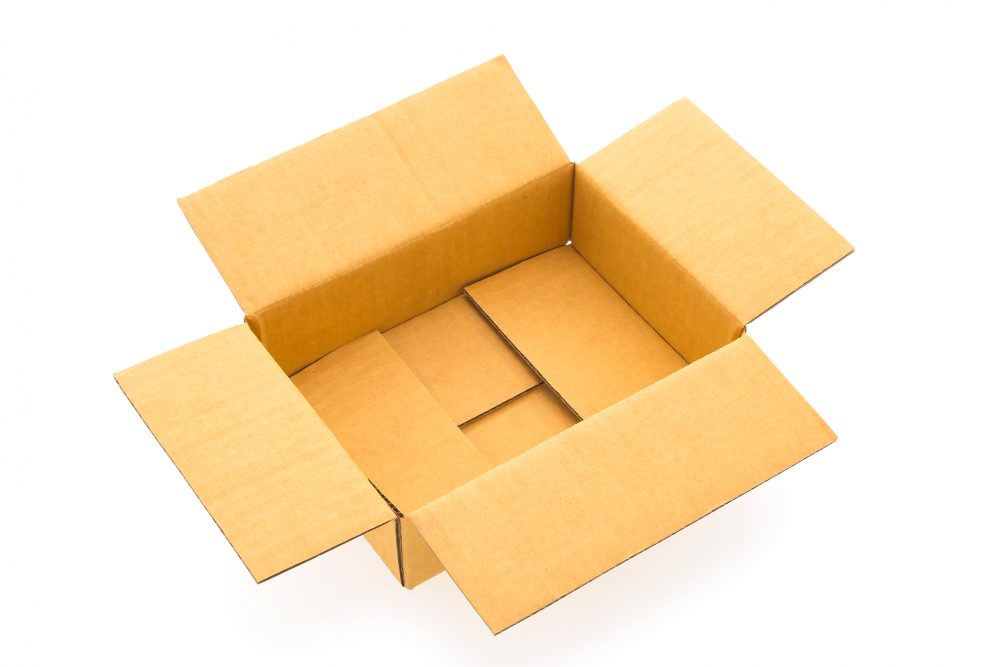
A cardboard box under a stack does not fail in the middle of a panel. It fails at the vertical edges, and this is well enough established that the industry’s standard measure of box strength is essentially a measure of how much the corners can take.
The reason is that the corners are the columns. A flat panel under downward load buckles outward or inward at fairly modest pressure, because a wide thin panel has very little resistance to bowing. The folded corner, though, is a vertical element stiffened in two directions at once, and it is far more resistant to buckling than either flat panel beside it. Under a stack, the load migrates towards the stiffest path, which is the corners, and they carry the great majority of it.
This explains several ordinary things. A box with a dented or crushed corner has lost most of its stacking strength even though it looks nearly intact, whereas a box with a dent in the middle of a panel is barely affected. Hand holes cut into the side of a box are placed away from the corners for the same reason. And a box that is slightly overfilled so the flaps bulge is much weaker in a stack than one filled level, because a bulging top stops the load transferring cleanly down through the corner columns and pushes it into the panels instead.
Water Is the Real Enemy
The weakness of corrugated board is not load. It is humidity, and the effect is much larger than people expect.
Paper fibres are hygroscopic: they take up water from the air and swell, and as they do, the hydrogen bonds between fibres that give paper its strength are disrupted. A box stored in a damp warehouse can lose a large proportion of its stacking strength compared with the same box in dry conditions, without ever being visibly wet. Cold stores and anything involving chilled or frozen goods are a continual problem for exactly this reason, and boxes destined for them are treated, coated or laminated specifically to slow water uptake.
The arch does not care about the shape of the paper being right; it cares about the paper being stiff. Soften the material and the arch simply folds. A wet box does not tear apart, it slumps, which is the same failure a dry sheet of paper shows when you hold it out flat: the material is still there, but the shape has stopped working.
It Started as a Hat Lining
The fluted sheet was patented in England in the middle of the nineteenth century for a purpose that had nothing to do with boxes: stiffening the inside of tall hats. A crimped paper liner held the shape and let air move around the wearer’s head.
The idea was carried to the United States, where the fluted sheet was first used as a wrapping to protect glass bottles and lamp chimneys in transit. It was a cushioning material at that point, not a structural one, and it had only one facing sheet or none.
The decisive step came when a facing was glued to both sides. That single change turned a crumple-resistant wrapping into a structural panel, because only then could the flutes be held in shape and made to act as arches. Boxes followed, and then the long argument with the railways, which for years classified wooden crates as the only acceptable shipping container and had to be convinced that folded paper could do the job. Once that was settled the wooden crate largely disappeared from general freight within a generation.
A Shape Doing the Work of a Material
What makes corrugated board worth thinking about is that nothing was improved about the paper. Paper is still weak, still floppy, still ruined by water. Every property of the material stayed the same.
What changed was the arrangement: get some of the material away from the middle, curve the part in between so that loads run along it rather than across it, and glue the whole thing so the curve cannot unroll. The result carries many times what the flat sheet could, using very little extra material and a great deal of air.
The same logic turns up wherever weight matters and material is expensive. Steel I-beams put the metal in the top and bottom flanges and leave a thin web between, for the same reason. Aircraft floors and doors are honeycomb sandwiched between thin skins. Corrugated iron is the same trick with no facings at all, relying on the curves alone. Even a sheet of paper becomes usefully stiff if you simply fold it into a fan.
Which is worth remembering next time you flatten a box. You are not destroying the material. You are just taking away the only thing that made it strong.
Like our content? Follow us for more.