

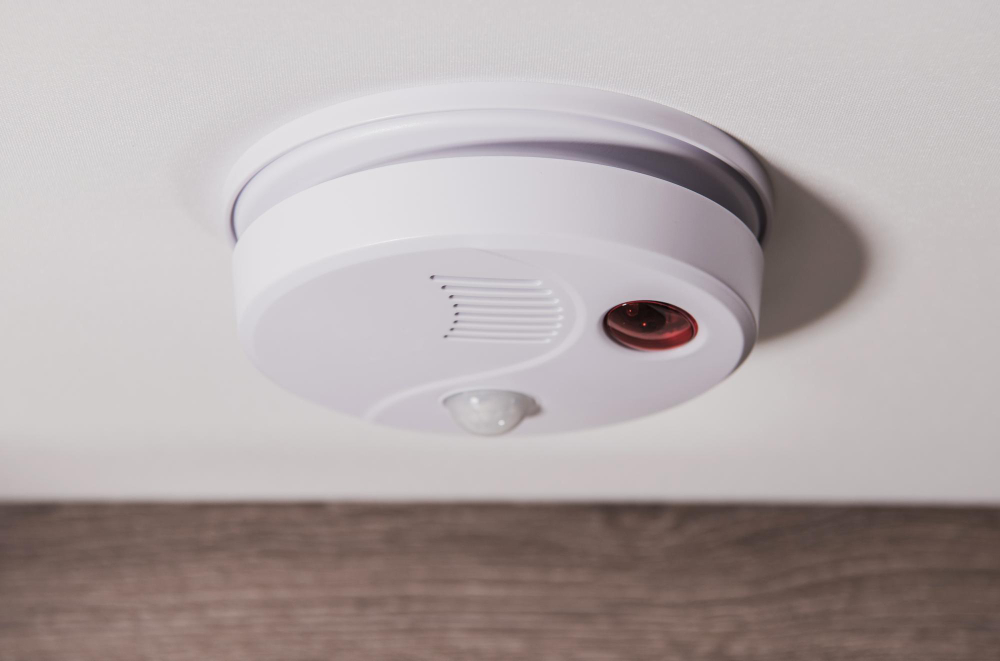
A smoke alarm is a white plastic disc with a button and a battery, and the assumption is that something inside it can somehow see smoke. Neither of the two common designs does anything of the sort. One measures an electrical current in air, the other watches for light going where it should not, and the difference between them determines which kinds of fire each one notices first – which turns out to matter a great deal.
The Ionisation Type
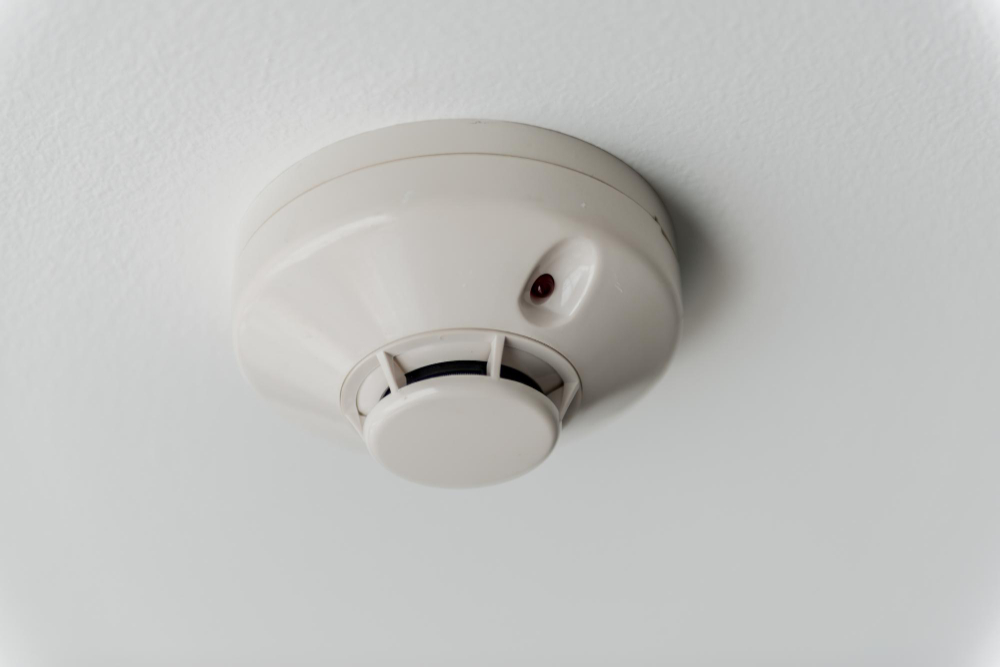
Inside the older and cheaper design is a sealed chamber containing a very small quantity of americium-241, a radioactive element that does not occur naturally and is produced in nuclear reactors. The amount is tiny, measured in micrograms.
It emits alpha particles, which are highly effective at knocking electrons off air molecules and very poor at penetrating anything. The particles ionise the air in the chamber, producing charged fragments, and two electrodes at a small voltage collect them. The result is a continuous, extremely small electrical current flowing through air that would otherwise be an insulator.
That current is the sensor. When smoke enters the chamber, its particles attach to the ions, which are much heavier as a result and reach the electrodes more slowly or not at all. The current falls. When it falls below a threshold, the alarm sounds.
The design is elegant in that it detects the presence of particles without needing to see them, and it is sensitive to extremely small ones. It is also why the alarm is so responsive to a fast, hot, flaming fire, which produces large numbers of very fine combustion particles.
Like our content? Follow us for more.
The Photoelectric Type
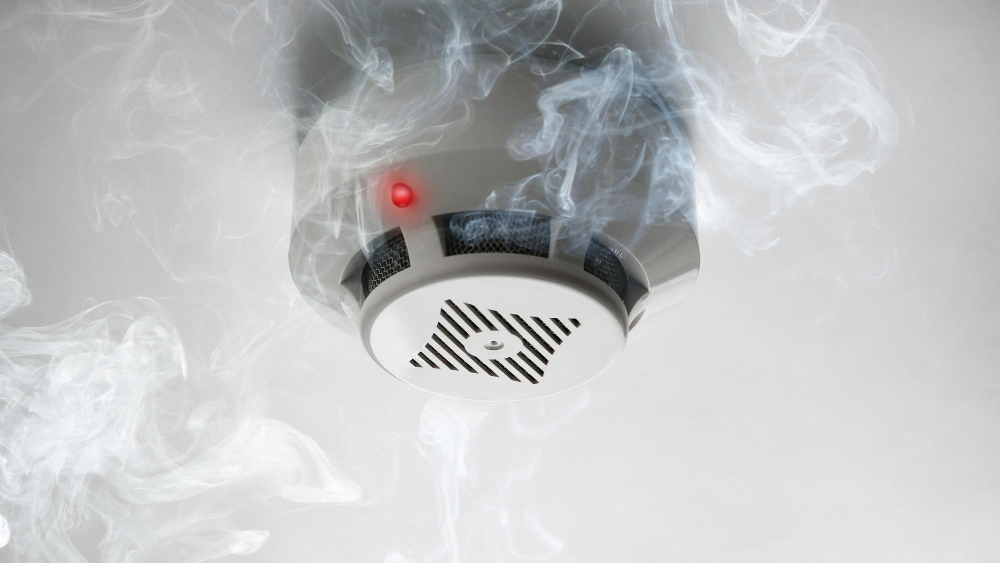
The other common design contains no radioactive material and works optically, but not in the obvious way.
Inside is a chamber with a light source pointing across it and a sensor positioned off to one side, deliberately out of the beam’s path. In clean air, the sensor sees essentially nothing.
When smoke enters, particles in the beam scatter light in all directions, and some of it reaches the sensor that should have been in shadow. Light appearing where there should be none is the trigger.
This design is not measuring how much light gets through. It is watching for light arriving off-axis, which is why it is called a light-scattering detector, and why the geometry inside the chamber is carefully arranged with baffles to keep stray light and insects out.
It responds better to larger particles, which means it is noticeably quicker on a smouldering fire – the slow, smoky kind produced by a cigarette in upholstery or an overheating cable – and comparatively slower on a fast flaming one.
Which Is Why the Two Types Disagree
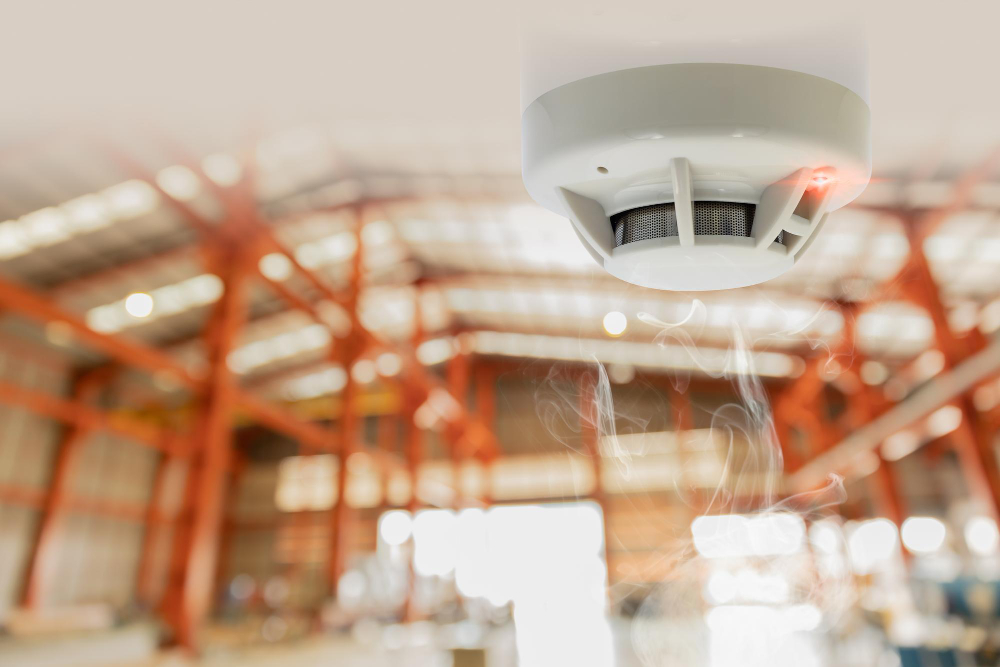
This is the part that matters most, and it follows directly from the physics.
Ionisation detectors respond faster to flaming fires and slower to smouldering ones. Photoelectric detectors respond faster to smouldering fires and slower to flaming ones. The differences in response time are not marginal; in test conditions they can run to many minutes.
Smouldering fires are the ones that most often occur at night and produce large quantities of smoke before any flame appears. That has led fire authorities in a number of countries to shift their recommendations, and some jurisdictions now specify photoelectric detectors for dwellings, or dual-sensor units containing both mechanisms.
It also explains the most familiar complaint about smoke alarms. Ionisation units are sensitive to the fine particles produced by cooking, so an alarm near a kitchen goes off when somebody makes toast. A disabled alarm protects nobody, so nuisance activation is a safety problem rather than an annoyance, and detector type and placement are the usual fix.
What any particular household should install, and where, is a matter for local fire-service guidance rather than for an article, and it varies by country.
The Test Button Does Not Test the Sensor

This is worth knowing and is widely misunderstood.
Pressing the test button generally checks the circuitry, the sounder and the battery. It confirms that if the sensor were triggered, the alarm would be heard. On most domestic units it does not introduce anything into the sensing chamber and therefore does not verify that the sensing chamber still works.
That is not a defect, since the failure most likely to leave an alarm silent is a dead battery, and the button catches exactly that. But it means a unit that beeps when tested has demonstrated one thing rather than everything.
Sensing chambers do degrade. Dust accumulates, insects get in, and the components age, which is why alarms carry an expiry date and a recommended replacement interval measured in years rather than decades. The radioactive source is not the limiting factor – its half-life runs to centuries – and the electronics and the chamber are.
The periodic single chirp that a dying alarm produces is a deliberate design feature intended to be irritating enough to force action, and its frequency and interval are chosen so that it cannot be comfortably ignored.
Why the Sound Is That Particular Sound
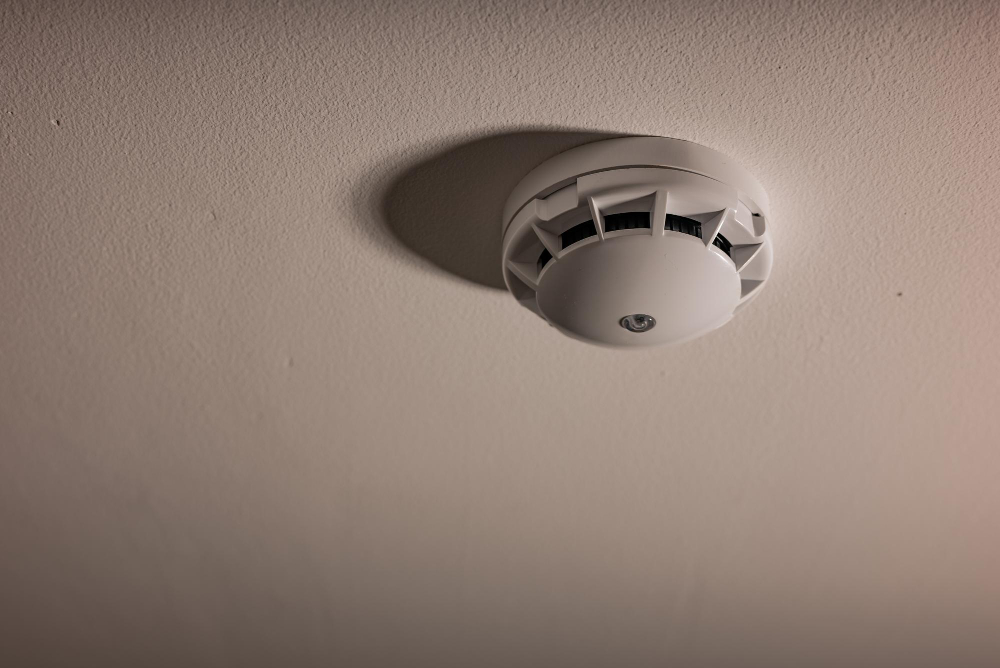
The alarm’s tone and pattern are engineered rather than arbitrary.
The standard pattern in many countries is three short blasts followed by a pause, repeated, and it was standardised specifically so that one signal means fire everywhere rather than varying by manufacturer.
The frequency has been the subject of serious revision. High-pitched tones, which were long standard, are poorly heard by people with age-related hearing loss, which preferentially affects high frequencies – and they are notably poor at waking children. Research found that a considerable proportion of sleeping children did not wake to a high-frequency alarm at all.
Lower-frequency alarms, and alarms using a recorded human voice, perform substantially better at waking both groups. Some newer units use a lower tone for exactly this reason. It is a case where the obvious engineering choice of a loud, piercing, cheaply produced tone turned out to be the wrong one for two of the populations most at risk.
This is a description of the research rather than a recommendation about equipment.
What Else Is in the Ceiling
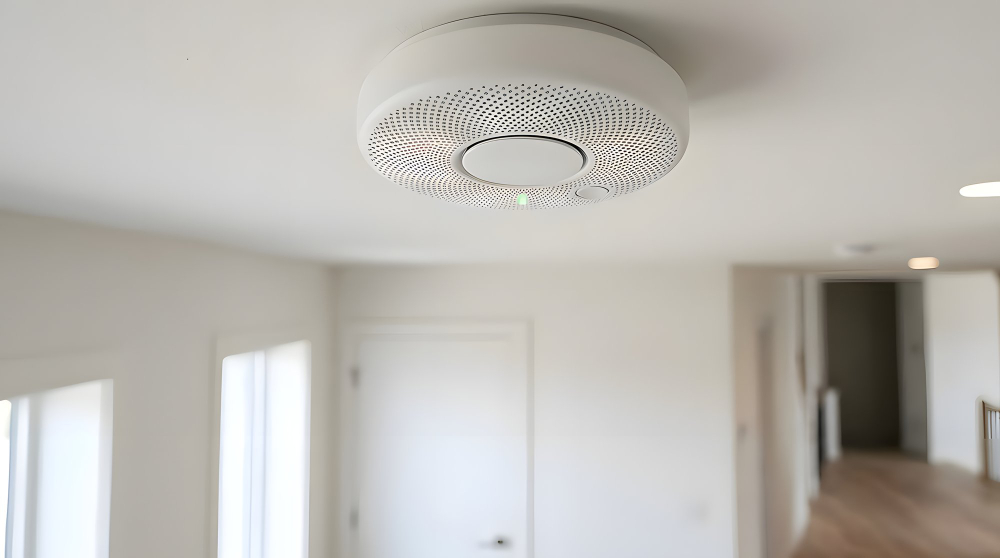
Two other detectors are frequently confused with smoke alarms and are doing entirely different things.
A heat detector responds to temperature, either to an absolute threshold or to a rate of rise. It cannot be set off by cooking smoke, which is why it is used in kitchens and garages, and it is considerably slower than any smoke detector because a fire has to produce substantial heat at the ceiling before it triggers.
A carbon monoxide detector is not a fire detector at all. It uses an electrochemical cell that reacts with carbon monoxide and produces a current proportional to concentration. It responds to a gas that is colourless, odourless and produced by incomplete combustion in fuel-burning appliances, and it will not respond to smoke. An alarm that detects one does not detect the other, and combined units contain two separate sensors.
That distinction is the one most worth being clear about, because the two hazards are different, arrive differently and are detected by unrelated technology.
Why They Go Off at Four in the Morning
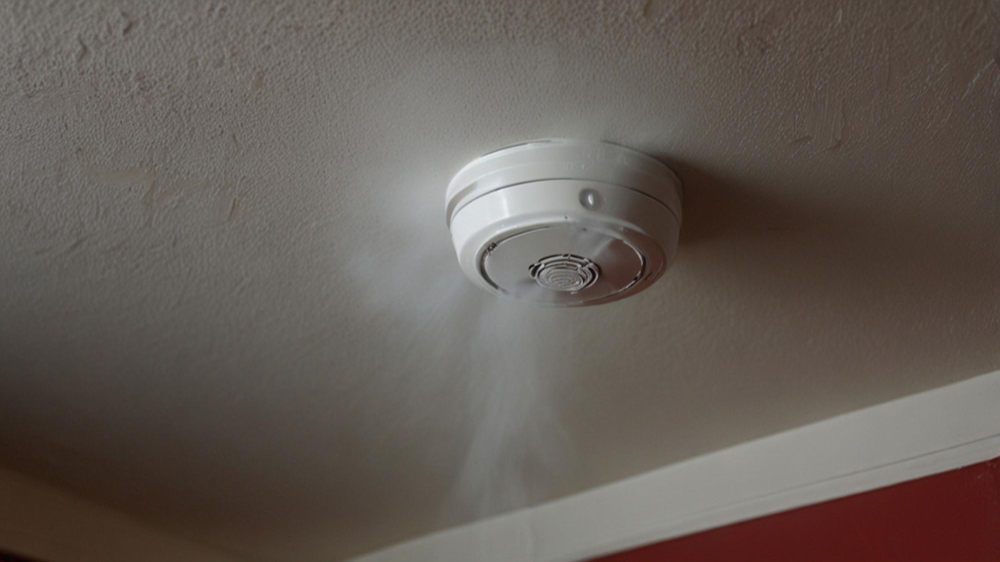
The low-battery chirp has a reputation for starting in the small hours, and it is not imagination or bad luck. There is a real mechanism.
A battery’s voltage varies with temperature. It falls as the cell gets colder and recovers as it warms. A cell that is marginal but adequate during the day can drop below the alarm’s low-voltage threshold once the house cools overnight, which in most homes reaches its lowest point in the hours before dawn.
So a battery on the edge will announce itself at the coldest moment of the twenty-four-hour cycle, then frequently stop once the sun is up and the ceiling warms by a couple of degrees. It is a real temperature effect being mistaken for malice.
The same physics explains a related complaint. An alarm in an unheated loft or garage will go through low-battery warnings faster than one in a heated room, because the cell spends more of its life cold and because temperature cycling shortens cell life independently.
And the chirp being near-impossible to locate is also physics rather than design. The sounders are tuned to a frequency at which the wavelength is comparable to the dimensions of a room, so the sound reflects and reinforces itself unevenly and the apparent source moves as you walk around. A short beep gives the ear almost nothing to work with – locating a sound relies on comparing what arrives at each ear, and a single brief tone at that frequency, arriving from every wall at once, is close to the worst possible case.
A Radioactive Source and a Beam of Light
The thing worth taking from all this is how indirect both methods are.
Neither design detects smoke. One detects a fall in an electrical current flowing through ionised air, caused by particles making the ions heavier. The other detects light arriving at a sensor that was deliberately positioned to receive none, caused by particles scattering a beam sideways.
In both cases the smoke is inferred rather than observed, from a consequence of its presence, by a device that costs very little and runs for years on a battery.
And in the commonest version of it, the component making that inference possible is a microgram of an element that did not exist on Earth until it was made in a reactor, sealed in a metal foil, screwed to the ceiling of an ordinary house.
Like our content? Follow us for more.
